
Complexity of NC systems and language contact Workshop
- Slides: 17
Complexity of NC systems and language contact Workshop on morphological complexity and noun classification, SOAS, 21 June 2017 Alexander Cobbinah Crossroads
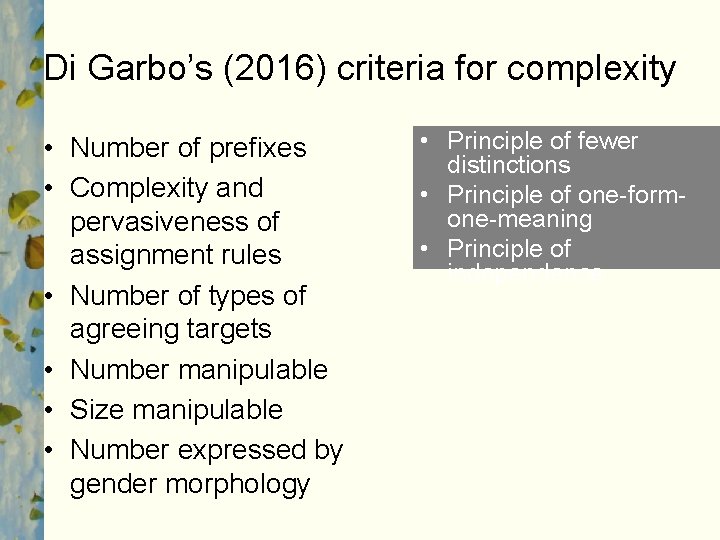
Di Garbo’s (2016) criteria for complexity • Number of prefixes • Complexity and pervasiveness of assignment rules • Number of types of agreeing targets • Number manipulable • Size manipulable • Number expressed by gender morphology • Principle of fewer distinctions • Principle of one-formone-meaning • Principle of independence
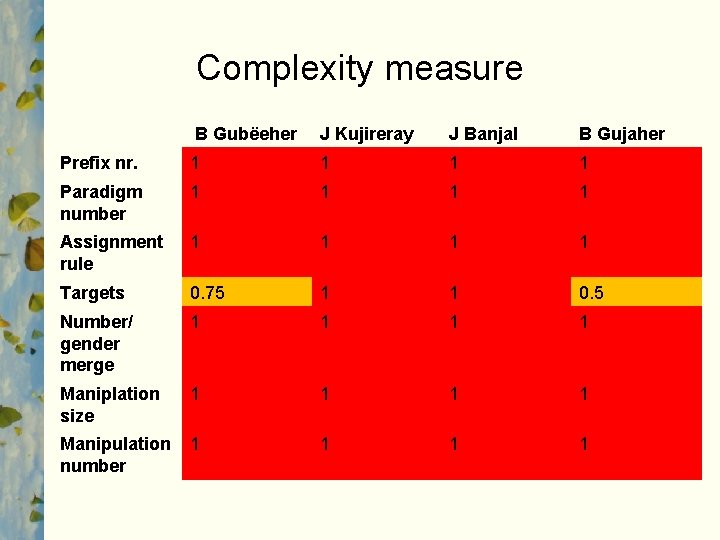
Complexity measure B Gubëeher J Kujireray J Banjal B Gujaher Prefix nr. 1 1 Paradigm number 1 1 Assignment rule 1 1 Targets 0. 75 1 1 0. 5 Number/ gender merge 1 1 Maniplation size 1 1 Manipulation number 1 1
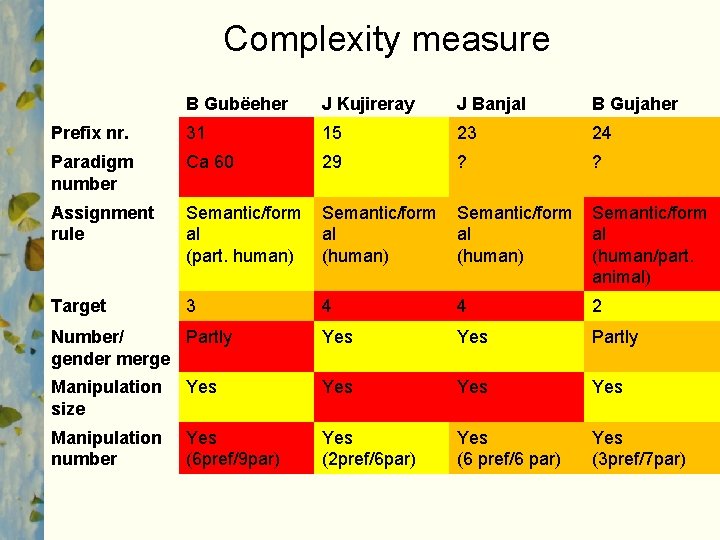
Complexity measure B Gubëeher J Kujireray J Banjal B Gujaher Prefix nr. 31 15 23 24 Paradigm number Ca 60 29 ? ? Assignment rule Semantic/form al (part. human) Semantic/form al (human) Semantic/form al (human/part. animal) Target 3 4 4 2 Number/ Partly gender merge Yes Partly Manipulation size Yes Yes Manipulation number Yes (6 pref/9 par) Yes (2 pref/6 par) Yes (6 pref/6 par) Yes (3 pref/7 par)
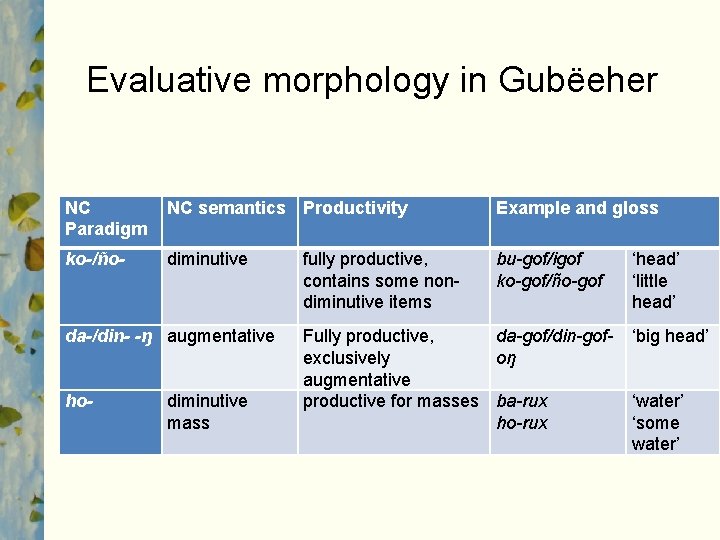
Evaluative morphology in Gubëeher NC Paradigm NC semantics Productivity Example and gloss ko-/ño- diminutive bu-gof/igof ko-gof/ño-gof da-/din- -ŋ augmentative ho- diminutive mass fully productive, contains some nondiminutive items Fully productive, da-gof/din-gofexclusively oŋ augmentative productive for masses ba-rux ho-rux ‘head’ ‘little head’ ‘big head’ ‘water’ ‘some water’
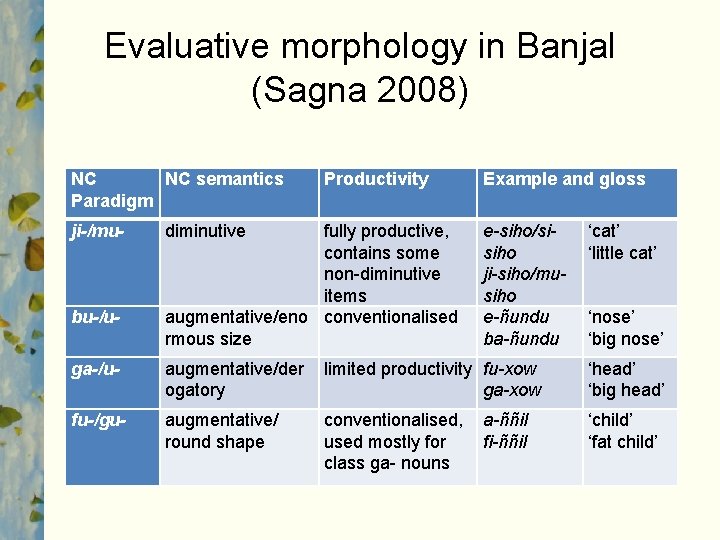
Evaluative morphology in Banjal (Sagna 2008) NC NC semantics Paradigm ji-/mu- bu-/u- Productivity diminutive fully productive, contains some non-diminutive items augmentative/eno conventionalised rmous size Example and gloss e-siho/sisiho ji-siho/musiho e-ñundu ba-ñundu ‘cat’ ‘little cat’ ‘nose’ ‘big nose’ ga-/u- augmentative/der ogatory limited productivity fu-xow ga-xow ‘head’ ‘big head’ fu-/gu- augmentative/ round shape conventionalised, used mostly for class ga- nouns ‘child’ ‘fat child’ a-ññil fi-ññil
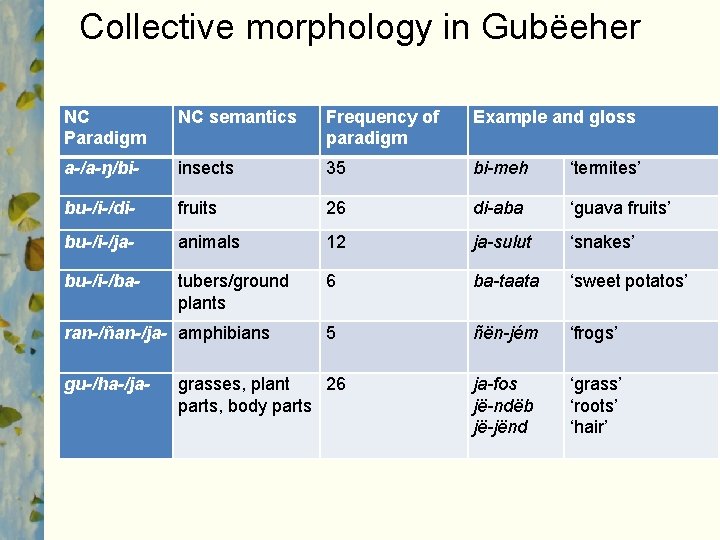
Collective morphology in Gubëeher NC Paradigm NC semantics Frequency of paradigm Example and gloss a-/a-ŋ/bi- insects 35 bi-meh ‘termites’ bu-/i-/di- fruits 26 di-aba ‘guava fruits’ bu-/i-/ja- animals 12 ja-sulut ‘snakes’ bu-/i-/ba- tubers/ground plants 6 ba-taata ‘sweet potatos’ 5 ñën-jém ‘frogs’ ja-fos jë-ndëb jë-jënd ‘grass’ ‘roots’ ‘hair’ ran-/ñan-/ja- amphibians gu-/ha-/ja- grasses, plant 26 parts, body parts
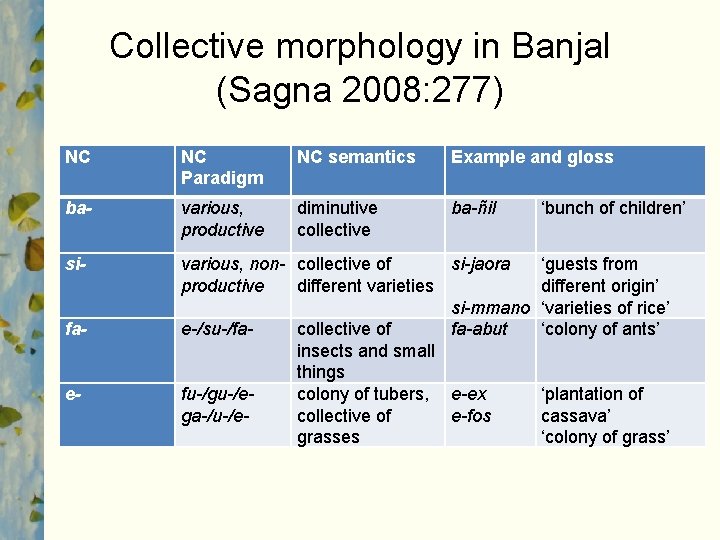
Collective morphology in Banjal (Sagna 2008: 277) NC NC Paradigm NC semantics Example and gloss ba- various, productive diminutive collective ba-ñil si- various, non- collective of si-jaora productive different varieties si-mmano e-/su-/facollective of fa-abut insects and small things fu-/gu-/ecolony of tubers, e-ex ga-/u-/ecollective of e-fos grasses fae- ‘bunch of children’ ‘guests from different origin’ ‘varieties of rice’ ‘colony of ants’ ‘plantation of cassava’ ‘colony of grass’
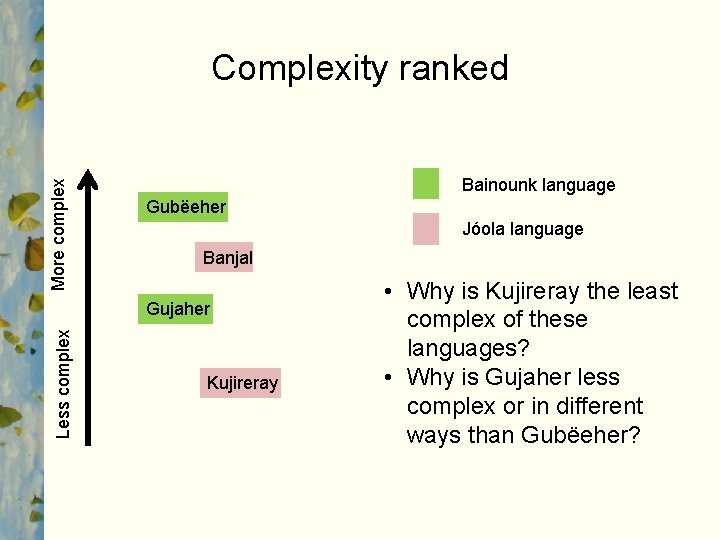
More complex Complexity ranked Bainounk language Gubëeher Jóola language Banjal Less complex Gujaher Kujireray • Why is Kujireray the least complex of these languages? • Why is Gujaher less complex or in different ways than Gubëeher?
The role of contact Hypoth es Langua is: ge leads to contact d comple iminishing xity?
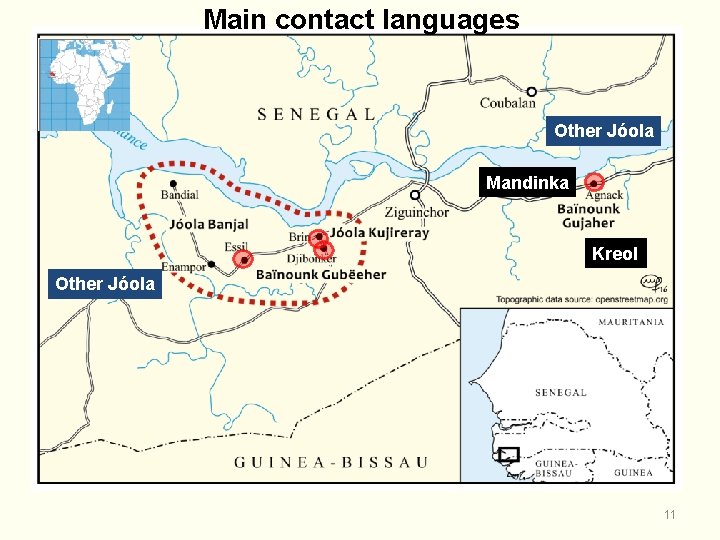
Main contact languages Other Jóola Mandinka Kreol Other Jóola 11
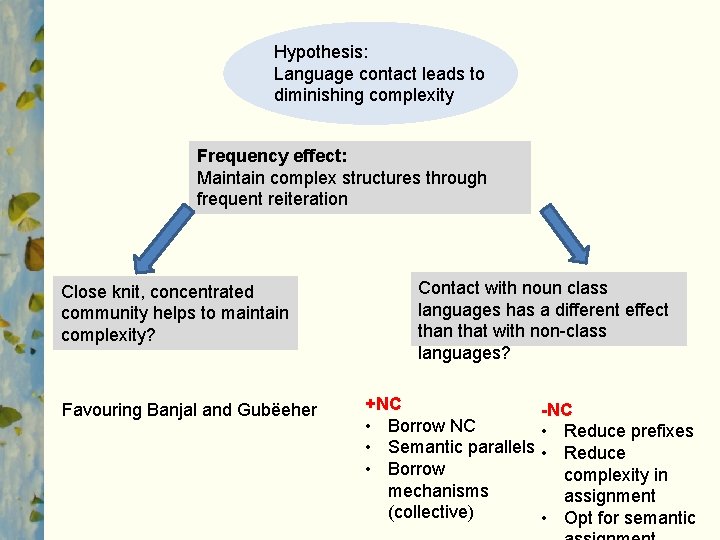
Hypothesis: Language contact leads to diminishing complexity Frequency effect: Maintain complex structures through frequent reiteration Close knit, concentrated community helps to maintain complexity? Favouring Banjal and Gubëeher Contact with noun class languages has a different effect than that with non-class languages? +NC • Borrow NC • Semantic parallels • Borrow mechanisms (collective) -NC • Reduce prefixes • Reduce complexity in assignment • Opt for semantic
Animacy in the Crossroads area
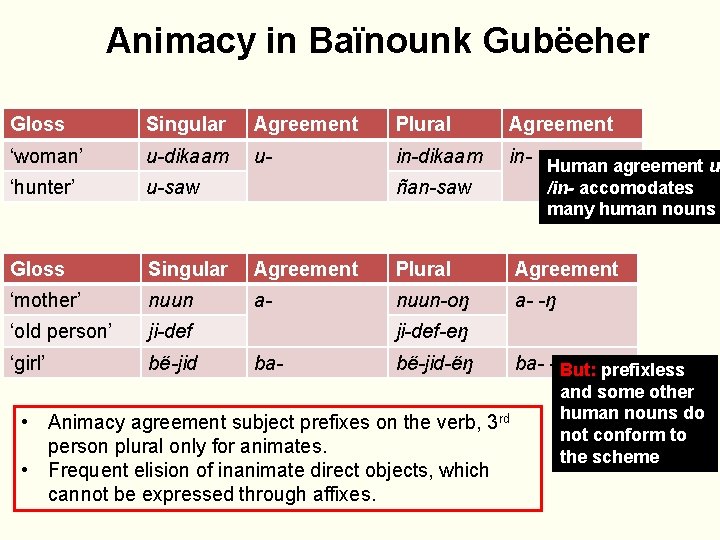
Animacy in Baïnounk Gubëeher Gloss Singular Agreement Plural Agreement ‘woman’ u-dikaam u- in-dikaam ‘hunter’ u-saw in- Human agreement u- Gloss Singular Agreement Plural Agreement ‘mother’ nuun a- nuun-oŋ a- -ŋ ‘old person’ ji-def ‘girl’ bë-jid ñan-saw /in- accomodates many human nouns ji-def-eŋ ba- bë-jid-ëŋ • Animacy agreement subject prefixes on the verb, 3 rd person plural only for animates. • Frequent elision of inanimate direct objects, which cannot be expressed through affixes. ba- -ŋBut: prefixless and some other human nouns do not conform to the scheme
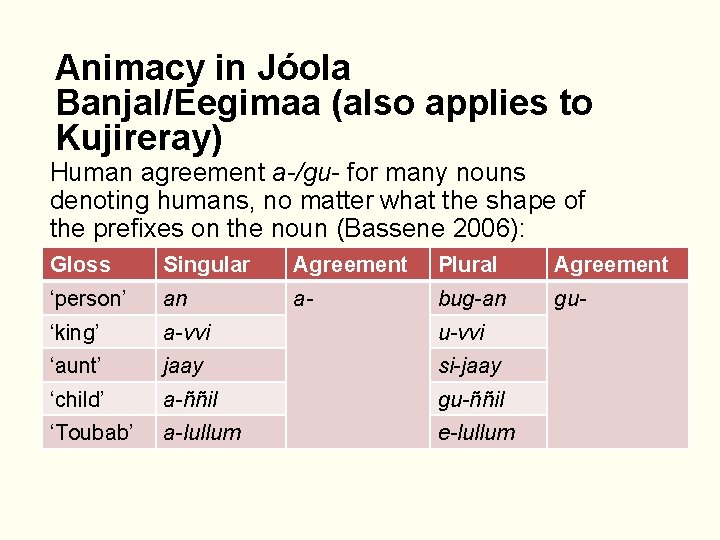
Animacy in Jóola Banjal/Eegimaa (also applies to Kujireray) Human agreement a-/gu- for many nouns denoting humans, no matter what the shape of the prefixes on the noun (Bassene 2006): Gloss Singular Agreement Plural Agreement ‘person’ an a- bug-an gu- ‘king’ a-vvi u-vvi ‘aunt’ jaay si-jaay ‘child’ a-ññil gu-ññil ‘Toubab’ a-lullum e-lullum
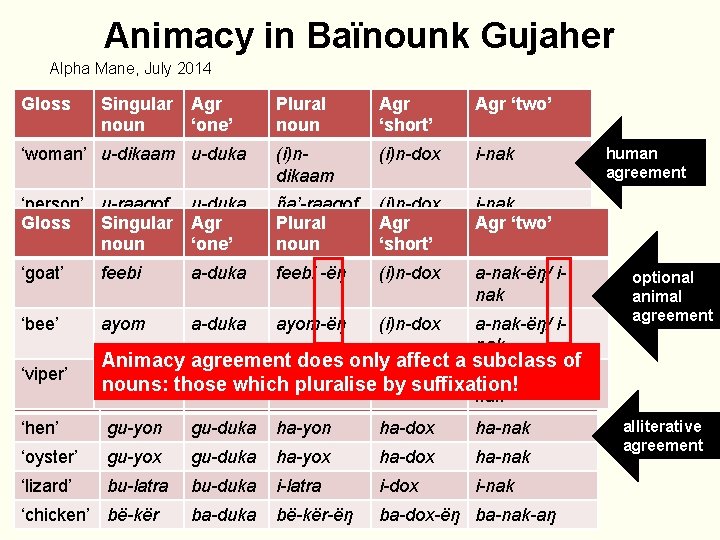
Animacy in Baïnounk Gujaher Alpha Mane, July 2014 Gloss Singular noun Agr ‘one’ Plural noun Agr ‘short’ Agr ‘two’ ‘woman’ u-dikaam u-duka (i)ndikaam (i)n-dox i-nak ‘person’ u-raagof Gloss Singular noun u-duka Agr ‘one’ ña’-raagof Plural noun (i)n-dox Agr ‘short’ i-nak Agr ‘two’ ‘goat’ feebi a-duka feebi -ëŋ (i)n-dox a-nak-ëŋ/ inak ‘bee’ ayom a-duka ayom-ëŋ (i)n-dox a-nak-ëŋ/ inak ‘viper’ Gloss fudux a-duka fudux-ëŋ i-dox a-nak-ëŋ/ Singula those Agr which Plural Agr ‘two’ inouns: pluralise Agr by suffixation! nak r noun ‘one’ noun ‘short’ human agreement optional animal agreement Animacy agreement does only affect a subclass of ‘hen’ gu-yon gu-duka ha-yon ha-dox ha-nak ‘oyster’ gu-yox gu-duka ha-yox ha-dox ha-nak ‘lizard’ bu-latra bu-duka i-latra i-dox i-nak ba-duka bë-kër-ëŋ ba-dox-ëŋ ba-nak-aŋ ‘chicken’ bë-kër alliterative agreement
Points for discussion • Is community size and type relevant for the effects of language contact on morphological complexity? • Which characteristics of a language influence the impact on the complexity of a language it is in contact with? • How fine-grained of a measure of complexity is feasible and necessary?