
Complexity in social work Rick Hood Kingston University
- Slides: 13
Complexity in social work Rick Hood, Kingston University and St Georges, University of London
What is complexity? Complexity is a set of principles about social events and behaviour that derive from scientific theories of complex adaptive systems. These principles help to explain the challenges of working with complex human problems, and therefore point towards appropriate professional and organisational approaches.
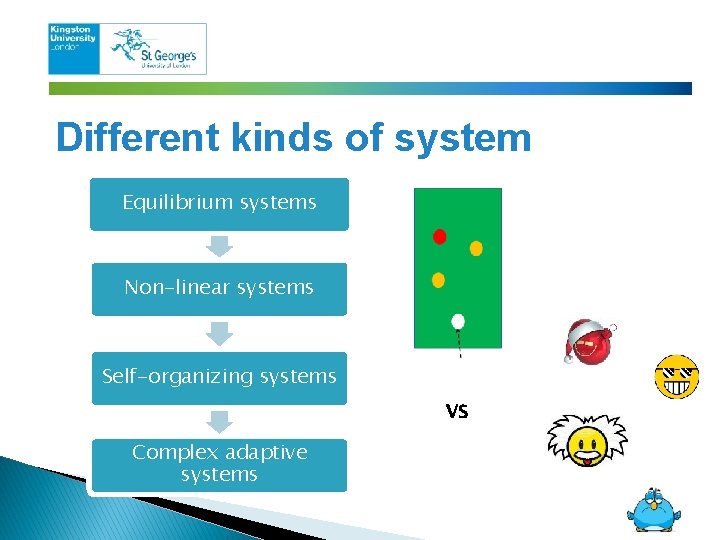
Different kinds of system Equilibrium systems Non-linear systems Self-organizing systems VS Complex adaptive systems
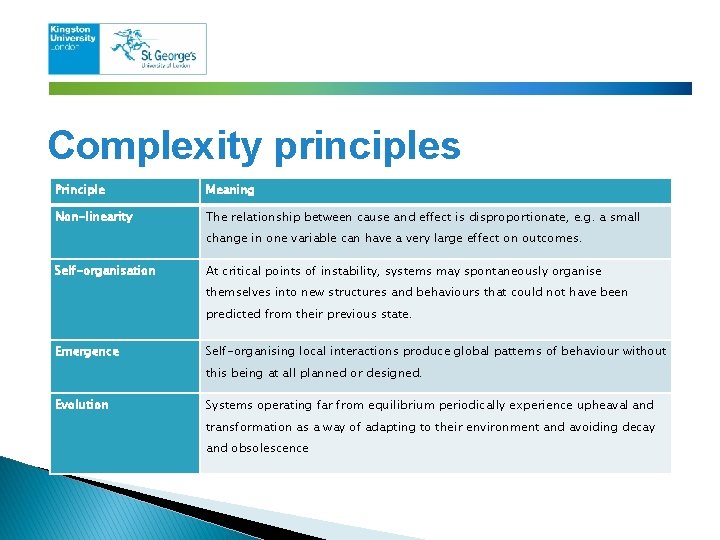
Complexity principles Principle Meaning Non-linearity The relationship between cause and effect is disproportionate, e. g. a small change in one variable can have a very large effect on outcomes. Self-organisation At critical points of instability, systems may spontaneously organise themselves into new structures and behaviours that could not have been predicted from their previous state. Emergence Self-organising local interactions produce global patterns of behaviour without this being at all planned or designed. Evolution Systems operating far from equilibrium periodically experience upheaval and transformation as a way of adapting to their environment and avoiding decay and obsolescence
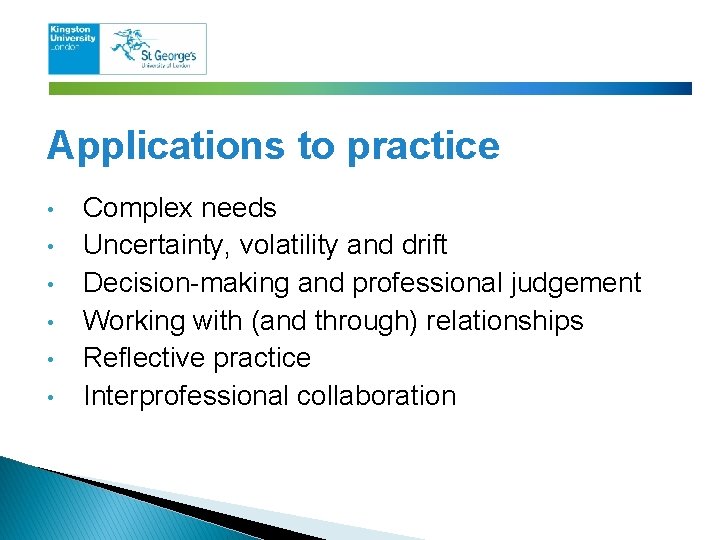
Applications to practice • • • Complex needs Uncertainty, volatility and drift Decision-making and professional judgement Working with (and through) relationships Reflective practice Interprofessional collaboration
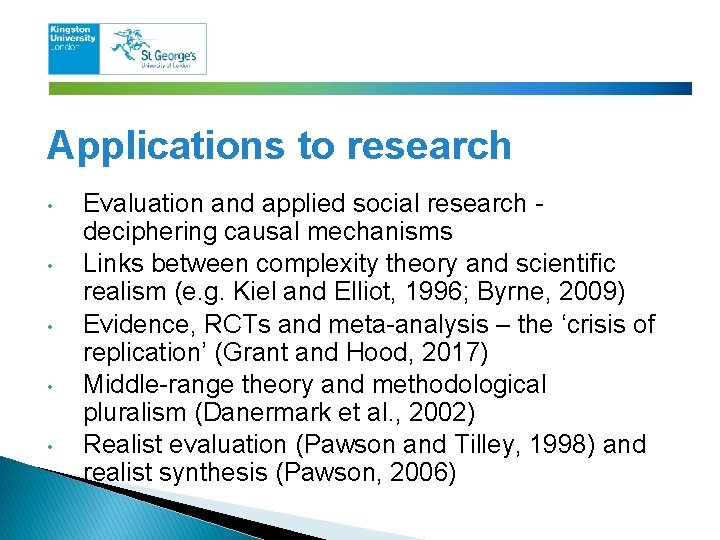
Applications to research • • • Evaluation and applied social research deciphering causal mechanisms Links between complexity theory and scientific realism (e. g. Kiel and Elliot, 1996; Byrne, 2009) Evidence, RCTs and meta-analysis – the ‘crisis of replication’ (Grant and Hood, 2017) Middle-range theory and methodological pluralism (Danermark et al. , 2002) Realist evaluation (Pawson and Tilley, 1998) and realist synthesis (Pawson, 2006)
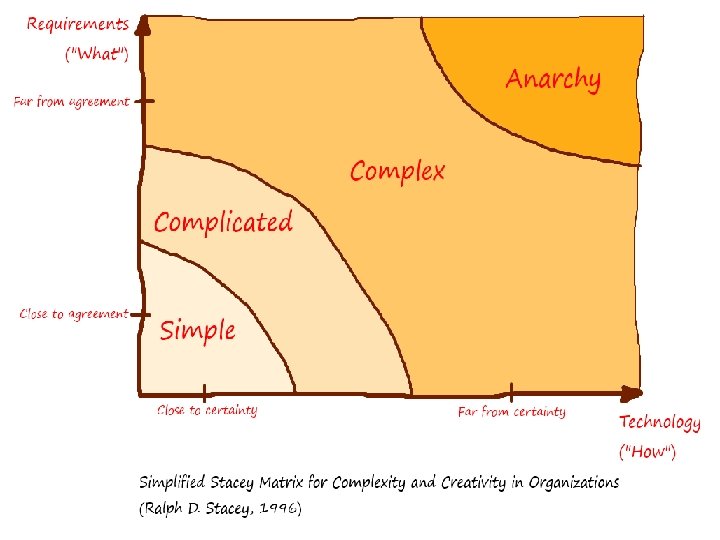
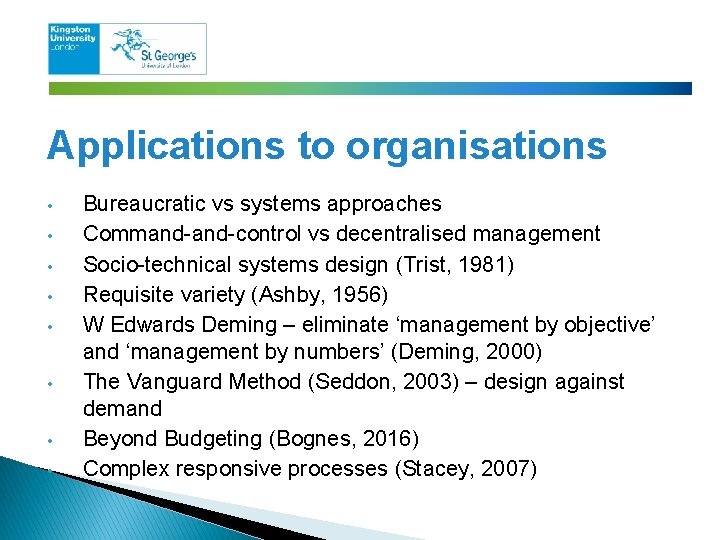
Applications to organisations • • Bureaucratic vs systems approaches Command-control vs decentralised management Socio-technical systems design (Trist, 1981) Requisite variety (Ashby, 1956) W Edwards Deming – eliminate ‘management by objective’ and ‘management by numbers’ (Deming, 2000) The Vanguard Method (Seddon, 2003) – design against demand Beyond Budgeting (Bognes, 2016) Complex responsive processes (Stacey, 2007)
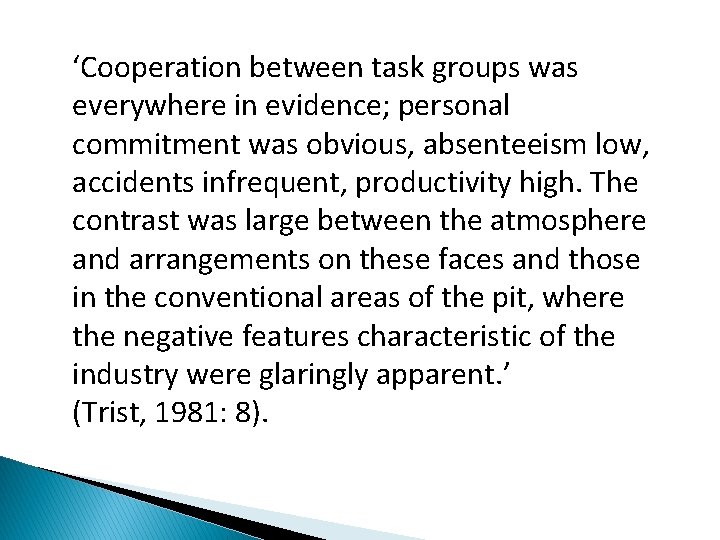
‘Cooperation between task groups was everywhere in evidence; personal commitment was obvious, absenteeism low, accidents infrequent, productivity high. The contrast was large between the atmosphere and arrangements on these faces and those in the conventional areas of the pit, where the negative features characteristic of the industry were glaringly apparent. ’ (Trist, 1981: 8).
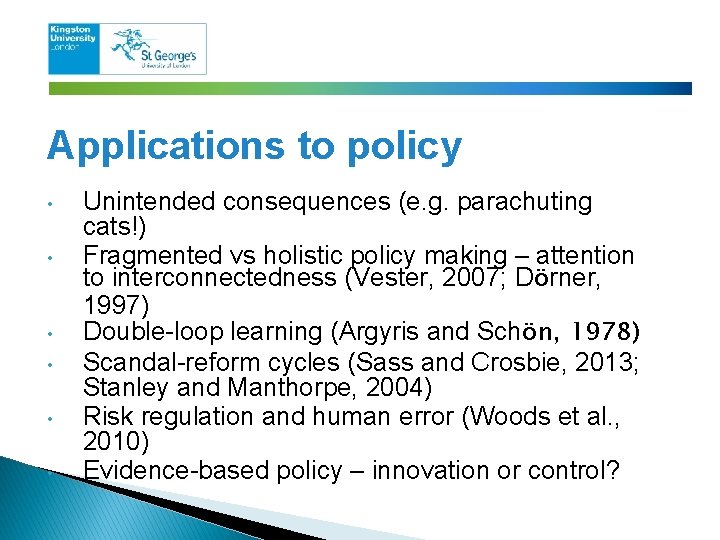
Applications to policy • • • Unintended consequences (e. g. parachuting cats!) Fragmented vs holistic policy making – attention to interconnectedness (Vester, 2007; Dörner, 1997) Double-loop learning (Argyris and Schön, 1978) Scandal-reform cycles (Sass and Crosbie, 2013; Stanley and Manthorpe, 2004) Risk regulation and human error (Woods et al. , 2010) Evidence-based policy – innovation or control?
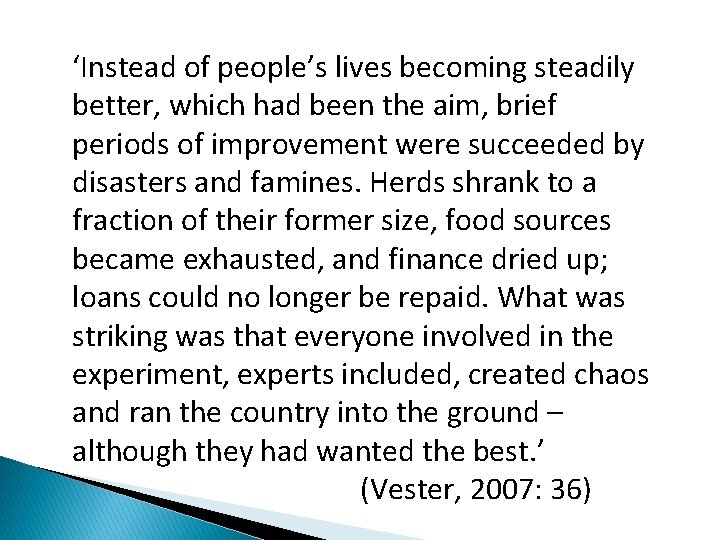
‘Instead of people’s lives becoming steadily better, which had been the aim, brief periods of improvement were succeeded by disasters and famines. Herds shrank to a fraction of their former size, food sources became exhausted, and finance dried up; loans could no longer be repaid. What was striking was that everyone involved in the experiment, experts included, created chaos and ran the country into the ground – although they had wanted the best. ’ (Vester, 2007: 36)
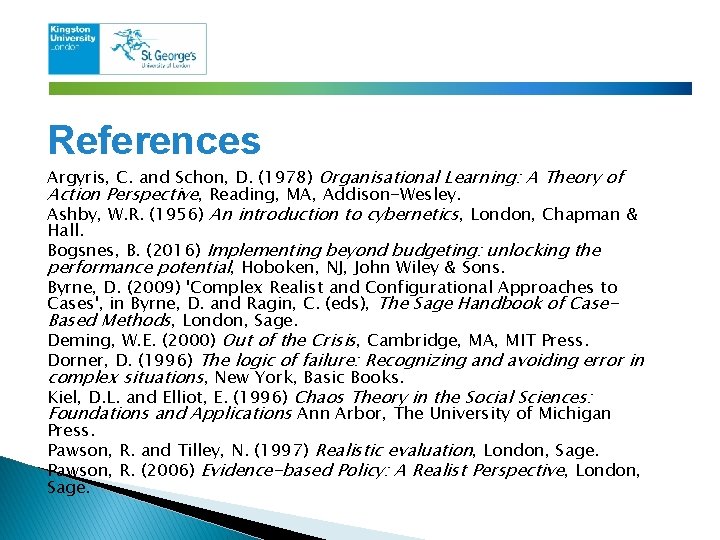
References Argyris, C. and Schon, D. (1978) Organisational Learning: A Theory of Action Perspective, Reading, MA, Addison-Wesley. Ashby, W. R. (1956) An introduction to cybernetics, London, Chapman & Hall. Bogsnes, B. (2016) Implementing beyond budgeting: unlocking the performance potential, Hoboken, NJ, John Wiley & Sons. Byrne, D. (2009) 'Complex Realist and Configurational Approaches to Cases', in Byrne, D. and Ragin, C. (eds), The Sage Handbook of Case. Based Methods, London, Sage. Deming, W. E. (2000) Out of the Crisis, Cambridge, MA, MIT Press. Dorner, D. (1996) The logic of failure: Recognizing and avoiding error in complex situations, New York, Basic Books. Kiel, D. L. and Elliot, E. (1996) Chaos Theory in the Social Sciences: Foundations and Applications Ann Arbor, The University of Michigan Press. Pawson, R. and Tilley, N. (1997) Realistic evaluation, London, Sage. Pawson, R. (2006) Evidence-based Policy: A Realist Perspective, London, Sage.
References Sass, J. and Crosbie, T. (2013) 'Democracy and scandal: A research agenda', Comparative Sociology, 12(6), pp. 851 -862. Seddon, J. (2003) Freedom from command control, Buckingham, Vanguard Education. Stacey, R. D. (2007) Strategic management and organisational dynamics: The challenge of complexity to ways of thinking about organisations (Fifth edition), Harlow, Pearson. Stanley, N. and Manthorpe, J. (2004) The Age of the Inquiry: Learning and Blaming in Health and Social Care. London: Routledge. Trist, E. (1981) The evolution of socio-technical systems: a conceptual framework and an action research programme, Toronto, Ontario Quality of Working Life Centre. Vester, F. (2007) 'The art of interconnected thinking', Ideas and Tools for tackling complexity. MCB-Verlag, Munich. Woods, D. , Dekker, S. , Cook, R. , Johansson, A. and Sarter, N. (2010) Behind Human Error, Farnham, Ashgate.