
Complexity 7 1 Complexity of Problems Complexity Andrei
Complexity 7 -1 Complexity of Problems Complexity Andrei Bulatov
Complexity 7 -2 Classifying Problems • We have seen that decision problems (and their associated languages) can be classified into decidable and undecida This result was obtained by Turing and others in the 1930’ before the invention of computers. • After the invention of computers, it became clear that it wo useful to classify decidable problems, to distinguish harder from easier problems This led to the development of computational complexity in the 1960’s and 1970’s
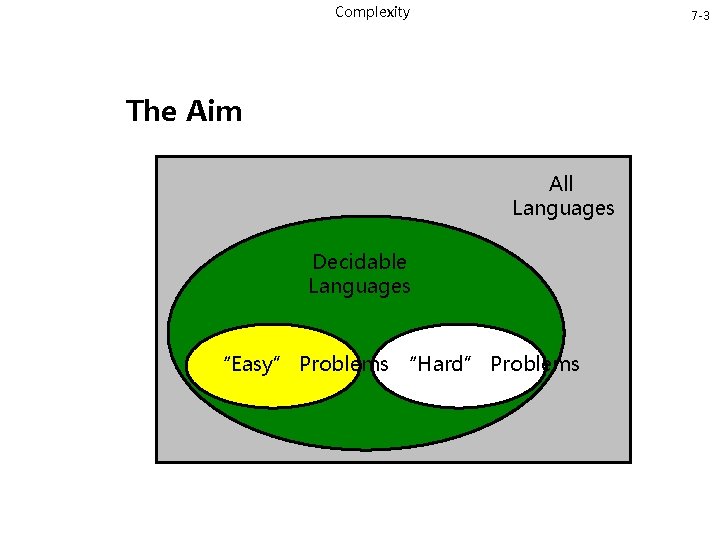
Complexity 7 -3 The Aim All Languages Decidable Languages “Easy” Problems “Hard” Problems
Complexity 7 -4 Question Which of these decision problem is hardest? 1. For a given n, is n prime? 2. For a given n, is n equal to the sum of 2 prime? ¹ 3. For a given n, does the nth person in the Vancouver telephone directory have first initial J? ¹see http: //www. faber. co. uk/faber/million_dollar. asp
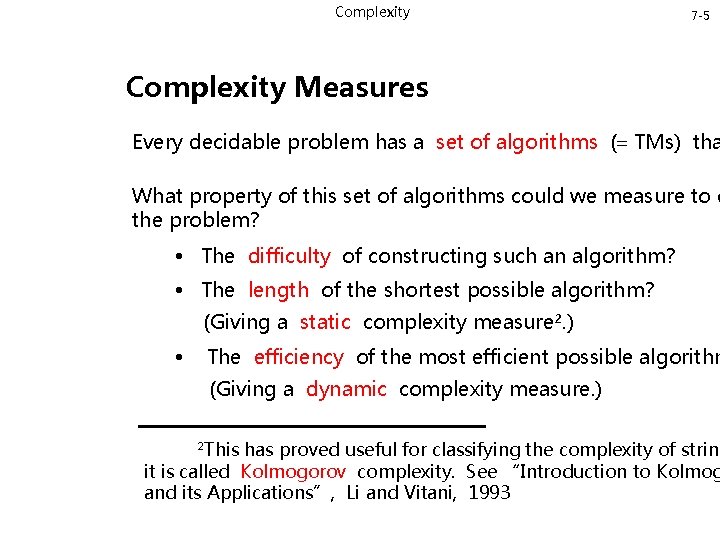
Complexity 7 -5 Complexity Measures Every decidable problem has a set of algorithms ( TMs) tha What property of this set of algorithms could we measure to c the problem? • The difficulty of constructing such an algorithm? • The length of the shortest possible algorithm? (Giving a static complexity measure². ) • The efficiency of the most efficient possible algorithm (Giving a dynamic complexity measure. ) ²This has proved useful for classifying the complexity of string it is called Kolmogorov complexity. See “Introduction to Kolmog and its Applications”, Li and Vitani, 1993
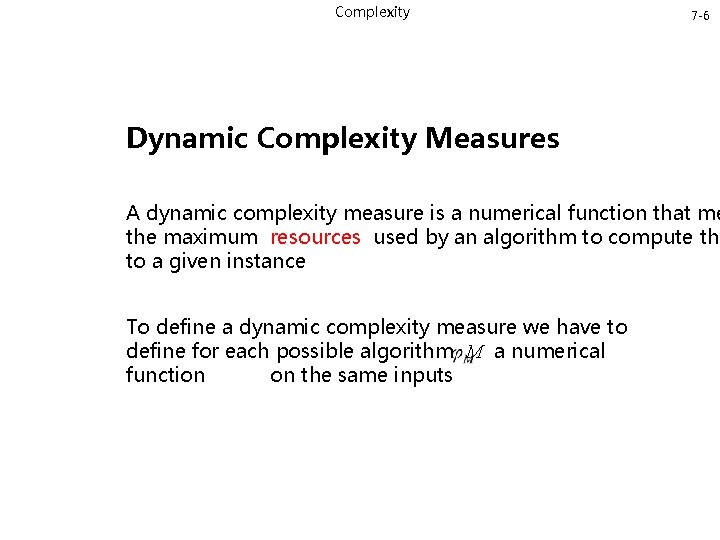
Complexity 7 -6 Dynamic Complexity Measures A dynamic complexity measure is a numerical function that me the maximum resources used by an algorithm to compute the to a given instance To define a dynamic complexity measure we have to define for each possible algorithm M a numerical function on the same inputs
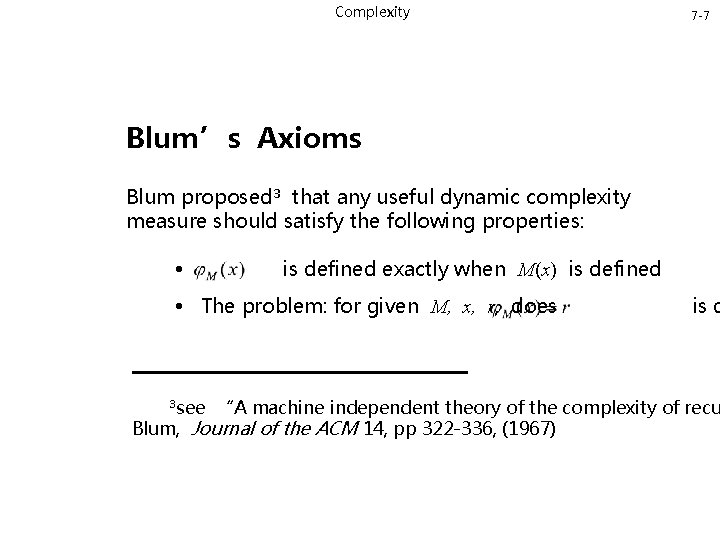
Complexity 7 -7 Blum’s Axioms Blum proposed³ that any useful dynamic complexity measure should satisfy the following properties: • is defined exactly when M(x) is defined • The problem: for given M, x, r, does is d ³see “A machine independent theory of the complexity of recu Blum, Journal of the ACM 14, pp 322 -336, (1967)
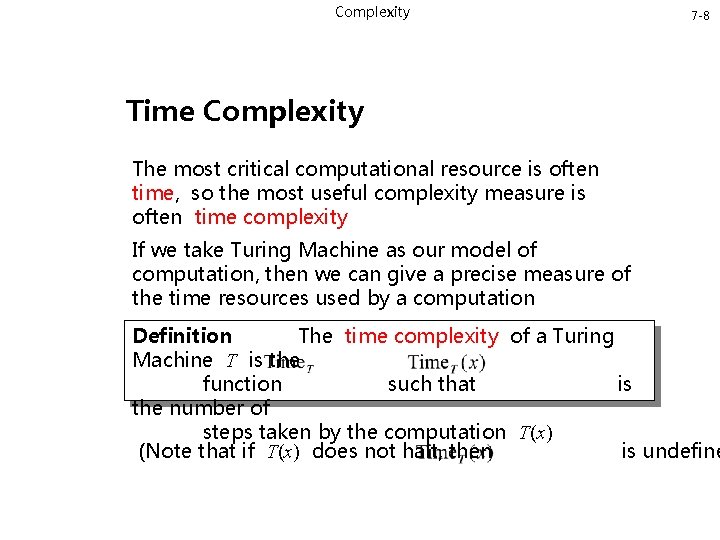
Complexity 7 -8 Time Complexity The most critical computational resource is often time, so the most useful complexity measure is often time complexity If we take Turing Machine as our model of computation, then we can give a precise measure of the time resources used by a computation Definition The time complexity of a Turing Machine T is the function such that is the number of steps taken by the computation T(x) (Note that if T(x) does not halt, then is undefine
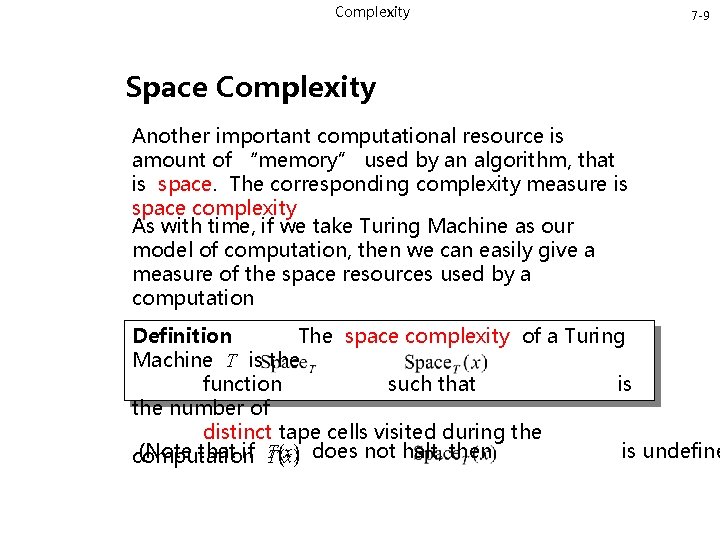
Complexity 7 -9 Space Complexity Another important computational resource is amount of “memory” used by an algorithm, that is space. The corresponding complexity measure is space complexity As with time, if we take Turing Machine as our model of computation, then we can easily give a measure of the space resources used by a computation Definition The space complexity of a Turing Machine T is the function such that is the number of distinct tape cells visited during the (Note that if T(x) is undefine computation T(x) does not halt, then
Complexity Time Complexity of Problems I Now it seems that we could define the time complexity of a problem as the time complexity of the most efficient Turing Machine that decides the corresponding language, but there is a difficulty … 7 -10
Complexity 7 -11 It may be impossible to define the most efficient Turing Machine, because: • It may be possible to speed up the computation by u bigger alphabet • It may be possible to speed up the computation by u more tapes
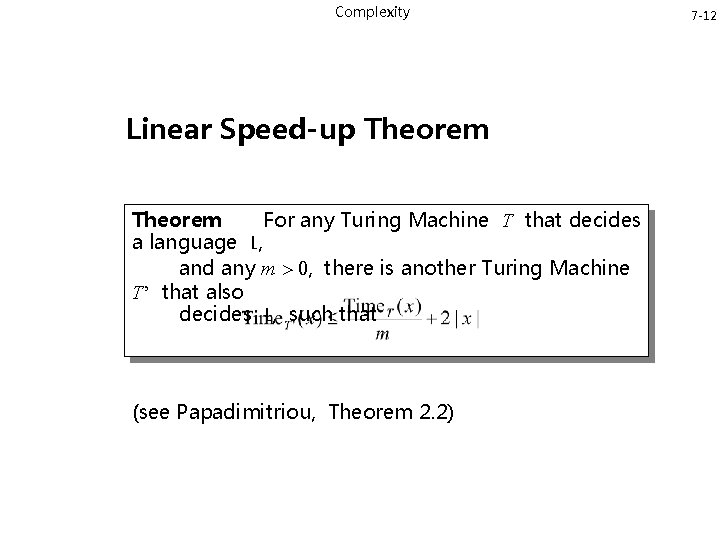
Complexity Linear Speed-up Theorem For any Turing Machine T that decides a language L, and any m > 0, there is another Turing Machine T’ that also decides L, such that (see Papadimitriou, Theorem 2. 2) 7 -12
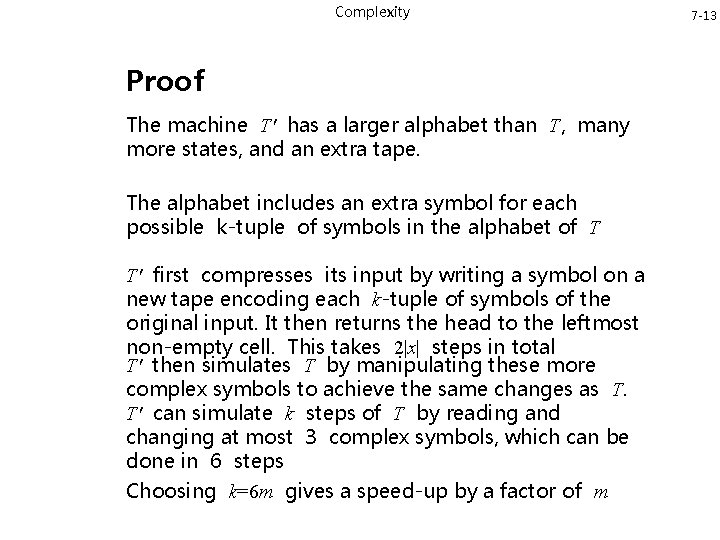
Complexity Proof The machine T' has a larger alphabet than T, many more states, and an extra tape. The alphabet includes an extra symbol for each possible k-tuple of symbols in the alphabet of T T' first compresses its input by writing a symbol on a new tape encoding each k-tuple of symbols of the original input. It then returns the head to the leftmost non-empty cell. This takes 2|x| steps in total T' then simulates T by manipulating these more complex symbols to achieve the same changes as T. T' can simulate k steps of T by reading and changing at most 3 complex symbols, which can be done in 6 steps Choosing k=6 m gives a speed-up by a factor of m 7 -13
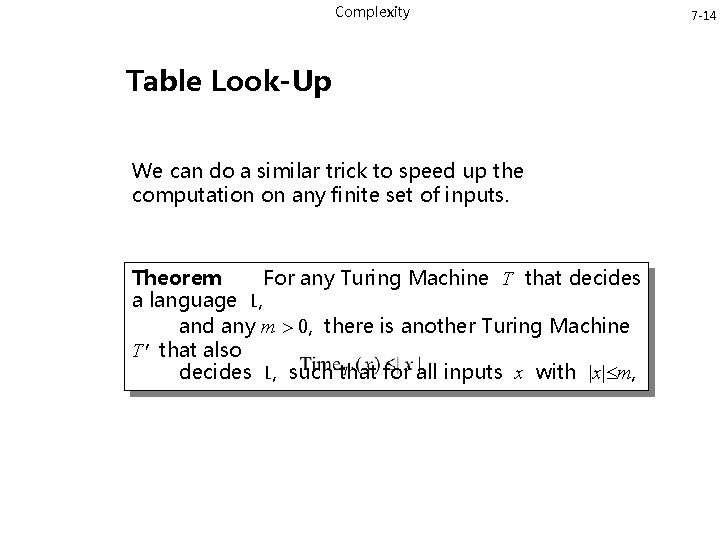
Complexity Table Look-Up We can do a similar trick to speed up the computation on any finite set of inputs. Theorem For any Turing Machine T that decides a language L, and any m > 0, there is another Turing Machine T' that also decides L, such that for all inputs x with |x| m, 7 -14
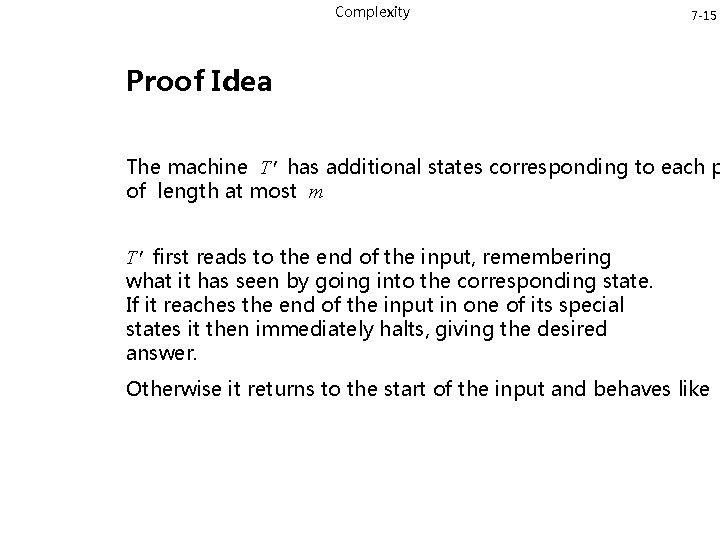
Complexity 7 -15 Proof Idea The machine T' has additional states corresponding to each p of length at most m T' first reads to the end of the input, remembering what it has seen by going into the corresponding state. If it reaches the end of the input in one of its special states it then immediately halts, giving the desired answer. Otherwise it returns to the start of the input and behaves like
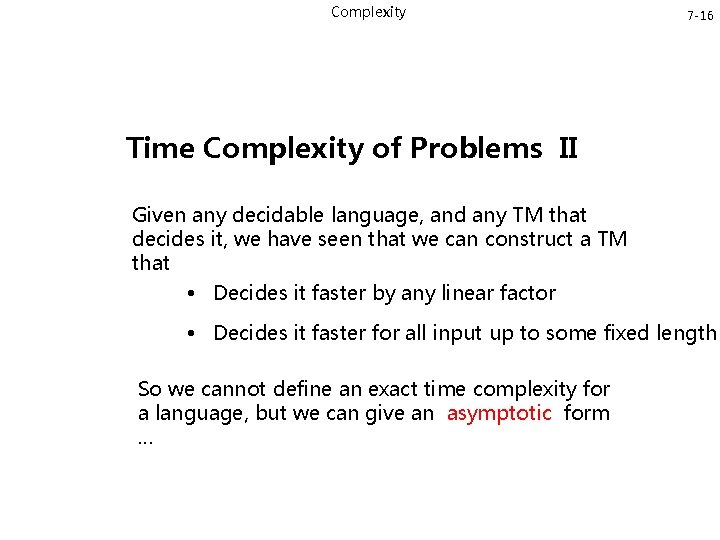
Complexity 7 -16 Time Complexity of Problems II Given any decidable language, and any TM that decides it, we have seen that we can construct a TM that • Decides it faster by any linear factor • Decides it faster for all input up to some fixed length So we cannot define an exact time complexity for a language, but we can give an asymptotic form …
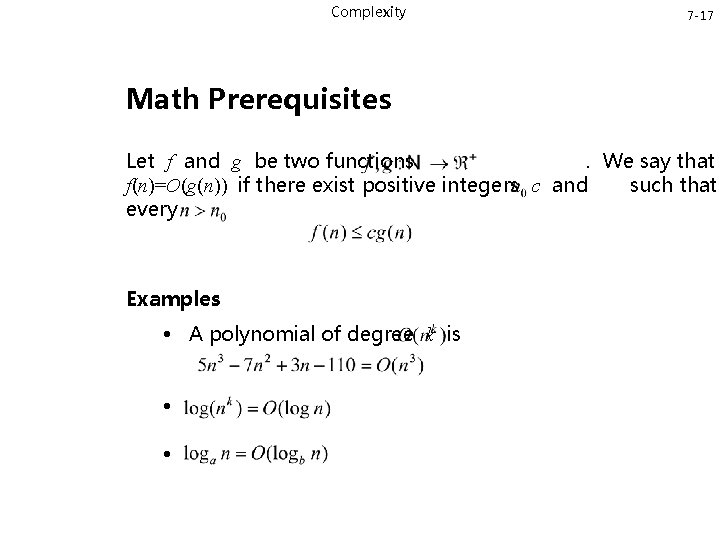
Complexity 7 -17 Math Prerequisites Let f and g be two functions. We say that f(n)=O(g(n)) if there exist positive integers c and such that every Examples • A polynomial of degree k is • •
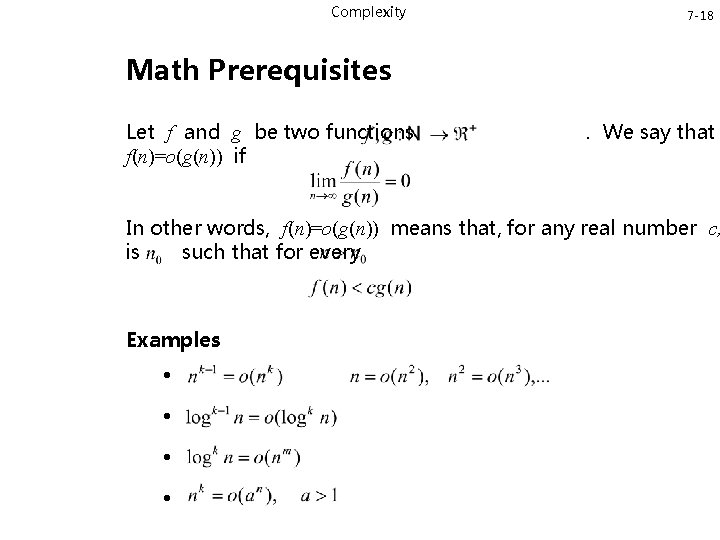
Complexity 7 -18 Math Prerequisites Let f and g be two functions f(n)=o(g(n)) if . We say that In other words, f(n)=o(g(n)) means that, for any real number c, is such that for every Examples • •
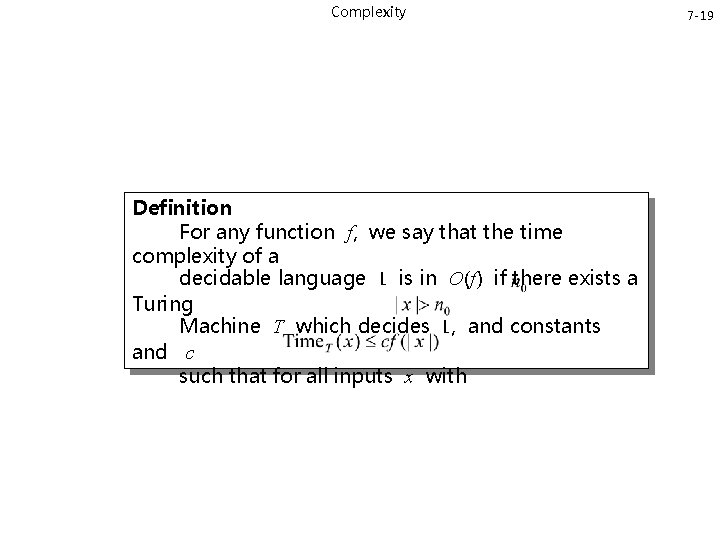
Complexity Definition For any function f, we say that the time complexity of a decidable language L is in O(f) if there exists a Turing Machine T which decides L, and constants and c such that for all inputs x with 7 -19
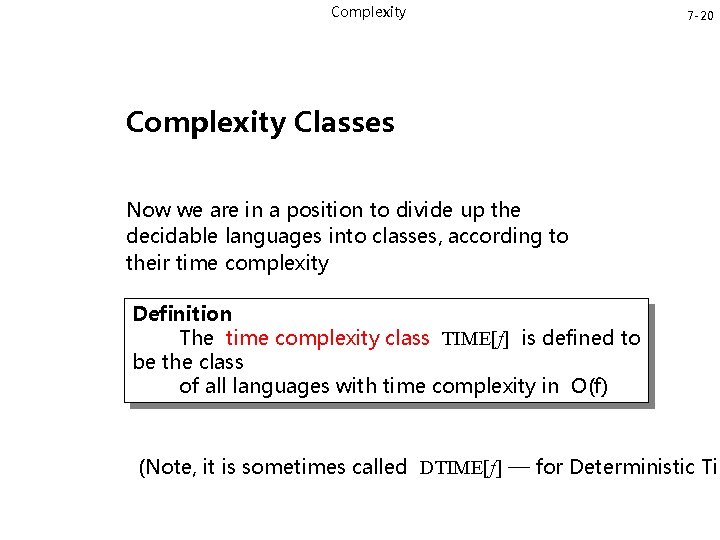
Complexity 7 -20 Complexity Classes Now we are in a position to divide up the decidable languages into classes, according to their time complexity Definition The time complexity class TIME[f] is defined to be the class of all languages with time complexity in O(f) (Note, it is sometimes called DTIME[f] — for Deterministic Tim
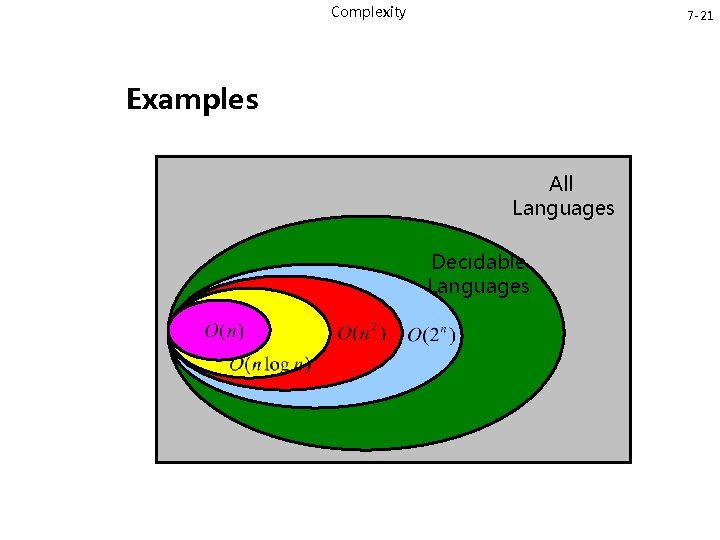
Complexity 7 -21 Examples All Languages Decidable Languages
- Slides: 21