
Complexities of Viral Nomenclature No consistent system for
- Slides: 12
Complexities of Viral Nomenclature No consistent system for naming viruses – some are named for the: • associated diseases (e. g. poliovirus, rabies virus) • specific type of disease they cause (e. g. hepatitis A, B, C, D, E) • sites in the body that are affected or from which they were first isolated (e. g. rhinovirus and adenovirus) • geographic locations in which they were first isolated (e. g. Sendai virus [Sendai, Japan] and Coxsackievirus [Coxsackie, New york]) • sicentists who first discovered them (e. g. Epstein-Barr virus) • way in which people imagined they were contracted (e. g. dengue, for “evil spirit” and influenza, for the “influence of bad air) • combinations (e. g. Rous sarcoma virus)
International Committee on Taxonomy of Viruses (ICTV) • member group of the International Union of Microbiological Societies • oversees the ongoing process of devising and maintaining a universal classification scheme for viruses • Assigns viruses to orders, families, subfamilies, genera, and species based on information provided by study groups composed of experts on specific types of viruses.
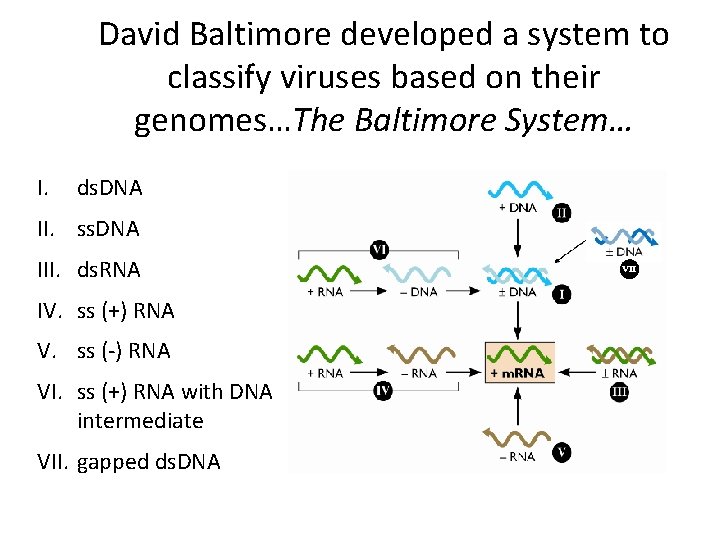
David Baltimore developed a system to classify viruses based on their genomes…The Baltimore System… I. ds. DNA II. ss. DNA III. ds. RNA IV. ss (+) RNA V. ss (-) RNA VI. ss (+) RNA with DNA intermediate VII. gapped ds. DNA VII
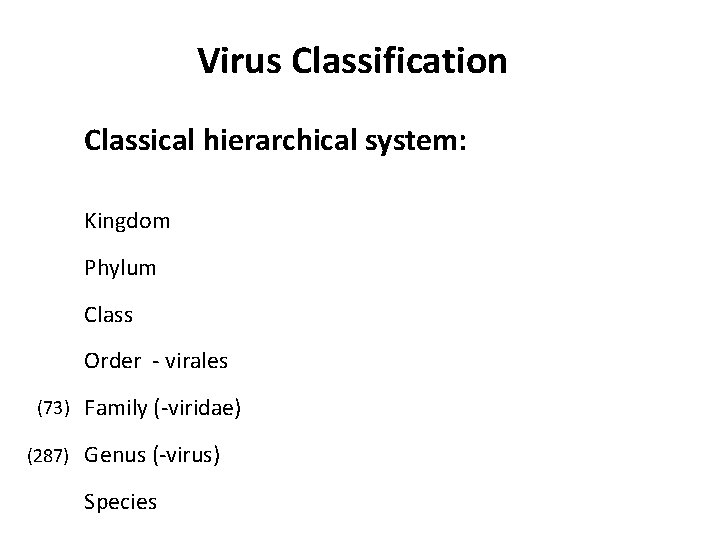
Virus Classification Classical hierarchical system: Kingdom Phylum Class Order - virales (73) (287) Family (-viridae) Genus (-virus) Species
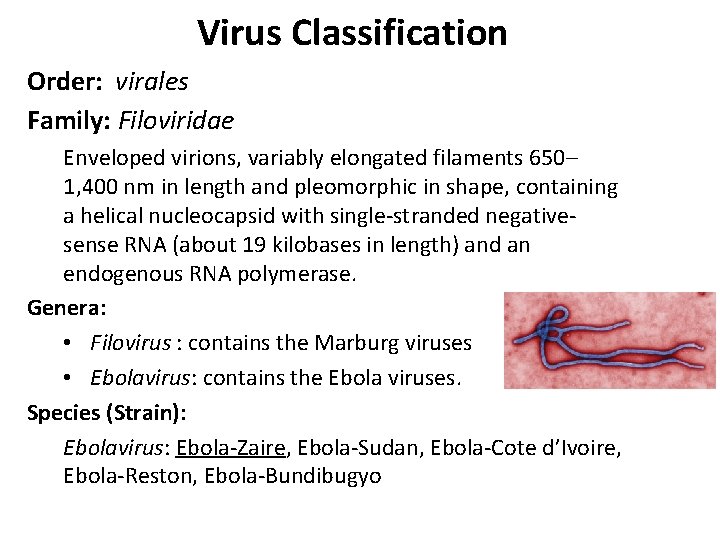
Virus Classification Order: virales Family: Filoviridae Enveloped virions, variably elongated filaments 650– 1, 400 nm in length and pleomorphic in shape, containing a helical nucleocapsid with single-stranded negativesense RNA (about 19 kilobases in length) and an endogenous RNA polymerase. Genera: • Filovirus : contains the Marburg viruses • Ebolavirus: contains the Ebola viruses. Species (Strain): Ebolavirus: Ebola-Zaire, Ebola-Sudan, Ebola-Cote d’Ivoire, Ebola-Reston, Ebola-Bundibugyo
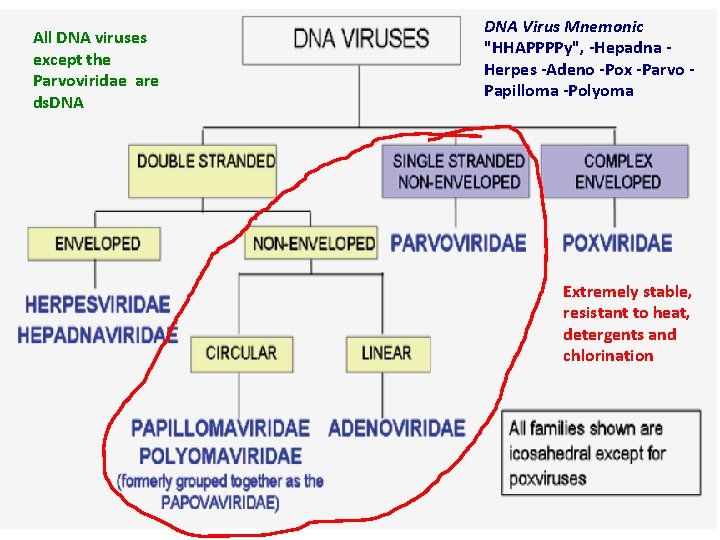
All DNA viruses except the Parvoviridae are ds. DNA Virus Mnemonic "HHAPPPPy", -Hepadna Herpes -Adeno -Pox -Parvo Papilloma -Polyoma Extremely stable, resistant to heat, detergents and chlorination
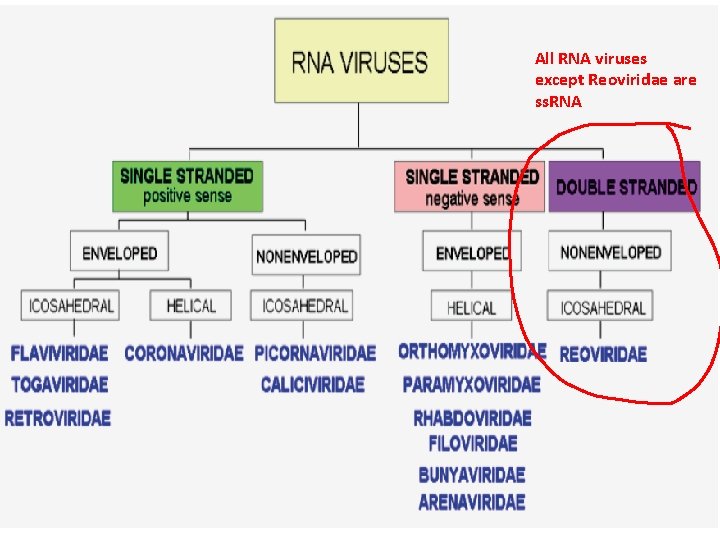
All RNA viruses except Reoviridae are ss. RNA
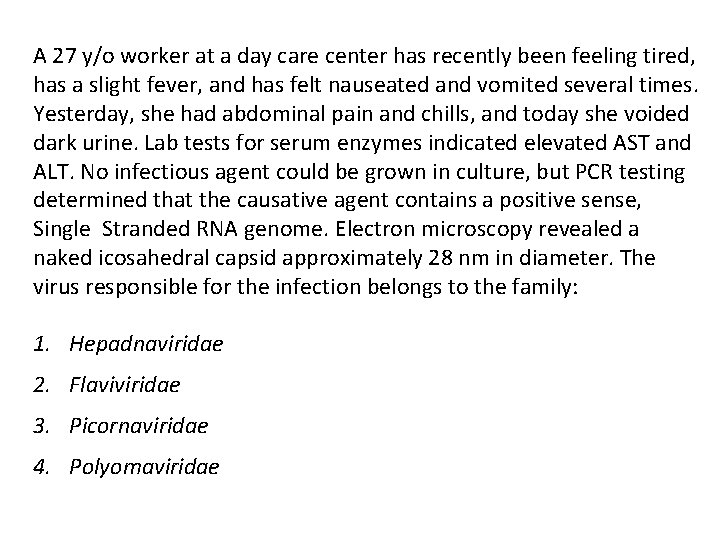
A 27 y/o worker at a day care center has recently been feeling tired, has a slight fever, and has felt nauseated and vomited several times. Yesterday, she had abdominal pain and chills, and today she voided dark urine. Lab tests for serum enzymes indicated elevated AST and ALT. No infectious agent could be grown in culture, but PCR testing determined that the causative agent contains a positive sense, Single Stranded RNA genome. Electron microscopy revealed a naked icosahedral capsid approximately 28 nm in diameter. The virus responsible for the infection belongs to the family: 1. Hepadnaviridae 2. Flaviviridae 3. Picornaviridae 4. Polyomaviridae
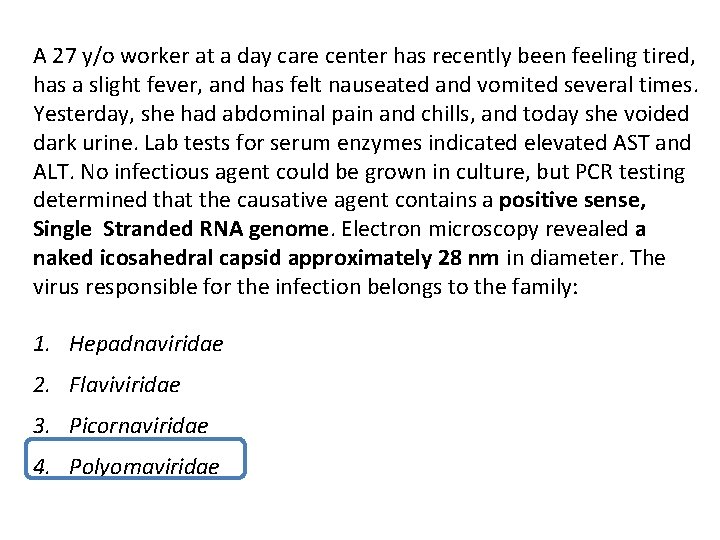
A 27 y/o worker at a day care center has recently been feeling tired, has a slight fever, and has felt nauseated and vomited several times. Yesterday, she had abdominal pain and chills, and today she voided dark urine. Lab tests for serum enzymes indicated elevated AST and ALT. No infectious agent could be grown in culture, but PCR testing determined that the causative agent contains a positive sense, Single Stranded RNA genome. Electron microscopy revealed a naked icosahedral capsid approximately 28 nm in diameter. The virus responsible for the infection belongs to the family: 1. Hepadnaviridae 2. Flaviviridae 3. Picornaviridae 4. Polyomaviridae
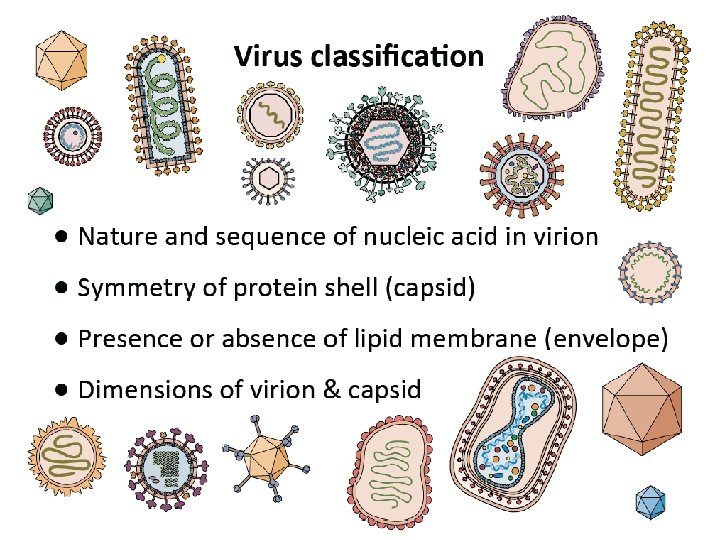
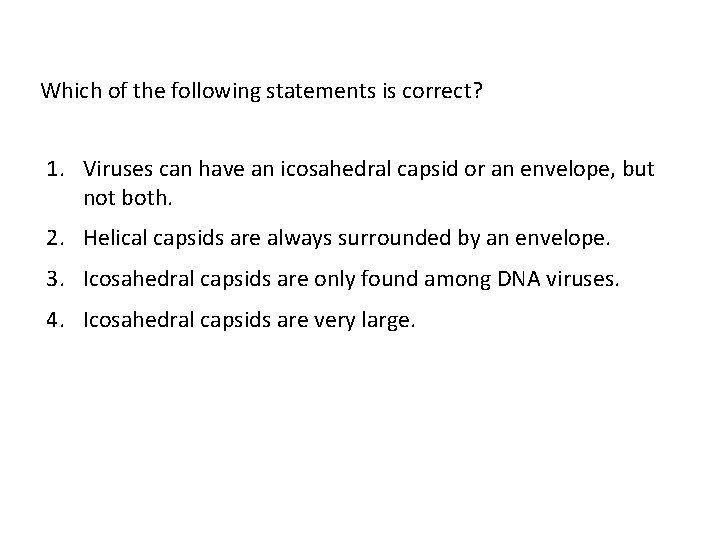
Which of the following statements is correct? 1. Viruses can have an icosahedral capsid or an envelope, but not both. 2. Helical capsids are always surrounded by an envelope. 3. Icosahedral capsids are only found among DNA viruses. 4. Icosahedral capsids are very large.
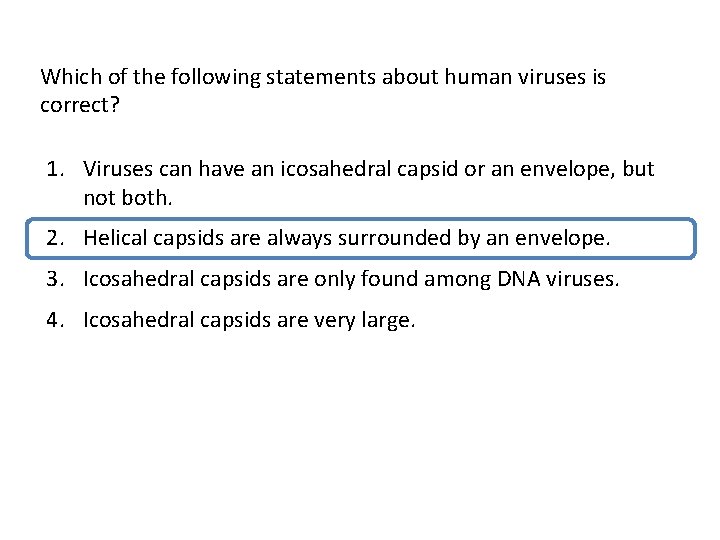
Which of the following statements about human viruses is correct? 1. Viruses can have an icosahedral capsid or an envelope, but not both. 2. Helical capsids are always surrounded by an envelope. 3. Icosahedral capsids are only found among DNA viruses. 4. Icosahedral capsids are very large.