
Complexicity and simplicity in e Infrastructures Laurent Romary



- Slides: 27
Complexicity and simplicity in e. Infrastructures Laurent Romary Max Planck Digital Library Buenos Aires, 2 October 2007
Background § Many initiatives to provide research infrastructures at national and EU level § What do they or will they offer? § Do we match the scientists’ expectations? § Access, standards and community building. …with a view on the humanities 1/7/2022 Seite 1
Why do we need e. Infrastructures? § The scientist’s ecology § Dealing with digital sources 1/7/2022 Seite 2
The Scientist’s (digital) ecology Scientific information workflow 1/7/2022 Seite 3
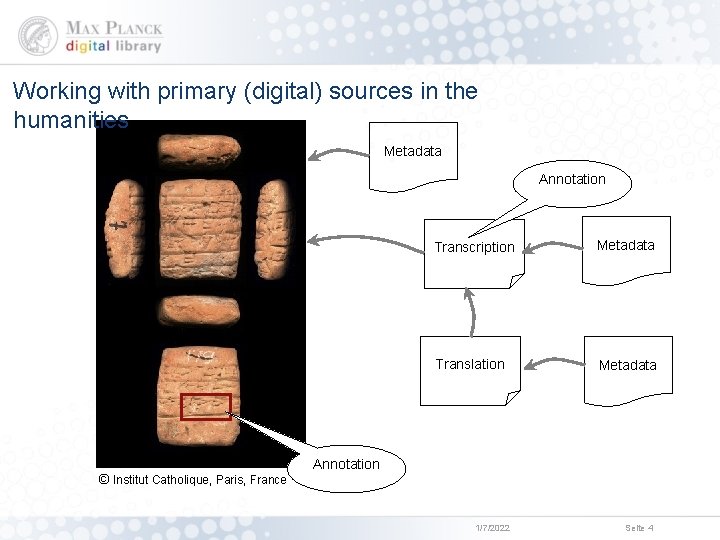
Working with primary (digital) sources in the humanities Metadata Annotation © Institut Catholique, Paris, France Transcription Metadata Translation Metadata Annotation 1/7/2022 Seite 4
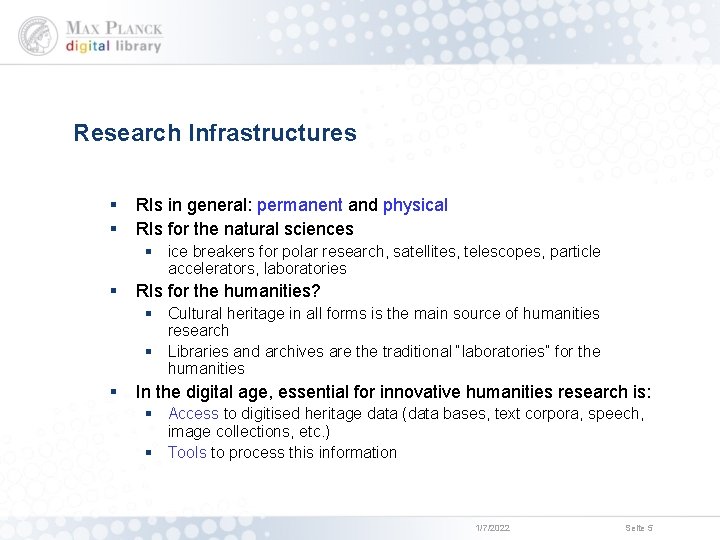
Research Infrastructures § § RIs in general: permanent and physical RIs for the natural sciences § ice breakers for polar research, satellites, telescopes, particle accelerators, laboratories § RIs for the humanities? § Cultural heritage in all forms is the main source of humanities research § Libraries and archives are the traditional “laboratories” for the humanities § In the digital age, essential for innovative humanities research is: § Access to digitised heritage data (data bases, text corpora, speech, image collections, etc. ) § Tools to process this information 1/7/2022 Seite 5
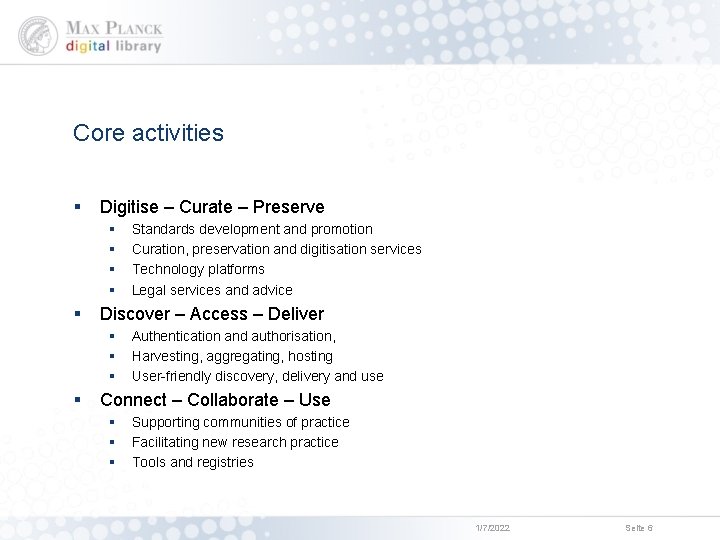
Core activities § Digitise – Curate – Preserve § § § Discover – Access – Deliver § § Standards development and promotion Curation, preservation and digitisation services Technology platforms Legal services and advice Authentication and authorisation, Harvesting, aggregating, hosting User-friendly discovery, delivery and use Connect – Collaborate – Use § § § Supporting communities of practice Facilitating new research practice Tools and registries 1/7/2022 Seite 6
1/7/2022 Seite 7
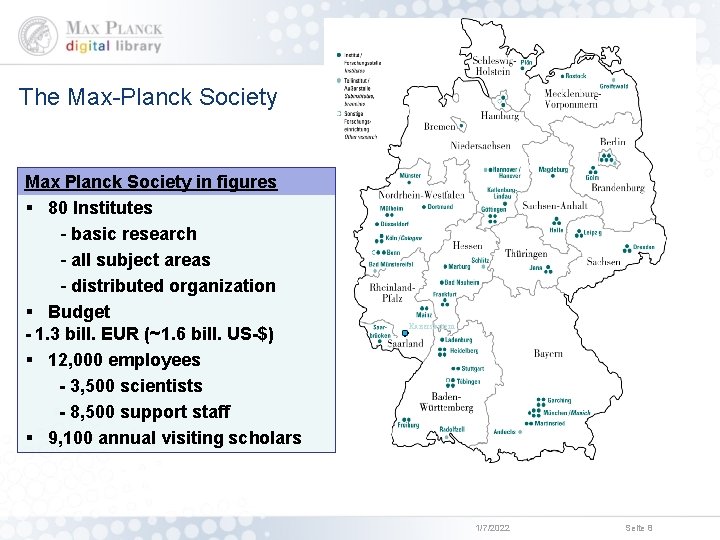
The Max-Planck Society Max Planck Society in figures § 80 Institutes - basic research - all subject areas - distributed organization § Budget - 1. 3 bill. EUR (~1. 6 bill. US-$) § 12, 000 employees - 3, 500 scientists - 8, 500 support staff § 9, 100 annual visiting scholars Kaiserslautern 1/7/2022 Seite 8
The Max Planck Digital Library (MPDL) § The newly created structure dedicated to scientific information within the Max Planck Society § Information sources § Journal and database subscriptions § Primary data and publications from researchers/institutes § Digital edition support § Actors § § Scientists Librarians, IT support Publishers, scholarly associations Other institutions in Germany and beyond… 1/7/2022 Seite 9
The e. Sci. Doc project § Overview § Joint project of the Max Planck Society and FIZ Karlsruhe § Five-year grant (2004 – 2009) from the German Federal Ministry of Education and Research § Target § a platform for flexible, open and persistent access to research results and materials § development of specialized solutions on top of a generic infrastructure addressing specific needs and requirements by Max-Planck Institutes… and beyond § e. Sci. Doc as a strategic project for the MPG § The basis for our future digital resource management activities 1/7/2022 Seite 10
Overview of Architecture 1/7/2022 Seite 11
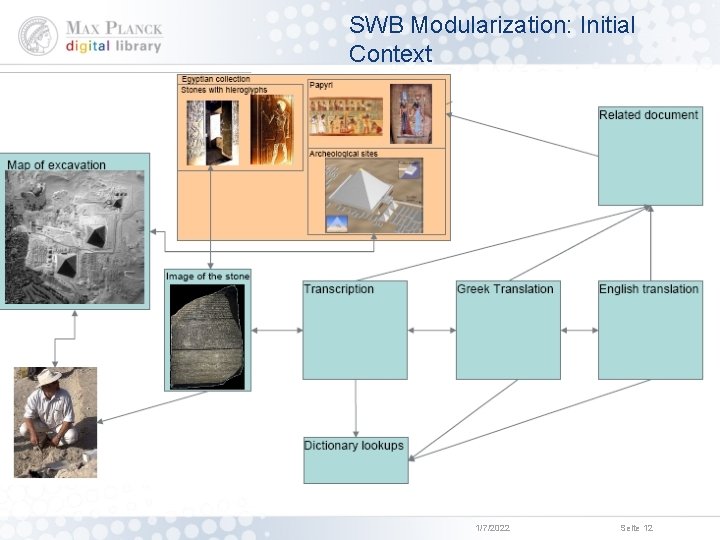
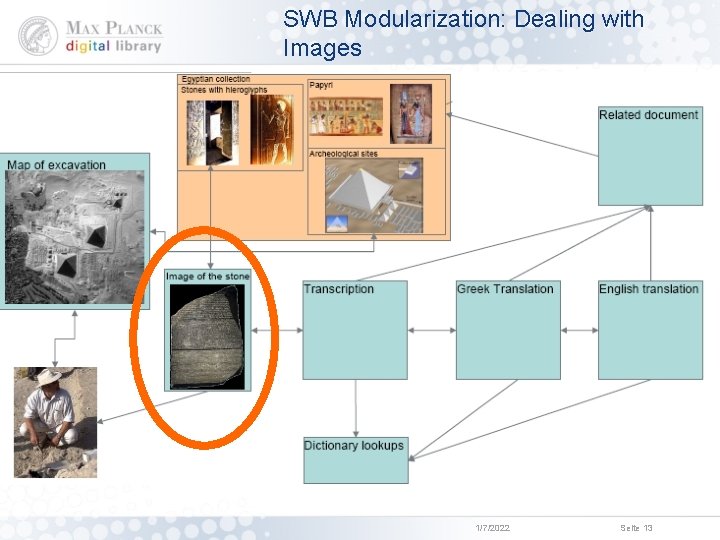
SWB Modularization: Initial Context 1/7/2022 Seite 12
SWB Modularization: Dealing with Images 1/7/2022 Seite 13
Dealing with Images and Metadata (Solution Example 1) § Max-Planck-Institut für Bildungsforschung § § § Requirement to deal with Images of “Human Faces” Institute local collection Discovery and Retrieval of Images Metadata searches and image displays § First Assumption: § § § One MD-record for Images One MD-record for Face specific Data Further needs: image annotation (details) 1/7/2022 Seite 14
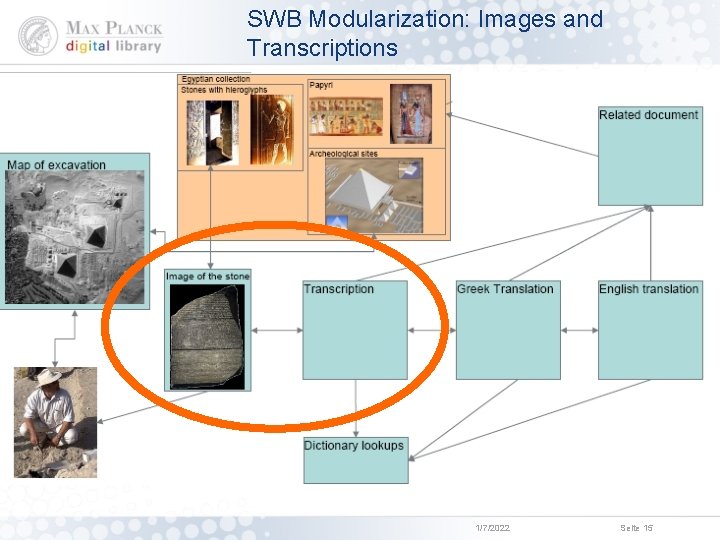
SWB Modularization: Images and Transcriptions 1/7/2022 Seite 15
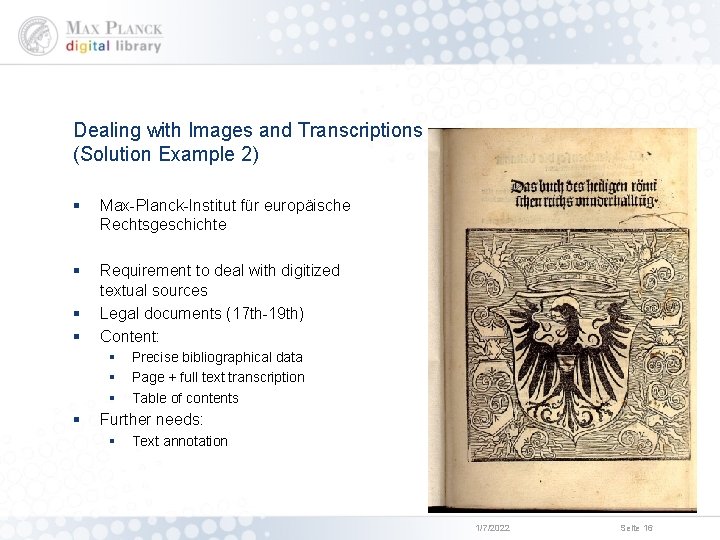
Dealing with Images and Transcriptions (Solution Example 2) § Max-Planck-Institut für europäische Rechtsgeschichte § Requirement to deal with digitized textual sources Legal documents (17 th-19 th) Content: § § § Precise bibliographical data Page + full text transcription Table of contents Further needs: § Text annotation 1/7/2022 Seite 16
Some issues § Any room left for new ideas? § How can we accumulate expertise? § Who will ensure the curation of data? § Not to speak about open access… 1/7/2022 Seite 17
New ideas — living sources
Describing observations World Atlas of Language Structures (WALS) • 2560 different languages • 142 features/maps/chapters • Phonology, Morphology, Nominal Categories, Nominal Syntax, Verbal, Word Order, Simple, Complex Sentences, Lexicon, etc. § Setting up a peer-reviewed environment § Submission of chapter + dataset § Conformance to good practice and scientific added values § Using WALS prestige § Getting academic credit for the data sets 1/7/2022 Seite 19
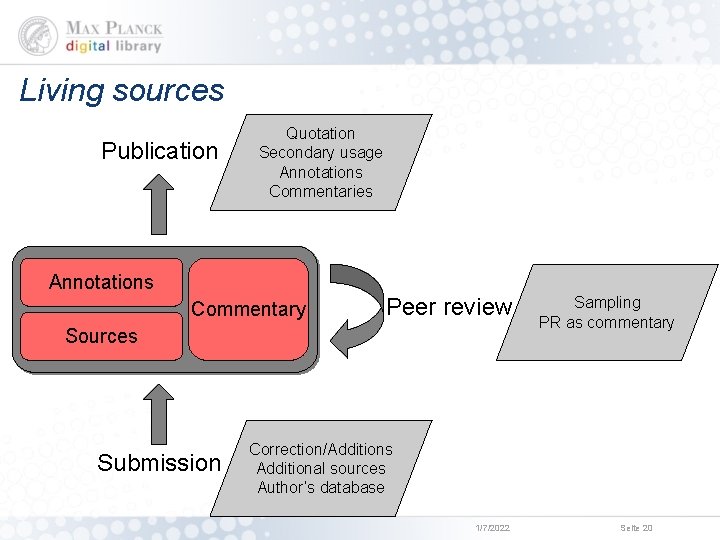
Living sources Publication Quotation Secondary usage Annotations Commentaries Annotations Commentary Peer review Sources Submission Sampling PR as commentary Correction/Additions Additional sources Author’s database 1/7/2022 Seite 20
Gathering expertise — Colab
Standards and good practices § An essential aspect of data preservation and reuse § Legibility of data § In space: sharing scientific sources with others § In time: pooling together the records of science § Generic standards (horizontal) § ISO 10646/Unicode, XML, etc. § Specific standards § ISO-IEC/JTC 1 (MPEG), ISO/TC 37 (ISO 639, TMF), TEI § E. g. TEI: § A wide range of documented elements for the encoding of textual data § A flexible architecture to select the elements adapted to one’s needs …potential complexity 1/7/2022 Seite 22
MPDL Co. Laboratory (MPDL Co. Lab) § § Platform for community building and knowledge exchange Aim: § improve exchange of explicit knwoledge and make tacit and individual know-how explicit § Supports community-building processes § Connects people with similar fields of interest and goals § within the MPS: MPDL, librarians, scientists § Outside: underlying basis of our national and international collaborations § Provide information about existing standards and best practices in the domain of supporting scientific life cycles § Ensuring long-term compatibility between local and centralized initiatives within the MPDL 1/7/2022 Seite 23
1/7/2022 Seite 24
Libraries, librarians: new scope, new roles § Library as function § From information provision to information management § Identification of a “digital curator” profile: interface between scientists and scientific information § Local mirrors of central activities § We probably do need even more librarians… § Library as a place § Core reference monographies § Complementarity with centralized archives § Local management of primary sources § Selection, digitization, access § Library as digital curation centres § Centre of gravity of scientific information (cf. Bibliothek 2007) 1/7/2022 Seite 25
Final words § e-Infrastructures § We need them => which model fits which scientific community § Communities § Sharing content and practices § Central-decentral § A constant balance between contradictory forces § Objective: simplicity for scientists 1/7/2022 Seite 26