
Complexes of alkenes alkynes and dienes Created by
Complexes of alkenes, alkynes, and dienes Created by Margaret L. Scheuermann, Princeton University; Abby R. O’Connor, The College of New Jersey, oconnora@tcnj. edu. Copyright Scheuermann and O’Connor, 2014. This work is licensed under the Creative Commons Attribution-Non. Commercial. Share. Alike 3. 0 Unported License. To view a copy of this license visit http: //creativecommons. org/about/license/
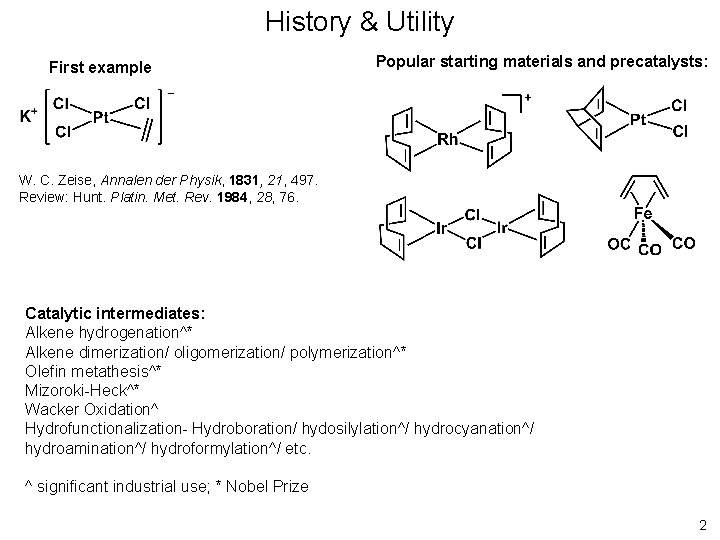
History & Utility First example Popular starting materials and precatalysts: W. C. Zeise, Annalen der Physik, 1831, 21, 497. Review: Hunt. Platin. Met. Rev. 1984, 28, 76. Catalytic intermediates: Alkene hydrogenation^* Alkene dimerization/ oligomerization/ polymerization^* Olefin metathesis^* Mizoroki-Heck^* Wacker Oxidation^ Hydrofunctionalization- Hydroboration/ hydosilylation^/ hydrocyanation^/ hydroamination^/ hydroformylation^/ etc. ^ significant industrial use; * Nobel Prize 2
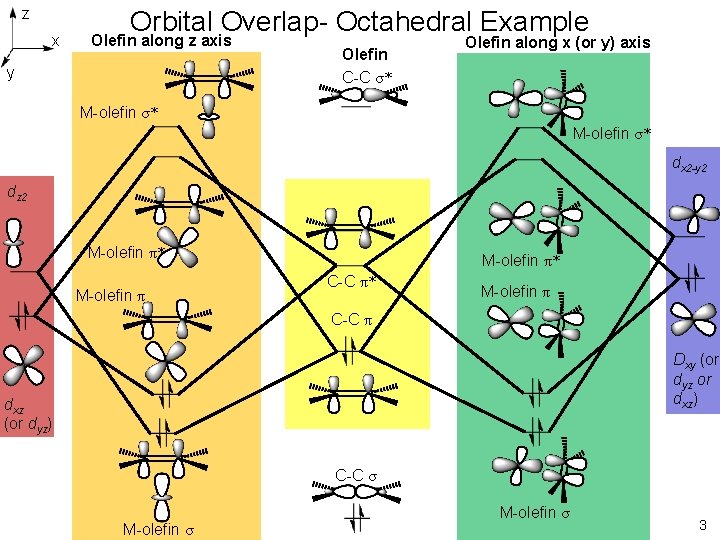
z x Orbital Overlap- Octahedral Example Olefin along z axis y Olefin C-C σ* Olefin along x (or y) axis M-olefin σ* dx 2 -y 2 dz 2 M-olefin π* C-C π* M-olefin π C-C π Dxy (or dyz or dxz) dxz (or dyz) C-C σ M-olefin σ 3
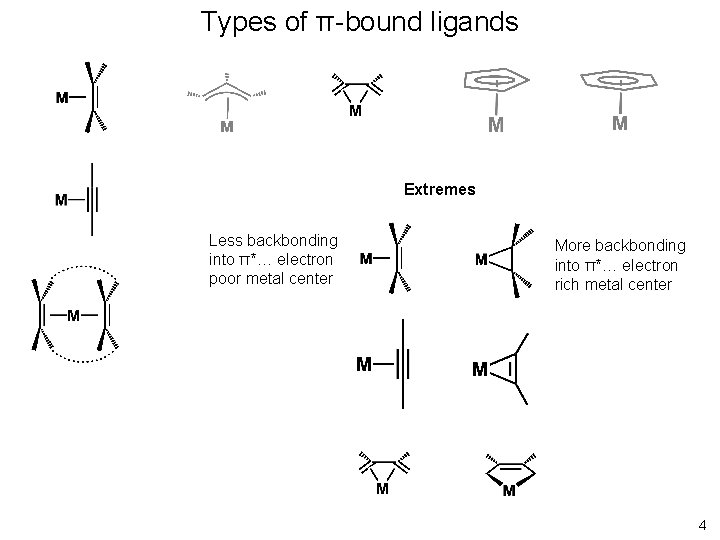
Types of π-bound ligands Extremes Less backbonding into π*… electron poor metal center More backbonding into π*… electron rich metal center 4
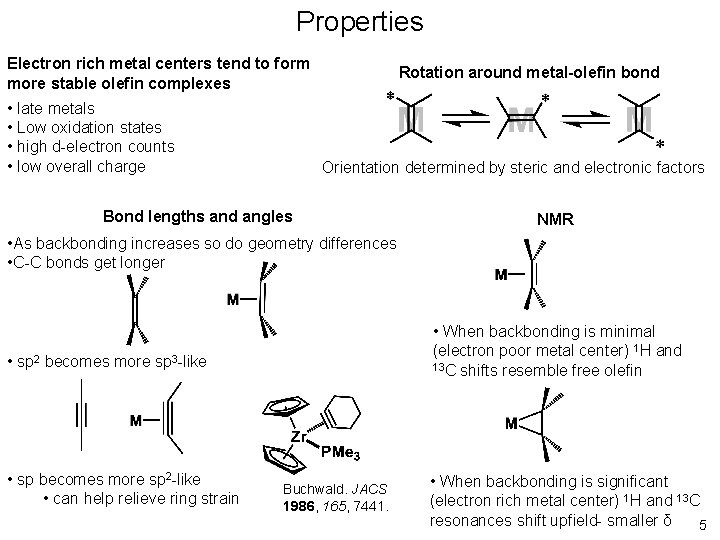
Properties Electron rich metal centers tend to form more stable olefin complexes • late metals • Low oxidation states • high d-electron counts • low overall charge Rotation around metal-olefin bond Orientation determined by steric and electronic factors Bond lengths and angles NMR • As backbonding increases so do geometry differences • C-C bonds get longer • When backbonding is minimal (electron poor metal center) 1 H and 13 C shifts resemble free olefin • sp 2 becomes more sp 3 -like • sp becomes more sp 2 -like • can help relieve ring strain Buchwald. JACS 1986, 165, 7441. • When backbonding is significant (electron rich metal center) 1 H and 13 C resonances shift upfield- smaller δ 5
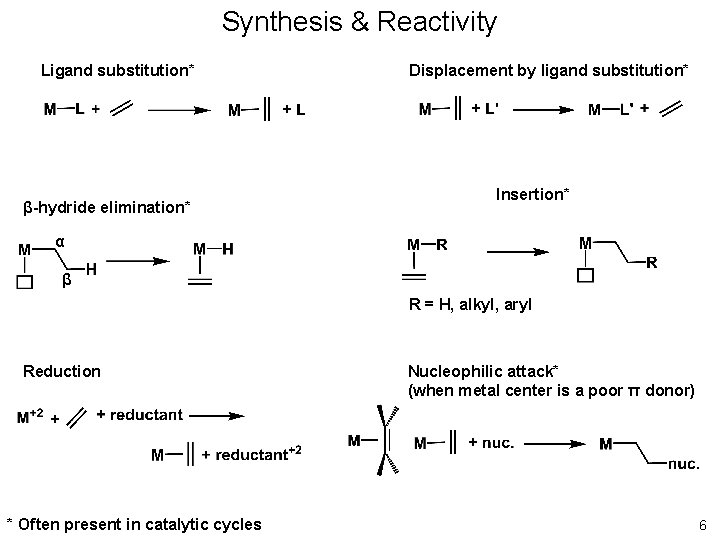
Synthesis & Reactivity Ligand substitution* β-hydride elimination* Displacement by ligand substitution* Insertion* α β R = H, alkyl, aryl Reduction * Often present in catalytic cycles Nucleophilic attack* (when metal center is a poor π donor) 6
- Slides: 6