
Complex Trauma Resources Residential Training Program Module 4

- Slides: 40
Complex Trauma Resources: Residential Training Program Module 4: Coaching Kids Through Common Stressors: Managing Challenging Behaviors Chipo Mc. Nichols, MA Pre-doctoral intern, Complex Trauma Resources
Understanding challenging behavior Challenging behavior happens when: • Cognitive demand outstrips coping capacity • Seek to help child by coaching child to resolve problems together vs. imposing what adult wants • Seek to help children learn to regulate their emotions
Understanding challenging behavior Child’s difficulty with frustration tolerance and inflexibility leads to: • unexpected outbursts & explosions • physical & verbal aggression • more intense reactions than expected for situation
What challenges a child’s coping? Different approaches to making sense of challenging behavior: • Complex trauma approach - Stress inducing situations • Actual stress or perceived as stressful • CPS approach - Unsolved problems • Child does not have skills to solve them
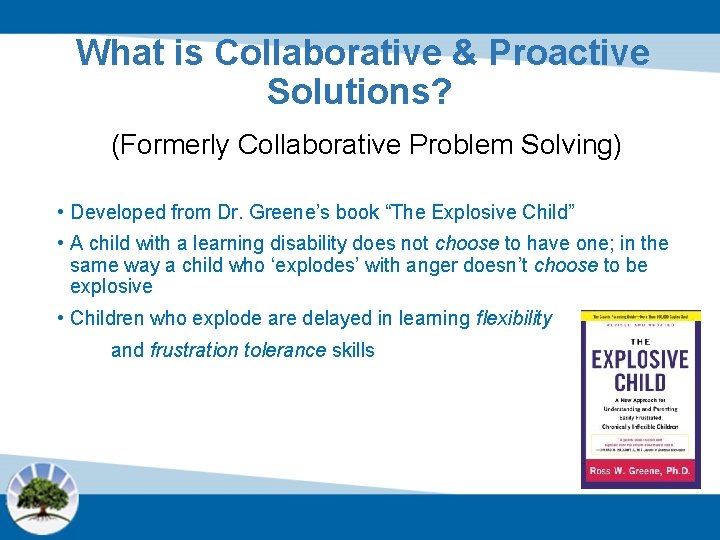
What is Collaborative & Proactive Solutions? (Formerly Collaborative Problem Solving) • Developed from Dr. Greene’s book “The Explosive Child” • A child with a learning disability does not choose to have one; in the same way a child who ‘explodes’ with anger doesn’t choose to be explosive • Children who explode are delayed in learning flexibility and frustration tolerance skills
CPS Overview 1. Byproducts of lagging cognitive skills Often seen as attention seeking, manipulative, limit-testing, or poor motivation, maybe diagnosed with ODD 2. Uses CPS skills to resolve the problems leading to the challenging behavior 3. Teaches the child the lacking thinking skills and skills at solving problems rather than teaching adults to be more effective at imposing their will
Common Explanations for Explosive Behaviour • • She just wants attention! Bratty! Resistant! Defiant! He does just fine when he wants to! She just wants control! He won’t cooperate! She’s manipulative! He just needs to step up to the plate! Ross Greene (2014)
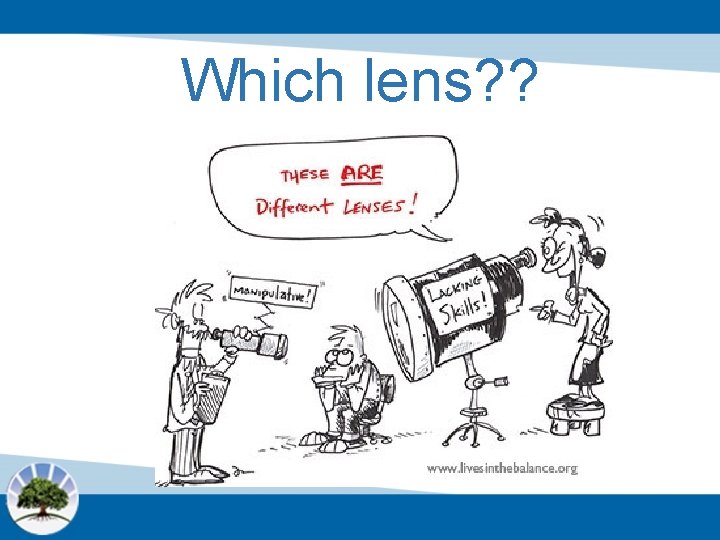
Which lens? ?
Weakness in Executive Functioning • Cognitive skills • Executive skills – memory • Language Processing skills • Emotional Regulation Skills • Cognitive flexibility skills • Social skills
STOP AND WATCH KIDS DO WELL IF THEY CAN VIDEO
Working with challenging behaviors Be curious not confirming! Ask yourself: • Why is the child exhibiting challenging behaviors? • When is the child exhibiting challenging behaviors?
Effect of Trauma on Child’s Development Trauma affects child’s development of skills needed to manage common stressors What does this look like in child’s life?
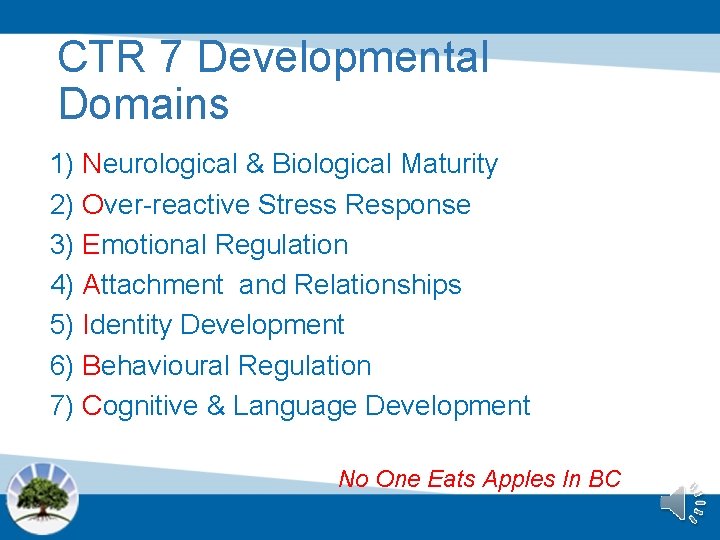
CTR 7 Developmental Domains 1) Neurological & Biological Maturity 2) Over-reactive Stress Response 3) Emotional Regulation 4) Attachment and Relationships 5) Identity Development 6) Behavioural Regulation 7) Cognitive & Language Development No One Eats Apples In BC
• Using a CPS approach helps the kids to • Calm emotions • Plan helps them deal with stress • Empathy helps them to experience positive relationships
Coping with stress When children lack executive skills: • They lack skills to deal with difficult situations • Leads them to pathways that are problematic Neuroplasticity allows for new pathways to be created
Coping with stress When children make gains in executive skills: • They develop the tools to deal with difficult situations • They can choose more helpful pathways
• • • Common Stressors Homework Sibling interactions Bedtimes/morning routines Mealtimes Boredom Changing activities/tasks Being in the car Recess Sensory issues/over or under stimulation Being teased Being hot, hungry or uncomfortable
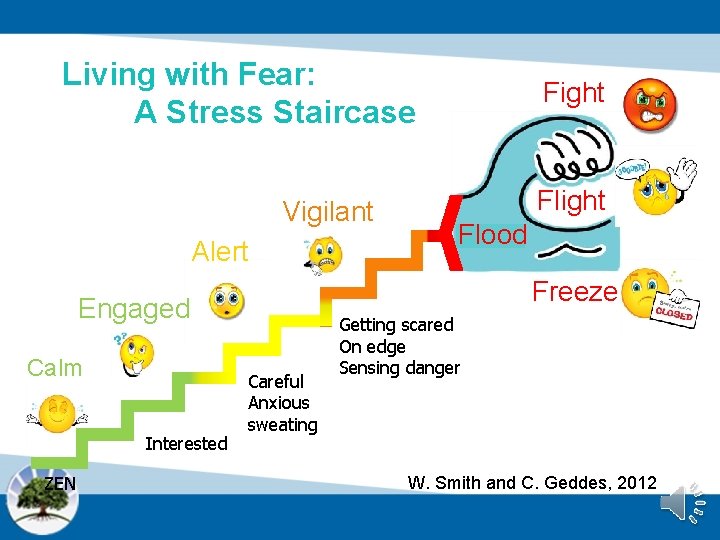
Living with Fear: A Stress Staircase Vigilant Alert Interested ZEN Flight Flood Freeze Engaged Calm Fight Careful Anxious sweating Getting scared On edge Sensing danger W. Smith and C. Geddes, 2012
Three Plans Common Approaches to Problems and Unmet Expectations: PLAN A: Impose adult will – common option PLAN C: Drop it (for now at least) PLAN B: Collaborative & proactive solution
Plan A: imposing adult will “no”, “You must”, You can’t”, 1… 2… 3 • Increases probability of explosion • Expectations often realistic, but manner in which they’re pursued heightens arousal What are the Benefits and disadvantages of using this plan?
Plan C: Drop it • • Usually gives into what the child wants “Okay” Choosing to remove a specific expectation Reduces child’s level of frustration What are the Benefits and Disadvantages of using this plan?
Plan B: Considers both adult’s & child's concerns • Dramatically reduces the frequency, intensity and duration of the explosions • Help adults determine their expectations and get them met in a mutually satisfactory way
Plan B: Collaborative & Proactive Solutions Resolving the problem with interests of the child and adult in mind regardless of the expectations 1. Empathy plus reassurance 2. Define the problem 3. Invite the child to solve the problem What are the Benefits and Disadvantages of using this plan?
STOP AND WATCH SIMPLE PLAN B VIDEO
PLAN B OPTIONS Emergency Plan B VS Proactive Plan B
Plan B Basics Lend me your brain please…. • Emergency plan B: Caregiver needs to coach child through a frustrating situation in the moment • Proactive plan B: Helps to solve problems that generally happen before the explosions
Plan B Basics Lend me your brain please…. • Caregiver acts as the child’s surrogate frontal lobe • Caregiver becomes temporary ‘coach’ for regulating emotions & solving problems until child learns to do so
Plan B steps 1. Empathy plus reassurance 2. Define the problem 3. Invitation for the child to solve the problem
Empathy (plus reassurance) • Keep the child and adult calm – tone of voice important • Child’s concerns are on the table – if unsure of child’s concerns ask (What’s up? ) • Reassurance helps to keep child calm
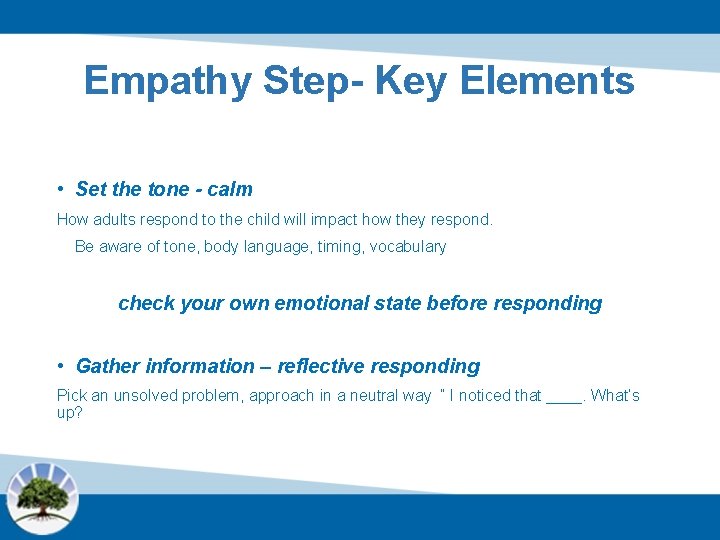
Empathy Step- Key Elements • Set the tone - calm How adults respond to the child will impact how they respond. Be aware of tone, body language, timing, vocabulary check your own emotional state before responding • Gather information – reflective responding Pick an unsolved problem, approach in a neutral way “ I noticed that ____. What’s up?
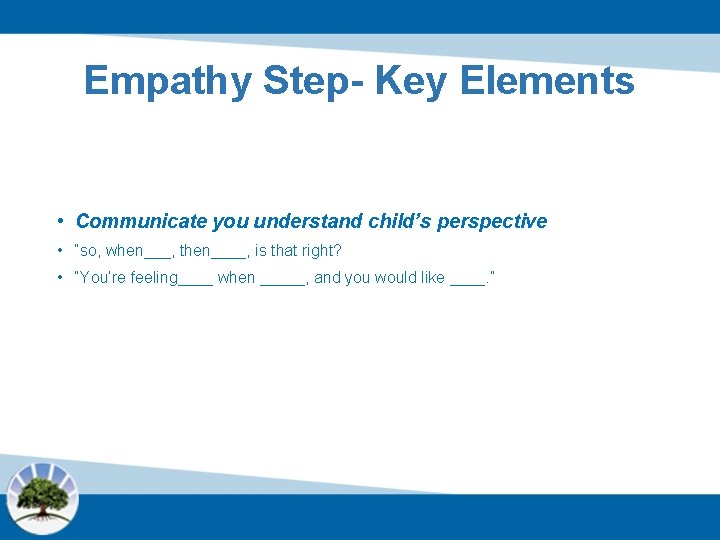
Empathy Step- Key Elements • Communicate you understand child’s perspective • “so, when___, then____, is that right? • “You’re feeling____ when _____, and you would like ____. ”
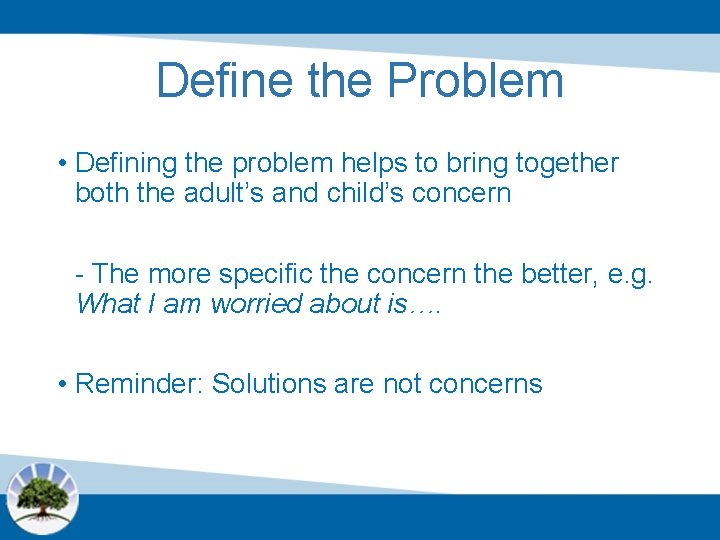
Define the Problem • Defining the problem helps to bring together both the adult’s and child’s concern - The more specific the concern the better, e. g. What I am worried about is…. • Reminder: Solutions are not concerns
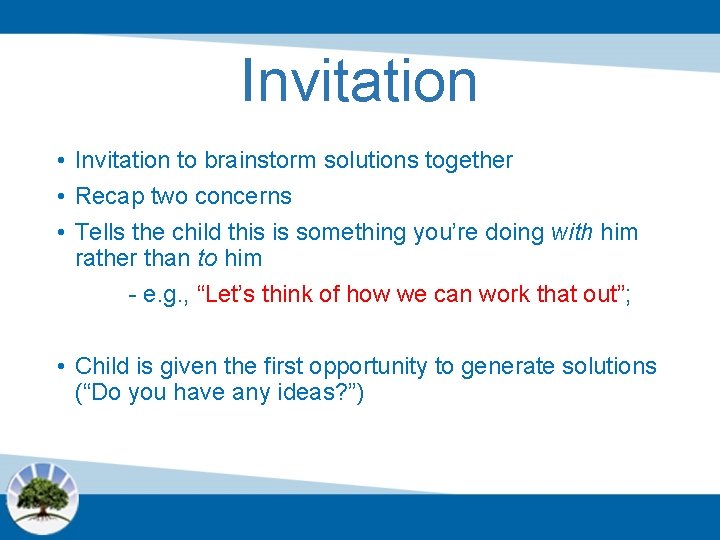
Invitation • Invitation to brainstorm solutions together • Recap two concerns • Tells the child this is something you’re doing with him rather than to him - e. g. , “Let’s think of how we can work that out”; • Child is given the first opportunity to generate solutions (“Do you have any ideas? ”)
Invitation • Both adult and child generate solutions • If child doesn’t have any ideas: “I have a few ideas, would you like to hear them? ” • It doesn’t matter what the solution is as long as the solution is mutually feasible, doable and satisfactory
Invitation • If child gives solution that is not mutually satisfactory, can say, “That solution might make you happy, but it wouldn’t make me very happy. Let’s find a solution that make us both happy. ”
STOP AND WATCH VIDEO STOP AND WATCH DRILLING FOR INFORMATION VIDEO
What might make plan B go astray? • Overreliance on emergency Plan B • Plan B as a last resort • solutions instead of concerns on the table • predetermined solutions • Unrealistic solutions
CTR THERAPEUTIC BOOKENDS Priority goals are to work towards therapeutic bookends of: • DECREASING AROUSAL This reduces chances of child escalating • DEEPENING ATTACHMENT This increases chances of child feeling safe and open to positive interactions Dr. Chuck Geddes, 2012
References • https: //parentsuniversalresourceexperts. wordpr ess. com/category/family-intel/ • www. livesinbalance. org • Green, R. , Ablon, J. (2006). Treating Explosive Kids, New York, Guildford Press. • Green, R. . W, (2014). The Explosive Child: A New Approach for Understanding and Parenting Easily Frustrated, Chronically Inflexible Children. New York, Harper. Collins Publishers
Thank You Chipo Mc. Nichols, MA Complex Trauma Resources Chilliwack, BC, Canada chipo@complextrauma. ca www. complextrauma. ca