
COMPLEX TEXT IN THE MATHEMATICS CLASSROOM Math and

- Slides: 22
COMPLEX TEXT IN THE MATHEMATICS CLASSROOM Math and Literacy Meet at the Corner of Making Meaning and Learning Deeply
COMMON CORE RELATIONSHIPS Math Practice Standards Literacy Standards
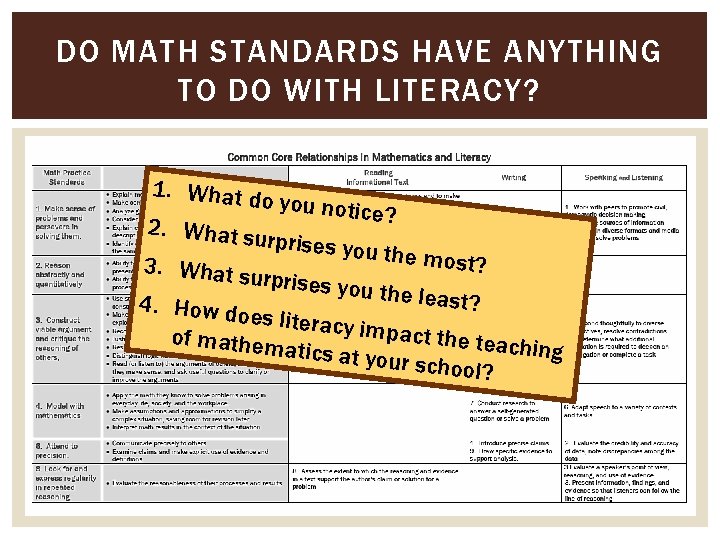
DO MATH STANDARDS HAVE ANYTHING TO DO WITH LITERACY? 1. What d o you notic e? 2. What s urprises yo u the most ? 3. What s urprises yo u the least ? 4. How do es literacy impact the of mathem teaching atics at you r school?
CONTEXTUAL LESSONS “According to contextual learning theory, learning occurs only when students (learners) process new information or knowledge in such a way that it makes sense to them in their own frames of reference (their own inner worlds of memory experience, and response). This approach to learning and teaching assumes that the mind naturally seeks meaning in context— that is, in relation to the person’s current environment — and that it does so by searching for relationships that make sense and appear useful. ” (Teaching Mathematics Contextually, © 1999, Cord)
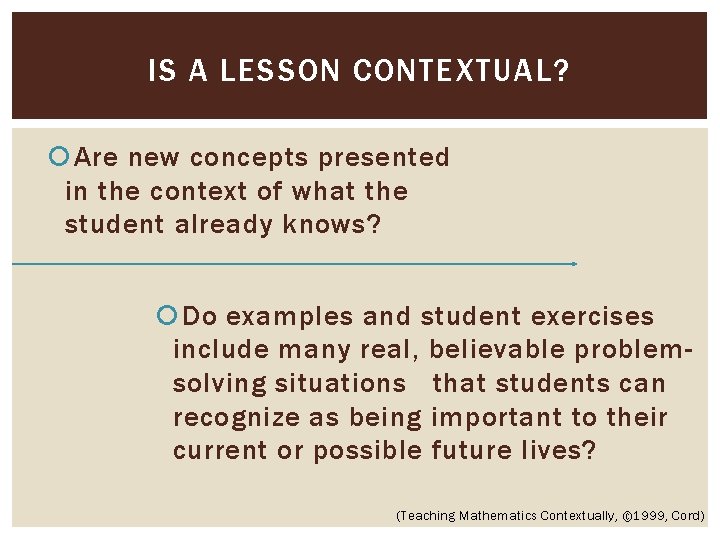
IS A LESSON CONTEXTUAL? Are new concepts presented in real-life (outside the classroom) situations and experiences that are Are concepts in examples and familiar to the student exercises student? presented in the context of their use? (Teaching Mathematics Contextually, © 1999, Cord)
IS A LESSON CONTEXTUAL? Are new concepts presented in the context of what the student already knows? Do examples and student exercises include many real, believable problemsolving situations that students can recognize as being important to their current or possible future lives? (Teaching Mathematics Contextually, © 1999, Cord)
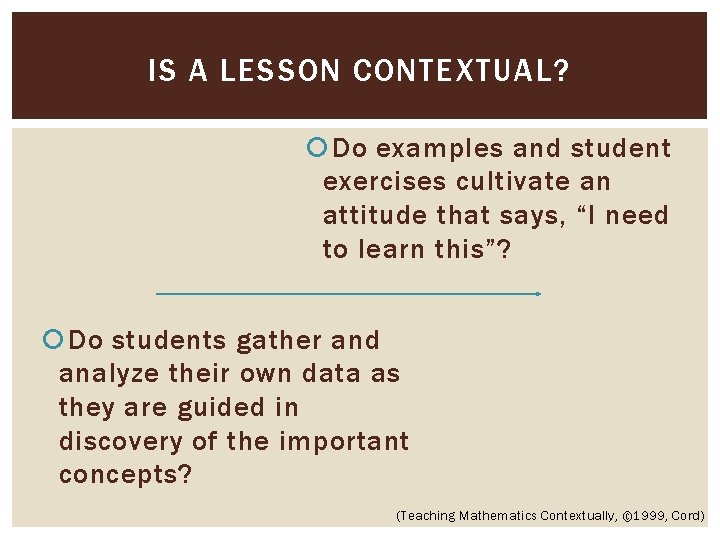
IS A LESSON CONTEXTUAL? Do examples and student exercises cultivate an attitude that says, “I need to learn this”? Do students gather and analyze their own data as they are guided in discovery of the important concepts? (Teaching Mathematics Contextually, © 1999, Cord)
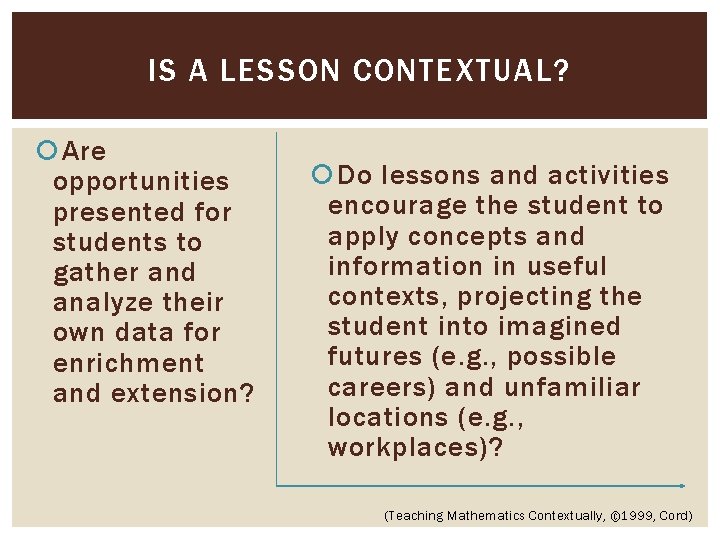
IS A LESSON CONTEXTUAL? Are opportunities presented for students to gather and analyze their own data for enrichment and extension? Do lessons and activities encourage the student to apply concepts and information in useful contexts, projecting the student into imagined futures (e. g. , possible careers) and unfamiliar locations (e. g. , workplaces)? (Teaching Mathematics Contextually, © 1999, Cord)
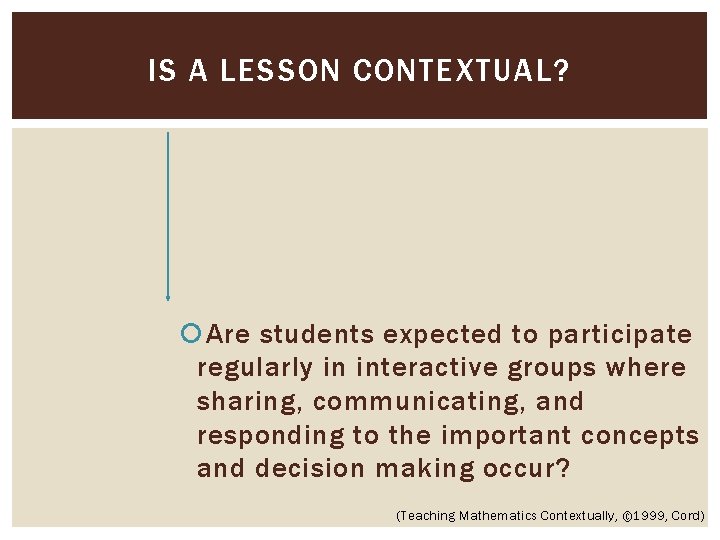
IS A LESSON CONTEXTUAL? Are students expected to participate regularly in interactive groups where sharing, communicating, and responding to the important concepts and decision making occur? (Teaching Mathematics Contextually, © 1999, Cord)
IS A LESSON CONTEXTUAL? Do lessons, exercises, and labs improve students’ reading and other communication skills in addition to mathematical reasoning and achievement? (Teaching Mathematics Contextually, © 1999, Cord)
MATH IN CONTEXT Using Complex Text
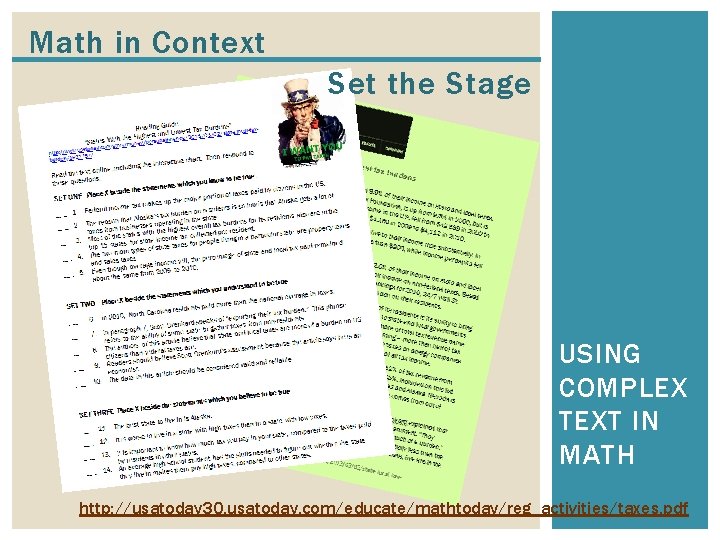
Math in Context Set the Stage USING COMPLEX TEXT IN MATH http: //usatoday 30. usatoday. com/educate/mathtoday/reg_activities/taxes. pdf
DIRECTIONS Individual Learning: 1. Go to http: //usatoday 30. usatoday. com/educate/mathtoday/reg_activities/taxes. pdf 2. Read the article. 3. As you read, mark your responses on the reading guide Peer Learning/Discourse: API Discourse 1. Compare 1. Text Complexity? 2. Evidence 2. Type of Scaffold? 3. Rationale 3. Value for Math Context?
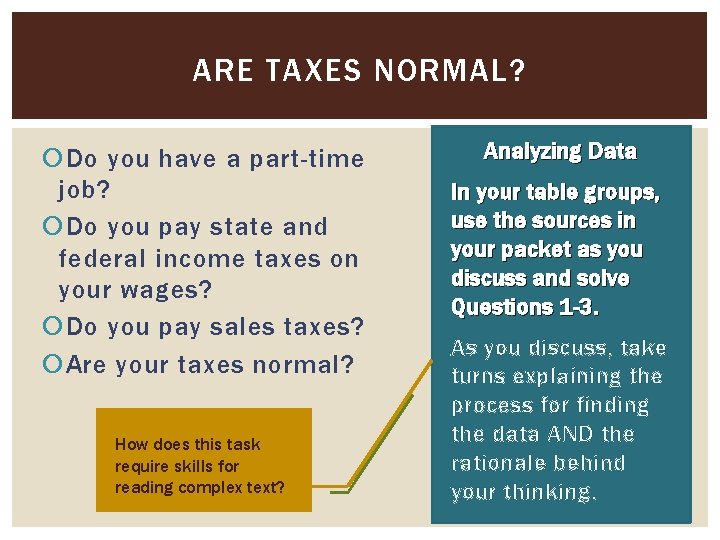
ARE TAXES NORMAL? Do you have a part-time job? Do you pay state and federal income taxes on your wages? Do you pay sales taxes? Are your taxes normal? How does this task require skills for reading complex text? Analyzing Data In your table groups, use the sources in your packet as you discuss and solve Questions 1 -3. As you discuss, take turns explaining the process for finding the data AND the rationale behind your thinking.
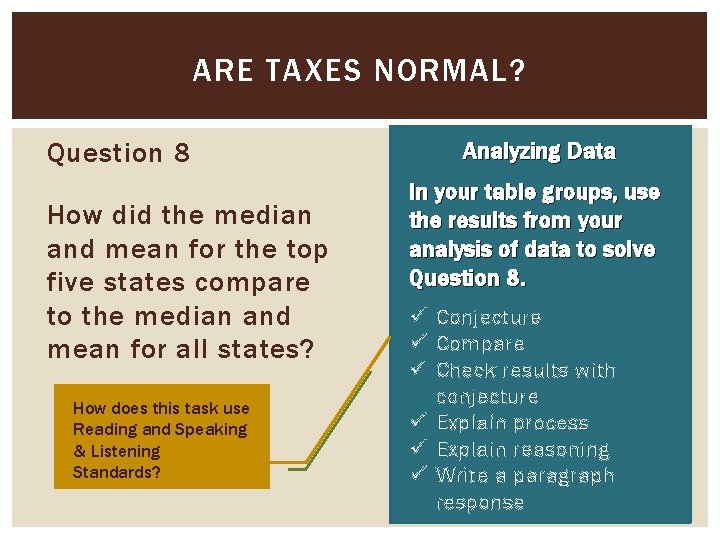
ARE TAXES NORMAL? Question 8 How did the median and mean for the top five states compare to the median and mean for all states? How does this task use Reading and Speaking & Listening Standards? Analyzing Data In your table groups, use the results from your analysis of data to solve Question 8. ü Conjecture ü Compare ü Check results with conjecture ü Explain process ü Explain reasoning ü Write a paragraph response
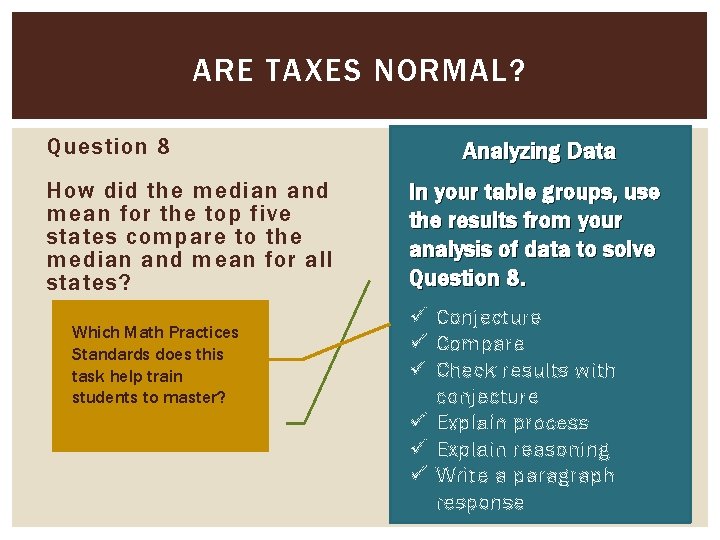
ARE TAXES NORMAL? Question 8 How did the median and mean for the top five states compare to the median and mean for all states? Which Math Practices Standards does this task help train students to master? Analyzing Data In your table groups, use the results from your analysis of data to solve Question 8. ü Conjecture ü Compare ü Check results with conjecture ü Explain process ü Explain reasoning ü Write a paragraph response
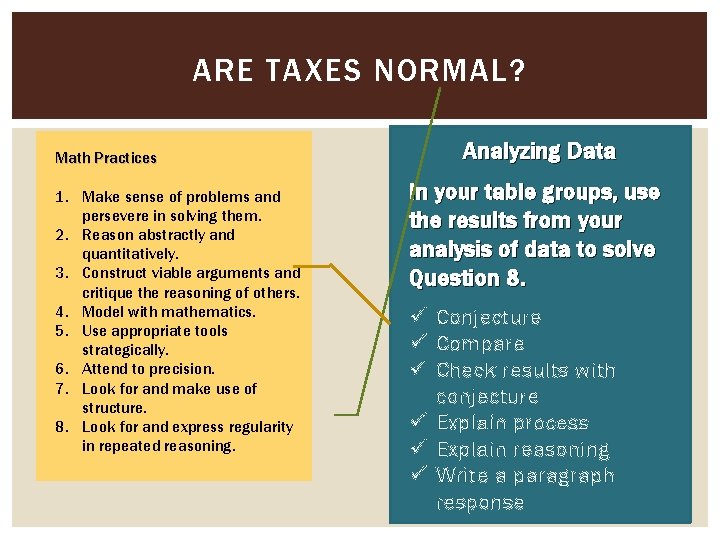
ARE TAXES NORMAL? Math Practices 1. Make sense of problems and persevere in solving them. 2. Reason abstractly and quantitatively. 3. Construct viable arguments and critique the reasoning of others. 4. Model with mathematics. 5. Use appropriate tools strategically. 6. Attend to precision. 7. Look for and make use of structure. 8. Look for and express regularity in repeated reasoning. Analyzing Data In your table groups, use the results from your analysis of data to solve Question 8. ü Conjecture ü Compare ü Check results with conjecture ü Explain process ü Explain reasoning ü Write a paragraph response
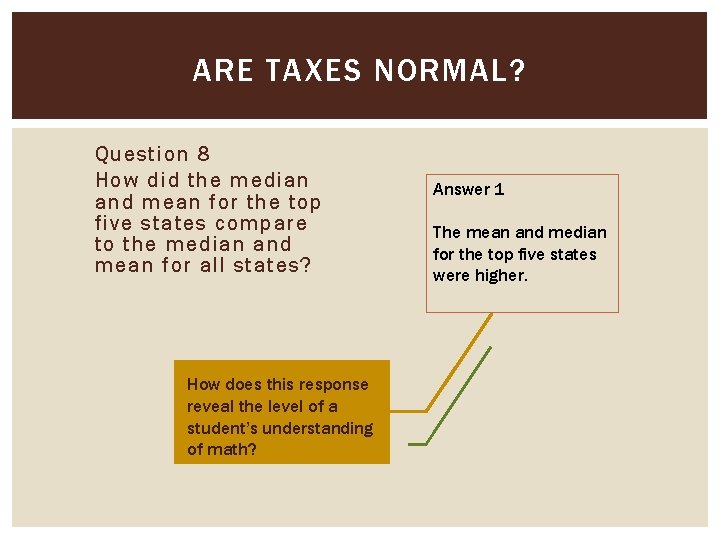
ARE TAXES NORMAL? Question 8 How did the median and mean for the top five states compare to the median and mean for all states? How does this response reveal the level of a student’s understanding of math? Answer 1 The mean and median for the top five states were higher.
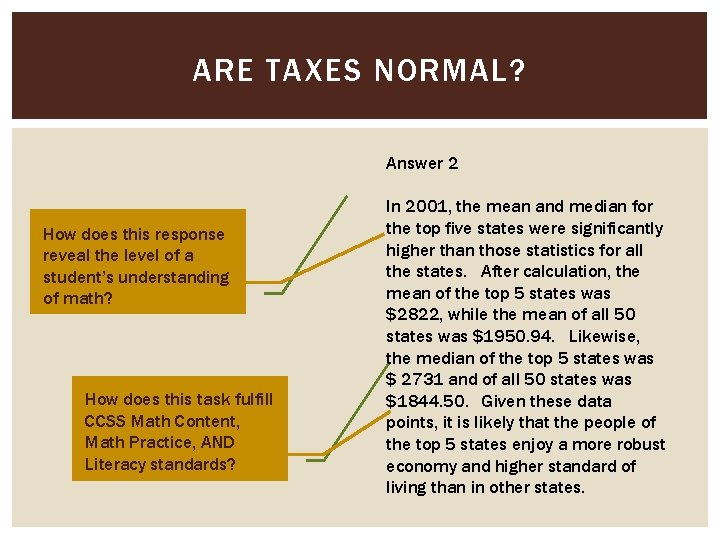
ARE TAXES NORMAL? Answer 2 How does this response reveal the level of a student’s understanding of math? How does this task fulfill CCSS Math Content, Math Practice, AND Literacy standards? In 2001, the mean and median for the top five states were significantly higher than those statistics for all the states. After calculation, the mean of the top 5 states was $2822, while the mean of all 50 states was $1950. 94. Likewise, the median of the top 5 states was $ 2731 and of all 50 states was $1844. 50. Given these data points, it is likely that the people of the top 5 states enjoy a more robust economy and higher standard of living than in other states.
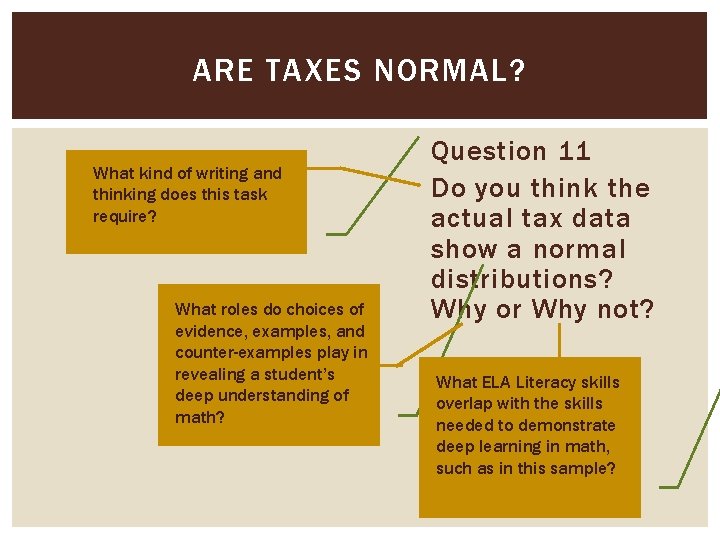
ARE TAXES NORMAL? What kind of writing and thinking does this task require? What roles do choices of evidence, examples, and counter-examples play in revealing a student’s deep understanding of math? Question 11 Do you think the actual tax data show a normal distributions? Why or Why not? What ELA Literacy skills overlap with the skills needed to demonstrate deep learning in math, such as in this sample?
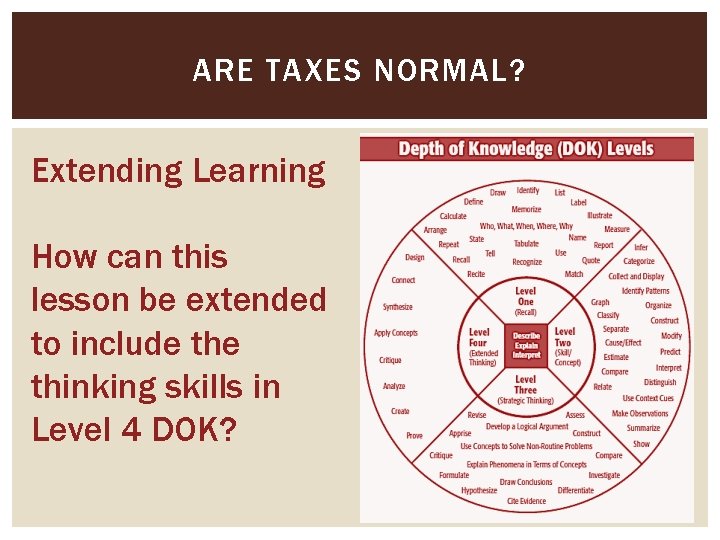
ARE TAXES NORMAL? Extending Learning How can this lesson be extended to include thinking skills in Level 4 DOK?
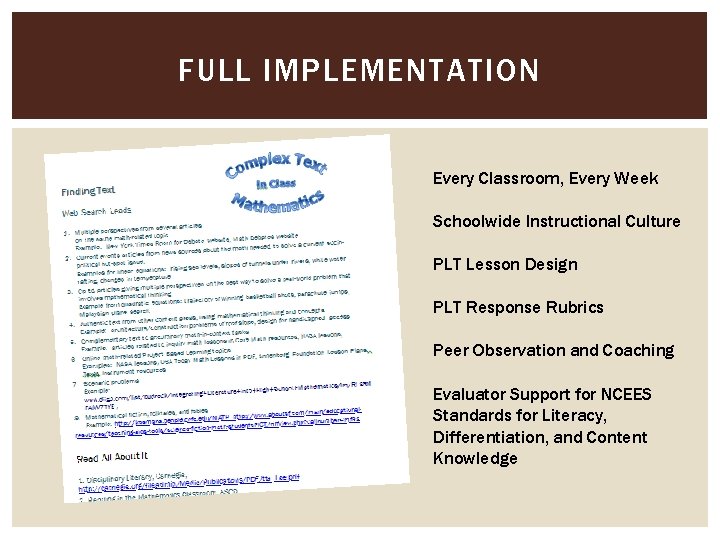
FULL IMPLEMENTATION Every Classroom, Every Week Schoolwide Instructional Culture PLT Lesson Design PLT Response Rubrics Peer Observation and Coaching Evaluator Support for NCEES Standards for Literacy, Differentiation, and Content Knowledge