
Complex Syntax in Narrative Texts CrossLinguistic Comparisons Ruth

![Syntactic Architecture in Clause Packaging: Categories of Analysis Isotaxis [I] = ‘equal organization’: isolated](https://slidetodoc.com/presentation_image_h2/776d613358eefca26b86894d76d00733/image-13.jpg "Syntactic Architecture in Clause Packaging: Categories of Analysis Isotaxis [I] = ‘equal organization’: isolated")
![Syntactic Architecture in Clause Packaging: Categories of Analysis Isotaxis [I] = isolated clauses clause](https://slidetodoc.com/presentation_image_h2/776d613358eefca26b86894d76d00733/image-14.jpg "Syntactic Architecture in Clause Packaging: Categories of Analysis Isotaxis [I] = isolated clauses clause")
![Syntactic Architecture in Clause Packaging: Categories of Analysis Isolaxis [I] = isolating: (a) lone](https://slidetodoc.com/presentation_image_h2/776d613358eefca26b86894d76d00733/image-15.jpg "Syntactic Architecture in Clause Packaging: Categories of Analysis Isolaxis [I] = isolating: (a) lone")
![Excerpt from Personal Experience Narrative Written in Spanish [Sa 15 fnw] CP 1 En](https://slidetodoc.com/presentation_image_h2/776d613358eefca26b86894d76d00733/image-16.jpg "Excerpt from Personal Experience Narrative Written in Spanish [Sa 15 fnw] CP 1 En")
![Personal Experience Narrative Written in French [Fa 17 fnw] CP 1 J’ai eu un](https://slidetodoc.com/presentation_image_h2/776d613358eefca26b86894d76d00733/image-17.jpg "Personal Experience Narrative Written in French [Fa 17 fnw] CP 1 J’ai eu un")
![Personal Experience Narrative Written in Hebrew [Ha 13 mnw] CP 1 mikre še-kara li](https://slidetodoc.com/presentation_image_h2/776d613358eefca26b86894d76d00733/image-18.jpg "Personal Experience Narrative Written in Hebrew [Ha 13 mnw] CP 1 mikre še-kara li")
![Personal Experience Narrative Written in English [Ea 11 fnw] CP 1 As I stated](https://slidetodoc.com/presentation_image_h2/776d613358eefca26b86894d76d00733/image-19.jpg "Personal Experience Narrative Written in English [Ea 11 fnw] CP 1 As I stated")
![Mean Number of Clauses per Clause Package by Language [N=74] Clauses per CP 6](https://slidetodoc.com/presentation_image_h2/776d613358eefca26b86894d76d00733/image-20.jpg "Mean Number of Clauses per Clause Package by Language [N=74] Clauses per CP 6")
- Slides: 24
Complex Syntax in Narrative Texts: Cross-Linguistic Comparisons Ruth A. Berman – Tel Aviv University with Bracha Nir – University of Haifa Department of English University of Santiago de Compostela April 2009
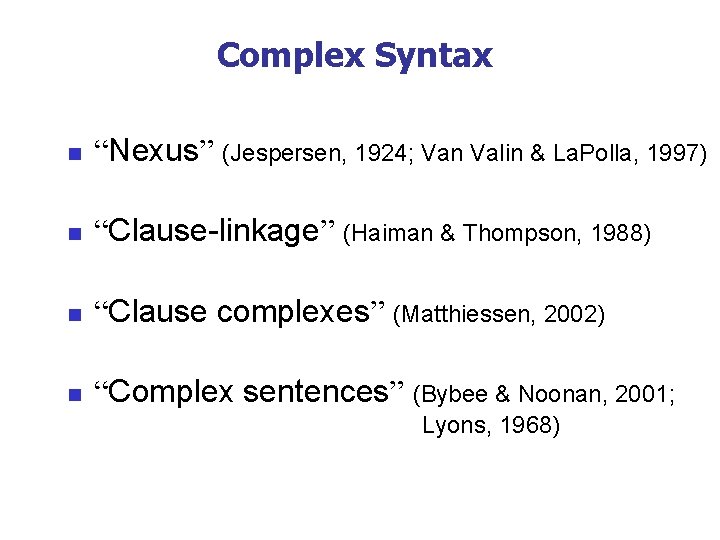
Complex Syntax n “Nexus” (Jespersen, 1924; Van Valin & La. Polla, 1997) n “Clause-linkage” (Haiman & Thompson, 1988) n “Clause complexes” (Matthiessen, 2002) n “Complex sentences” (Bybee & Noonan, 2001; Lyons, 1968)
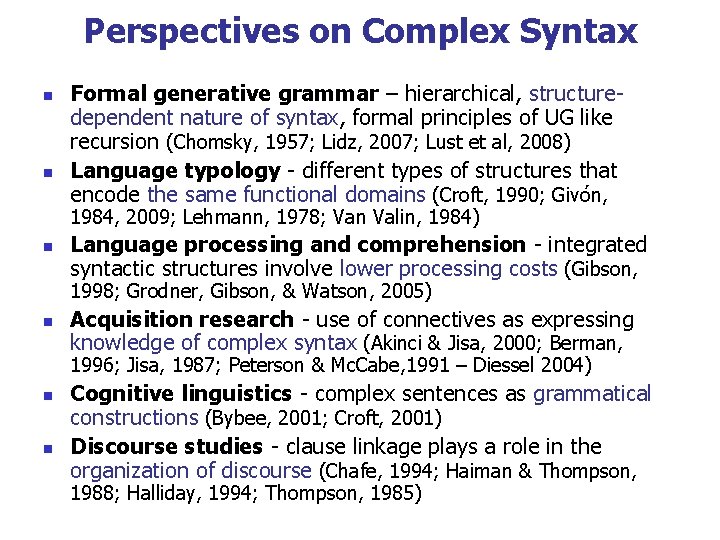
Perspectives on Complex Syntax n n Formal generative grammar – hierarchical, structuredependent nature of syntax, formal principles of UG like recursion (Chomsky, 1957; Lidz, 2007; Lust et al, 2008) Language typology - different types of structures that encode the same functional domains (Croft, 1990; Givón, 1984, 2009; Lehmann, 1978; Van Valin, 1984) n Language processing and comprehension - integrated syntactic structures involve lower processing costs (Gibson, 1998; Grodner, Gibson, & Watson, 2005) n Acquisition research - use of connectives as expressing knowledge of complex syntax (Akinci & Jisa, 2000; Berman, 1996; Jisa, 1987; Peterson & Mc. Cabe, 1991 – Diessel 2004) n n Cognitive linguistics - complex sentences as grammatical constructions (Bybee, 2001; Croft, 2001) Discourse studies - clause linkage plays a role in the organization of discourse (Chafe, 1994; Haiman & Thompson, 1988; Halliday, 1994; Thompson, 1985)
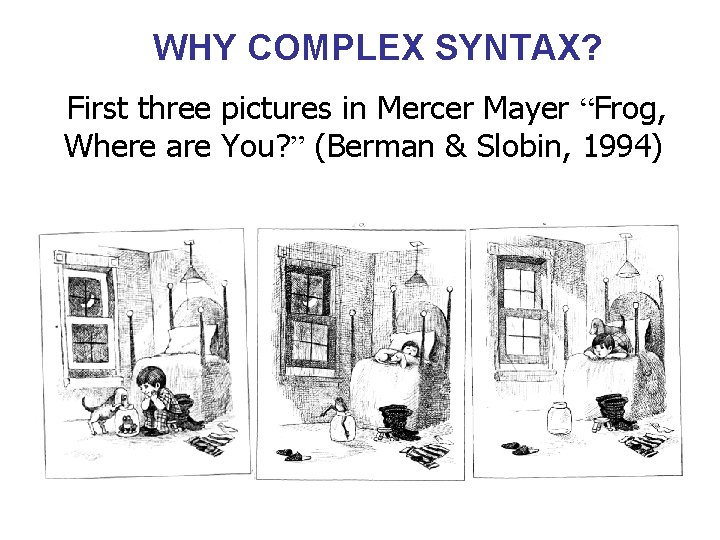
WHY COMPLEX SYNTAX? First three pictures in Mercer Mayer “Frog, Where are You? ” (Berman & Slobin, 1994)
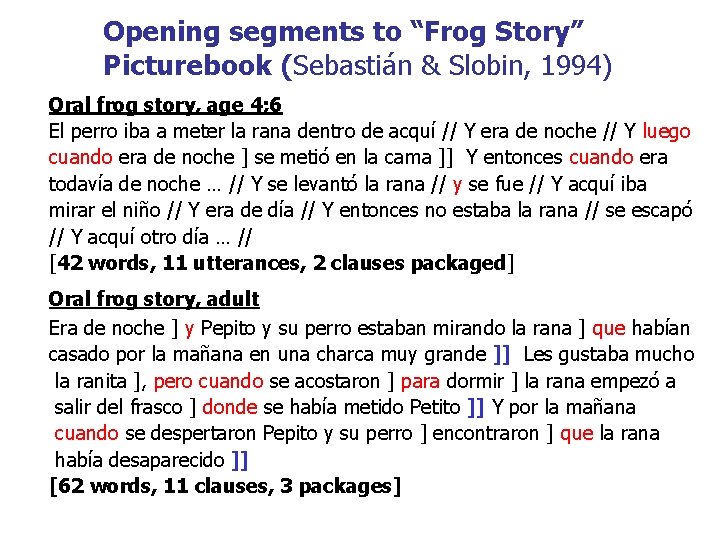
Opening segments to “Frog Story” Picturebook (Sebastián & Slobin, 1994) Oral frog story, age 4; 6 El perro iba a meter la rana dentro de acquí // Y era de noche // Y luego cuando era de noche ] se metió en la cama ]] Y entonces cuando era todavía de noche … // Y se levantó la rana // y se fue // Y acquí iba mirar el niño // Y era de día // Y entonces no estaba la rana // se escapó // Y acquí otro día … // [42 words, 11 utterances, 2 clauses packaged] Oral frog story, adult Era de noche ] y Pepito y su perro estaban mirando la rana ] que habían casado por la mañana en una charca muy grande ]] Les gustaba mucho la ranita ], pero cuando se acostaron ] para dormir ] la rana empezó a salir del frasco ] donde se había metido Petito ]] Y por la mañana cuando se despertaron Pepito y su perro ] encontraron ] que la rana había desaparecido ]] [62 words, 11 clauses, 3 packages]
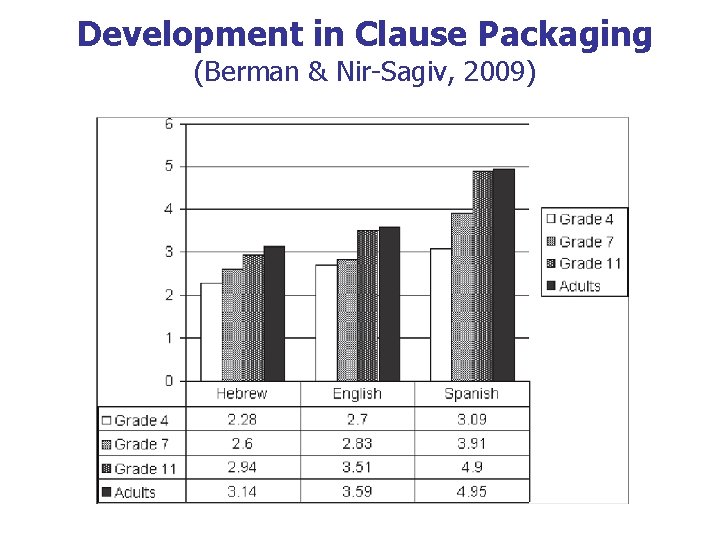
Development in Clause Packaging (Berman & Nir-Sagiv, 2009)
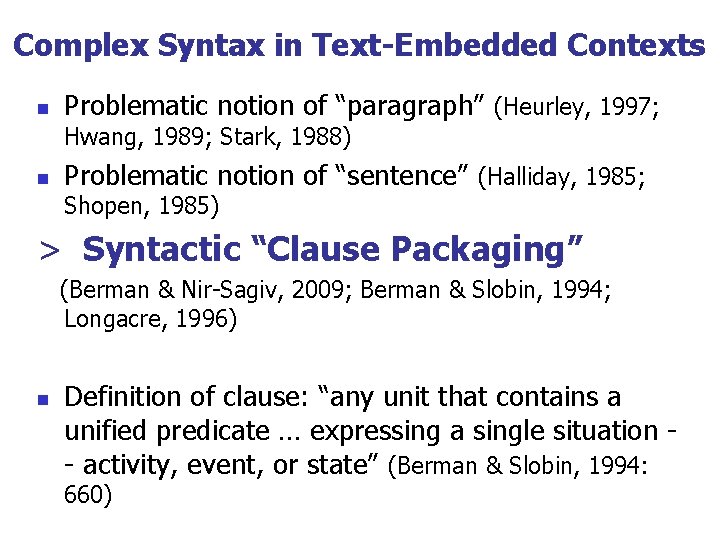
Complex Syntax in Text-Embedded Contexts n Problematic notion of “paragraph” (Heurley, 1997; Hwang, 1989; Stark, 1988) n Problematic notion of “sentence” (Halliday, 1985; Shopen, 1985) > Syntactic “Clause Packaging” (Berman & Nir-Sagiv, 2009; Berman & Slobin, 1994; Longacre, 1996) n Definition of clause: “any unit that contains a unified predicate … expressing a single situation - activity, event, or state” (Berman & Slobin, 1994: 660)
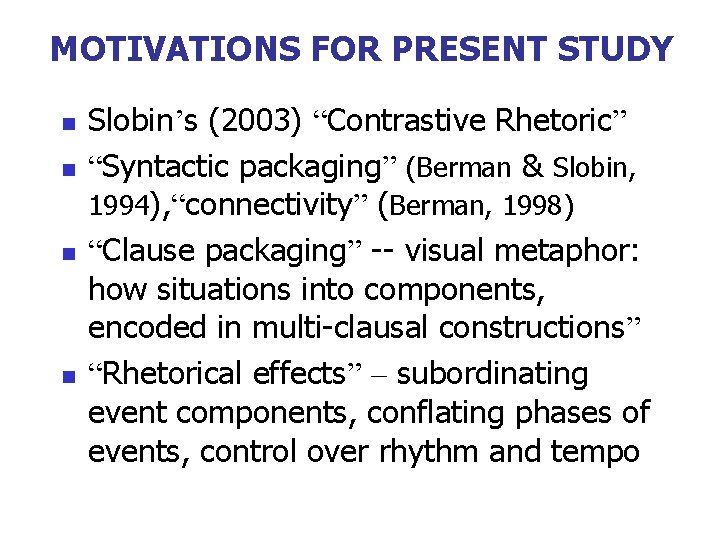
MOTIVATIONS FOR PRESENT STUDY n n Slobin’s (2003) “Contrastive Rhetoric” “Syntactic packaging” (Berman & Slobin, 1994), “connectivity” (Berman, 1998) “Clause packaging” -- visual metaphor: how situations into components, encoded in multi-clausal constructions” “Rhetorical effects” – subordinating event components, conflating phases of events, control over rhythm and tempo
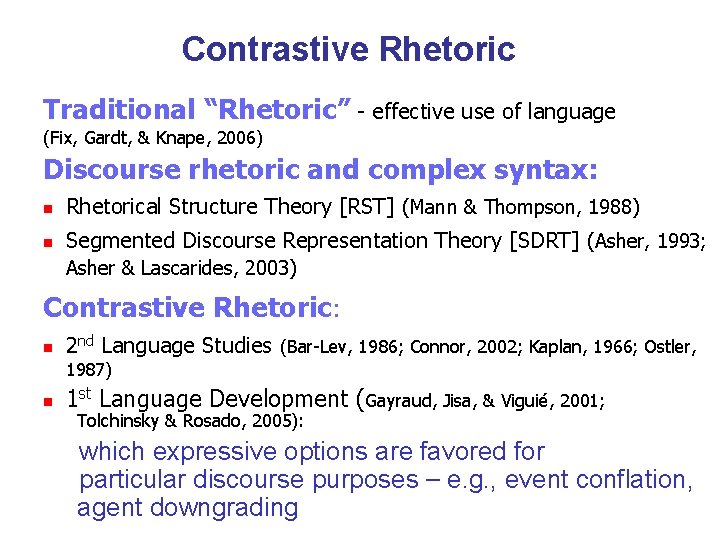
Contrastive Rhetoric Traditional “Rhetoric” - effective use of language (Fix, Gardt, & Knape, 2006) Discourse rhetoric and complex syntax: n Rhetorical Structure Theory [RST] (Mann & Thompson, 1988) n Segmented Discourse Representation Theory [SDRT] (Asher, 1993; Asher & Lascarides, 2003) Contrastive Rhetoric: n 2 nd Language Studies (Bar-Lev, 1986; Connor, 2002; Kaplan, 1966; Ostler, 1987) n 1 st Language Development (Gayraud, Jisa, & Viguié, 2001; Tolchinsky & Rosado, 2005): which expressive options are favored for particular discourse purposes – e. g. , event conflation, agent downgrading
Facets of Contrastive Rhetoric n Expressive options n Rhetorical preferences n Rhetorical strategies n Rhetorical style n Rhetorical purpose
Present Analysis n Syntactic architecture: n n syntactic construction type of the individual clause its relation to surrounding clauses n Strategies of clause combining n Preferred narrative (rhetorical) style n Cross-linguistic comparisons
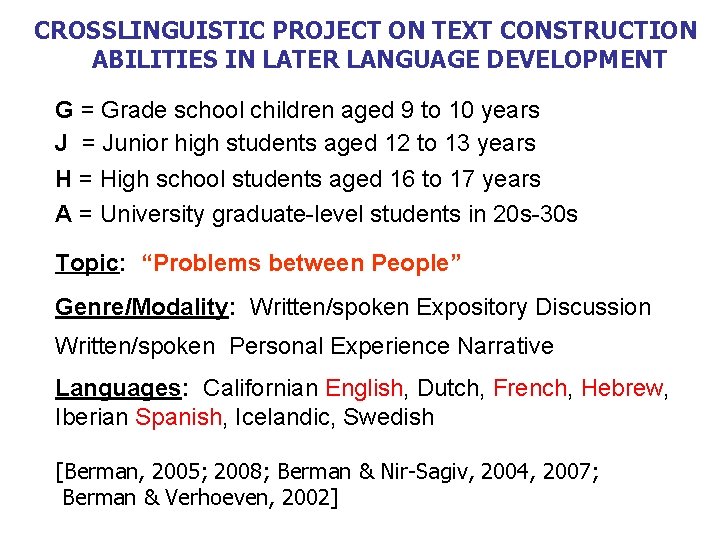
CROSSLINGUISTIC PROJECT ON TEXT CONSTRUCTION ABILITIES IN LATER LANGUAGE DEVELOPMENT G = Grade school children aged 9 to 10 years J = Junior high students aged 12 to 13 years H = High school students aged 16 to 17 years A = University graduate-level students in 20 s-30 s Topic: “Problems between People” Genre/Modality: Written/spoken Expository Discussion Written/spoken Personal Experience Narrative Languages: Californian English, Dutch, French, Hebrew, Iberian Spanish, Icelandic, Swedish [Berman, 2005; 2008; Berman & Nir-Sagiv, 2004, 2007; Berman & Verhoeven, 2002]
Syntactic Architecture in Clause Packaging: Categories of Analysis Isotaxis [I] = ‘equal organization’: isolated clauses Symmetric Parataxis [P]= ‘side by side organization’: stringing of clauses Asymmetric Parataxis [As. P]= dependent stringing Hypotaxis [H] = ‘one under the other’: layering of clauses Endotaxis [E] = ‘one inside the other’: nesting of clauses (Akinci et Jisa, 2001; Koch, 1995; Lehmann, 1988; Vigué 2001)
Syntactic Architecture in Clause Packaging: Categories of Analysis Isotaxis [I] = isolated clauses clause 1 Symmetric Parataxis [P]= stringing of clauses clause 1 co clausen Asymmetric Parataxis [As. P]= dependent stringing clause co clause 1 n Hypotaxis [H] = layering of clauses clause 1 co clausen Endotaxis [E] = nesting of clauses clause 1 co clausen (Akinci et Jisa, 2001; Koch 1995; Lehmann, 1988; Vigué 2001)
Syntactic Architecture in Clause Packaging: Categories of Analysis Isolaxis [I] = isolating: (a) lone clauses, not linked to others in the same CP [MC-I] (b) main clauses [MC] Parataxis [P]= stringing: (a) juxtaposed clauses, asyndetic, linked by juxtaposition [MCJ-P] (b) coordinate clauses, listed or marked by conjunction, with surface subject [CO-P] Asymmetric Parataxis [As. P] = dependent stringing: (a) coordinate clauses with subject ellipsis [CO-As. P] (b) complement clauses, indirect questions [CMP-As. P], [CMPQ-As. P] Hypotaxis [H] = layering of clauses (a) dependent relative clauses [RC-H] (b) dependent adverbial clauses [ADV-H] Endotaxis [E] = nesting of clauses (a) center-embedded adverbial and relative clauses [RC-E], [ADV-E] (b) parenthetical constructions [PAR-E]
Excerpt from Personal Experience Narrative Written in Spanish [Sa 15 fnw] CP 1 En lo <que se refiere a historias o experiencias> [RC-E] <que yo he vivido> [RC-E] y <que reflejan situaciones reflejadas en el vídeo > [RC-E] tengo muy variadas [MC] pero no sólo del ambiente educativo [CO-P], sino también experiencias del ambiente social [CO-P] que no he vivido directamente [RC-H] pero que han sido evidentes [RC-H]. ‘As for <what relates to stories or situations> <that I have experienced> and <that reflect situations shown on the video>, I have many different ones, but not only in the educational domain, but also experiences in the social domain that I have not lived directly (myself) but that have been clear (to see)’. CP 2 La primera experiencia <que recuerdo con ella> [RC-E] es un tipo de discriminación intelectual [MC]. Me refiero [MCJ-P] a que el profesor nos etiquetaba a los alumnos por inteligentes o más torpes [NCMP-H] y lo demostraba [NCMP-H] resaltando [ADV-H] y valorando siempre a aquellos alumnos [ADV-H] que acababan pronto sus actividades [RC-H] y realizaban buenos exámenes [RC-H] y por el contrario desprestigiaba a los [NCMP-H] que tenían dificultad [RC-H] para resolver ciertos problemas de aprendizaje [NCOMP-H]. ‘The first experience <that I remember with her> is a kind of intellectual discrimination. I refer to it [=the fact] that the teacher would label us as smart or as clumsy, and (he) proved this (by) always highlighting and praising those students that completed their assignments quickly and (that) did well on tests, and on the other hand, he would deprecate those that had difficulty with solving certain learning problems’.
Personal Experience Narrative Written in French [Fa 17 fnw] CP 1 J’ai eu un conflit avec une personne dans le milieu professionnel [MC-I]. CP 2 Je travaille dans un service export [MC] où la flexibilité entre les personnes est indispensable [RC-H]. CP 3 Nous devons nous remplacer lors des absences des uns et des autres [MC-I]. CP 4 Une de mes collègues est partie une semaine en vacances [MC]. J' ai dû la remplacer [MCJ-P] alors que son poste et le mien étaient très chargés [ADV-H]. CP 5 Sur le poste de ma collègue j' ai eu un problème informatique [MC] qu'il était urgent de résoudre [RC-H] pour pouvoir travailler [ADV-H]. Cet incident est arrivé à un mauvais moment [MCJ-I] puisque j'étais débordée [ADV-H]. CP 6 J’ai donc contacté la personne au service informatique [MC] qui était susceptible de m' aider [RC-H]. CP 7 Malheureusement cette dernière était elle aussi surchargée de travail [MC] | et également très énervée [CO-P]. Elle a donc refusé de m'aider [MCJ-P] et m'a par contre répétée pendant dix minutes [CO-P] qu'elle était surchargée de travail [CMP-As. P]. CP 8 Le fait <qu'elle perde dix minutes à me raconter ses malheurs> [NCMP-E] m'a davantage énervée [MC]. CP 9 Nous en sommes arrivées à une situation conflictuelles [MC] qui a duré dix minutes [RC-H] avant que nous parvenions à un accord [ADV-H].
Personal Experience Narrative Written in Hebrew [Ha 13 mnw] CP 1 mikre še-kara li im amit la-avoda [MC-I] ‘(An) incident that-happened to-me with (a) colleague at-work’ CP 2 le-orex kol ha-tkufa <še-ani oved ito> [RC-E], ani margish kin'a <ve-eyn al ma lekane> [PAR-E] ve-ayin cara [MC], omnam loh rak klapay [CO-GAP-P] gam klapey axerim [CO-GAP -P] ‘Throughout the entire period, that-I work with-him, I feel envy <and-(there’s) nothing to beenvious of> and-malice, although not only towards-me, towards others as well’. CP 3 yom exad ha-menahel loh higia [MC] ve-hayiti amur lehaxlif oto [CO-P] ve-la'asot et avodato shel ha-menahel [CO-P] heyot ve-gam ani yodea ota [ADV-H] ‘One day the-boss(did) not arrive, and-(I)-was-supposed to-replace him and-to-do the boss’s job, since I also know it’. CP 4 hu ka'as meod al~kax [MC] še-ha-menahel loh higia [NCMP-H] ‘He was-furious about (it) that-the-boss (had) not arrived’. CP 5 ax hu sovev et ha-inyan [MC] ve-ta'an [CO-P] še-ha-siba le-kax <še-ha-menahel hodia al i bo'o la-avoda> [NCMP-E] neuca bi [CMP-As. P] mishum še-hirgalti et ha-menahel [ADV-H] šeyesh lo maxlif dehaynu ani [CMP-As. P] ‘However, he twisted the matter around, and claimed that -the-reason for it <that-the boss announced his non-arrival at-work> (is)-occasioned by-me as I(had) accustomed the-boss (to the fact that) he has a substitute, namely me’. CP 6 hu higdil [MC] ve-amar [CO-P] še-ani loh ose klum [CMP-As. P] ve-ani nehene lashevet vela'asot et avodato shel ha-menahel [CMP-As. P] ‘He went-far and said [=went so far as to say] that I do nothing and-I enjoy sitting and-doing the boss’s work’. CP 7 ze hixis oti meod [MC-I] ‘It annoyed me very-much’. CP 8 hayu xilufey dvarim kashim, tonim gvohim [MC-I] ‘(There) were harsh exchanges, loud tones (of voice)’. CP 9 ve-levasof hixlateti [MC] še-eyn yoter cxokim ito [CMP-As. P] ve-yaxasay imo yiyu inyaniyim bilvad [CMP-As. P] ve-kax yitav li [CMP-As. P] ‘And-eventually (I) decided that(there’s) no more fun with-him, and-my-relations with-him will-be strictly business-like, and-thus I’ll benefit’.
Personal Experience Narrative Written in English [Ea 11 fnw] CP 1 As I stated just moments prior in an interview [ADV-H], a story about a conflict <that arose in my own life> [RC-E] occurred recently [MC]. CP 2 Within my research laboratory there are certain times [MC] within which stress is much more tangible than other times, for example [RC-H] when one is under the time pressure of a grant submission deadline [ADV-H]. CP 3 It was during one of those crunch times [MC] that it became readily apparent [NCMPH] that our research staff was under a great deal of stress [CMP-As. P]. CP 4 Concomitantly, groups of people began to snap at each other [MC-I], show labile mood [CO-P], and / or have certain tones in conversation [CO-P] that were found [RC-H] to be condescending by others [CMP-As. P]. CP 5 In one instance, this type of scenario occurred between me and a colleague [MC-I]. CP 6 When alone in my office [ADV-H], we both exchanged less than optimal tones with each other [MC] and the conflict or tension was all too evident [CO-P]. CP 7 We decided [MC] that we should close the door [CMP-As. P] and discuss what [CMPAs. P] was going on [RC-H]. CP 8 Although it was difficult [ADV-H] and I felt vulnerable [ADV-H], it was helpful [MC] to talk things through [CMP-As. P] and resolve the situation [CMP-As. P]. CP 9 Our resolution was [MC] to warn each other [CMP-As. P] when feeling stressed out or tired [ADV-H] and to assert the fact [CMP-As. P] that this had nothing [NCMP-H] to do with the other individual personally [RC-H], but all to do with the stressful environment [NCMP-H] within which we worked [RC-H]. CP 10 Since then our interactions have been much better [MC] and during stressful periods we are clearer about what [CO-P] is going on [RC-H] without snapping at each other [ADV-H] or allowing the pressure [ADV-H] to manifest in other hurtful ways [CMP-As. P].
Mean Number of Clauses per Clause Package by Language [N=74] Clauses per CP 6 5 4 3 2 1 0 French Hebrew English Spanish
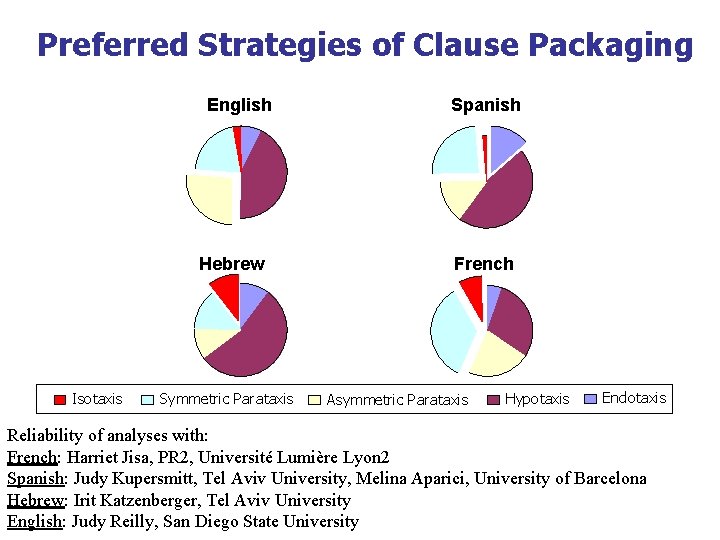
Preferred Strategies of Clause Packaging English Hebrew Isotaxis Symmetric Parataxis Spanish French Asymmetric Parataxis Hypotaxis Endotaxis Reliability of analyses with: French: Harriet Jisa, PR 2, Université Lumière Lyon 2 Spanish: Judy Kupersmitt, Tel Aviv University, Melina Aparici, University of Barcelona Hebrew: Irit Katzenberger, Tel Aviv University English: Judy Reilly, San Diego State University
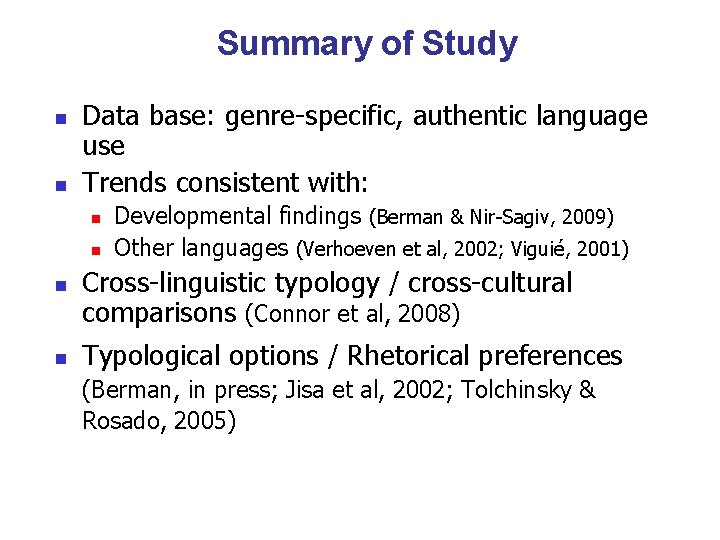
Summary of Study n n Data base: genre-specific, authentic language use Trends consistent with: n n Developmental findings (Berman & Nir-Sagiv, 2009) Other languages (Verhoeven et al, 2002; Viguié, 2001) Cross-linguistic typology / cross-cultural comparisons (Connor et al, 2008) Typological options / Rhetorical preferences (Berman, in press; Jisa et al, 2002; Tolchinsky & Rosado, 2005)
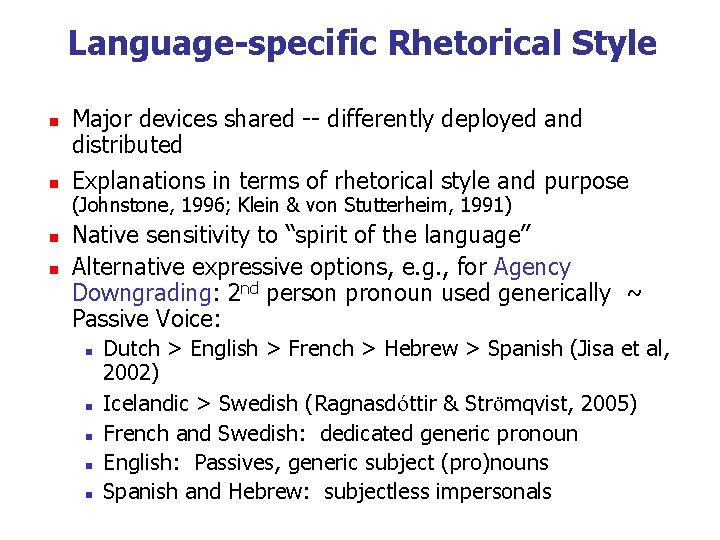
Language-specific Rhetorical Style n n Major devices shared -- differently deployed and distributed Explanations in terms of rhetorical style and purpose (Johnstone, 1996; Klein & von Stutterheim, 1991) n n Native sensitivity to “spirit of the language” Alternative expressive options, e. g. , for Agency Downgrading: 2 nd person pronoun used generically ~ Passive Voice: n n n Dutch > English > French > Hebrew > Spanish (Jisa et al, 2002) Icelandic > Swedish (Ragnasdóttir & Strömqvist, 2005) French and Swedish: dedicated generic pronoun English: Passives, generic subject (pro)nouns Spanish and Hebrew: subjectless impersonals
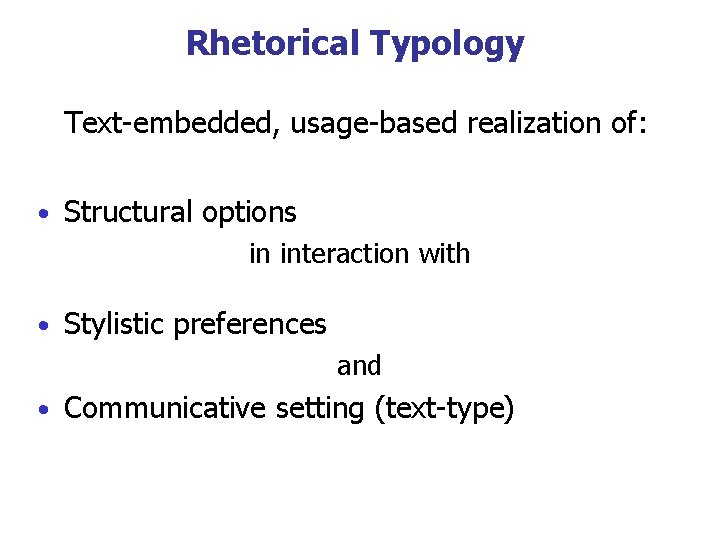
Rhetorical Typology Text-embedded, usage-based realization of: • Structural options in interaction with • Stylistic preferences and • Communicative setting (text-type)