
COMPLEX SUPPORT NEEDS Briefing David Coyne Branch Manager
COMPLEX SUPPORT NEEDS Briefing David Coyne Branch Manager Complex Support Needs ACT Snr Practitioner Presentation November 2019
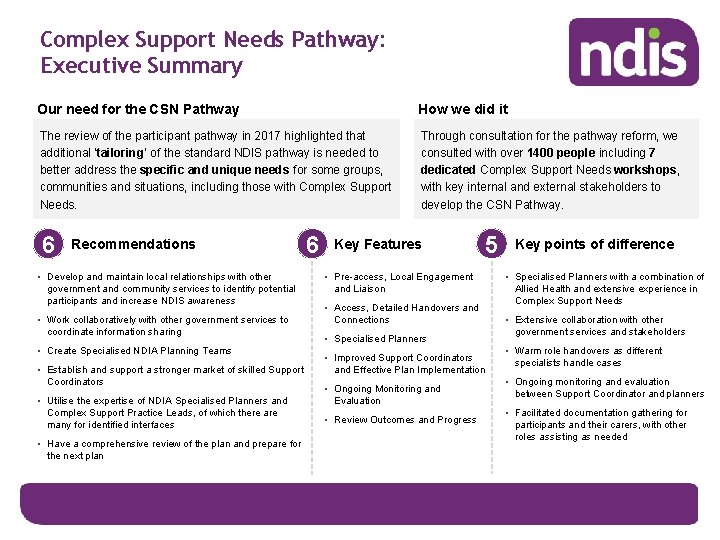
Complex Support Needs Pathway: Executive Summary Our need for the CSN Pathway How we did it The review of the participant pathway in 2017 highlighted that additional ‘tailoring’ of the standard NDIS pathway is needed to better address the specific and unique needs for some groups, communities and situations, including those with Complex Support Needs. Through consultation for the pathway reform, we consulted with over 1400 people including 7 dedicated Complex Support Needs workshops, with key internal and external stakeholders to develop the CSN Pathway. 6 Recommendations • Develop and maintain local relationships with other government and community services to identify potential participants and increase NDIS awareness • Work collaboratively with other government services to coordinate information sharing • Create Specialised NDIA Planning Teams • Establish and support a stronger market of skilled Support Coordinators • Utilise the expertise of NDIA Specialised Planners and Complex Support Practice Leads, of which there are many for identified interfaces • Have a comprehensive review of the plan and prepare for the next plan 6 Key Features 5 • Pre-access, Local Engagement and Liaison • Access, Detailed Handovers and Connections • Specialised Planners • Improved Support Coordinators and Effective Plan Implementation • Ongoing Monitoring and Evaluation • Review Outcomes and Progress Key points of difference • Specialised Planners with a combination of Allied Health and extensive experience in Complex Support Needs • Extensive collaboration with other government services and stakeholders • Warm role handovers as different specialists handle cases • Ongoing monitoring and evaluation between Support Coordinator and planners • Facilitated documentation gathering for participants and their carers, with other roles assisting as needed
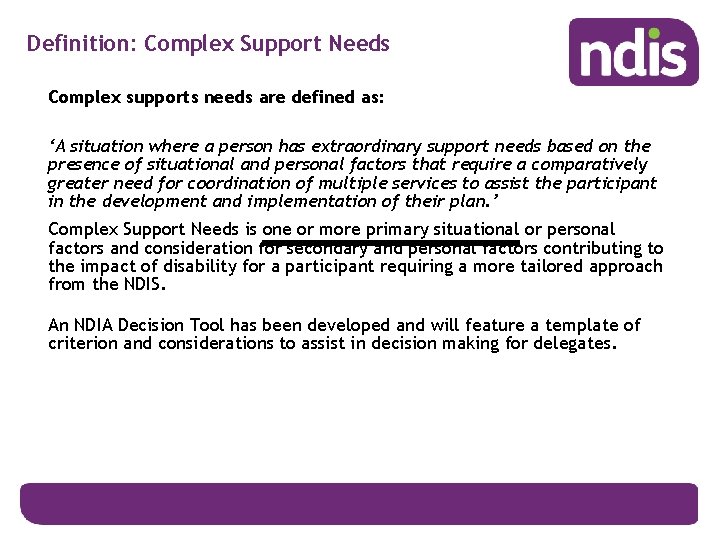
Definition: Complex Support Needs Complex supports needs are defined as: ‘A situation where a person has extraordinary support needs based on the presence of situational and personal factors that require a comparatively greater need for coordination of multiple services to assist the participant in the development and implementation of their plan. ’ Complex Support Needs is one or more primary situational or personal factors and consideration for secondary and personal factors contributing to the impact of disability for a participant requiring a more tailored approach from the NDIS. An NDIA Decision Tool has been developed and will feature a template of criterion and considerations to assist in decision making for delegates.

Definition: Complex Support Needs Primary Situational Factors Primary Personal Factors Voluntary or involuntary involvement in other government Identified Behaviours of Concern and/or Regulated Restrictive Practice. service systems, in particular health, child protection, guardianship orders, mental health and justice Hard to reach / difficulty engaging (including a significant psychosocial disability or someone who is Transitional supports for returning to community (leaving itinerant) rehab or hospital, incarceration etc. ) An immediate unmet need for targeted support or a crisis situation. Extraordinary challenges/barriers in regard to market or services Secondary Situational Factors Interaction with multiple government services or multiple community supports Insufficient formal (ie. advocate, guardian, nominee) and informal (ie. family member, carer, friend support) support to assist with decision making or engaging in planning including informal support context Minimal/or no informal supports Multiple family members with disability or a parent/carer with disability Secondary Personal Factors Multiple diagnosis Clinical complexity of disability A history of trauma or abuse Limited or no expressive communication
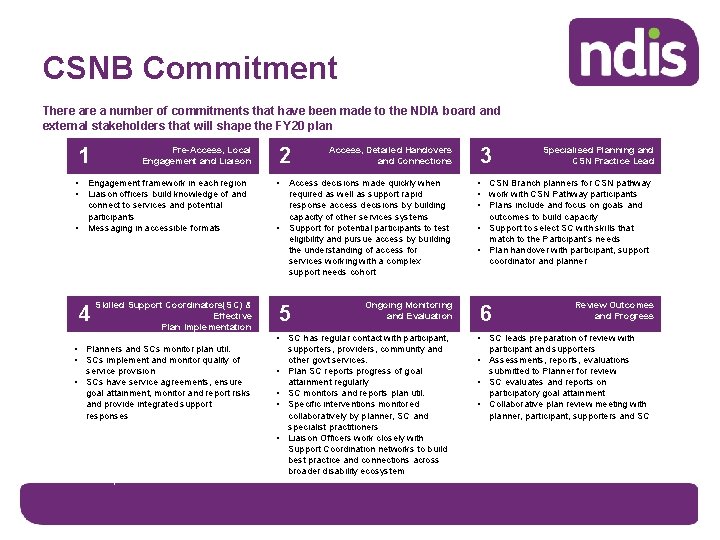
CSNB Commitment There a number of commitments that have been made to the NDIA board and external stakeholders that will shape the FY 20 plan 1 Pre-Access, Local Engagement and Liaison • Engagement framework in each region • Liaison officers build knowledge of and connect to services and potential participants • Messaging in accessible formats 4 Skilled Support Coordinators(SC) & Effective Plan Implementation 2 Access, Detailed Handovers and Connections • Access decisions made quickly when required as well as support rapid response access decisions by building capacity of other services systems • Support for potential participants to test eligibility and pursue access by building the understanding of access for services working with a complex support needs cohort 5 Ongoing Monitoring and Evaluation • SC has regular contact with participant, • Planners and SCs monitor plan util. • SCs implement and monitor quality of service provision • • SCs have service agreements, ensure goal attainment, monitor and report risks and provide integrated support responses • • • Source: April 2018 Board Presentation supporters, providers, community and other govt services. Plan SC reports progress of goal attainment regularly SC monitors and reports plan util. Specific interventions monitored collaboratively by planner, SC and specialist practitioners Liaison Officers work closely with Support Coordination networks to build best practice and connections across broader disability ecosystem 3 Specialised Planning and CSN Practice Lead • CSN Branch planners for CSN pathway • work with CSN Pathway participants • Plans include and focus on goals and outcomes to build capacity • Support to select SC with skills that match to the Participant’s needs • Plan handover with participant, support coordinator and planner 6 Review Outcomes and Progress • SC leads preparation of review with participant and supporters • Assessments, reports, evaluations submitted to Planner for review • SC evaluates and reports on participatory goal attainment • Collaborative plan review meeting with planner, participant, supporters and SC
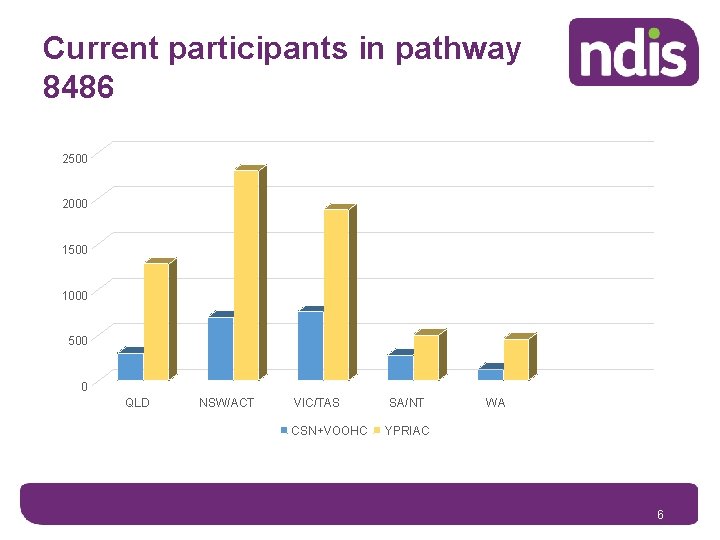
Current participants in pathway 8486 2500 2000 1500 1000 500 0 QLD NSW/ACT VIC/TAS CSN+VOOHC SA/NT WA YPRIAC 6
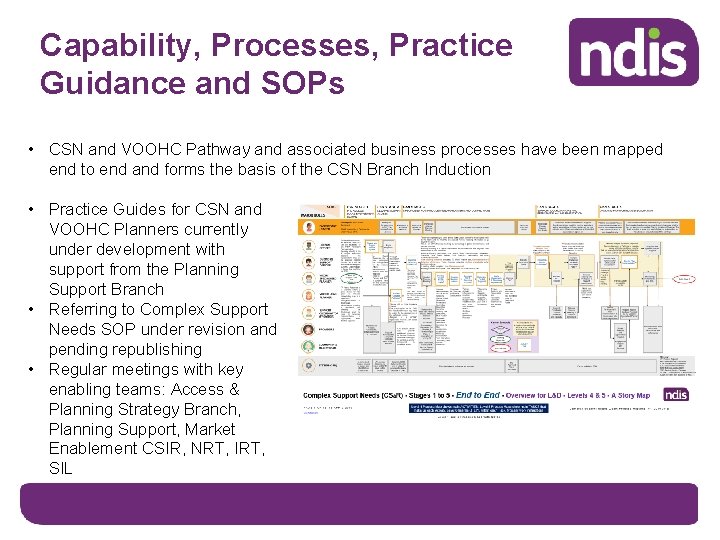
Capability, Processes, Practice Guidance and SOPs • CSN and VOOHC Pathway and associated business processes have been mapped end to end and forms the basis of the CSN Branch Induction • Practice Guides for CSN and VOOHC Planners currently under development with support from the Planning Support Branch • Referring to Complex Support Needs SOP under revision and pending republishing • Regular meetings with key enabling teams: Access & Planning Strategy Branch, Planning Support, Market Enablement CSIR, NRT, IRT, SIL
Health Liaison Officers The NDIA piloted the role of Health Liaison Officers to work with the SA Local Health Networks and key hospital staff to improve communication between SA Health and the NDIS in relation to hospital discharge. These roles assisted NDIS participants to move through the NDIS pathway whilst in hospital and were important contact officers for health staff to make connections with so that people requiring services through the NDIS can get timely access to them. The NDIA is now implementing these positions nationally. Health Liaison Officers will; • promote understanding of the NDIS within Health Services to support hospital discharge. This includes understanding the participant pathway from access to pre-planning, plan development and plan implementation. • promote awareness of the scope of supports and services provided through the NDIS. • connect with hospitals, acute and non acute health services to provide information and help through the NDIS pathway. • link directly with health clinicians and allied health professionals to provide support for planning, case conferences and information exchange. • build connections between existing government, mainstream and community services and the NDIA to ensure the right information is available for the planning process.
Justice Liaison Officers At a meeting on 9 October 2019 the Disability Reform Council endorsed the implementation of Justice Liaison Officers to respond to the concerns facing prisoners with disability and the navigation with NDIS. The scope of the NDIA designed Justice Liaison Officer role includes: • Connect with prisons and correctional facilities to promote understanding of the NDIS within justice interface to support prison entry and discharge and community transition. This includes understanding the participant pathway from access pre-planning, plan development and plan implementation. • Promote awareness of the scope of supports and services provided through the NDIS with key justice staff and stakeholders. • Build connections between existing government and community services and the NDIA to ensure the right information is available for the planning process. This is a critical component that enables collaborative pre-planning, planning and plan implementation regarding which pathway the participant goes into. • Work collaboratively with Local Area Coordinators and Planners where appropriate as the participant moves through the pathway. This includes providing a detailed handover to LACs and Planners and supporting plan implementation and providing immediate support where a rapid response is required. The benefit of this will ensure timely resolution and communications between all stakeholders to support plan outcomes • Provide strategic advice to the broader NDIA including Scheme Policy, Service Delivery and Learning and Development on improving the capability of NDIS representatives while interacting with the justice interface.
CSN Interim Evaluation Following the initial roll out of the CSNP in November 2018, an interim evaluation report has been completed (covering the commencement sites in Vic and NSW) examining the following: Participant experience Specialised Planner capability development and applied learning Progress towards Complex Support Needs pathway objectives A copy of the interim evaluation report was provided to the CSN Working Group noting that the document is not public and not for further distribution. Early insights and observations, so far indicate there has been a positive impact for participants. Although limited, the participant/carer feedback demonstrates participants and carers highly value and appreciate the quality of support provided in the CSNP. In addition, the feedback gathered highlighted: Positive feedback has been received from both internal NDIA Service Delivery networks and state and territory governments in relation to the responsiveness and emerging participant outcomes; Participants are feeling more supported and listened to, more comfortable with the planning discussion and the opportunity to ask questions, and are appreciative of the skills and approach by specialised planners;
CSN Interim Evaluation Participants are feeling more supported and listened to, more comfortable with the planning discussion and the opportunity to ask questions, and are appreciative of the skills and approach by specialised planners Early feedback from staff training demonstrates they are feeling confident to apply the new skills and knowledge they have gained. The NDIA is currently undertaking a more fulsome evaluation of the CSNP that will involve additional participant surveys and interviews, as well as service partner focus groups that will include mainstream service providers such as justice, health and child protection.
- Slides: 11