
Complex Sentences Starter What is a clause Learning
- Slides: 40
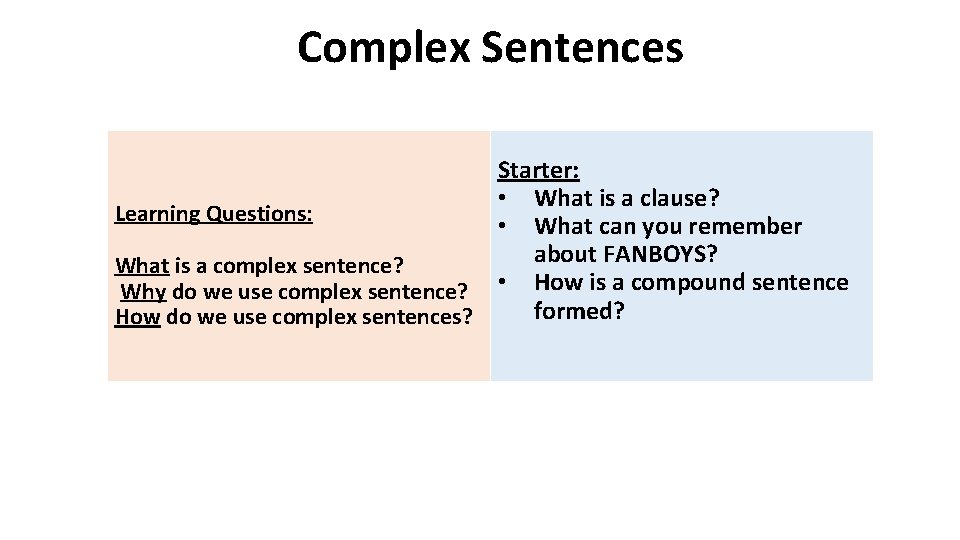
Complex Sentences Starter: • What is a clause? Learning Questions: • What can you remember about FANBOYS? What is a complex sentence? Why do we use complex sentence? • How is a compound sentence formed? How do we use complex sentences?
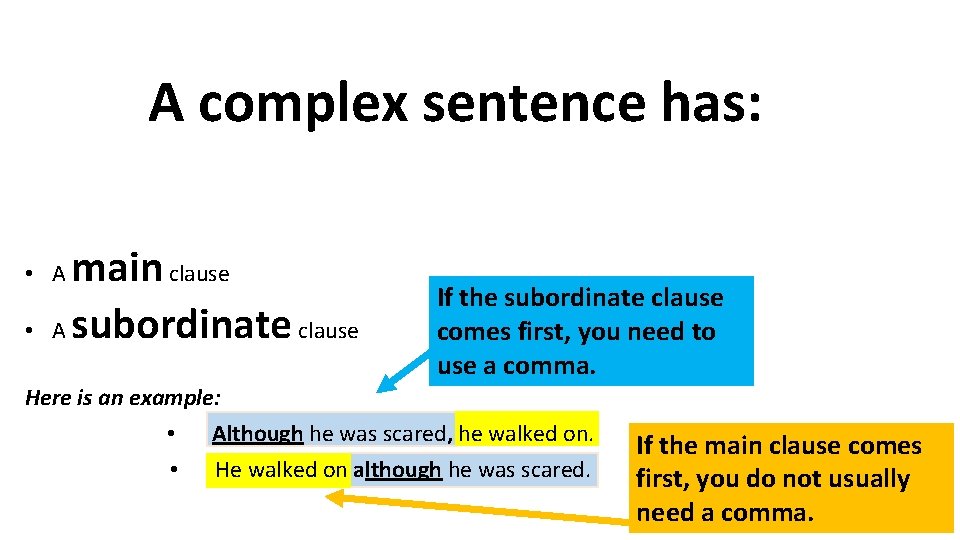
A complex sentence has: The main clause makes sense on its own. It is • A main clause usually a simple sentence. If the subordinate clause • A subordinate clause comes first, you need to use a comma. The subordinate clause Here is an example: does not. It gives more • Although he was scared, he walked on. information If the mainabout clausethe comes • He walked on although he was scared. main first, clause. you do not usually need a comma.
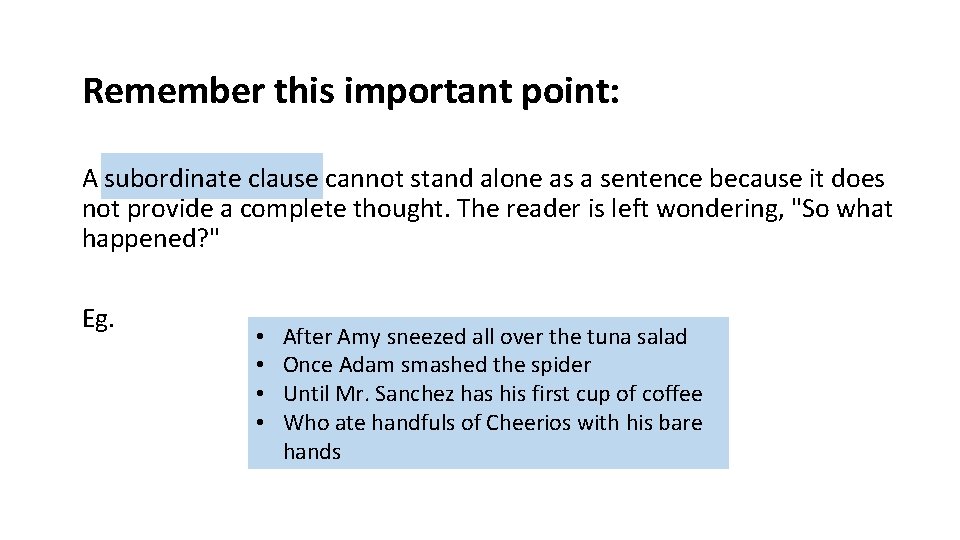
Remember this important point: A subordinate clause cannot stand alone as a sentence because it does not provide a complete thought. The reader is left wondering, "So what happened? " Eg. • • After Amy sneezed all over the tuna salad Once Adam smashed the spider Until Mr. Sanchez has his first cup of coffee Who ate handfuls of Cheerios with his bare hands
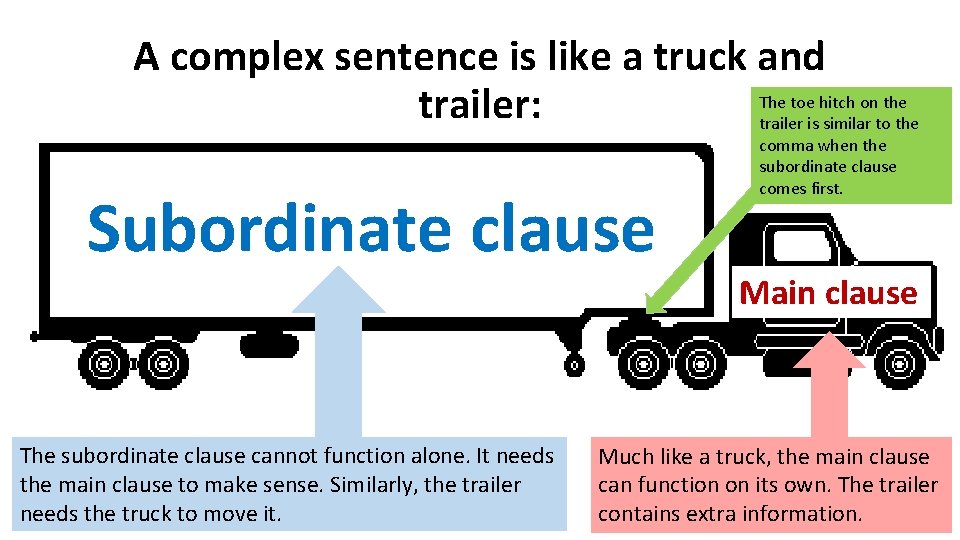
A complex sentence is like a truck and The toe hitch on the trailer: trailer is similar to the Subordinate clause The subordinate clause cannot function alone. It needs the main clause to make sense. Similarly, the trailer needs the truck to move it. comma when the subordinate clause comes first. Main clause Much like a truck, the main clause can function on its own. The trailer contains extra information.
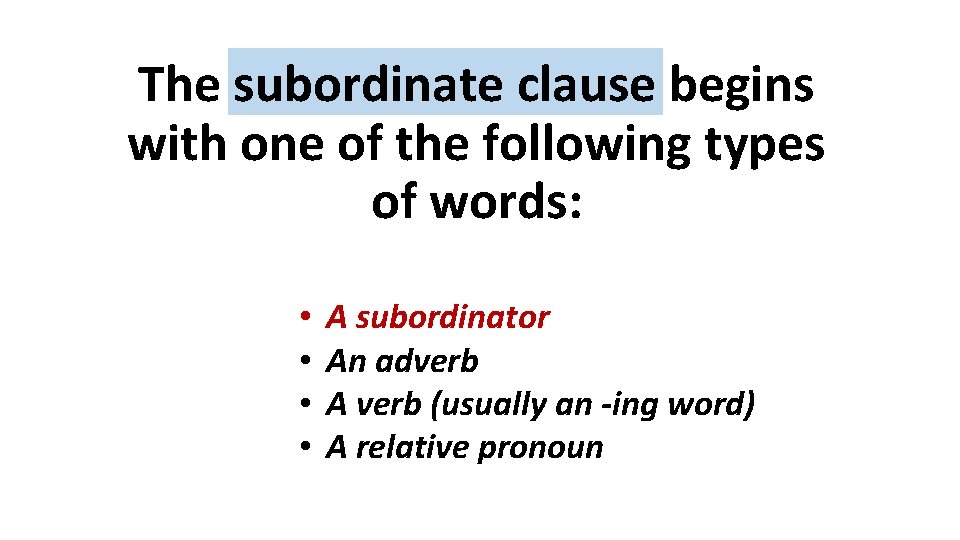
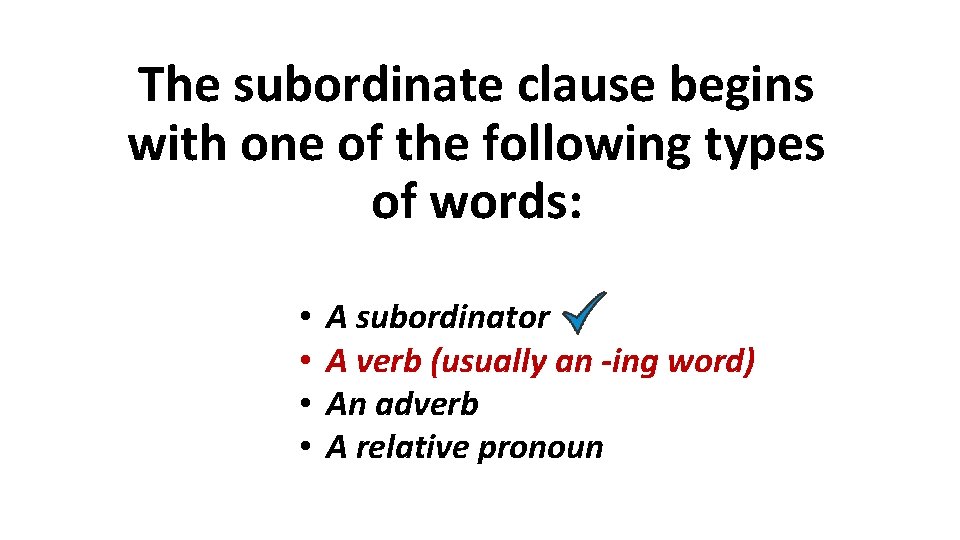
The subordinate clause begins with one of the following types of words: • • A subordinator An adverb A verb (usually an -ing word) A relative pronoun
How do we use subordinators to form subordinate clauses?
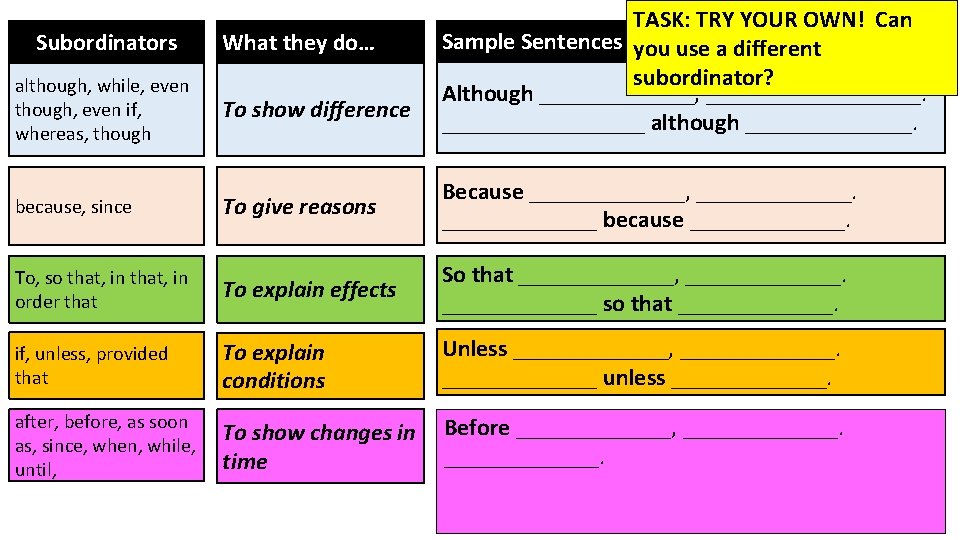
Subordinators although, while, even though, even if, whereas, though What they do… To show difference TASK: TRY YOUR OWN! Can Sample Sentences you use a different subordinator? Although _______, he was scared, he_________. walked on. He walked on although _________ although he was _______. scared. To give reasons Because _______, I listen in lessons, _______. I will become wise _______ because _______. I listen in lessons. To, so that, in order that To explain effects So that _______, I get a good job, I_______. will work hard. I will work hard so _______ sothat. I_______. get a good job. if, unless, provided that To explain conditions Unless _______, we work hard, we_______. will struggle. We will struggle unless _______ we work hard. after, before, as soon as, since, when, while, until, To show changes in time Before _______, you leave today, check _______. that you have underlined your title. _______. Check that you have underlined your title before you leave today. because, since
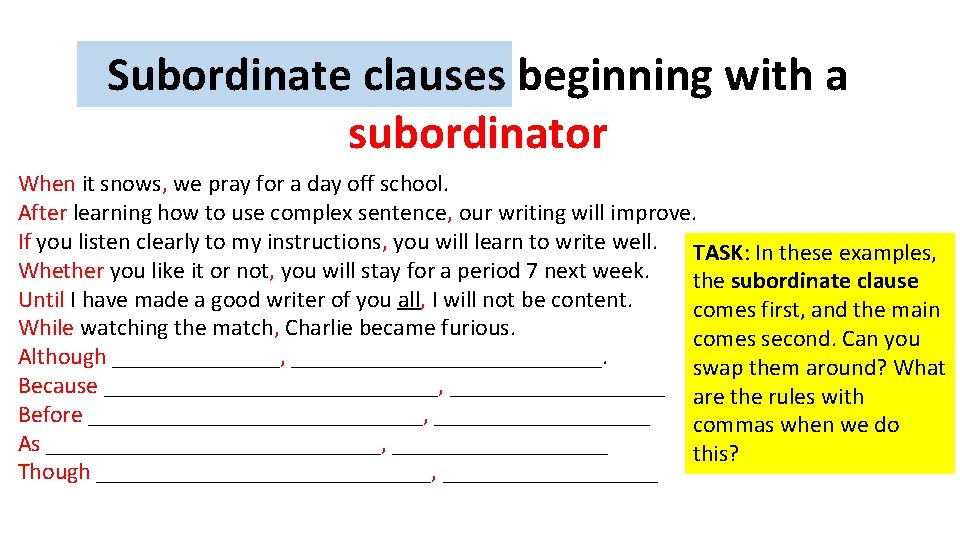
Subordinate clauses beginning with a subordinator When it snows, we pray for a day off school. After learning how to use complex sentence, our writing will improve. If you listen clearly to my instructions, you will learn to write well. TASK: In these examples, Whether you like it or not, you will stay for a period 7 next week. the subordinate clause Until I have made a good writer of you all, I will not be content. comes first, and the main While watching the match, Charlie became furious. comes second. Can you Although _______, _____________. swap them around? What Because ______________, _________ are the rules with Before ______________, _________ commas when we do As ______________, _________ this? Though ______________, _________
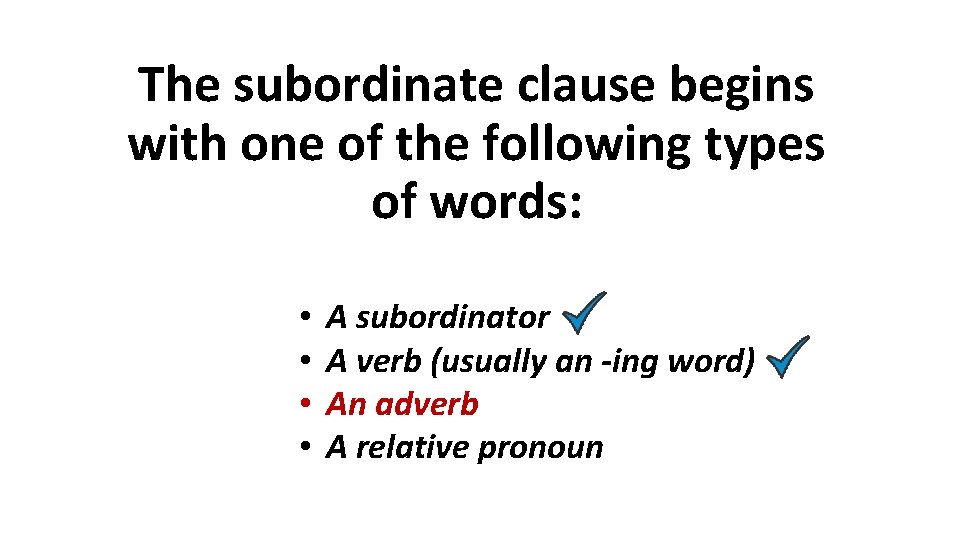
The subordinate clause begins with one of the following types of words: • • A subordinator A verb (usually an -ing word) An adverb A relative pronoun
How do we use verb -ing words to form subordinate clauses?
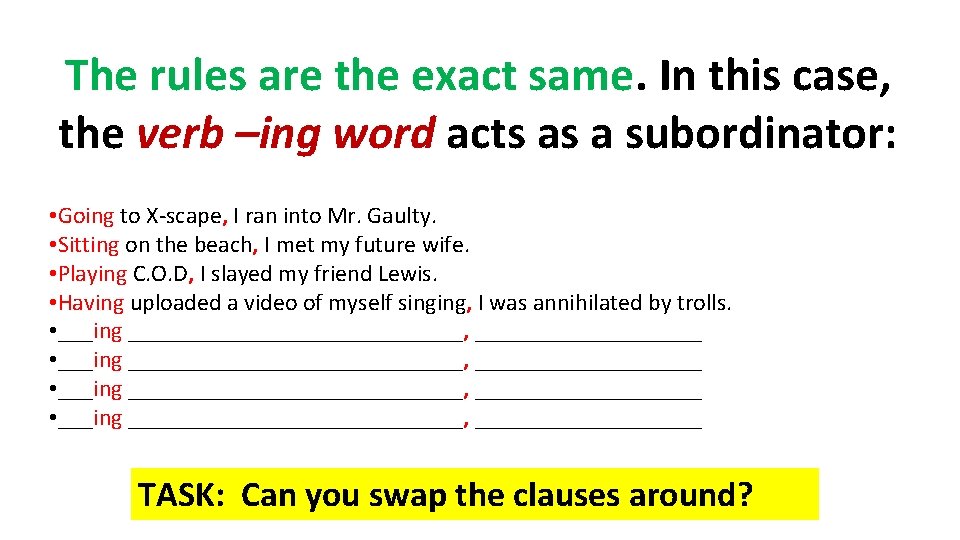
The rules are the exact same. In this case, the verb –ing word acts as a subordinator: • Going to X-scape, I ran into Mr. Gaulty. • Sitting on the beach, I met my future wife. • Playing C. O. D, I slayed my friend Lewis. • Having uploaded a video of myself singing, I was annihilated by trolls. • ___ing ____________________________, ___________________ TASK: Can you swap the clauses around?
The subordinate clause begins with one of the following types of words: • • A subordinator A verb (usually an -ing word) An adverb A relative pronoun
How do we use adverbs to form subordinate clauses?
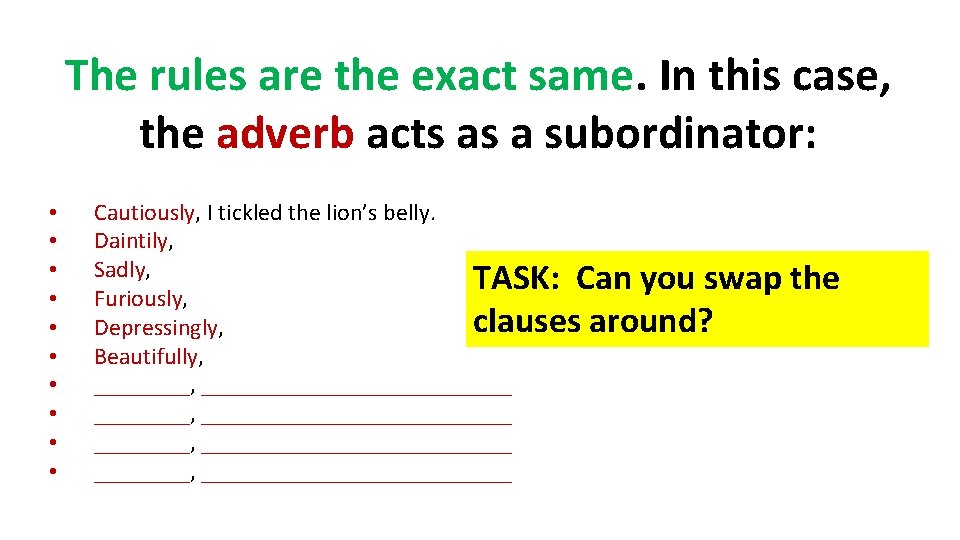
The rules are the exact same. In this case, the adverb acts as a subordinator: • • • Cautiously, I tickled the lion’s belly. Daintily, Sadly, TASK: Can you swap Furiously, clauses around? Depressingly, Beautifully, __________________________, _________________, _____________ the
The subordinate clause begins with one of the following types of words: • • A subordinator A verb (usually an -ing word) An adverb A relative pronoun
How do we use relative pronouns to form subordinate clauses? These are tricky. e ativ s Rel noun pro
When we use relative pronouns to form subordinate clauses, they are also referred to as relative clauses.
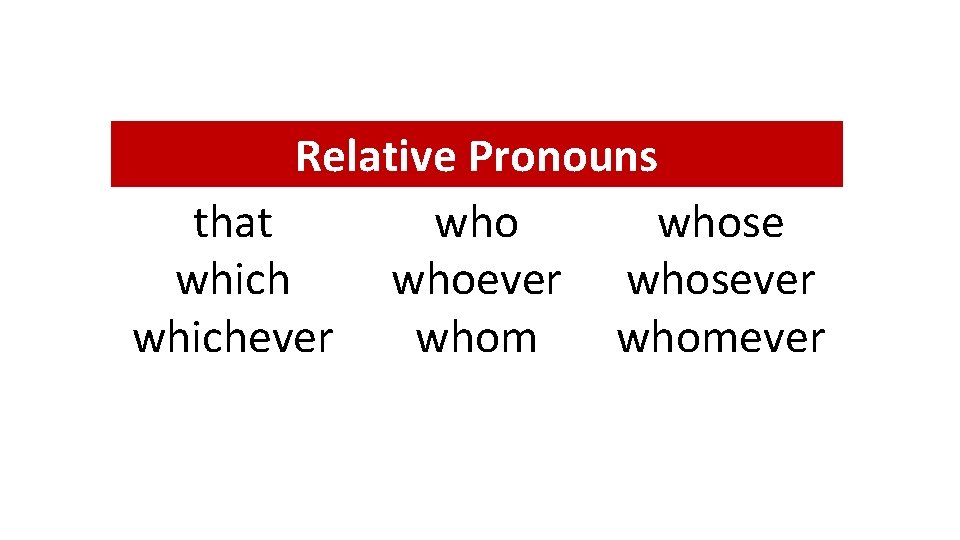
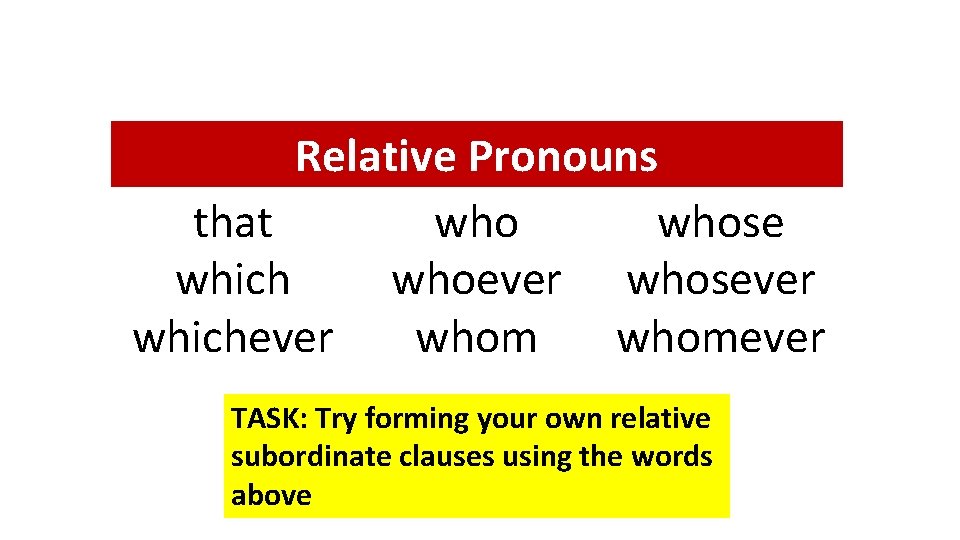
Relative Pronouns that whose which whoever whosever whichever whomever
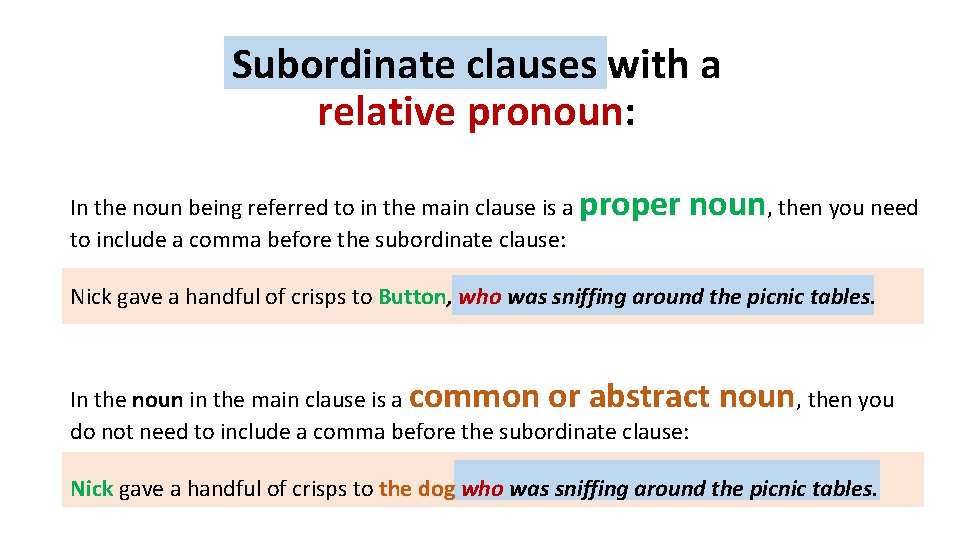
Subordinate clauses with a relative pronoun: In the noun being referred to in the main clause is a proper to include a comma before the subordinate clause: noun, then you need Nick gave a handful of crisps to Button, who was sniffing around the picnic tables. In the noun in the main clause is a common or abstract do not need to include a comma before the subordinate clause: noun, then you Nick gave a handful of crisps to the dog who was sniffing around the picnic tables.
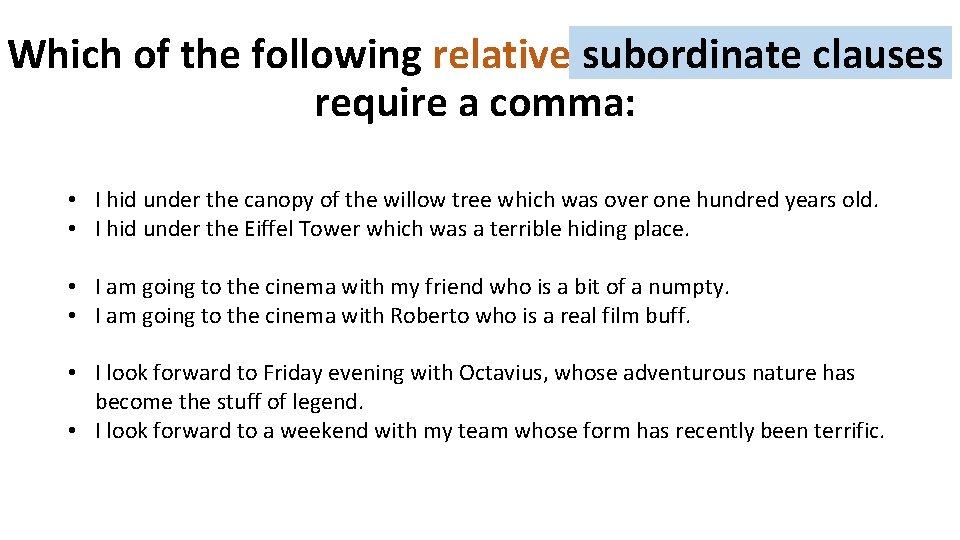
Which of the following relative subordinate clauses require a comma: • I hid under the canopy of the willow tree which was over one hundred years old. • I hid under the Eiffel Tower which was a terrible hiding place. • I am going to the cinema with my friend who is a bit of a numpty. • I am going to the cinema with Roberto who is a real film buff. • I look forward to Friday evening with Octavius, whose adventurous nature has become the stuff of legend. • I look forward to a weekend with my team whose form has recently been terrific.
Relative Pronouns that whose which whoever whosever whichever whomever TASK: Try forming your own relative subordinate clauses using the words above
The subordinate clause begins with one of the following types of words: • • A subordinator A verb (usually an -ing word) An adverb A relative pronoun
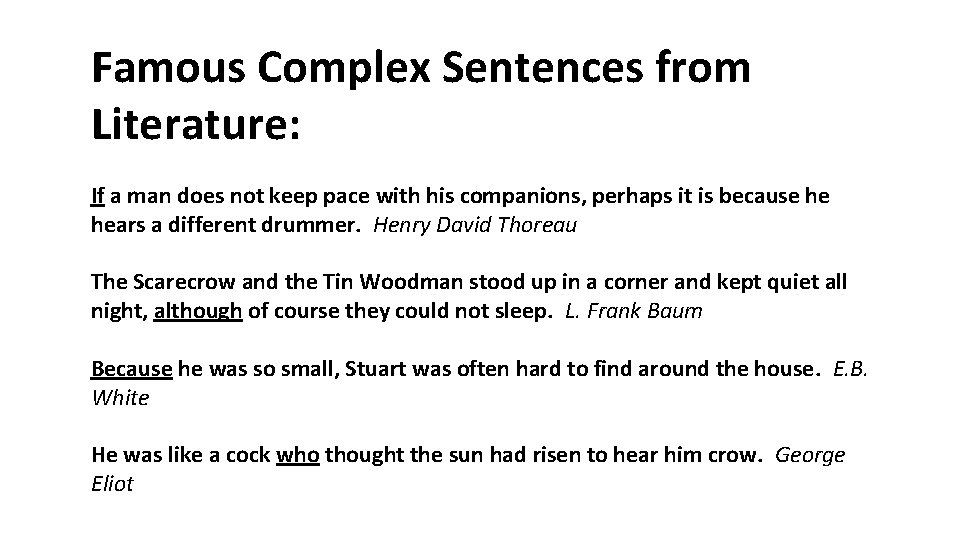
Famous Complex Sentences from Literature: If a man does not keep pace with his companions, perhaps it is because he hears a different drummer. Henry David Thoreau The Scarecrow and the Tin Woodman stood up in a corner and kept quiet all night, although of course they could not sleep. L. Frank Baum Because he was so small, Stuart was often hard to find around the house. E. B. White He was like a cock who thought the sun had risen to hear him crow. George Eliot
Complex Sentences Learning Questions: What is a complex sentence? Why do we use complex sentence? How do we use complex sentences?
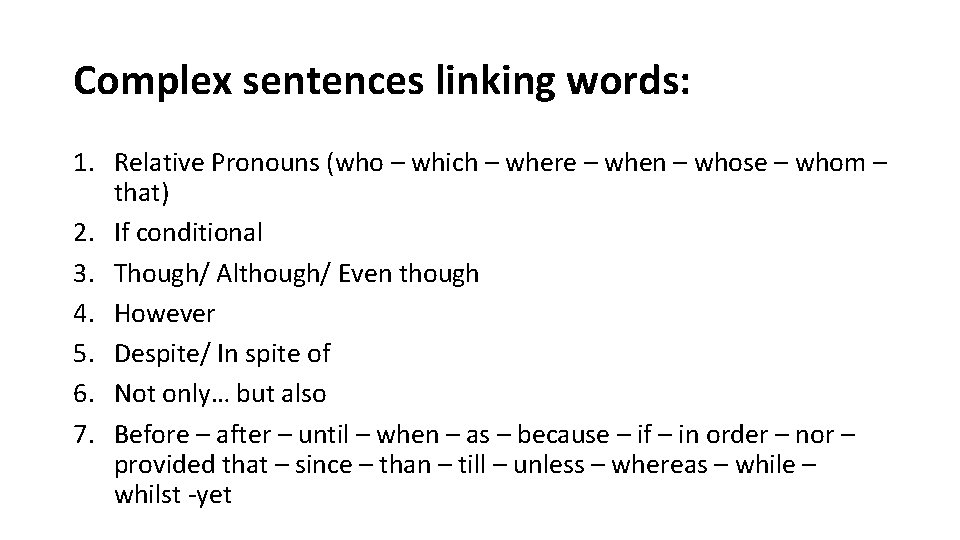
Complex sentences linking words: 1. Relative Pronouns (who – which – where – when – whose – whom – that) 2. If conditional 3. Though/ Although/ Even though 4. However 5. Despite/ In spite of 6. Not only… but also 7. Before – after – until – when – as – because – if – in order – nor – provided that – since – than – till – unless – whereas – while – whilst -yet
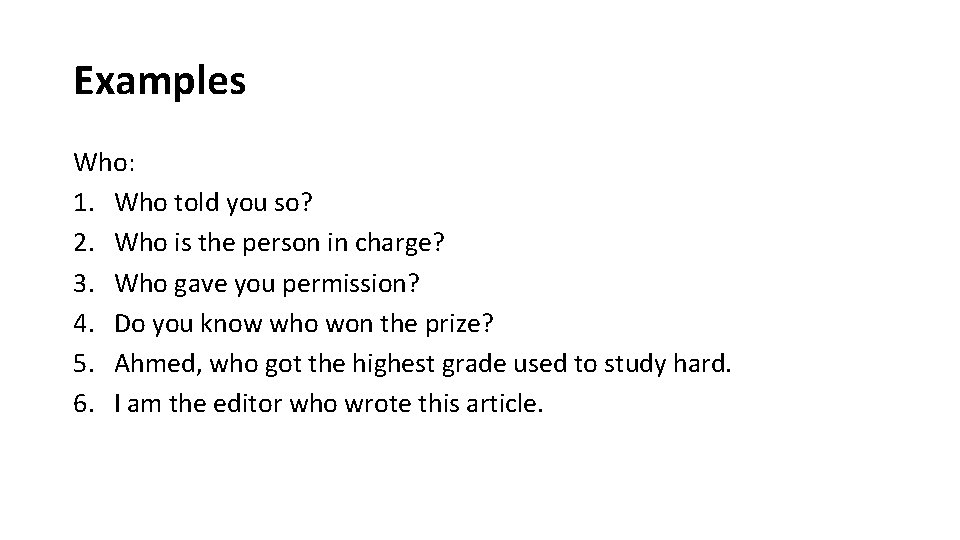
Examples Who: 1. Who told you so? 2. Who is the person in charge? 3. Who gave you permission? 4. Do you know who won the prize? 5. Ahmed, who got the highest grade used to study hard. 6. I am the editor who wrote this article.
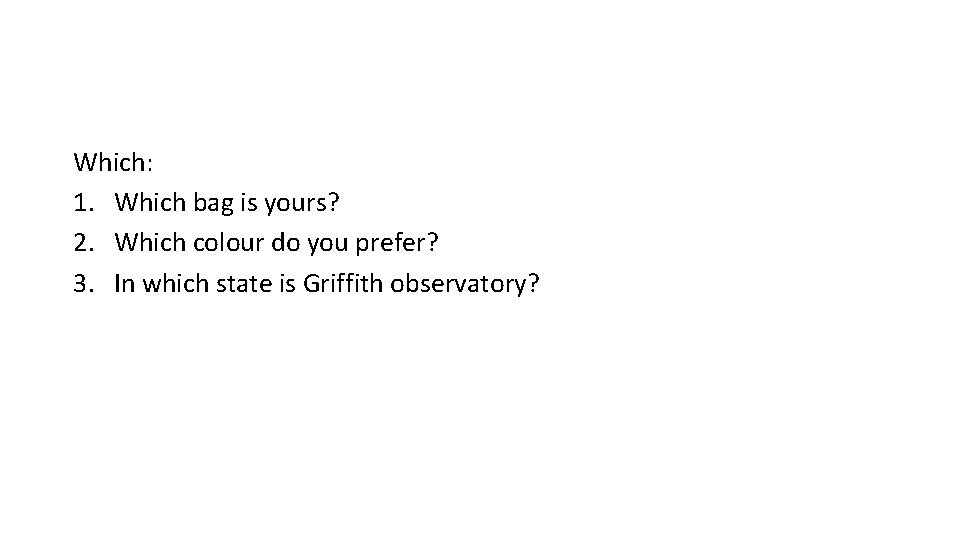
Which: 1. Which bag is yours? 2. Which colour do you prefer? 3. In which state is Griffith observatory?
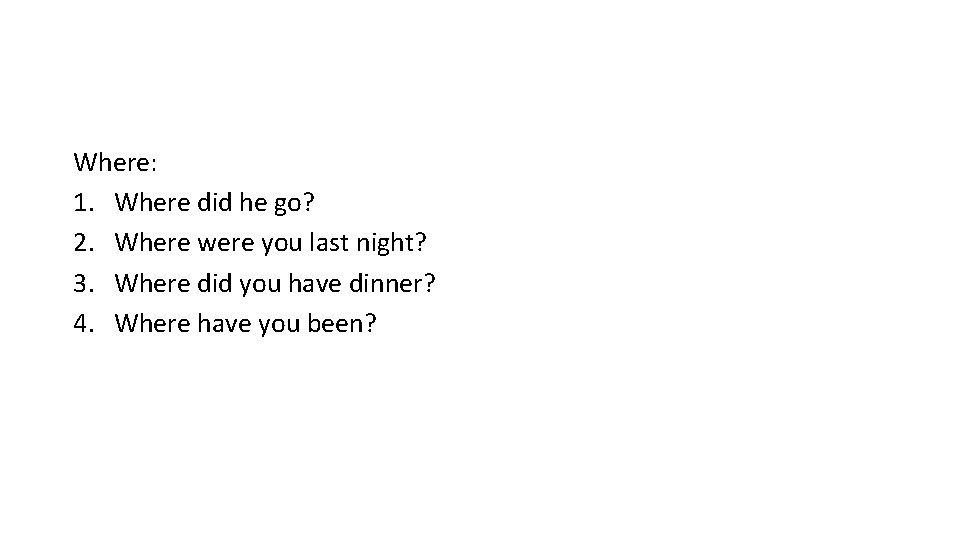
Where: 1. Where did he go? 2. Where were you last night? 3. Where did you have dinner? 4. Where have you been?
When: 1. When will I see you again? 2. When was that? 3. I cannot remember when I saw you last.
Whose: 1. Whose car is this? 2. Whose cell phone keeps ringing? 3. Whose dog is barking outside? 4. She knew the family whose house we bought.
Whom: 1. He hired the engineer whom he interviewed yesterday. 2. With whom am I speaking?
That: 1. Is that the dish you told me about? 2. Who is that new girl? 3. That is not the right way to the stadium.
If conditional: 1. If you study hard, you will pass the exam. 2. He told me to call him if I want to go to the party with him.
Though/ although / even though: 1. Although I was very sick, I went to school. 2. He still painted on the wall though I shouted at him. 3. Even though the weather was sunny, I wore a jacket.
However: 1. My stomach was full however, there was still room for dessert.
Despite/ in spite of: 1. Despite the fact that there were several terrorist attacks in Paris, I still want to go there during the Summer vacation. 2. She still watched the movie in spite of how many times I complained to her about how boring it is.
Not only. . But also: 1. Not only do I intend to major in Chemistry, but I also want to minor in Physics.
Before – after – until – when – as – because – if – in order – nor – provided that – since – than – till – unless – whereas – while – whilst –yet: 1. I woke up right before my alarm rang. 2. I want to go to the club after school. 3. Until? 4. Call me when you get home safe. 5. As happy as a pig rolling the mud. 6. She got an A because she studied hard.
7. ‘’In order to succeed, your desire to succeed has to be greater than you fear of failure’’ 8. I do not want to eat neither fish nor chicken. 9. Provided that? 10. Ever since I left the city, you have been on my mind. 11. ‘’You are stronger than you think you are’’ 12. Till? 13. Do not call me unless you have good news.
14. Mom told me to wear the black dress whereas my sister suggested I wear the pink one. 15. Leave while I am not looking. 16. Whilst? 17. Yet?