
Complex Rocket Design Considerations HPR Staging Air Starting
- Slides: 30
Complex Rocket Design Considerations HPR Staging & Air Starting By Gary Stroick
Agenda 1. 2. 3. 4. 5. Tripoli Safety Code Technical Considerations Clusters/Air Starts Staging Summary © 2012 Off We Go Rocketry, LLC 2
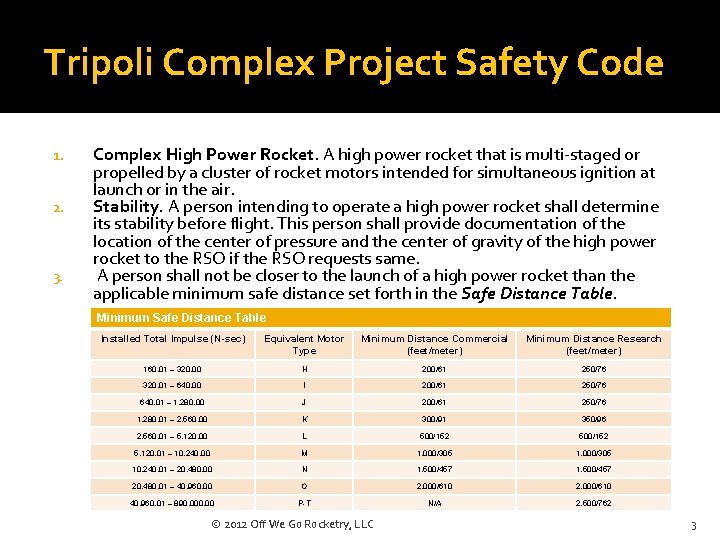
Tripoli Complex Project Safety Code 1. 2. 3. Complex High Power Rocket. A high power rocket that is multi-staged or propelled by a cluster of rocket motors intended for simultaneous ignition at launch or in the air. Stability. A person intending to operate a high power rocket shall determine its stability before flight. This person shall provide documentation of the location of the center of pressure and the center of gravity of the high power rocket to the RSO if the RSO requests same. A person shall not be closer to the launch of a high power rocket than the applicable minimum safe distance set forth in the Safe Distance Table. Minimum Safe Distance Table Installed Total Impulse (N-sec) Equivalent Motor Type Minimum Distance Commercial (feet/meter) Minimum Distance Research (feet/meter) 160. 01 – 320. 00 H 200/61 250/76 320. 01 – 640. 00 I 200/61 250/76 640. 01 – 1, 280. 00 J 200/61 250/76 1, 280. 01 – 2, 560. 00 K 300/91 350/96 2, 560. 01 – 5, 120. 00 L 500/152 5, 120. 01 – 10, 240. 00 M 1, 000/305 10, 240. 01 – 20, 480. 00 N 1, 500/457 20, 480. 01 – 40, 960. 00 O 2, 000/610 40, 960. 01 – 890, 000. 00 P-T N/A 2, 500/762 © 2012 Off We Go Rocketry, LLC 3
General Technical Considerations �Motor Selection (Air Start, Cluster or Multi Stage) Propellant Type ▪ Avoid Hard Starting Motors (e. g. Greens)! ▪ Aero. Tech ▪ Blue Thunder ▪ White Lightning ▪ Cesaroni ▪ Black pellet design permits use of all propellant types ( 54 mm) Core Size ▪ Smaller is Better (e. g. usually implies easier starting) © 2012 Off We Go Rocketry, LLC 4
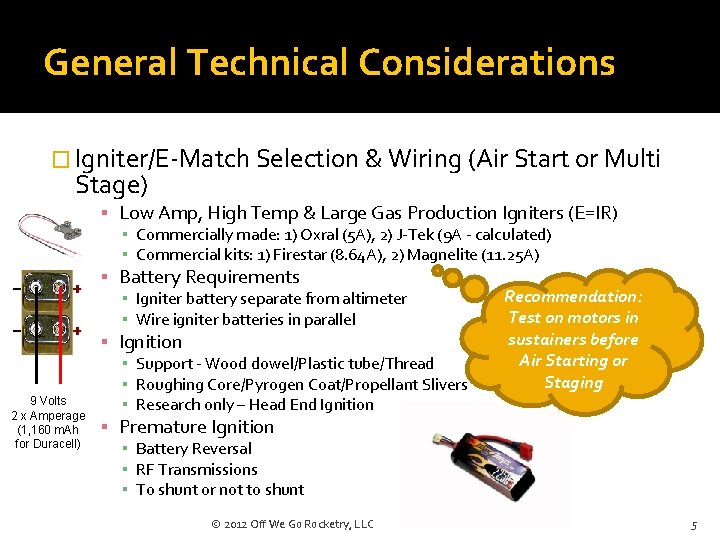
General Technical Considerations � Igniter/E-Match Selection & Wiring (Air Start or Multi Stage) ▪ Low Amp, High Temp & Large Gas Production Igniters (E=IR) ▪ Commercially made: 1) Oxral (5 A), 2) J-Tek (9 A - calculated) ▪ Commercial kits: 1) Firestar (8. 64 A), 2) Magnelite (11. 25 A) ▪ Battery Requirements ▪ Igniter battery separate from altimeter ▪ Wire igniter batteries in parallel ▪ Ignition 9 Volts 2 x Amperage (1, 160 m. Ah for Duracell) ▪ Support - Wood dowel/Plastic tube/Thread ▪ Roughing Core/Pyrogen Coat/Propellant Slivers ▪ Research only – Head End Ignition Recommendation: Test on motors in sustainers before Air Starting or Staging ▪ Premature Ignition ▪ Battery Reversal ▪ RF Transmissions ▪ To shunt or not to shunt © 2012 Off We Go Rocketry, LLC 5
Staging �Why? �Design Considerations �Simulation Techniques �Altimeter Requirements & Programming �Launch Preparation © 2012 Off We Go Rocketry, LLC 6
Why Stage? �Additional set of challenges at current cert. level Multiple flight profiles Multiple deployments Combined and individual stability profiles Combination of multiple motor types Construction challenges ▪ Sustainer/Booster coupling ▪ Electronics driven ignition © 2012 Off We Go Rocketry, LLC 7
What can go Wrong? � � Failure Modes (non-exhaustive) Stage ignition failure Late stage ignition Coupler malfunction Early, late or no deployment Non-vertical flight (horizontal, loops, powered descent, …) Coupler Failure Issues (Tolerance, Strength, …) Shred Deployment issues Resultant Flight Profile ▪ ▪ ▪ Motor ignition after parachute deployment Parachute deployment during motor burn Zippering Stripping parachute Negative Altitude Records (i. e. , Core Sampling ) Estimated altitude not reached © 2012 Off We Go Rocketry, LLC 8
Staging – Design Considerations � Inline Staging (Single Sustainer) Vertically stacked boosters and sustainer Each booster is discarded after motor burnout � Parallel Staging (Single Sustainer) Similar to Air Starting Boosters are externally attached to the sustainer Each booster separates from the sustainer after its motor burns out � Parasite Staging (Multiple Sustainers) Similar to Air Starting Sustainers are externally attached to the booster Each sustainer separates after booster burn out © 2012 Off We Go Rocketry, LLC 9
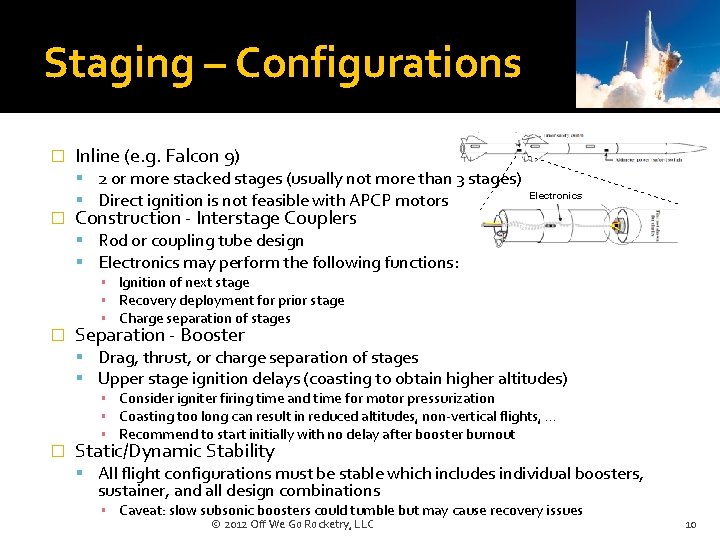
Staging – Configurations � � Inline (e. g. Falcon 9) 2 or more stacked stages (usually not more than 3 stages) Direct ignition is not feasible with APCP motors Electronics Construction - Interstage Couplers Rod or coupling tube design Electronics may perform the following functions: � ▪ Ignition of next stage ▪ Recovery deployment for prior stage ▪ Charge separation of stages Separation - Booster Drag, thrust, or charge separation of stages Upper stage ignition delays (coasting to obtain higher altitudes) � ▪ Consider igniter firing time and time for motor pressurization ▪ Coasting too long can result in reduced altitudes, non-vertical flights, … ▪ Recommend to start initially with no delay after booster burnout Static/Dynamic Stability All flight configurations must be stable which includes individual boosters, sustainer, and all design combinations ▪ Caveat: slow subsonic boosters could tumble but may cause recovery issues © 2012 Off We Go Rocketry, LLC 10
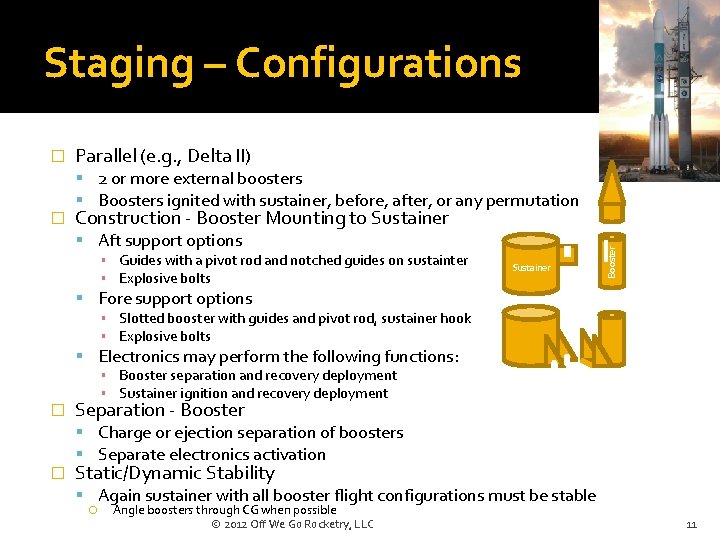
Staging – Configurations � Parallel (e. g. , Delta II) 2 or more external boosters Boosters ignited with sustainer, before, after, or any permutation Construction - Booster Mounting to Sustainer Aft support options ▪ Guides with a pivot rod and notched guides on sustainter ▪ Explosive bolts Sustainer Booster � Fore support options ▪ Slotted booster with guides and pivot rod, sustainer hook ▪ Explosive bolts Electronics may perform the following functions: � � ▪ Booster separation and recovery deployment ▪ Sustainer ignition and recovery deployment Separation - Booster Charge or ejection separation of boosters Separate electronics activation Static/Dynamic Stability Again sustainer with all booster flight configurations must be stable Angle boosters through CG when possible © 2012 Off We Go Rocketry, LLC 11
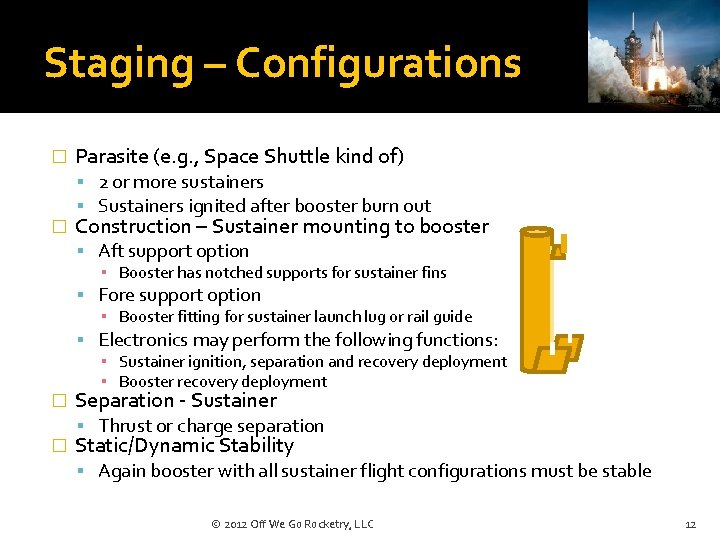
Staging – Configurations � � Parasite (e. g. , Space Shuttle kind of) 2 or more sustainers Sustainers ignited after booster burn out Construction – Sustainer mounting to booster Aft support option ▪ Booster has notched supports for sustainer fins Fore support option ▪ Booster fitting for sustainer launch lug or rail guide Electronics may perform the following functions: � � ▪ Sustainer ignition, separation and recovery deployment ▪ Booster recovery deployment Separation - Sustainer Thrust or charge separation Static/Dynamic Stability Again booster with all sustainer flight configurations must be stable © 2012 Off We Go Rocketry, LLC 12
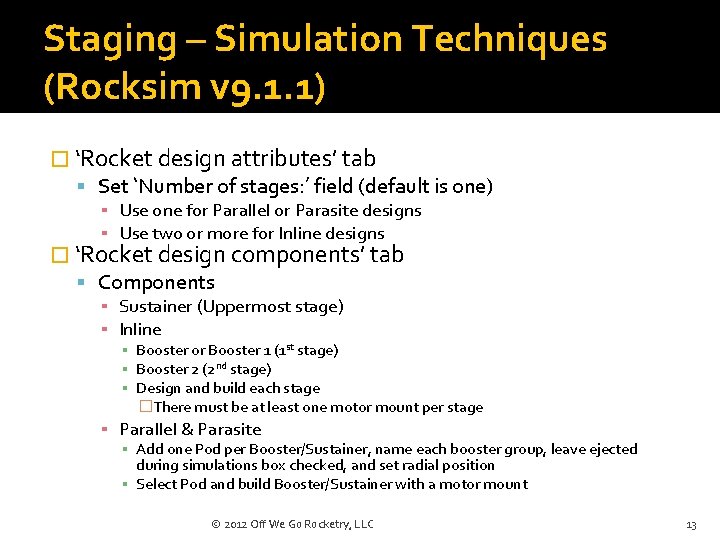
Staging – Simulation Techniques (Rocksim v 9. 1. 1) � ‘Rocket design attributes’ tab Set ‘Number of stages: ’ field (default is one) ▪ Use one for Parallel or Parasite designs ▪ Use two or more for Inline designs � ‘Rocket design components’ tab Components ▪ Sustainer (Uppermost stage) ▪ Inline ▪ Booster or Booster 1 (1 st stage) ▪ Booster 2 (2 nd stage) ▪ Design and build each stage �There must be at least one motor mount per stage ▪ Parallel & Parasite ▪ Add one Pod per Booster/Sustainer, name each booster group, leave ejected during simulations box checked, and set radial position ▪ Select Pod and build Booster/Sustainer with a motor mount © 2012 Off We Go Rocketry, LLC 13
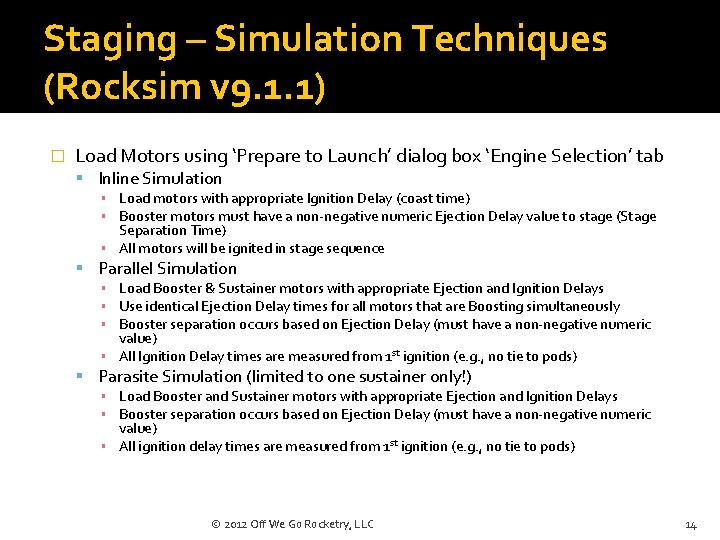
Staging – Simulation Techniques (Rocksim v 9. 1. 1) � Load Motors using ‘Prepare to Launch’ dialog box ‘Engine Selection’ tab Inline Simulation ▪ Load motors with appropriate Ignition Delay (coast time) ▪ Booster motors must have a non-negative numeric Ejection Delay value to stage (Stage Separation Time) ▪ All motors will be ignited in stage sequence Parallel Simulation ▪ Load Booster & Sustainer motors with appropriate Ejection and Ignition Delays ▪ Use identical Ejection Delay times for all motors that are Boosting simultaneously ▪ Booster separation occurs based on Ejection Delay (must have a non-negative numeric value) ▪ All Ignition Delay times are measured from 1 st ignition (e. g. , no tie to pods) Parasite Simulation (limited to one sustainer only!) ▪ Load Booster and Sustainer motors with appropriate Ejection and Ignition Delays ▪ Booster separation occurs based on Ejection Delay (must have a non-negative numeric value) ▪ All ignition delay times are measured from 1 st ignition (e. g. , no tie to pods) © 2012 Off We Go Rocketry, LLC 14
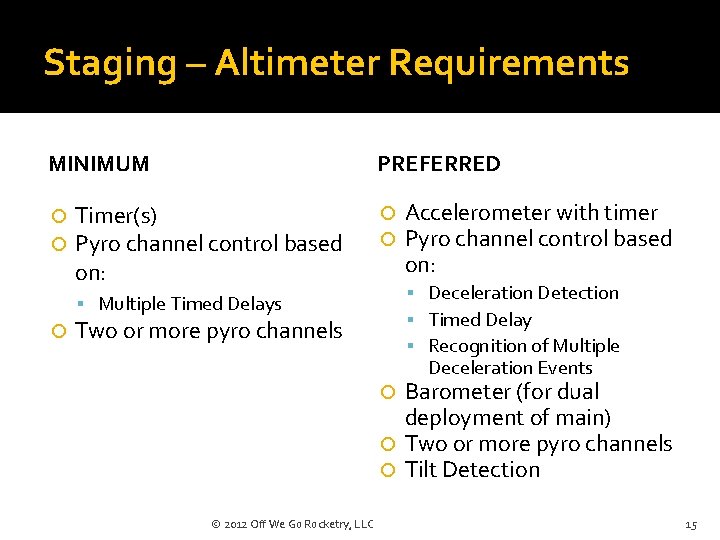
Staging – Altimeter Requirements MINIMUM PREFERRED Timer(s) Pyro channel control based on: Deceleration Detection Timed Delay Recognition of Multiple Timed Delays Accelerometer with timer Pyro channel control based on: Two or more pyro channels Deceleration Events Barometer (for dual deployment of main) Two or more pyro channels Tilt Detection © 2012 Off We Go Rocketry, LLC 15
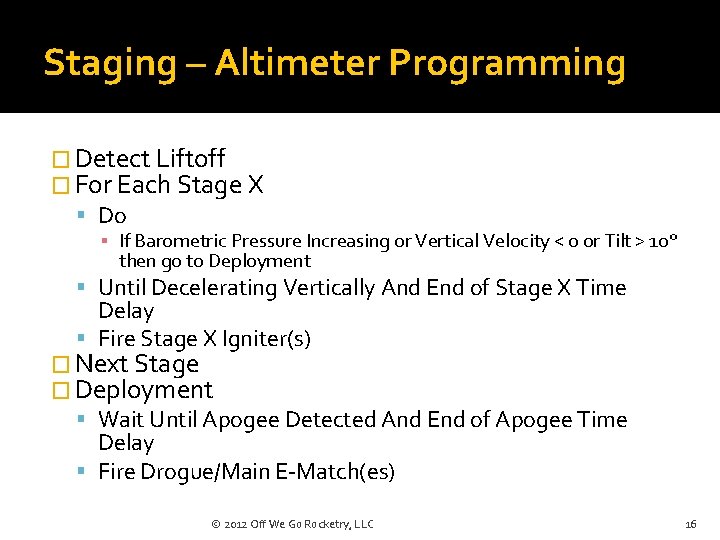
Staging – Altimeter Programming � Detect Liftoff � For Each Stage X Do ▪ If Barometric Pressure Increasing or Vertical Velocity < 0 or Tilt > 10° then go to Deployment Until Decelerating Vertically And End of Stage X Time Delay Fire Stage X Igniter(s) � Next Stage � Deployment Wait Until Apogee Detected And End of Apogee Time Delay Fire Drogue/Main E-Match(es) © 2012 Off We Go Rocketry, LLC 16
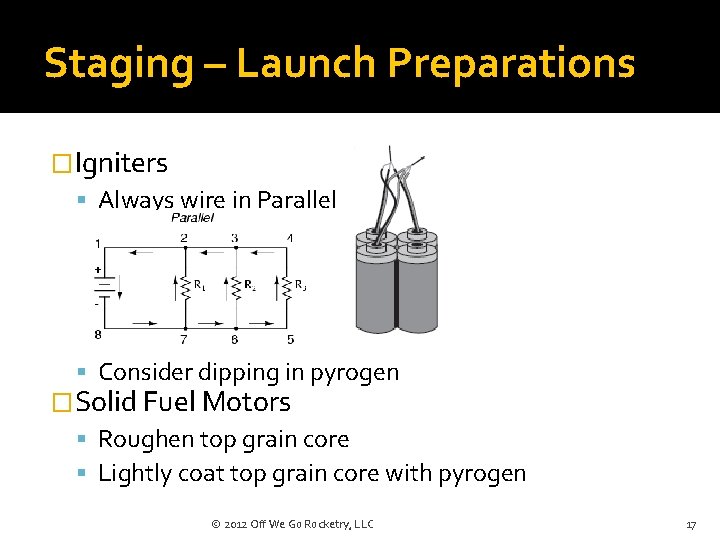
Staging – Launch Preparations �Igniters Always wire in Parallel Consider dipping in pyrogen �Solid Fuel Motors Roughen top grain core Lightly coat top grain core with pyrogen © 2012 Off We Go Rocketry, LLC 17
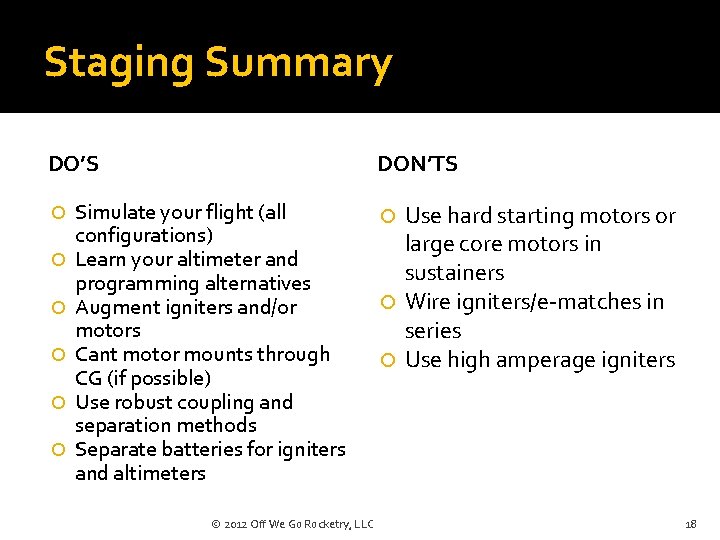
Staging Summary DO’S DON’TS Simulate your flight (all configurations) Learn your altimeter and programming alternatives Augment igniters and/or motors Cant motor mounts through CG (if possible) Use robust coupling and separation methods Separate batteries for igniters and altimeters © 2012 Off We Go Rocketry, LLC Use hard starting motors or large core motors in sustainers Wire igniters/e-matches in series Use high amperage igniters 18
Cluster/Air Starting �Why? �Design Considerations �Simulation Techniques �Altimeter Requirements & Programming �Launch Preparation © 2012 Off We Go Rocketry, LLC 19
Why Cluster or Air Start? �Cluster Additional set of challenges at current cert. level ▪ Igniting multiple motors simultaneously ▪ Combining multiple motor types ▪ Centerings & motor mounts �Air Start All of the above plus Electronics driven ignitions Combine motors and delays for adjustable flight profile © 2012 Off We Go Rocketry, LLC 20
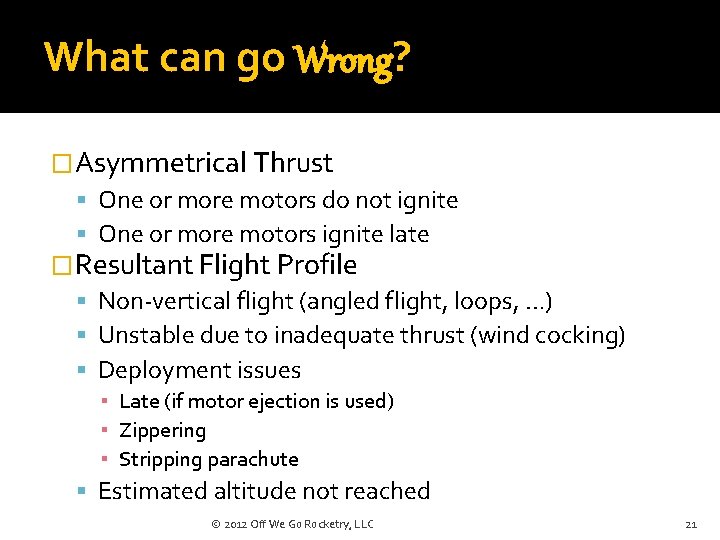
What can go Wrong? �Asymmetrical Thrust One or more motors do not ignite One or more motors ignite late �Resultant Flight Profile Non-vertical flight (angled flight, loops, …) Unstable due to inadequate thrust (wind cocking) Deployment issues ▪ Late (if motor ejection is used) ▪ Zippering ▪ Stripping parachute Estimated altitude not reached © 2012 Off We Go Rocketry, LLC 21
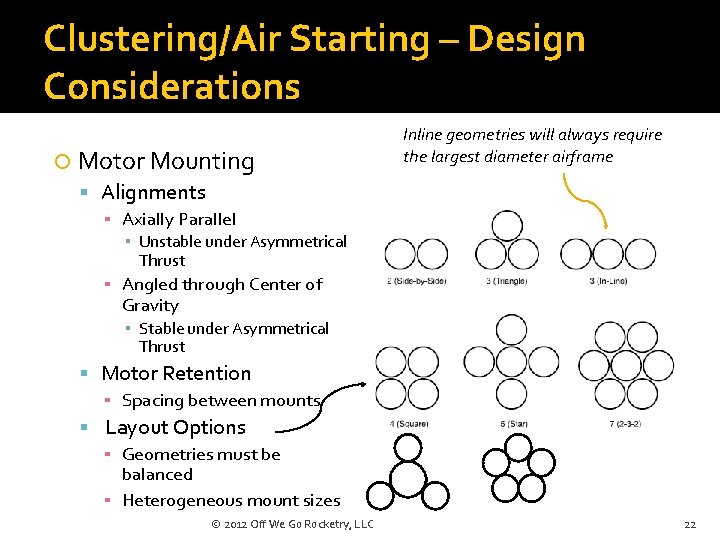
Clustering/Air Starting – Design Considerations Motor Mounting Alignments Inline geometries will always require the largest diameter airframe ▪ Axially Parallel ▪ Unstable under Asymmetrical Thrust ▪ Angled through Center of Gravity ▪ Stable under Asymmetrical Thrust Motor Retention ▪ Spacing between mounts Layout Options ▪ Geometries must be balanced ▪ Heterogeneous mount sizes © 2012 Off We Go Rocketry, LLC 22
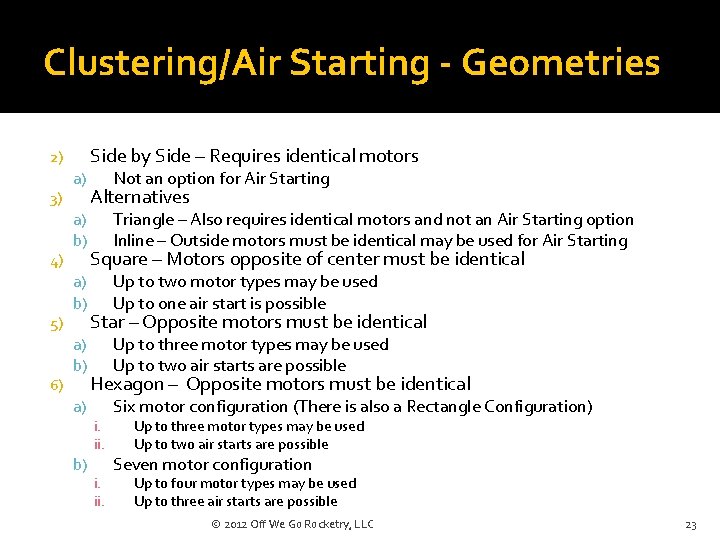
Clustering/Air Starting - Geometries Side by Side – Requires identical motors 2) 3) 4) 5) 6) a) a) b) Not an option for Air Starting Alternatives Triangle – Also requires identical motors and not an Air Starting option Inline – Outside motors must be identical may be used for Air Starting Square – Motors opposite of center must be identical Up to two motor types may be used Up to one air start is possible Star – Opposite motors must be identical Up to three motor types may be used Up to two air starts are possible Hexagon – Opposite motors must be identical i. ii. Six motor configuration (There is also a Rectangle Configuration) Up to three motor types may be used Up to two air starts are possible Seven motor configuration Up to four motor types may be used Up to three air starts are possible © 2012 Off We Go Rocketry, LLC 23
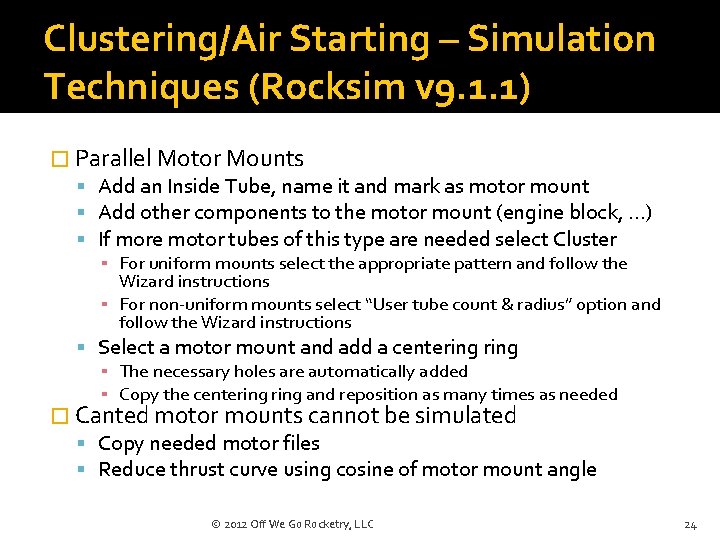
Clustering/Air Starting – Simulation Techniques (Rocksim v 9. 1. 1) � Parallel Motor Mounts Add an Inside Tube, name it and mark as motor mount Add other components to the motor mount (engine block, …) If more motor tubes of this type are needed select Cluster ▪ For uniform mounts select the appropriate pattern and follow the Wizard instructions ▪ For non-uniform mounts select “User tube count & radius” option and follow the Wizard instructions Select a motor mount and add a centering ▪ The necessary holes are automatically added ▪ Copy the centering and reposition as many times as needed � Canted motor mounts cannot be simulated Copy needed motor files Reduce thrust curve using cosine of motor mount angle © 2012 Off We Go Rocketry, LLC 24
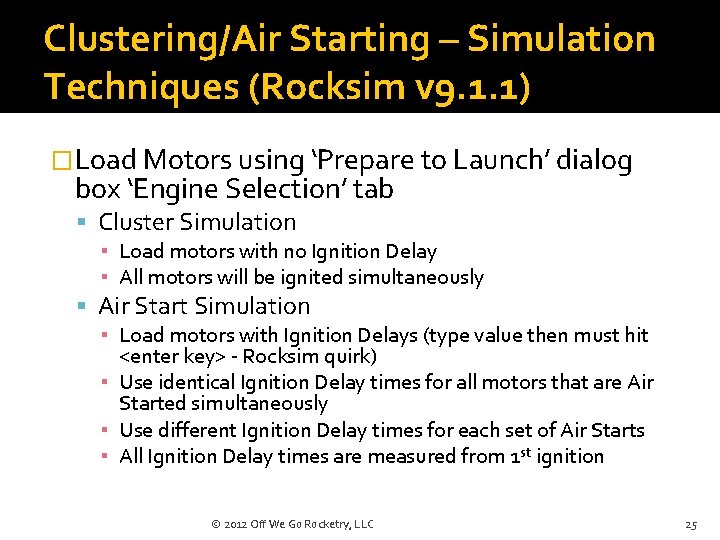
Clustering/Air Starting – Simulation Techniques (Rocksim v 9. 1. 1) �Load Motors using ‘Prepare to Launch’ dialog box ‘Engine Selection’ tab Cluster Simulation ▪ Load motors with no Ignition Delay ▪ All motors will be ignited simultaneously Air Start Simulation ▪ Load motors with Ignition Delays (type value then must hit <enter key> - Rocksim quirk) ▪ Use identical Ignition Delay times for all motors that are Air Started simultaneously ▪ Use different Ignition Delay times for each set of Air Starts ▪ All Ignition Delay times are measured from 1 st ignition © 2012 Off We Go Rocketry, LLC 25
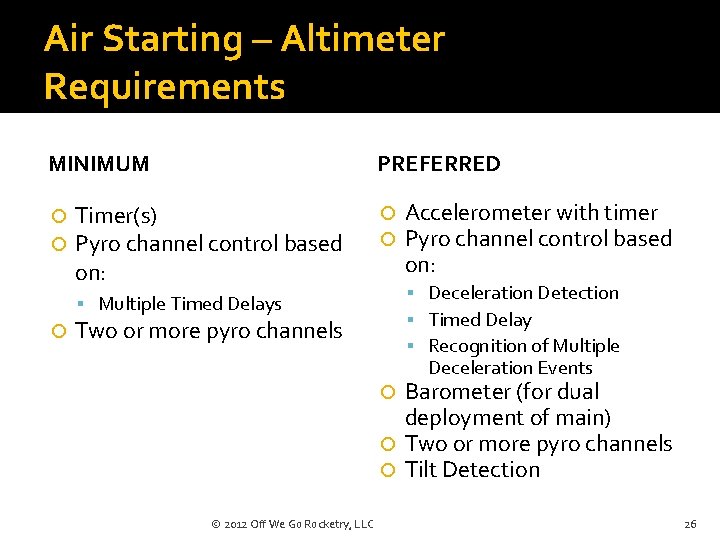
Air Starting – Altimeter Requirements MINIMUM PREFERRED Timer(s) Pyro channel control based on: Deceleration Detection Timed Delay Recognition of Multiple Timed Delays Accelerometer with timer Pyro channel control based on: Two or more pyro channels Deceleration Events Barometer (for dual deployment of main) Two or more pyro channels Tilt Detection © 2012 Off We Go Rocketry, LLC 26
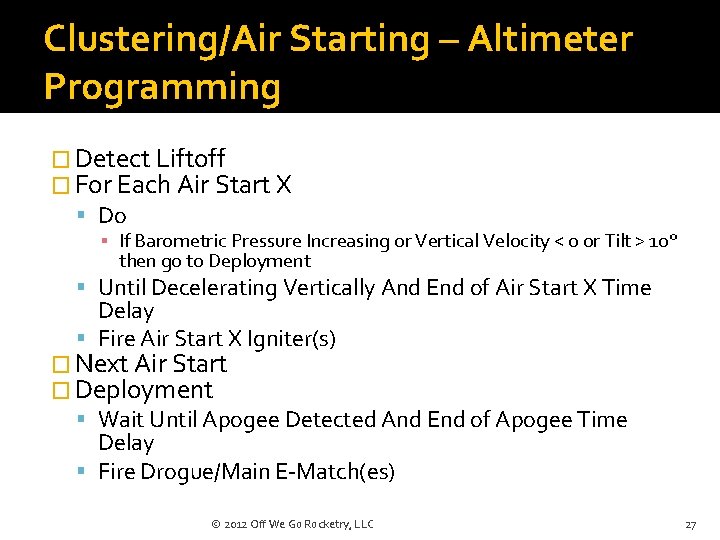
Clustering/Air Starting – Altimeter Programming � Detect Liftoff � For Each Air Start X Do ▪ If Barometric Pressure Increasing or Vertical Velocity < 0 or Tilt > 10° then go to Deployment Until Decelerating Vertically And End of Air Start X Time Delay Fire Air Start X Igniter(s) � Next Air Start � Deployment Wait Until Apogee Detected And End of Apogee Time Delay Fire Drogue/Main E-Match(es) © 2012 Off We Go Rocketry, LLC 27
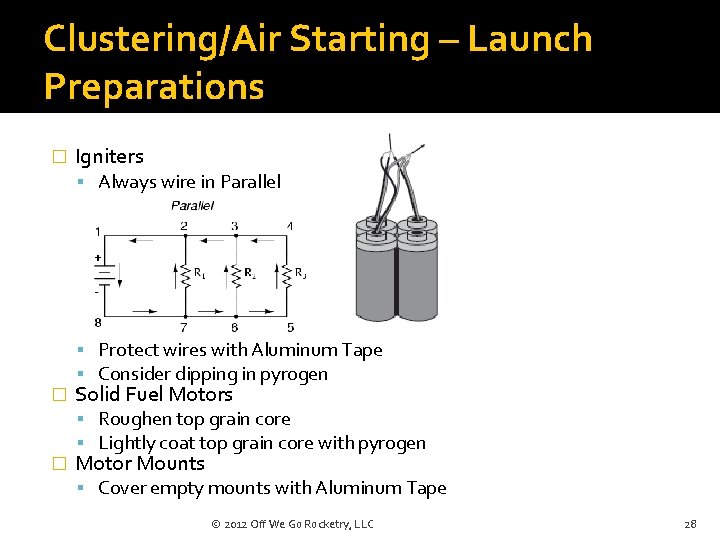
Clustering/Air Starting – Launch Preparations � Igniters Always wire in Parallel � � Protect wires with Aluminum Tape Consider dipping in pyrogen Solid Fuel Motors Roughen top grain core Lightly coat top grain core with pyrogen Motor Mounts Cover empty mounts with Aluminum Tape © 2012 Off We Go Rocketry, LLC 28
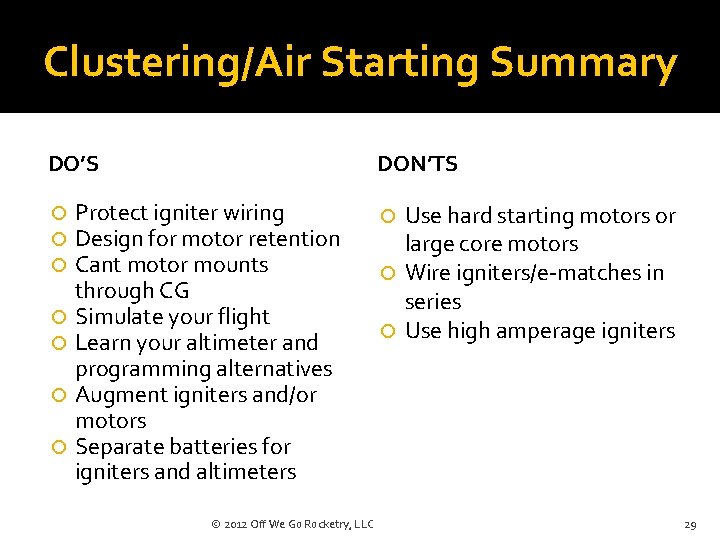
Clustering/Air Starting Summary DO’S DON’TS Protect igniter wiring Design for motor retention Cant motor mounts through CG Simulate your flight Learn your altimeter and programming alternatives Augment igniters and/or motors Separate batteries for igniters and altimeters © 2012 Off We Go Rocketry, LLC Use hard starting motors or large core motors Wire igniters/e-matches in series Use high amperage igniters 29
Summary �Many aspects of Air Starting and Staging are similar Altimeter selection & programming Some design elements Motor and igniter preparation �Clustering, Air Starting & Staging provide new construction, electronics, and motor challenges at your current certification level Combine all three for even greater challenges © 2012 Off We Go Rocketry, LLC 30