
Complex Restricted Repetitive Patterns of Vocal Behavior of
Complex Restricted Repetitive Patterns of Vocal Behavior of Individuals With High Functioning Autism: An Innovative Intervention Kimberlee K. Flatt, Ph. D, BCBA Smita Mehta, Ph. D. 1
Outline �Introduction to Higher-Order RRBs �Theoretical Foundations �Purpose �Method § Participants and Setting § Dependent Measures and Data Collection § Research Design and Procedures �Results 2
Introduction Restricted Repetitive Behaviors (RRBs) Lower-Order Higher-Order Hand Flapping Insistence on Sameness Vocal Babble Ritualistic Patterns of Behavior SIB Perseverative Interest 3

Interventions for RRBs �Lower-Order § RIRD Response blocking / extinction Redirection DRI; DRO �Higher-Order § Incorporate perseverative interests § DRA § Cognitive. Behavior 4
Social Conversation �Social conversation § Visual representation of conversation and video feedback (Koegel et al. , 2016 -a); § Reframing negative statements (Koegel et al. , 2016 -b) § DR (tokens), trial-based teaching, textual prompt (Hood et al. , 2016); § Priming, modeling, prompting, DRA (Leaf et al. , 2006, 2009) 5
Theoretical Framework �Hernstein’s Matching Law (1970) § Response rate dictated by reinforcement rate �Baer’s principle of intra-response class covariation § Choice of behavior - functional response class of problem and appropriate behavior § Goal is to document inverse relationship 6
Purpose of the Study �Repeated verbal speech patterns: § Reduce access and opportunity § Adversely affect individuals with HFA and families �Need intervention to: § Increase social conversation skill, decrease RRBs Meaningful and mutual relationships Increase opportunities and access to employment 7
Research Question 1 �Is there a functional relation between instruction in social conversation skills and decrease in repetitive higherorder verbal behavior for persons with HFA? 8
Research Question 2 �To what extent will decreased rates of higher-order RRBs and increased social conversation skills maintain in naturalistic conversational settings? 9
Participants �Four adults in Texas �Work in a post-secondary technologybased training center § IQ = 70 or higher § Diagnosis of ASD § Age 18 -30 years § Behavioral prerequisites T-score of 70> in RRB domain of Social Responsiveness Scale(SRS™-2) 10
Emily �Female, 26 -years �Asian-American �IQ = 77 �SSR-2, 72 T (other and self-report) �Comorbidities: �RRB: Depression Pokémon Go 11
Ashton �Male, 25 -years �Caucasian �IQ = 127 �SSR-2, 75 T(other), 77 T (self-report) �Comorbidities: Generalized anxiety disorder, depression �RRB: Autism, social connections, King Arthur, mental health, and writing 12
Isaac �Male, 24 -years �Caucasian �IQ = 122 �SSR-2, 70 T (other and self-report) �Comorbidities: Generalized anxiety disorder, depression �RRB: Politics of TV, films, and sports 13
Shawn �Male, 23 -years �Asian-American �IQ = 89 �SSR-2, 80 T (other) 75 T (self-report) �Comorbidities: Stuttering �RRB: Digital art, Pokémon the and Mario paper video games 14
Setting �Work; technical training center for adults with HFA (different shifts) § Vacant office, devoid of visual stimuli, one desk with a computer, three office style chairs, one small wastebasket § Maintenance sessions in individualized naturalistic settings 15
Dependent Measures �Higher-order verbal RRBs; �Social conversation (expand, ask questions, agree, compliment); �Measurement – occurrence or nonoccurrence of behavior per 15 -second interval; § No opportunity (e. g. , writing activity, therapist talking) 16
Social Validity �Post intervention participant interviews § Purpose was to determine social relevance of intervention § An open-ended interview 17
Data Collection �All sessions were video recorded; �Coded by 3 graduate students with ABA training; �IOA scores: § Emily 95. 92% (93. 33%-100%) § Ashton 95. 96% (90%-100%) § Isaac 98. 71% (96. 70%-100%) § Shawn 98. 17% (93. 33%-100%) 18
Research Design �Multiple baseline design across participants; �Experimental procedures: § Functional assessment of behavior interview; § FA to isolate maintaining variables (reversals); § Collection of baseline data; § Implementation of intervention; 19
FBA Procedures �Structured open-ended interview § Function: social attention �Functional analysis § ABAB / BABA design (control order effects) Condition (a): contingent access to social attention Condition (b): ignore or no attention (therapist’s back to participant attending to computer) 20
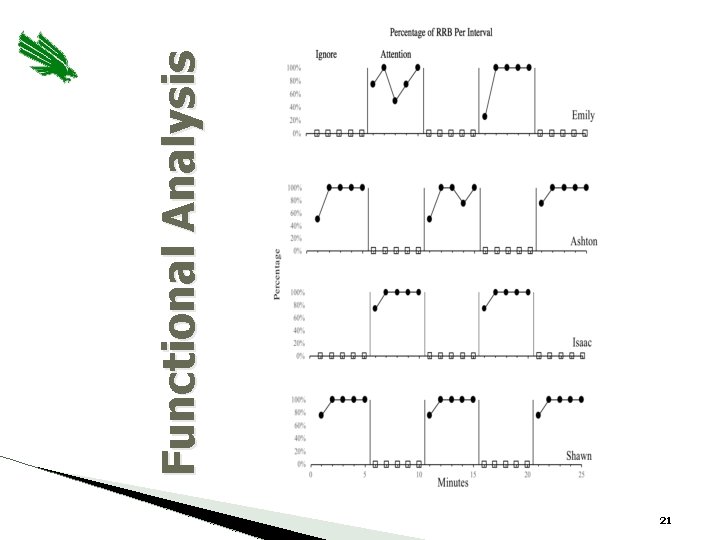
21 Functional Analysis
Baseline �Interventionist § SD: “Let’s have a conversation; ” § Speak on subjects of their choice; § If no verbalizations for 60 s, prompt, “we can talk about anything; ” § Responses, attentive, neutral positive statements 22
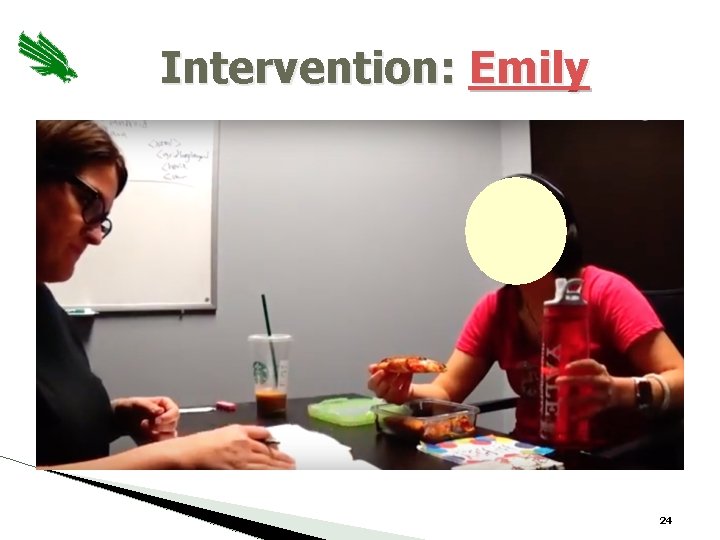
Intervention �Identify and label target skill; �Present a rationale; �Describe and demonstrate; �Teach the skill; practice, practice; § Multiple opportunities to practice logic and action; �Feedback for both RRBs and SC; § Interruption and redirection (RRB) § Contingent social praise (SC) 23
Intervention: Emily 24
Intervention: Ashton 25
Procedural Fidelity �Recorded by independent observer for about 39% across BL and INT; § FOI = 100% § IOA on FOI: Emily 33% of sessions - 100% Ashton Isaac 40% of sessions - 100% 42. 85% of sessions - 100% Shawn 42. 85% of sessions - 100% 26
27 Results
Maintenance Probes �One-three weeks post intervention �Opportunity to practice conversations § Alternative settings, with a different person, or an alternative context § Purpose, evaluate the effects of treatment within individually designed naturalistic conversation context 28
Maintenance: Emily �Alternative § Setting, site, context and novel partner 0% RRB, 100% AC, 3 of 3 TI skills § Setting, site, context and number of partners 0% RRB, 100% AC, 3 of 3 TI skills § Setting, context and partners 0% RRB, 100% AC, 3 of 3 TI skills 29
Maintenance: Ashton �None 30
Maintenance: Isaac �Alternative § Setting, context and novel person 0% RRB, 100% AC, 3 of 4 TI skills § Setting, context and novel person 0% RRB, 100% AC, 4 of 4 TI skills § Setting, context and number of partners 0% RRB, 100% AC, 4 of 4 TI skills 31
Maintenance Shawn �Alternative § Setting, context and novel partner 0%RRB, 100% AC/SC, 3 of 3 core skills § Setting, context and novel partners 0% RRB, 100% AC/SC, 3 of 3 core skills § Setting, site and context 13. 3% RRB, 86. 7% AC/SC INT Booster 0% RRB, 100% AC/SC, 3 of 3 core skills 32
Social Validity Interview: Isaac 33
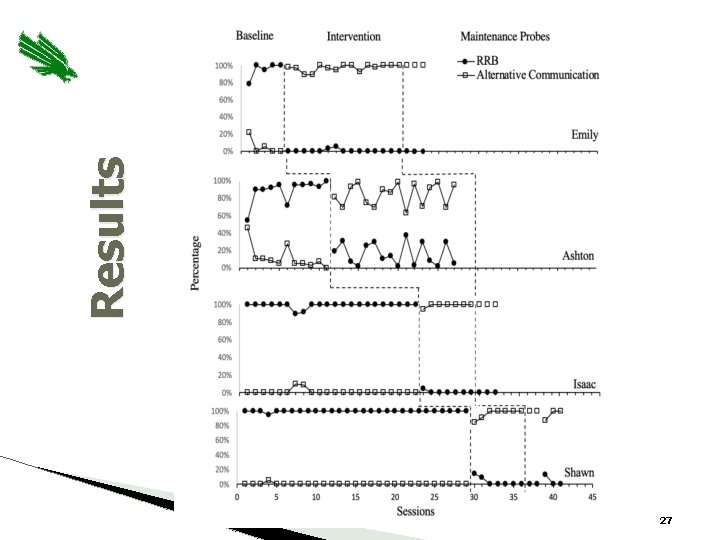
Conclusion �Demonstration of experimental control § Decreased complex-restricted RRBs for adults with HFA and inversely increased alternative social communication § Intervention effects maintained for the three participants in a variety of meaningful naturalistic settings 34
- Slides: 34