
Complex Organizational System A Complex System Model for
- Slides: 15
Complex Organizational System A Complex System Model for Organizations, Companies and Social Actions
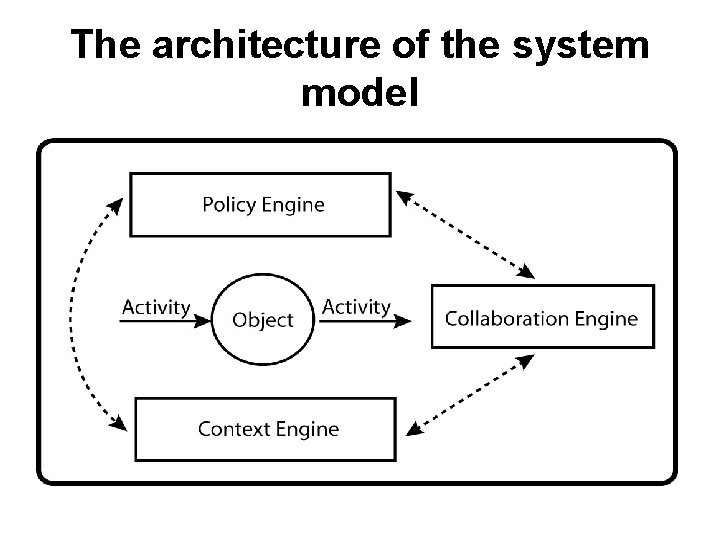
The Model Basics • Objects are the elements that populate and perform the ‘work’ of the complex system. • Tasks specify work to be done by objects. • Policy is a course of action selected in light of given conditions to guide, modify and determine activities in the complex system. • Context is the environment, the inputs, the systems and the events that surround the complex system. • Collaboration is an essential part of organizational work. It takes on many forms, team formation, negotiation and straightforward collaboration.
Goals • Refine the model to explain, simulate and reason about a variety of organizations and social events • Constructing engines for small complex systems is simple • Constructing engines for larger complex systems is feasible and methods to accommodate them are demonstrated • The model is generalized to include different types of complex systems such as more social frameworks, biological and physical systems. • Each of the engines is well understood and bounded
The architecture of the system model
System Organization • Unstructured objects - Some complex systems contain or consist of unstructured objects. • Team - Team formation is an important organizational step where objects come together to perform a collaborative task or tasks. • Hierarchies of objects - Hierarchies imply a parenting or supervisory role for objects at a higher level in the hierarchy. • Objects within objects - An object may contain other objects.
Tasks • The task is as the basic unit of work. • Task management allocates, performs and completes tasks within a complex system. • Task dependency supports parallel and sequential performance of tasks. Activities contain one or more tasks that may be independent or dependent on each other. Tasks may be comprised of subtasks. • An object may perform a task by itself or several objects collaborate in performing a single task.
Tasks Details • Directed Task Allocation – Directed task performance assumes that the task issuer has the authority to issue a task. In this case, the task either preempts the tasks being performed or it is performed after the currently executing task is completed. • Negotiated Task Allocation – Non-Allocated task assignment is negotiated. Negotiation is described in the Collaboration Engine section. • Actions – Actions are activities that do not perform work. For example, object recruitment and negotiation during team formation consist of multiple actions.
Policy Rules • The general policy rule is a statement R of the form: R: if conjunction of predicates then conjunction of actions
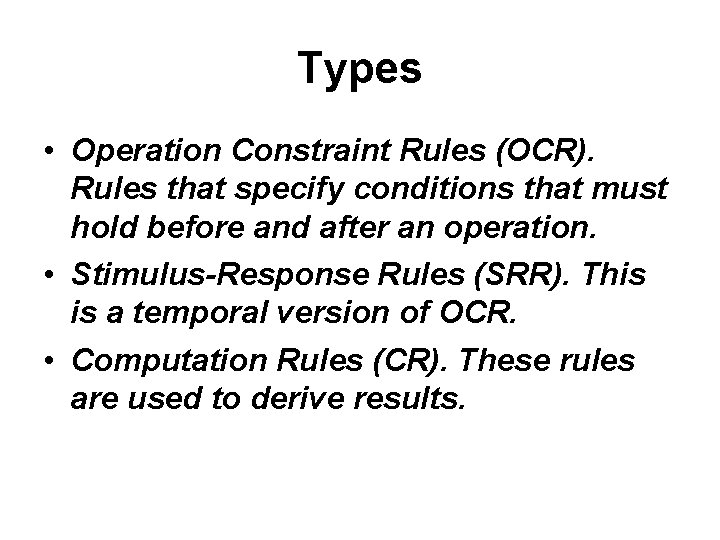
Types • Operation Constraint Rules (OCR). Rules that specify conditions that must hold before and after an operation. • Stimulus-Response Rules (SRR). This is a temporal version of OCR. • Computation Rules (CR). These rules are used to derive results.
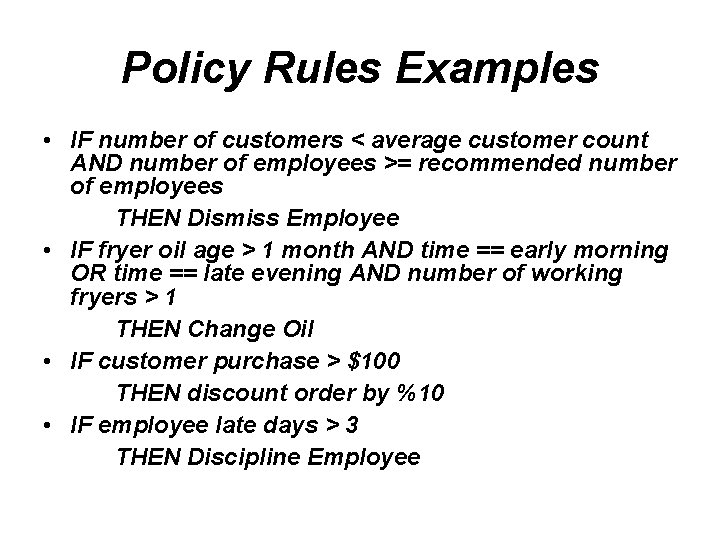
Policy Rules Examples • IF number of customers < average customer count AND number of employees >= recommended number of employees THEN Dismiss Employee • IF fryer oil age > 1 month AND time == early morning OR time == late evening AND number of working fryers > 1 THEN Change Oil • IF customer purchase > $100 THEN discount order by %10 • IF employee late days > 3 THEN Discipline Employee
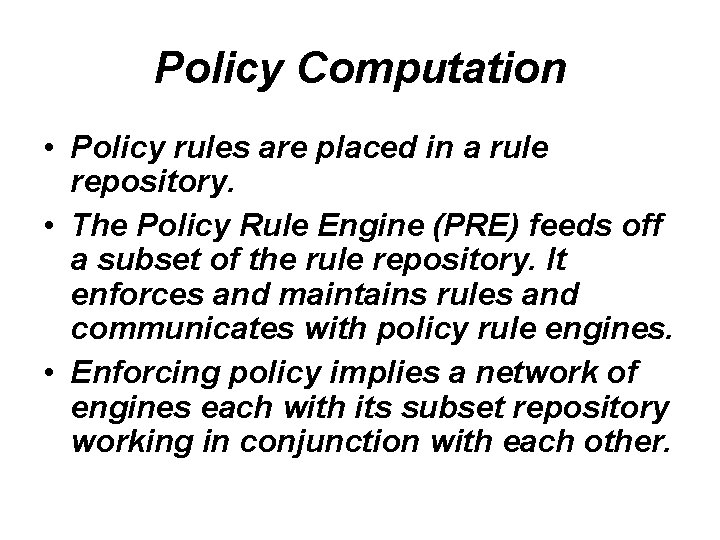
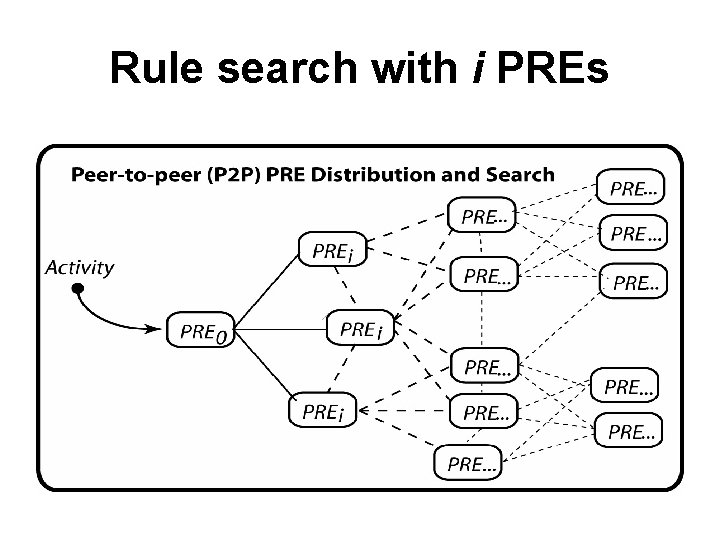
Policy Computation • Policy rules are placed in a rule repository. • The Policy Rule Engine (PRE) feeds off a subset of the rule repository. It enforces and maintains rules and communicates with policy rule engines. • Enforcing policy implies a network of engines each with its subset repository working in conjunction with each other.
Rule search with i PREs
The Context of Policy • Policy Rules are declarative statements with the general form of policy rules. • An intervention of the context engine is desired when a policy rule if A then B and the environment indicates that the action was B despite –A being true. • The context engine may find that the effect is as if we had: if A or X then B, where X is another predicate.
Context Types • Operation Constraint Rule (OCR) – Example: an airplane can take off if it is ready. Assume that it is a new type of airplane for which new policy is not available yet and this type of airplane can take off even if is not completely ready. • Stimulus-Response Rules (SSR) – Example: On 9/11/2001 there was no policy dealing with hijacked airplane flying over Manhattan. At the very least context engines should report a problem. • Computation Rules – Examples: assume computation of mortgage interest rate. – Potential changes by the context engine: – Add 1% due to company losses – Interest rate ≥ 5%
Collaboration • Negotiated Task Allocation • Task assignment is negotiated. An object initiates the task and becomes the Task Initiator (TI). A TI generates a Task Announcement (TA) that contains the parameters required to perform the task. The TA is distributed to all relevant objects. • Objects able to perform the task respond to the TA with a bid. TI evaluates bids received accepting the best bid or deferring bid evaluation until more bids are received. Once the bids are evaluated, the task is awarded employing a two-phase commit protocol to ensure award completion (Fig. 3). • Once the task is awarded, the awarded object notifies the TI of task progress and eventual completion.