
Complex organic molecules in hot corinos Sandrine Bottinelli
Complex organic molecules in hot corinos Sandrine Bottinelli Laboratoire d’Astr. Ophysique de Grenoble (France) / Institute for Astronomy (Hawaii) Cecilia Ceccarelli (LAOG), Jonathan Williams (If. A) and Roberto Neri (IRAM) Outline: I – Background II – 30 m observations of NGC 1333 -IRAS 4 A III – Pd. B observations of IRAS 16293 IV – Conclusions
Hot core: first stage in the evolution of massive protostars • Compact (<0. 1 pc), warm • 1 st discovered around (>100 K), dense (>107 cm-3) Orion-KL (Morris et al. regions. 1980). Nowadays, >20 massive hot cores. • Rich chemistry: • Many studies: e. g. Friedel Ø Saturated molecules, et al. (this morning), Ø Complex organic molecules (oxygen-, nitrogen-, sulfur. Comito et al. (Friday bearing). morning). Hot cores around Class 0?
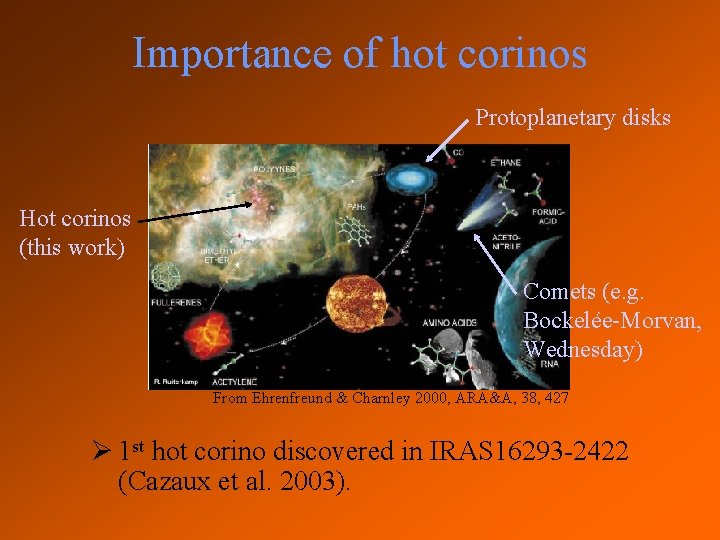
Importance of hot corinos Protoplanetary disks Hot corinos (this work) Comets (e. g. Bockelée-Morvan, Wednesday) From Ehrenfreund & Charnley 2000, ARA&A, 38, 427 Ø 1 st hot corino discovered in IRAS 16293 -2422 (Cazaux et al. 2003).
Questions and goals • Is IRAS 16293 an exception or is the hot corino phase common in the evolution of low-mass protostars? Search for complex molecules towards other Class 0. • Is the chemistry in hot corinos similar to that in massive hot cores? Compare abundances. • What are the formation mechanisms of these complex molecules? Interferometry, laboratory work, chemical modeling.
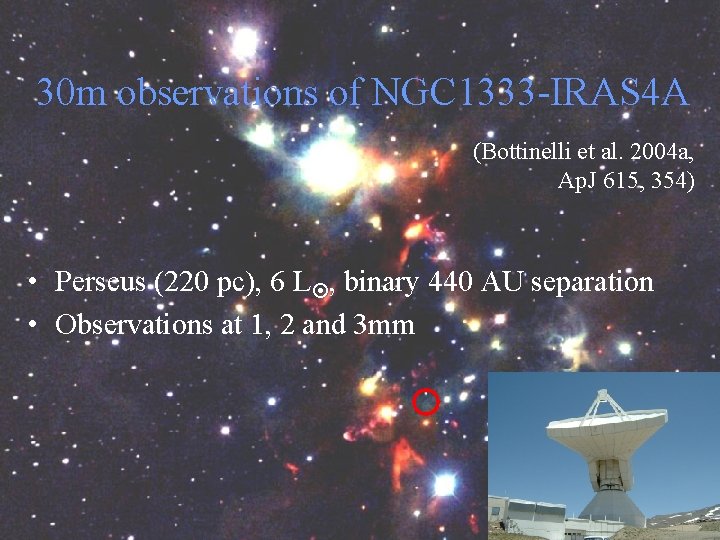
30 m observations of NGC 1333 -IRAS 4 A (Bottinelli et al. 2004 a, Ap. J 615, 354) • Perseus (220 pc), 6 L , binary 440 AU separation • Observations at 1, 2 and 3 mm
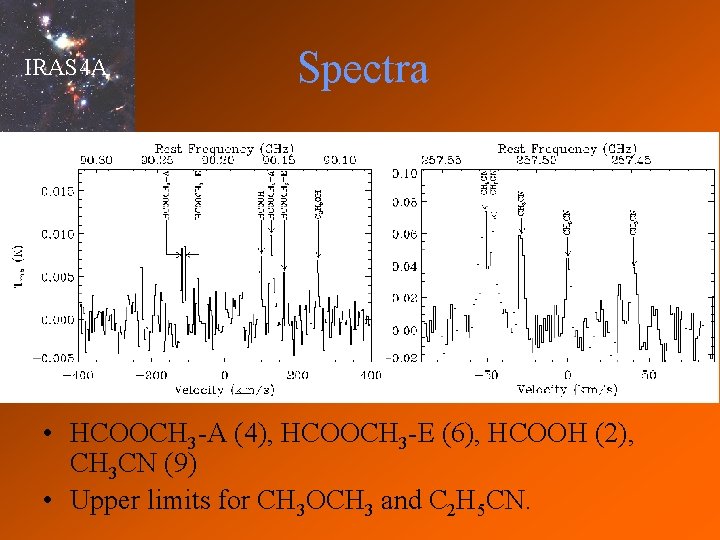
IRAS 4 A Spectra • HCOOCH 3 -A (4), HCOOCH 3 -E (6), HCOOH (2), CH 3 CN (9) • Upper limits for CH 3 OCH 3 and C 2 H 5 CN.
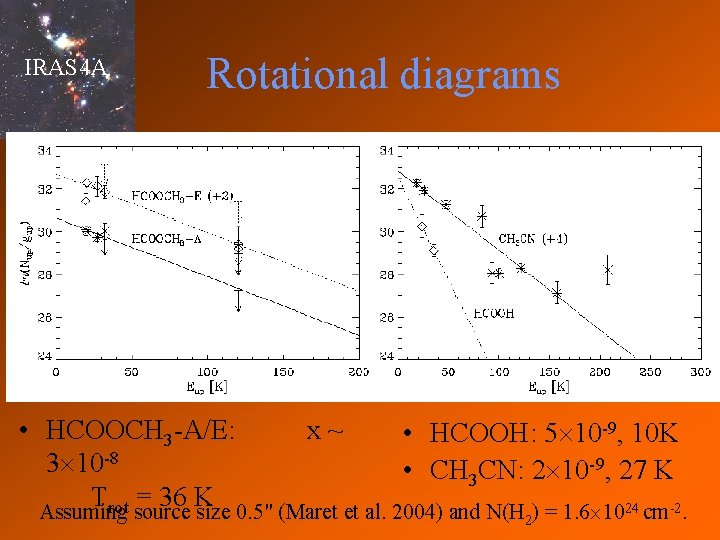
IRAS 4 A Rotational diagrams • HCOOCH 3 -A/E: x~ • HCOOH: 5 10 -9, 10 K 3 10 -8 • CH 3 CN: 2 10 -9, 27 K Trot source = 36 K Assuming size 0. 5" (Maret et al. 2004) and N(H ) = 1. 6 1024 cm-2. 2
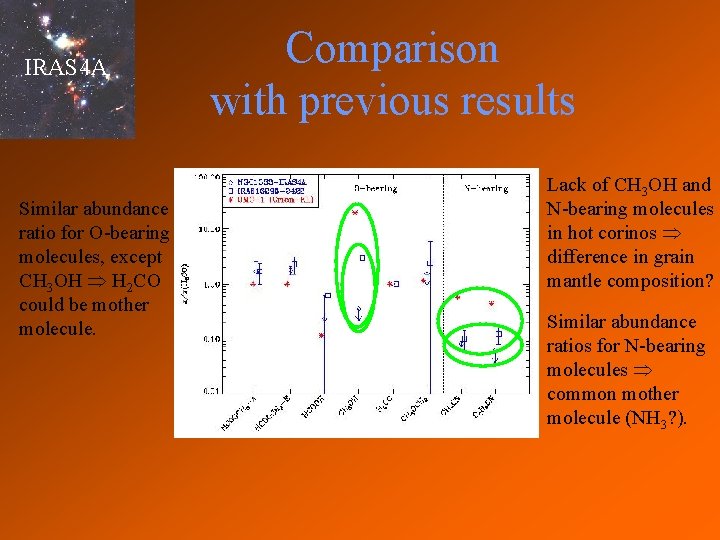
IRAS 4 A Similar abundance ratio for O-bearing molecules, except CH 3 OH H 2 CO could be mother molecule. Comparison with previous results Lack of CH 3 OH and N-bearing molecules in hot corinos difference in grain mantle composition? Similar abundance ratios for N-bearing molecules common mother molecule (NH 3? ).
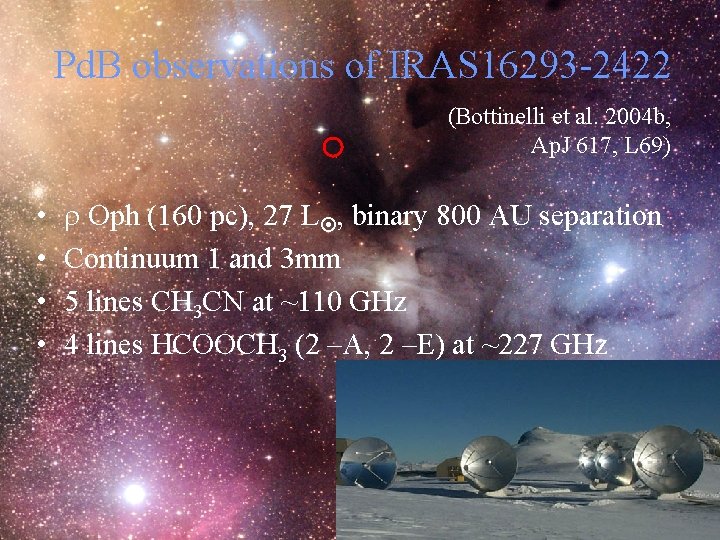
Pd. B observations of IRAS 16293 -2422 (Bottinelli et al. 2004 b, Ap. J 617, L 69) • • Oph (160 pc), 27 L , binary 800 AU separation Continuum 1 and 3 mm 5 lines CH 3 CN at ~110 GHz 4 lines HCOOCH 3 (2 –A, 2 –E) at ~227 GHz
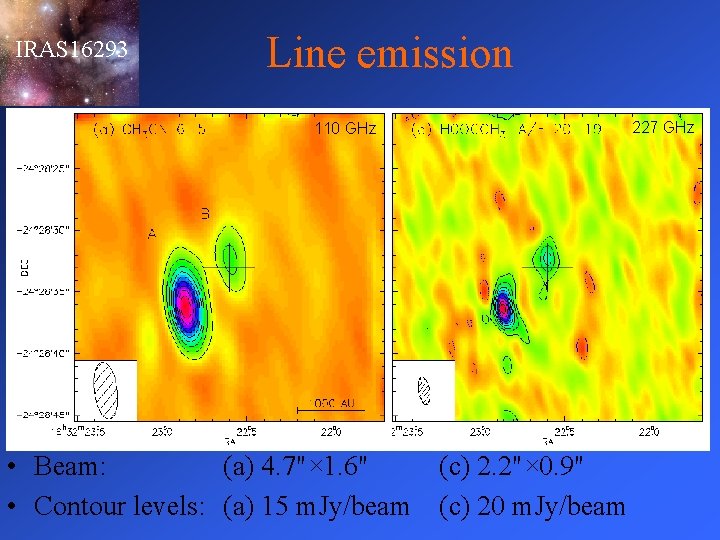
IRAS 16293 Line emission 110 GHz • Beam: (a) 4. 7"× 1. 6" (c) 2. 2"× 0. 9" • Contour levels: (a) 15 m. Jy/beam (c) 20 m. Jy/beam 227 GHz
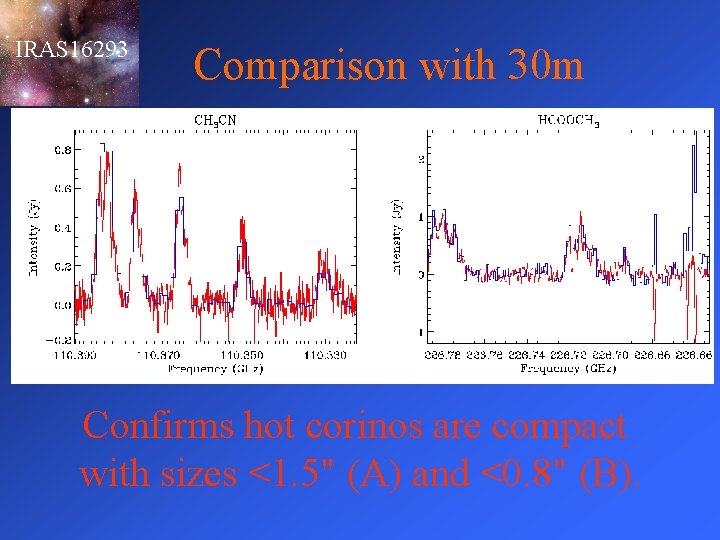
IRAS 16293 Comparison with 30 m Confirms hot corinos are compact with sizes <1. 5" (A) and <0. 8" (B).
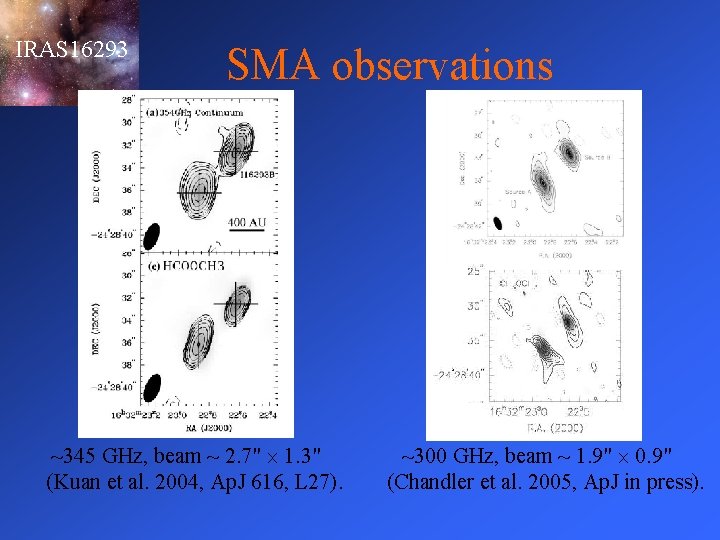
IRAS 16293 SMA observations ~345 GHz, beam ~ 2. 7" 1. 3" (Kuan et al. 2004, Ap. J 616, L 27). ~300 GHz, beam ~ 1. 9" 0. 9" (Chandler et al. 2005, Ap. J in press).
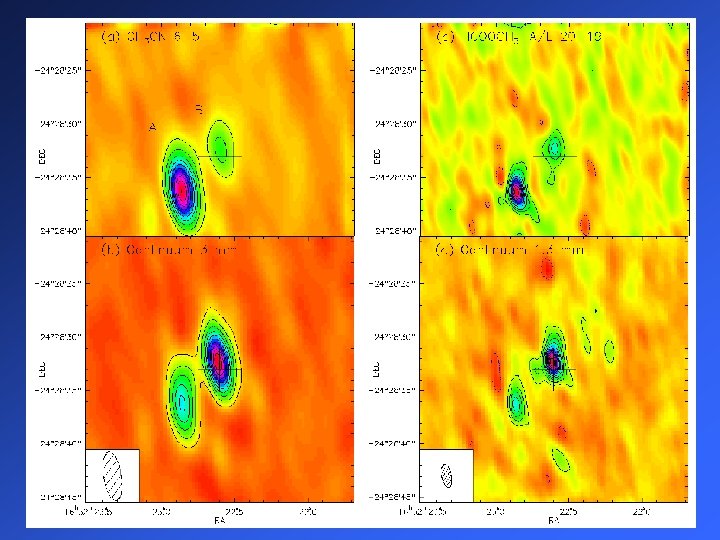
Continuum emission
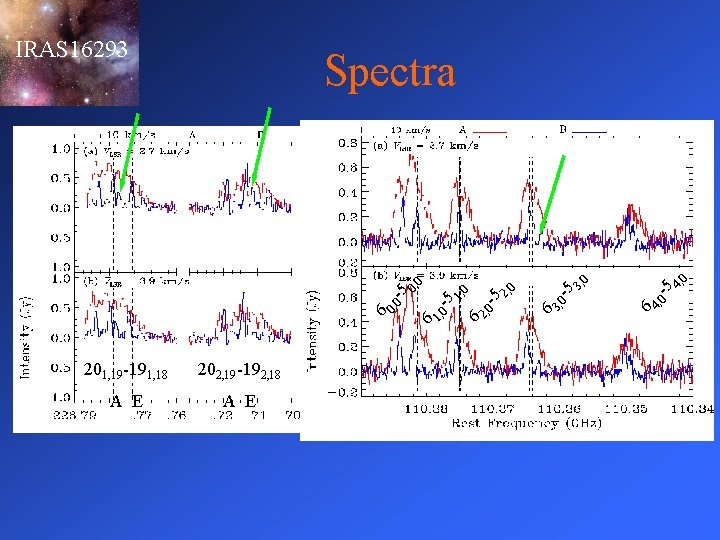
IRAS 16293 201, 19 -191, 18 202, 19 -192, 18 A E CN 2 -1 0 0 -5 4, 4, 6 0 0 -5 3, 3, 6 0 2, 0 -5 2, 6 0 -5 1, 0 1, 6 6 0, 0 -5 0, 0 Spectra
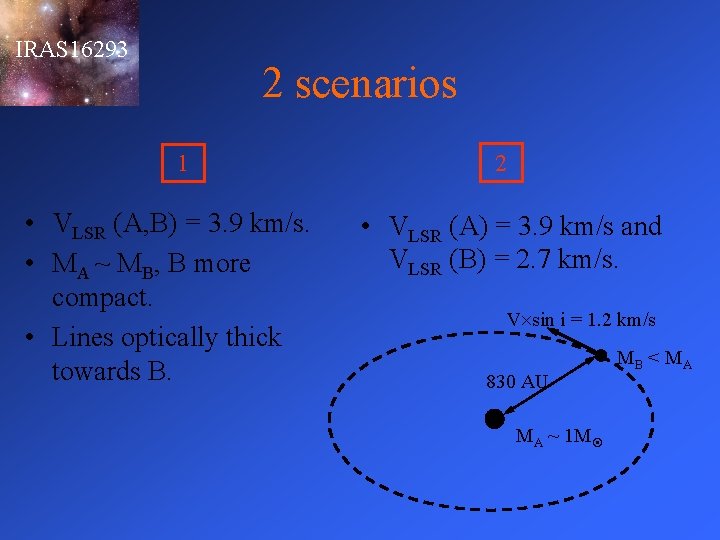
IRAS 16293 2 scenarios 1 • VLSR (A, B) = 3. 9 km/s. • MA ~ MB, B more compact. • Lines optically thick towards B. 2 • VLSR (A) = 3. 9 km/s and VLSR (B) = 2. 7 km/s. V sin i = 1. 2 km/s 830 AU MA ~ 1 M MB < M A
Chemical modeling • Coupling between chemistry, dynamics and radiative transfer is computationally intensive, but many efforts to tackle different aspects: – chemical evolution in protostellar envelopes (e. g. Rodgers & Charnley 2003; Doty et al. (2004); – laboratory studies (e. g. Horn et al. 2004); – molecular line profiles (e. g. Lee et al. 2004); – chemical clocks (e. g. Wakelam et al. 2004, previous talk); – grain surface reactions (e. g. Weaver & Blake this afternoon). • Problem = difficult to reconcile theory and observations for gas-phase formation of complex molecules (e. g. for HCOOCH 3 - Horn et al. 2004).
Conclusions • Hot corinos exist and have been imaged. • IRAS 16293 not alone (however still don’t know how common hot corinos are). • Open questions: – What are the formation mechanisms of these molecules? – Evolution, link with comets? to answer, continue the effort through combining modeling and observations.
- Slides: 17