
Complex Numbers What are they Why do we
Complex Numbers What are they? Why do we need them? 5 i
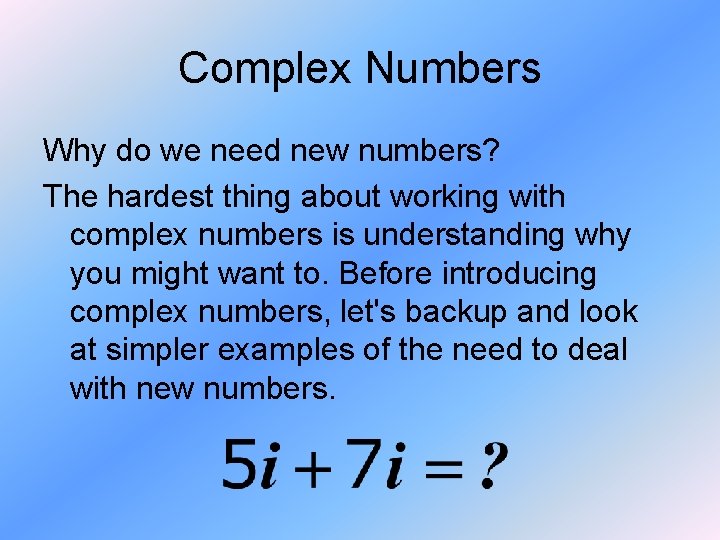
Complex Numbers Why do we need new numbers? The hardest thing about working with complex numbers is understanding why you might want to. Before introducing complex numbers, let's backup and look at simpler examples of the need to deal with new numbers.
If you are like most people, initially number meant whole number 0, 1, 2, 3, . . . _______, Whole numbers make sense. They provide a way to answer questions of the form "How many. . . ? " You also learned about the operations of addition and ______, subtraction and you found that while subtraction is a perfectly good operation, some subtraction problems, like 3 - 5, don't have answers if we only work with whole numbers. Then you find that if you are willing to work with ____, . . . , -2, -1, 0, 1, 2, . . . , then all integers subtraction problems do have answers! Furthermore, by considering examples such as temperature scales, you see that ____ negative numbers often make sense.
Now that we have fixed subtraction, we will deal with division. Some, in fact most, division integers problems do not have answers that are ____. For example, 3 ÷ 2 is not an integer. We need new rational numbers! Now we have ________ (fractions). There is more to this story. There are problems with square roots and other operations, but we will not get into that here. The point is that you have had to expand your idea of “number” on several occasions, and now we are going to do that again. The "problem" that leads to complex numbers solutions of equations concerns ____________.
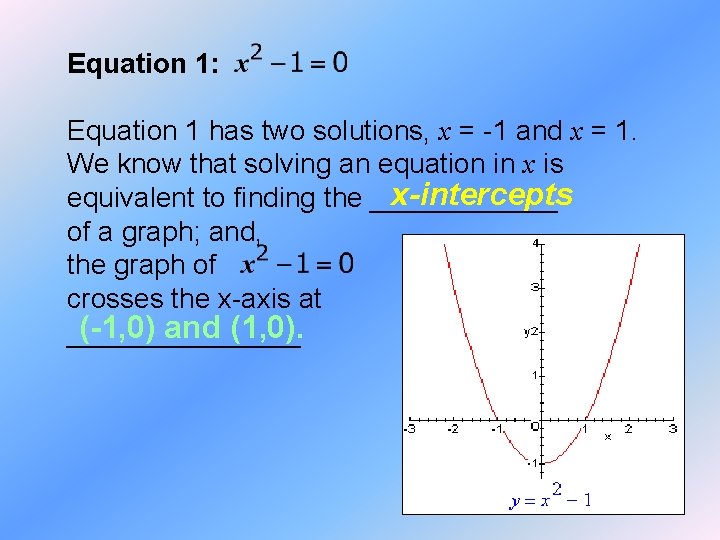
Equation 1: Equation 1 has two solutions, x = -1 and x = 1. We know that solving an equation in x is x-intercepts equivalent to finding the ______ of a graph; and, the graph of crosses the x-axis at (-1, 0) and (1, 0). ________
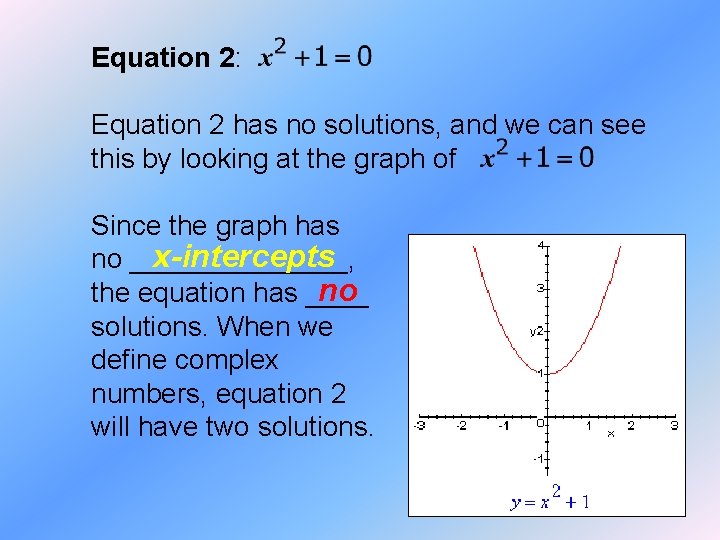
Equation 2: Equation 2 has no solutions, and we can see this by looking at the graph of Since the graph has x-intercepts no _______, no the equation has ____ solutions. When we define complex numbers, equation 2 will have two solutions.
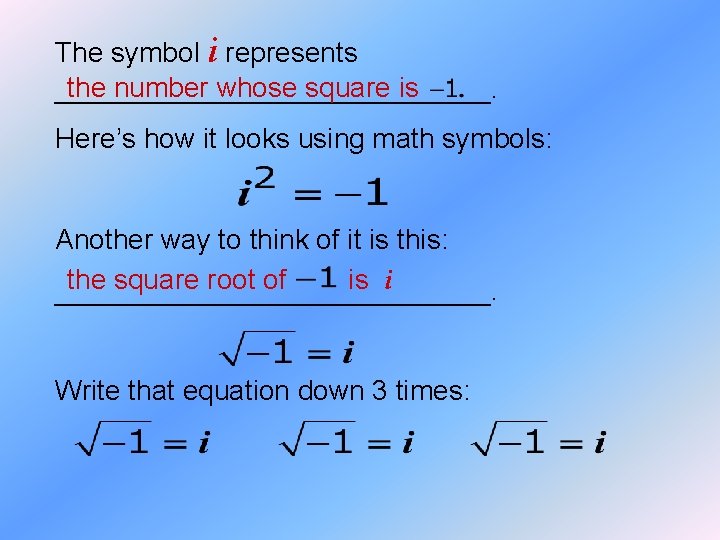
The symbol i represents the number whose square is ______________. Here’s how it looks using math symbols: Another way to think of it is this: the square root of is i ______________. Write that equation down 3 times:
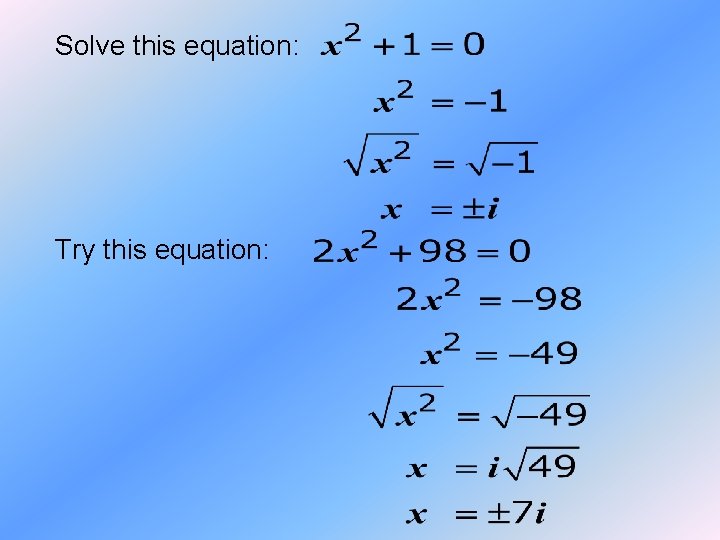
Solve this equation: Try this equation:
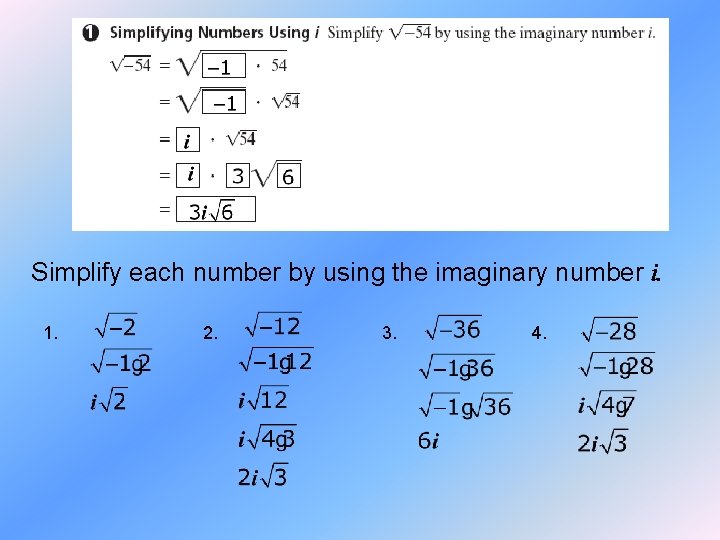
Simplify each number by using the imaginary number i. 1. 2. 3. 4.
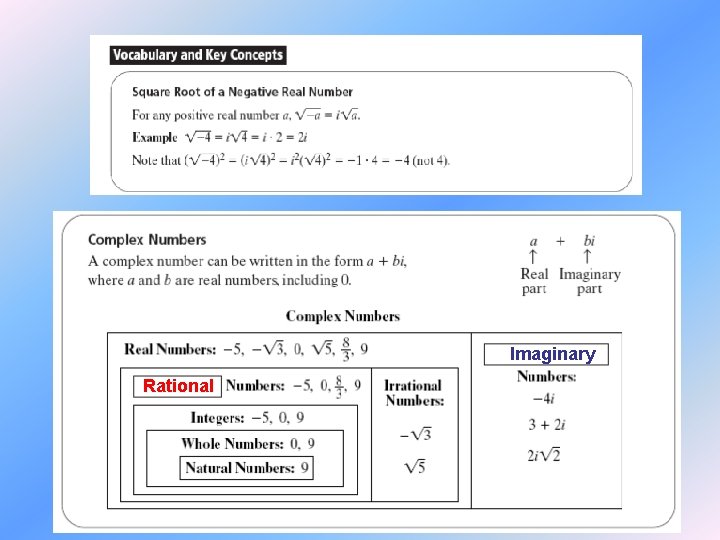
Imaginary Rational
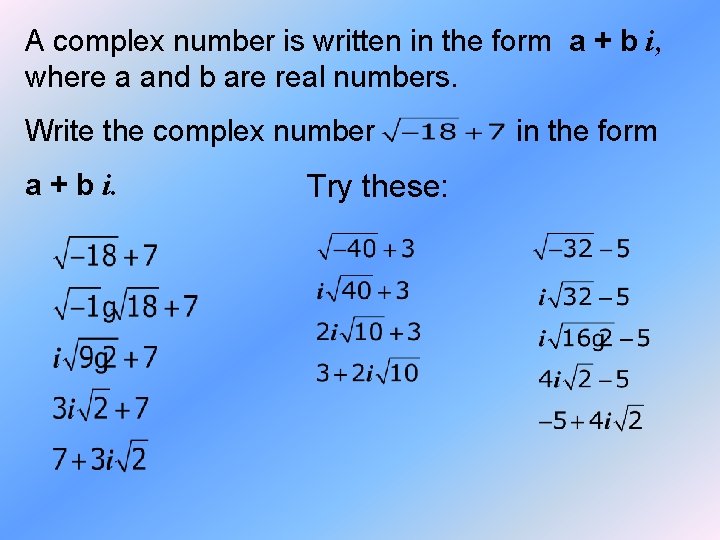
A complex number is written in the form a + b i, where a and b are real numbers. Write the complex number a + b i. Try these: in the form
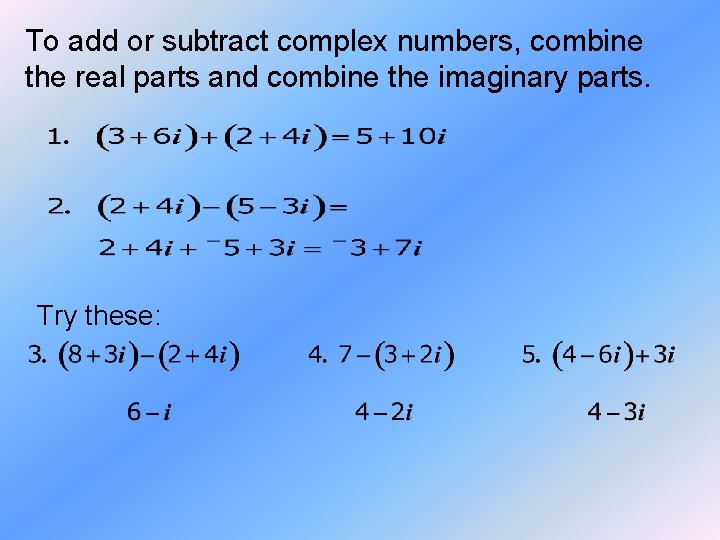
To add or subtract complex numbers, combine the real parts and combine the imaginary parts. Try these:
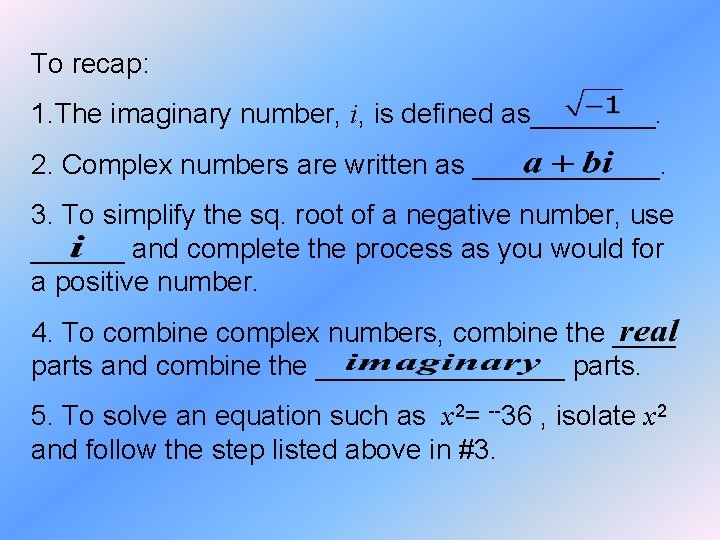
To recap: 1. The imaginary number, i, is defined as____. 2. Complex numbers are written as ______. 3. To simplify the sq. root of a negative number, use ______ and complete the process as you would for a positive number. 4. To combine complex numbers, combine the ____ parts and combine the ________ parts. 5. To solve an equation such as x 2= --36 , isolate x 2 and follow the step listed above in #3.
Use your imagination!!! Tomorrow we will see how imaginary numbers look on a complex plane, how to multiply them, and how to graph them using an imaginary axis. Just imagine the possibilities!!!!!! Work in your group and begin your homework!
- Slides: 14