
Complex Networks Luis Miguel Varela COST meeting Lisbon
Complex Networks Luis Miguel Varela COST meeting, Lisbon March 27 th 2013
Complex Networks Luis Miguel Varela Cabo Introduction Main properties of complex networks Computational algorithms Applications - Market models Regional trade and development - Other social network models of interest Suggested trends Complex Networks Luis Miguel Varela COST meeting, Lisbon March 27 th 2013
Complex Networks Introduction Luis Miguel Varela Cabo Introduction Complex networks analysis in socioeconomic models Statistical mechanics of complex networks Computational algorithms Applications Statistical mechanics of complex networks Computational algorithms - Market models Regional trade and development - Other social network models of interest Suggested trends Applications - Market models - Regional trade and development - Other social network models of interest Suggested trends
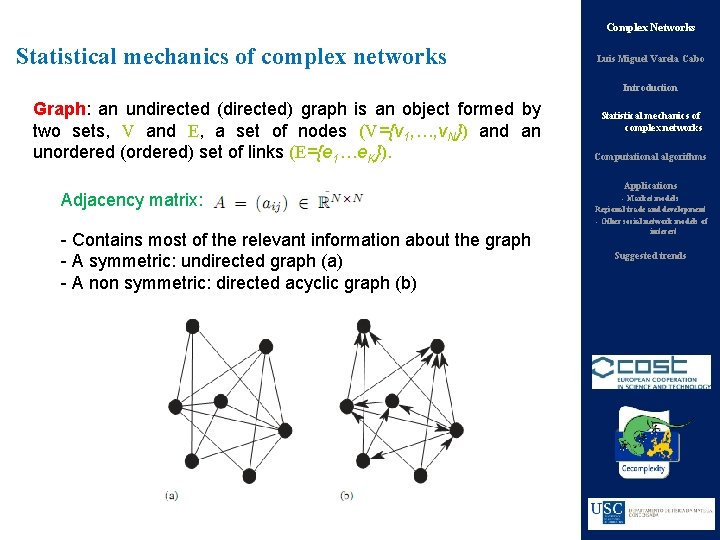
Complex Networks Statistical mechanics of complex networks Luis Miguel Varela Cabo Introduction Graph: an undirected (directed) graph is an object formed by two sets, V and E, a set of nodes (V={v 1, …, v. N}) and an unordered (ordered) set of links (E={e 1…e. K}). Adjacency matrix: - Contains most of the relevant information about the graph - A symmetric: undirected graph (a) - A non symmetric: directed acyclic graph (b) Statistical mechanics of complex networks Computational algorithms Applications - Market models Regional trade and development - Other social network models of interest Suggested trends
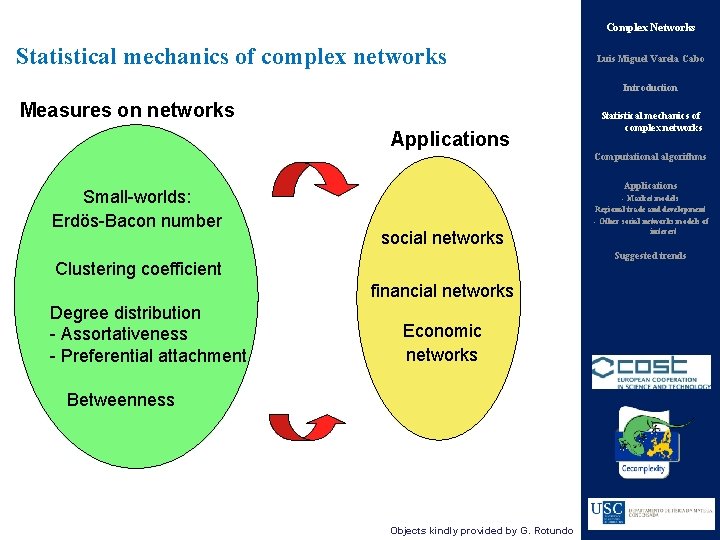
Complex Networks Statistical mechanics of complex networks Luis Miguel Varela Cabo Introduction Measures on networks Applications Statistical mechanics of complex networks Computational algorithms Small-worlds: Erdös-Bacon number Applications social networks Suggested trends Clustering coefficient financial networks Degree distribution - Assortativeness - Preferential attachment - Market models Regional trade and development - Other social networks models of interest Economic networks Betweenness Objects kindly provided by G. Rotundo
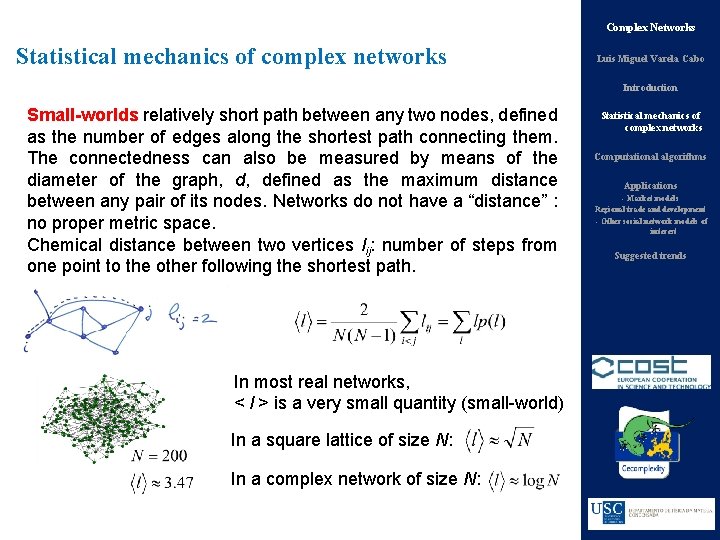
Complex Networks Statistical mechanics of complex networks Luis Miguel Varela Cabo Introduction Small-worlds relatively short path between any two nodes, defined as the number of edges along the shortest path connecting them. The connectedness can also be measured by means of the diameter of the graph, d, defined as the maximum distance between any pair of its nodes. Networks do not have a “distance” : no proper metric space. Chemical distance between two vertices lij: number of steps from one point to the other following the shortest path. In most real networks, < l > is a very small quantity (small-world) In a square lattice of size N: In a complex network of size N: Statistical mechanics of complex networks Computational algorithms Applications - Market models Regional trade and development - Other social network models of interest Suggested trends
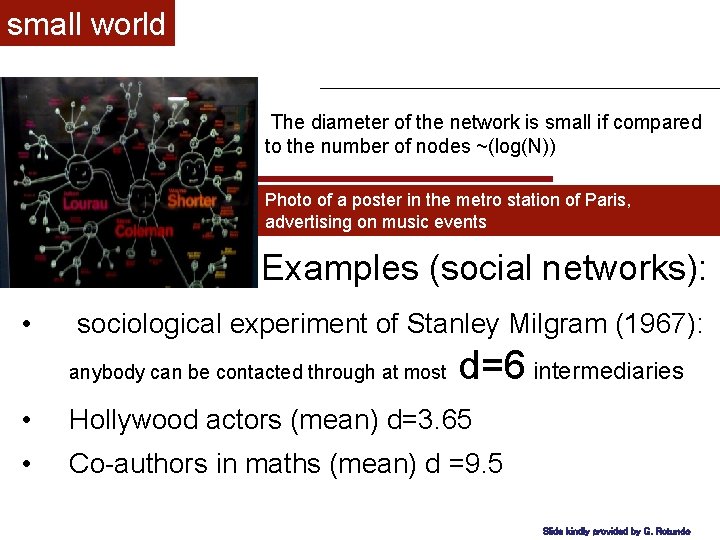
small world The diameter of the network is small if compared to the number of nodes ~(log(N)) Photo of a poster in the metro station of Paris, advertising on music events Examples (social networks): • sociological experiment of Stanley Milgram (1967): anybody can be contacted through at most d=6 intermediaries • Hollywood actors (mean) d=3. 65 • Co-authors in maths (mean) d =9. 5 Slide kindly provided by G. Rotundo
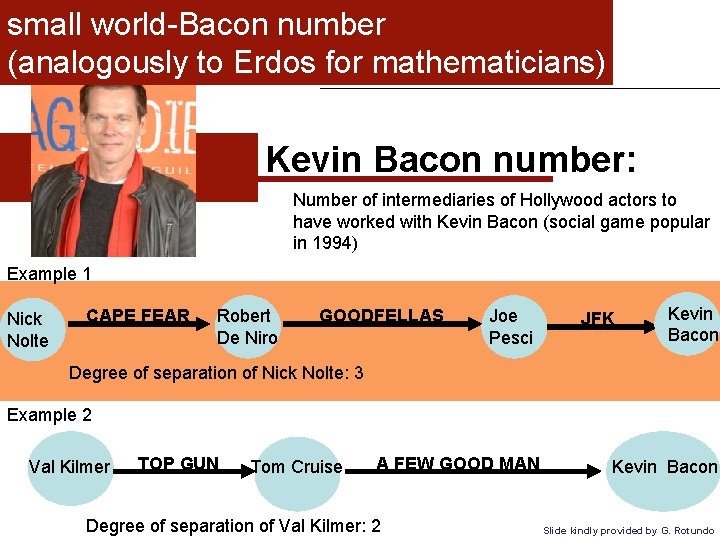
small world-Bacon number (analogously to Erdos for mathematicians) Kevin Bacon number: Number of intermediaries of Hollywood actors to have worked with Kevin Bacon (social game popular in 1994) Example 1 Nick Nolte CAPE FEAR Robert De Niro GOODFELLAS Joe Pesci JFK Kevin Bacon. Degree of separation of Nick Nolte: 3 Example 2 Val Kilmer TOP GUN Tom Cruise A FEW GOOD MAN Degree of separation of Val Kilmer: 2 Kevin Bacon Slide kindly provided by G. Rotundo

Complex Networks Statistical mechanics of complex networks Centrality, To go from one vertex to other in the network, following the shortest path, a series of other vertices and edges are visited. The ones visited more frequently will be more central in the network. Betweenness, number of shortest paths that passes through a given node for all the possible paths between two nodes. Measures the “importance” of a node in a network. C(v)= Number of shortest paths including v Total number of shortest paths Example: node has the most high C(v) Objects kindly provided by G. Rotundo Betweenness (red=0, blue=max) Luis Miguel Varela Cabo Introduction Statistical mechanics of complex networks Computational algorithms Applications - Market models Regional trade and development - Other social network models of interest Suggested trends
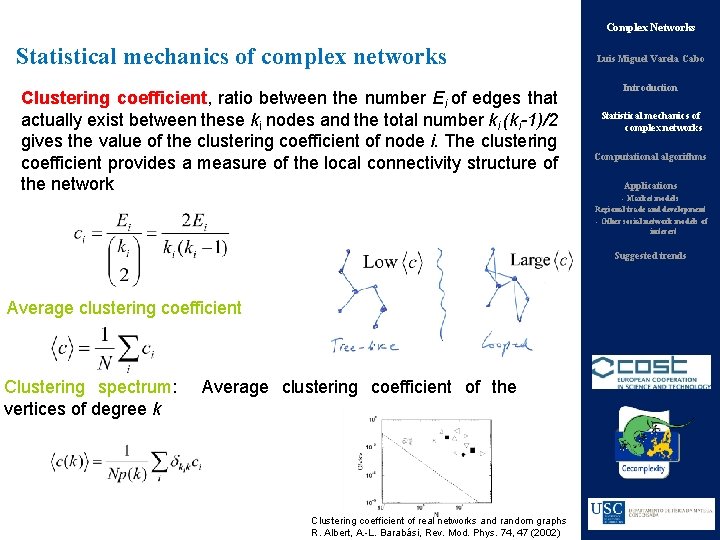
Complex Networks Statistical mechanics of complex networks Clustering coefficient, ratio between the number Ei of edges that actually exist between these ki nodes and the total number ki (ki-1)/2 gives the value of the clustering coefficient of node i. The clustering coefficient provides a measure of the local connectivity structure of the network Luis Miguel Varela Cabo Introduction Statistical mechanics of complex networks Computational algorithms Applications - Market models Regional trade and development - Other social network models of interest Suggested trends Average clustering coefficient Clustering spectrum: vertices of degree k Average clustering coefficient of the Clustering coefficient of real networks and random graphs R. Albert, A. -L. Barabási, Rev. Mod. Phys. 74, 47 (2002)
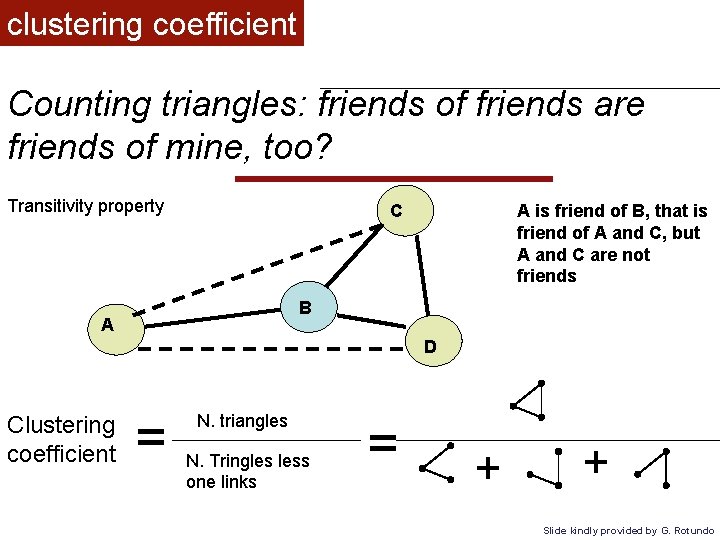
clustering coefficient Counting triangles: friends of friends are friends of mine, too? Transitivity property C A is friend of B, that is friend of A and C, but A and C are not friends B A D Clustering coefficient = N. triangles N. Tringles less one links = + + Slide kindly provided by G. Rotundo
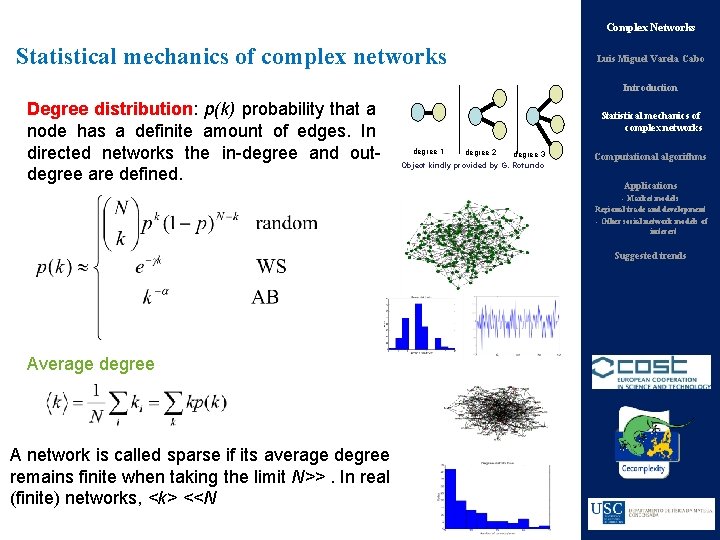
Complex Networks Statistical mechanics of complex networks Luis Miguel Varela Cabo Introduction Degree distribution: p(k) probability that a node has a definite amount of edges. In directed networks the in-degree and outdegree are defined. Statistical mechanics of complex networks degree 1 degree 2 degree 3 Object kindly provided by G. Rotundo Computational algorithms Applications - Market models Regional trade and development - Other social network models of interest Suggested trends Average degree A network is called sparse if its average degree remains finite when taking the limit N>>. In real (finite) networks, <k> <<N
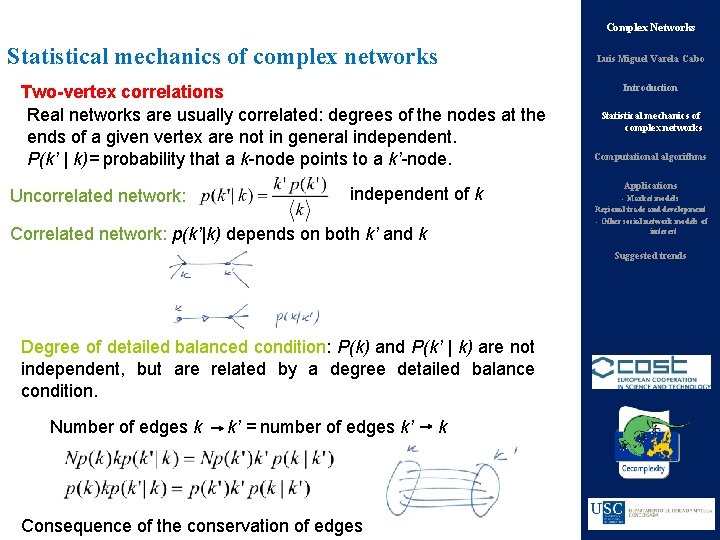
Complex Networks Statistical mechanics of complex networks Two-vertex correlations Real networks are usually correlated: degrees of the nodes at the ends of a given vertex are not in general independent. P(k’ | k)= probability that a k-node points to a k’-node. Fundamental concepts for network topology description independent of k Uncorrelated network: Correlated network: p(k’|k) depends on both k’ and k Luis Miguel Varela Cabo Introduction Statistical mechanics of complex networks Computational algorithms Applications - Market models Regional trade and development - Other social network models of interest Suggested trends Degree of detailed balanced condition: P(k) and P(k’ | k) are not independent, but are related by a degree detailed balance condition. Number of edges k k’ = number of edges k’ Consequence of the conservation of edges k
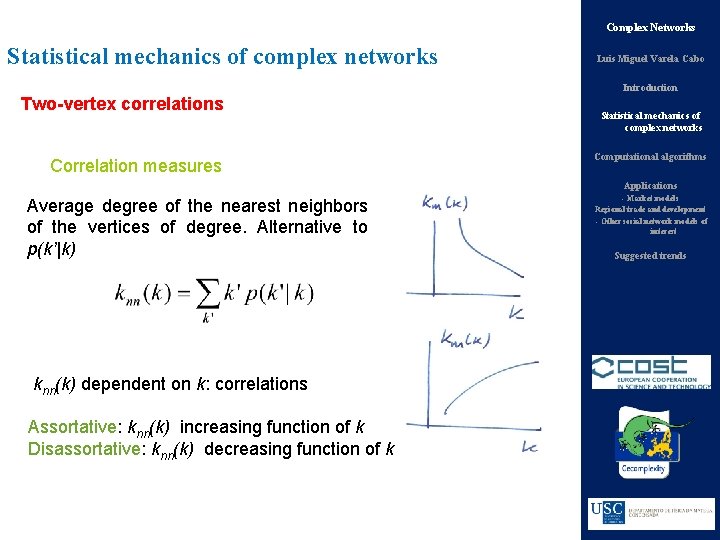
Complex Networks Statistical mechanics of complex networks Luis Miguel Varela Cabo Introduction Two-vertex correlations Correlation measures Fundamental concepts for network topology description Statistical mechanics of complex networks Computational algorithms Applications Average degree of the nearest neighbors of the vertices of degree. Alternative to p(k’|k) knn(k) dependent on k: correlations Assortative: knn(k) increasing function of k Disassortative: knn(k) decreasing function of k - Market models Regional trade and development - Other social network models of interest Suggested trends
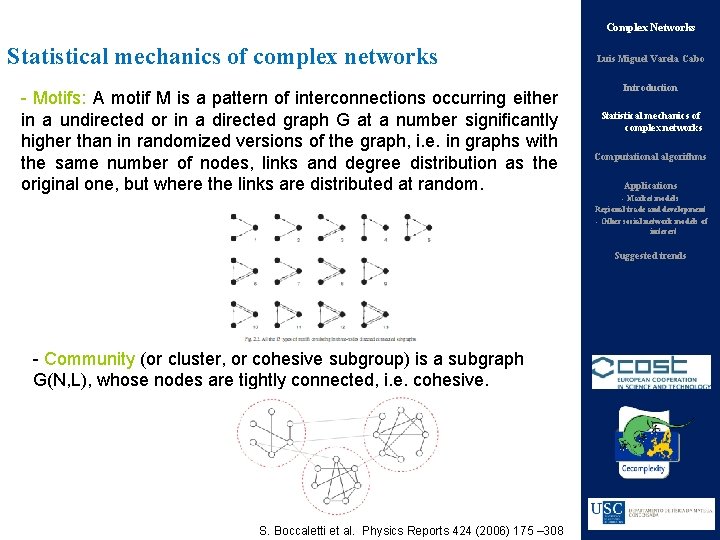
Complex Networks Statistical mechanics of complex networks - Motifs: A motif M is a pattern of interconnections occurring either in a undirected or in a directed graph G at a number significantly higher than in randomized of the graph, description i. e. in graphs with Fundamental conceptsversions for network topology the same number of nodes, links and degree distribution as the original one, but where the links are distributed at random. Luis Miguel Varela Cabo Introduction Statistical mechanics of complex networks Computational algorithms Applications - Market models Regional trade and development - Other social network models of interest Suggested trends - Community (or cluster, or cohesive subgroup) is a subgraph G(N, L), whose nodes are tightly connected, i. e. cohesive. S. Boccaletti et al. Physics Reports 424 (2006) 175 – 308
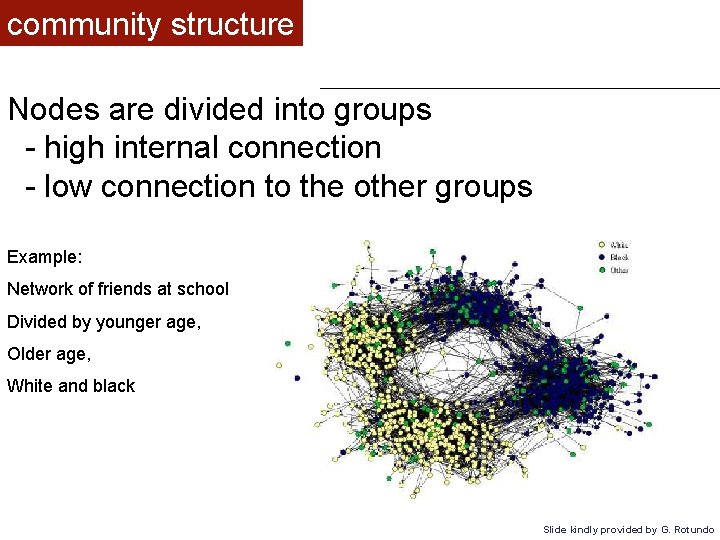
community structure Nodes are divided into groups - high internal connection - low connection to the other groups Example: Network of friends at school Divided by younger age, Older age, White and black Slide kindly provided by G. Rotundo
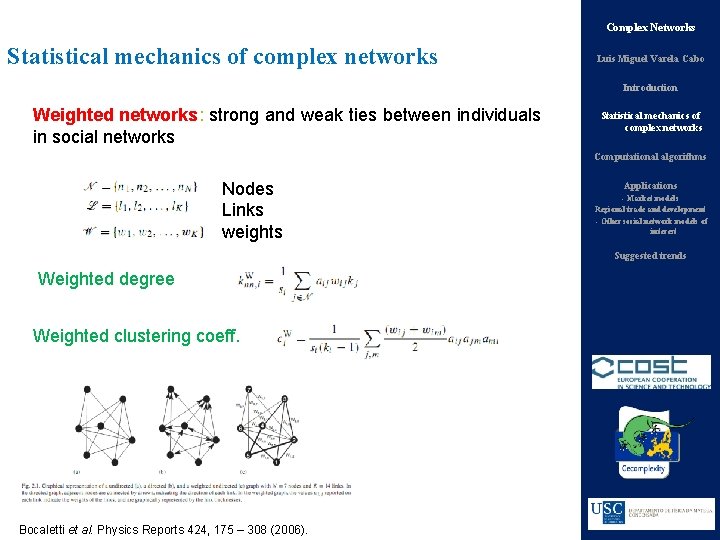
Complex Networks Statistical mechanics of complex networks Luis Miguel Varela Cabo Introduction Weighted networks: strong and weak ties between individuals in social networks Statistical mechanics of complex networks Computational algorithms Directed networks and weighted networks Nodes Links weights Applications - Market models Regional trade and development - Other social network models of interest Suggested trends Weighted degree Weighted clustering coeff. Bocaletti et al. Physics Reports 424, 175 – 308 (2006).
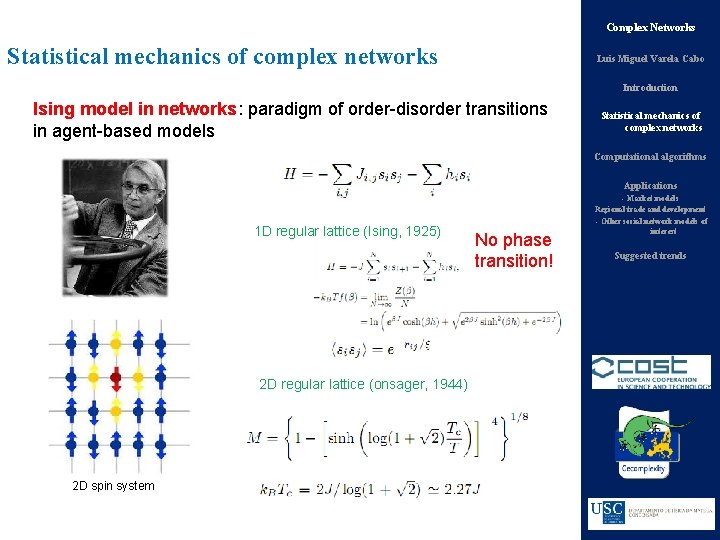
Complex Networks Statistical mechanics of complex networks Luis Miguel Varela Cabo Introduction Ising model in networks: paradigm of order-disorder transitions in agent-based models Statistical mechanics of complex networks Computational algorithms Applications 1 D regular lattice (Ising, 1925) 2 D regular lattice (onsager, 1944) 2 D spin system No phase transition! - Market models Regional trade and development - Other social network models of interest Suggested trends
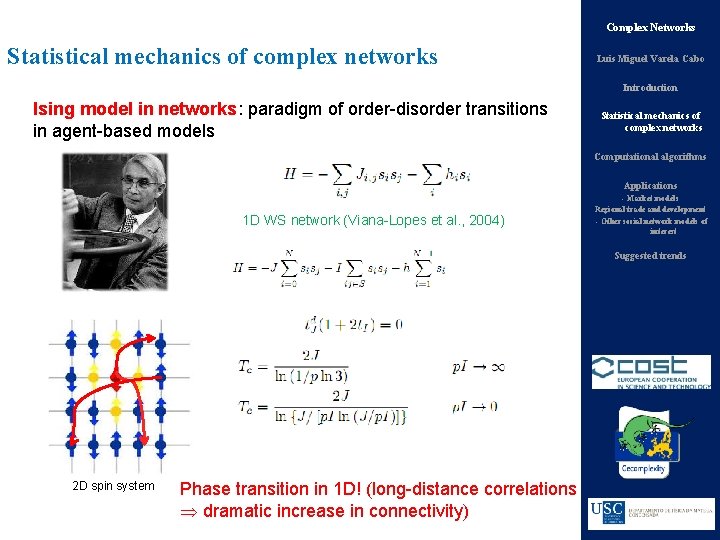
Complex Networks Statistical mechanics of complex networks Luis Miguel Varela Cabo Introduction Ising model in networks: paradigm of order-disorder transitions in agent-based models Statistical mechanics of complex networks Computational algorithms Applications 1 D WS network (Viana-Lopes et al. , 2004) - Market models Regional trade and development - Other social network models of interest Suggested trends 2 D spin system Phase transition in 1 D! (long-distance correlations dramatic increase in connectivity)
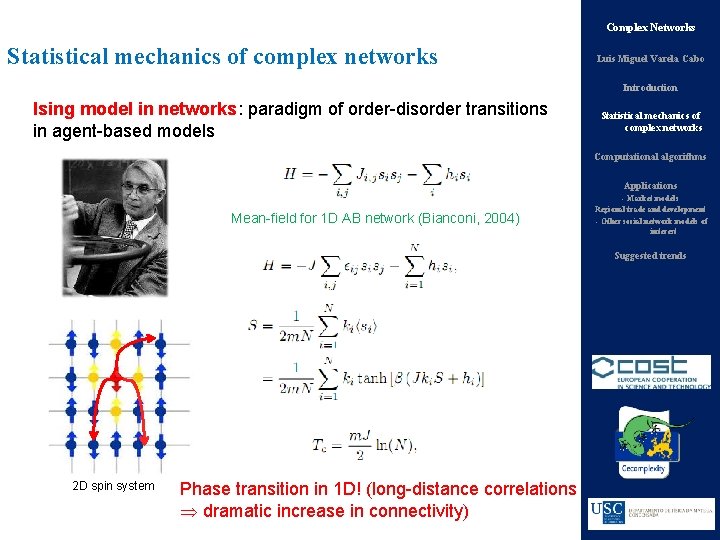
Complex Networks Statistical mechanics of complex networks Luis Miguel Varela Cabo Introduction Ising model in networks: paradigm of order-disorder transitions in agent-based models Statistical mechanics of complex networks Computational algorithms Applications Mean-field for 1 D AB network (Bianconi, 2004) - Market models Regional trade and development - Other social network models of interest Suggested trends 2 D spin system Phase transition in 1 D! (long-distance correlations dramatic increase in connectivity)
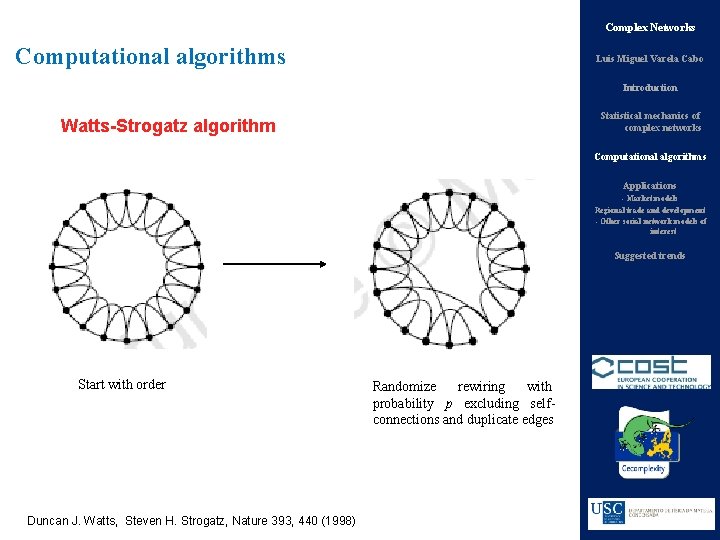
Complex Networks Computational algorithms Luis Miguel Varela Cabo Introduction Statistical mechanics of complex networks Watts-Strogatz algorithm Computational algorithms Applications - Market models Regional trade and development - Other social network models of interest Suggested trends Start with order Duncan J. Watts, Steven H. Strogatz, Nature 393, 440 (1998) Randomize rewiring with probability p excluding selfconnections and duplicate edges
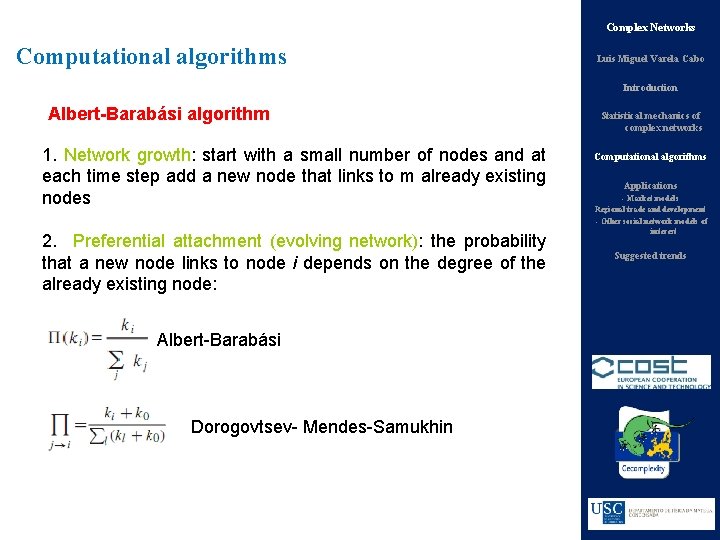
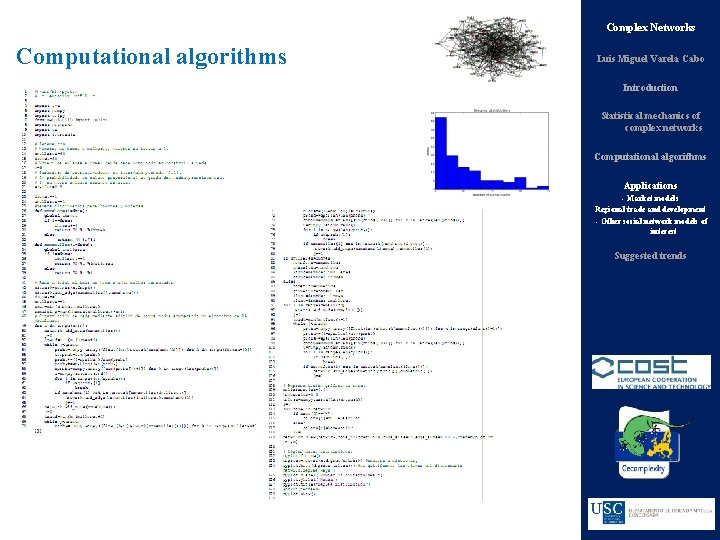
Complex Networks Computational algorithms Luis Miguel Varela Cabo Introduction Albert-Barabási algorithm 1. Network growth: start with a small number of nodes and at each time step add a new node that links to m already existing nodes 2. Preferential attachment (evolving network): the probability that a new node links to node i depends on the degree of the already existing node: Albert-Barabási Dorogovtsev- Mendes-Samukhin Statistical mechanics of complex networks Computational algorithms Applications - Market models Regional trade and development - Other social network models of interest Suggested trends
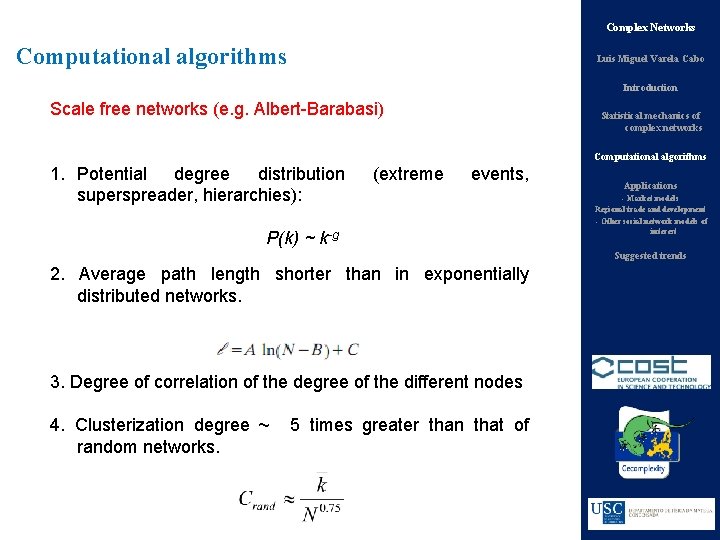
Complex Networks Computational algorithms Luis Miguel Varela Cabo Introduction Scale free networks (e. g. Albert-Barabasi) Statistical mechanics of complex networks Computational algorithms 1. Potential degree distribution superspreader, hierarchies): (extreme events, P(k) ~ k-g Applications - Market models Regional trade and development - Other social network models of interest Suggested trends 2. Average path length shorter than in exponentially distributed networks. 3. Degree of correlation of the degree of the different nodes 4. Clusterization degree ~ random networks. 5 times greater than that of
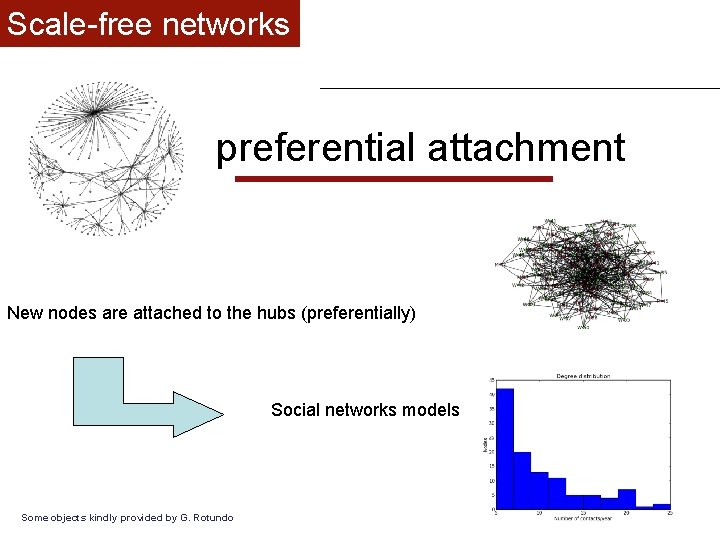
Scale-free networks preferential attachment New nodes are attached to the hubs (preferentially) Social networks models Some objects kindly provided by G. Rotundo
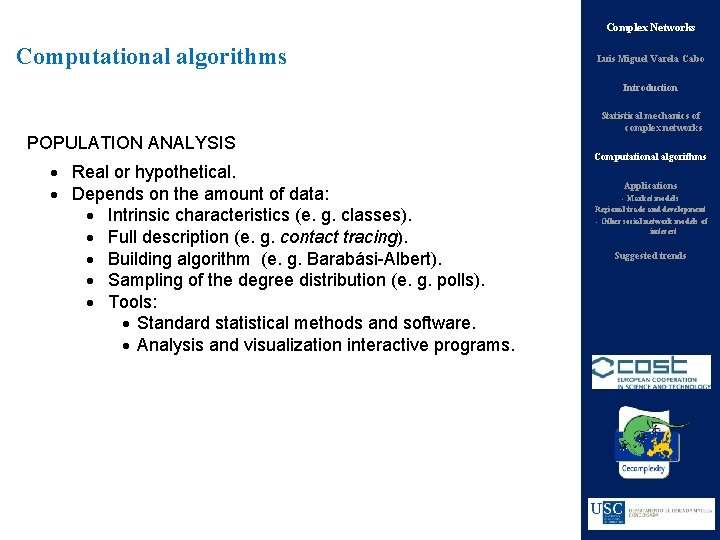
Complex Networks Computational algorithms Luis Miguel Varela Cabo Introduction POPULATION ANALYSIS Real or hypothetical. Depends on the amount of data: Intrinsic characteristics (e. g. classes). Full description (e. g. contact tracing). Building algorithm (e. g. Barabási-Albert). Sampling of the degree distribution (e. g. polls). Tools: Standard statistical methods and software. Analysis and visualization interactive programs. Statistical mechanics of complex networks Computational algorithms Applications - Market models Regional trade and development - Other social network models of interest Suggested trends
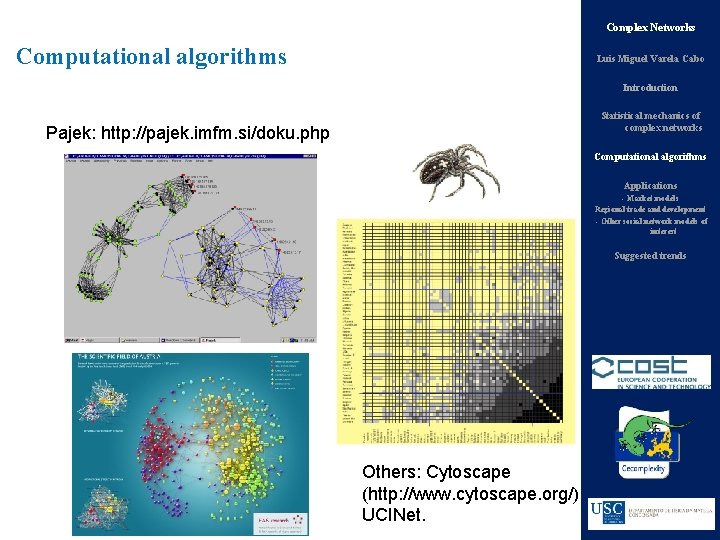
Complex Networks Computational algorithms Luis Miguel Varela Cabo Introduction Statistical mechanics of complex networks Pajek: http: //pajek. imfm. si/doku. php Computational algorithms Applications - Market models Regional trade and development - Other social network models of interest Suggested trends Others: Cytoscape (http: //www. cytoscape. org/), UCINet.
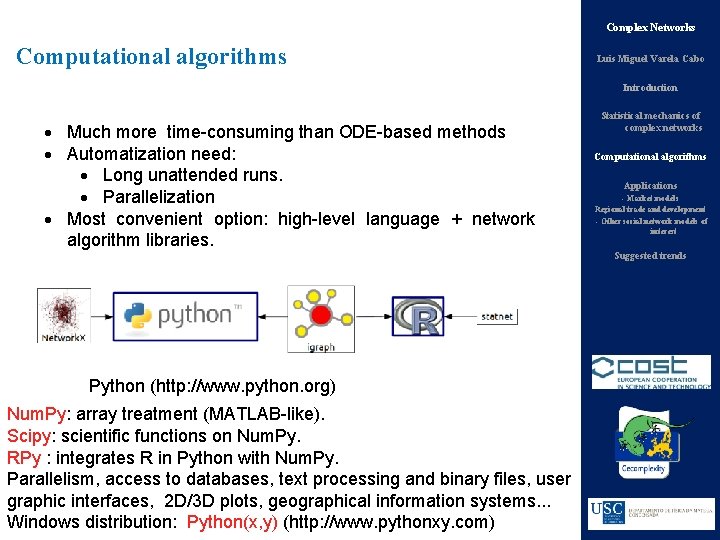
Complex Networks Computational algorithms Luis Miguel Varela Cabo Introduction Much more time-consuming than ODE-based methods Automatization need: Long unattended runs. Parallelization Most convenient option: high-level language + network algorithm libraries. Statistical mechanics of complex networks Computational algorithms Applications - Market models Regional trade and development - Other social network models of interest Suggested trends Python (http: //www. python. org) Num. Py: array treatment (MATLAB-like). Scipy: scientific functions on Num. Py. RPy : integrates R in Python with Num. Py. Parallelism, access to databases, text processing and binary files, user graphic interfaces, 2 D/3 D plots, geographical information systems. . . Windows distribution: Python(x, y) (http: //www. pythonxy. com)
Complex Networks Computational algorithms Luis Miguel Varela Cabo Introduction POSTPROCESSING Statistical mechanics of complex networks Computational algorithms Applications General methods: Calculus sheets [catastrophic precission: G. Almiron et al. , Journal of Statistical Software 34 (2010)]. Analysis environments: MATLAB, Mathematica, Octave, etc. Specific: R+statnet, Python+Network. X - Market models Regional trade and development - Other social network models of interest Suggested trends
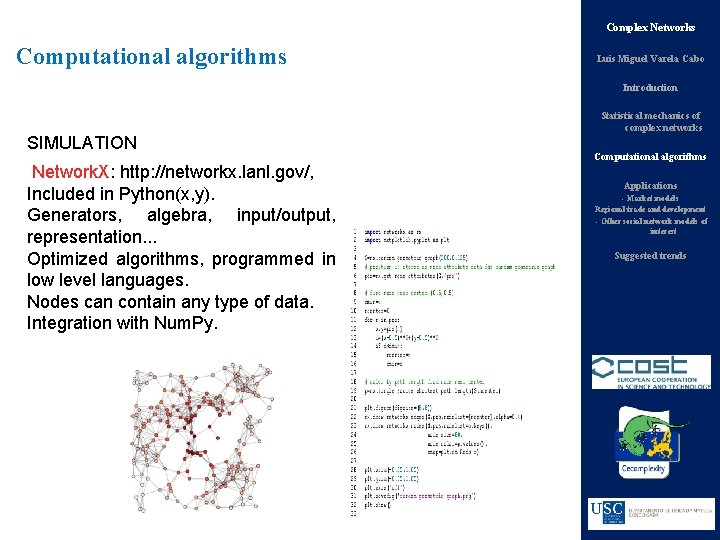
Complex Networks Computational algorithms Luis Miguel Varela Cabo Introduction SIMULATION Network. X: http: //networkx. lanl. gov/, Included in Python(x, y). Generators, algebra, input/output, representation. . . Optimized algorithms, programmed in low level languages. Nodes can contain any type of data. Integration with Num. Py. Statistical mechanics of complex networks Computational algorithms Applications - Market models Regional trade and development - Other social network models of interest Suggested trends
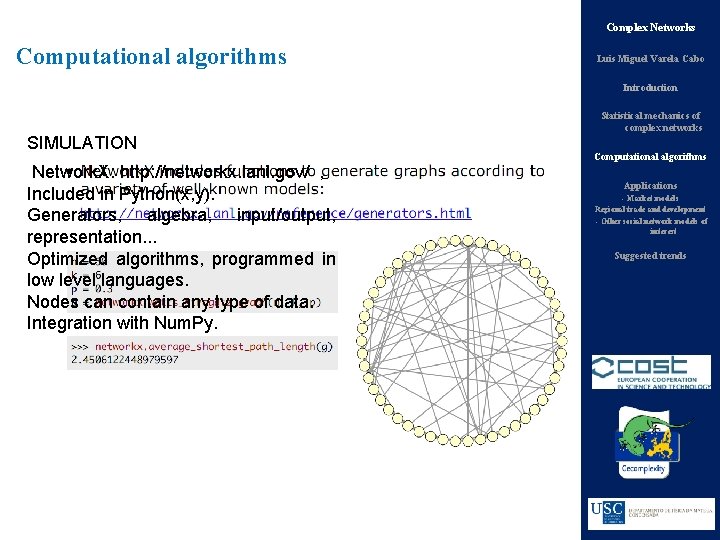
Complex Networks Computational algorithms Luis Miguel Varela Cabo Introduction SIMULATION Network. X: http: //networkx. lanl. gov/ , Included in Python(x, y). Generators, algebra, input/output, representation. . . Optimized algorithms, programmed in low level languages. Nodes can contain any type of data. Integration with Num. Py. Statistical mechanics of complex networks Computational algorithms Applications - Market models Regional trade and development - Other social network models of interest Suggested trends
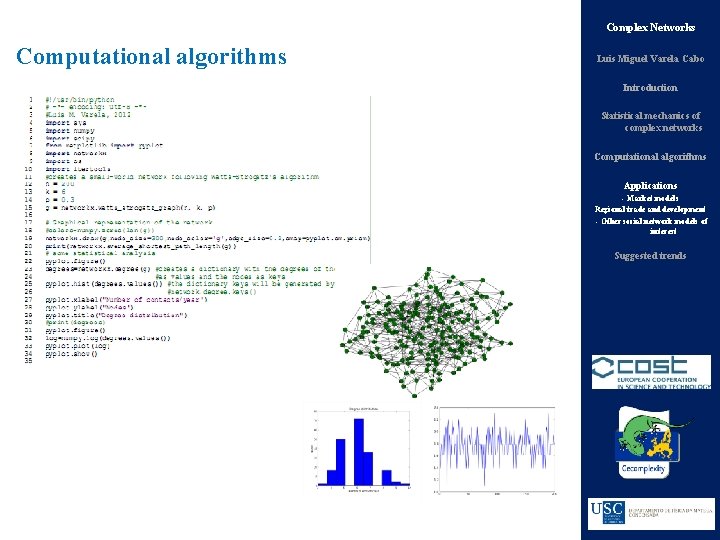
Complex Networks Computational algorithms Luis Miguel Varela Cabo Introduction Statistical mechanics of complex networks Computational algorithms Applications - Market models Regional trade and development - Other social network models of interest Suggested trends
Complex Networks Computational algorithms Luis Miguel Varela Cabo Introduction Statistical mechanics of complex networks Computational algorithms Applications - Market models Regional trade and development - Other social network models of interest Suggested trends
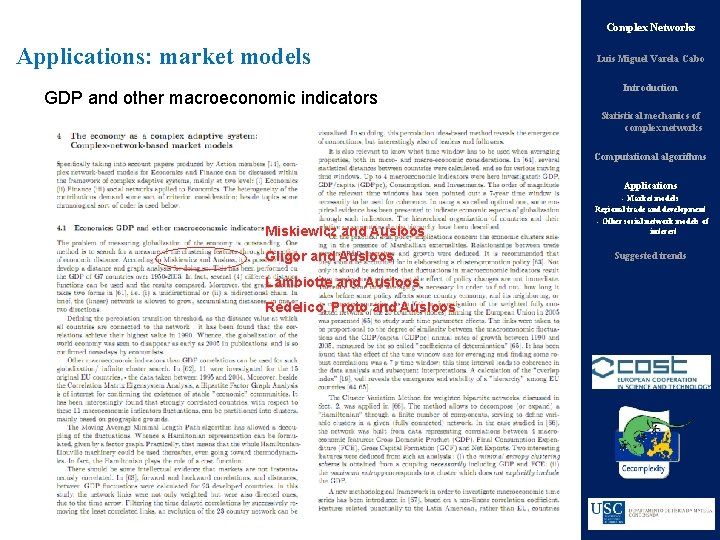
Complex Networks Applications: market models GDP and other macroeconomic indicators Luis Miguel Varela Cabo Introduction Statistical mechanics of complex networks Computational algorithms Applications Miskiewicz and Ausloos Gligor and Ausloos Lambiotte and Ausloos Redelico, Proto and Ausloos - Market models Regional trade and development - Other social network models of interest Suggested trends
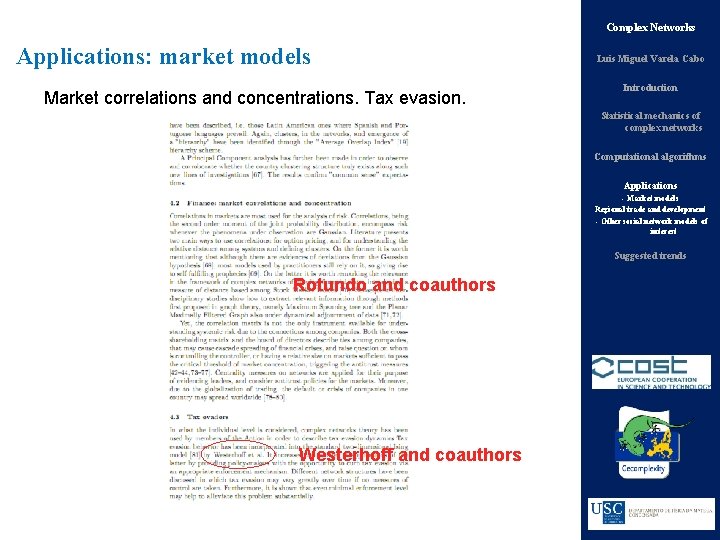
Complex Networks Applications: market models Market correlations and concentrations. Tax evasion. Luis Miguel Varela Cabo Introduction Statistical mechanics of complex networks Computational algorithms Applications - Market models Regional trade and development - Other social network models of interest Suggested trends Rotundo and coauthors Westerhoff and coauthors
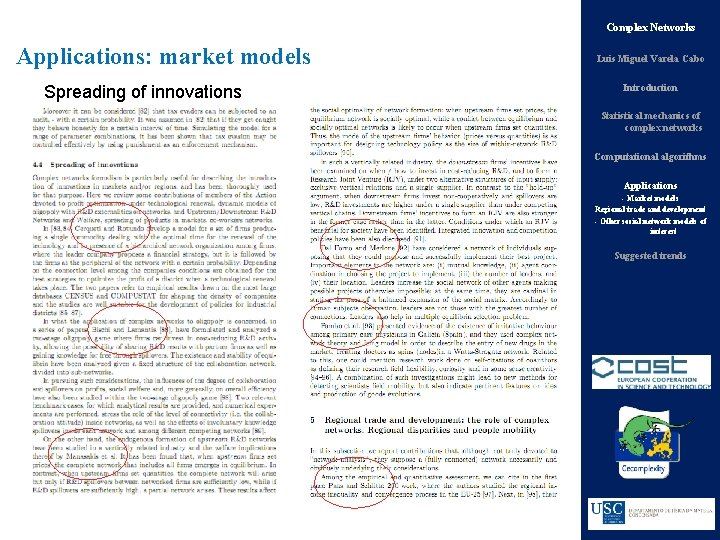
Complex Networks Applications: market models Spreading of innovations Luis Miguel Varela Cabo Introduction Statistical mechanics of complex networks Computational algorithms Applications - Market models Regional trade and development - Other social network models of interest Suggested trends
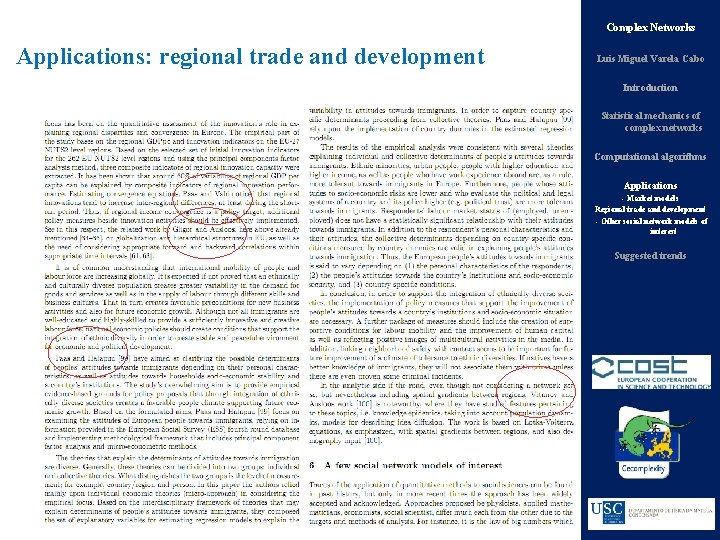
Complex Networks Applications: regional trade and development Luis Miguel Varela Cabo Introduction Statistical mechanics of complex networks Computational algorithms Applications - Market models Regional trade and development - Other social network models of interest Suggested trends
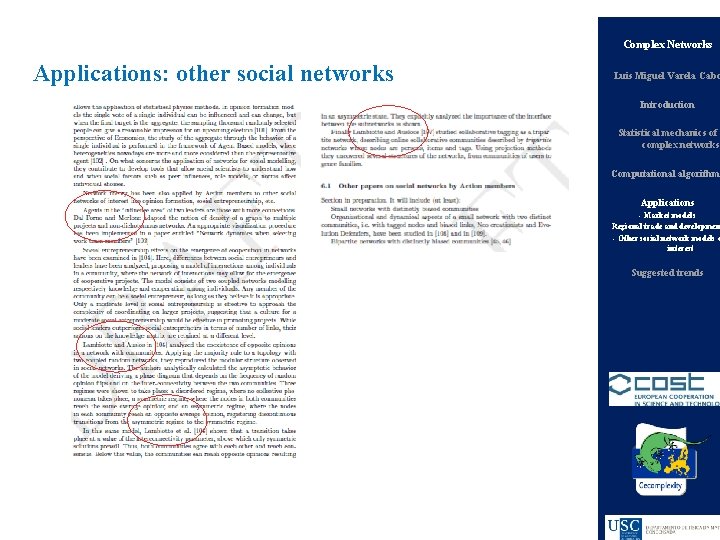
Complex Networks Applications: other social networks Luis Miguel Varela Cabo Introduction Statistical mechanics of complex networks Computational algorithm Applications - Market models Regional trade and developmen - Other social network models o interest Suggested trends
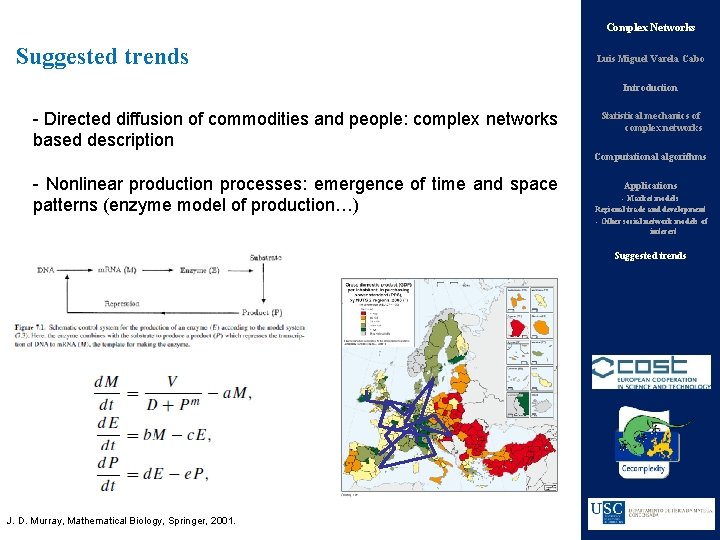
Complex Networks Suggested trends Luis Miguel Varela Cabo Introduction - Directed diffusion of commodities and people: complex networks based description Statistical mechanics of complex networks Computational algorithms - Nonlinear production processes: emergence of time and space patterns (enzyme model of production…) Applications - Market models Regional trade and development - Other social network models of interest Suggested trends J. D. Murray, Mathematical Biology, Springer, 2001.
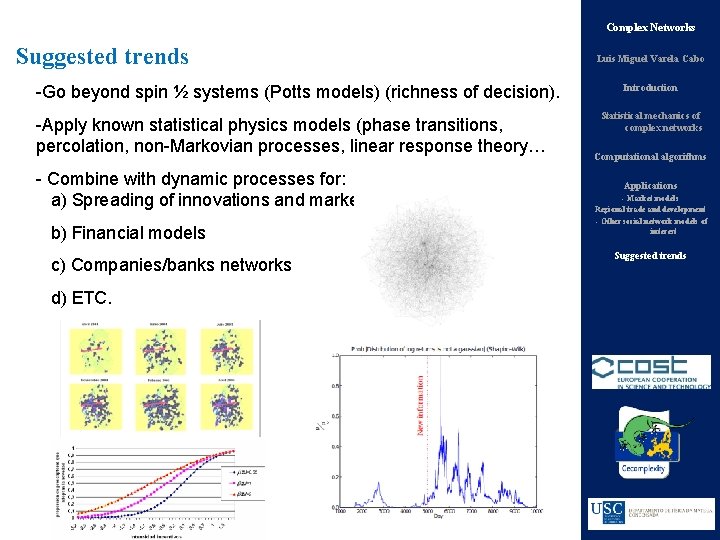
Complex Networks Suggested trends -Go beyond spin ½ systems (Potts models) (richness of decision). -Apply known statistical physics models (phase transitions, percolation, non-Markovian processes, linear response theory… - Combine with dynamic processes for: a) Spreading of innovations and market models b) Financial models c) Companies/banks networks d) ETC. Luis Miguel Varela Cabo Introduction Statistical mechanics of complex networks Computational algorithms Applications - Market models Regional trade and development - Other social network models of interest Suggested trends

MANY THANKS FOR YOUR ATTENTION
Complex Networks Luis Miguel Varela COST meeting, Lisbon March 27 th 2013
- Slides: 41