
Complex Ions and stuff like that Complex Ions

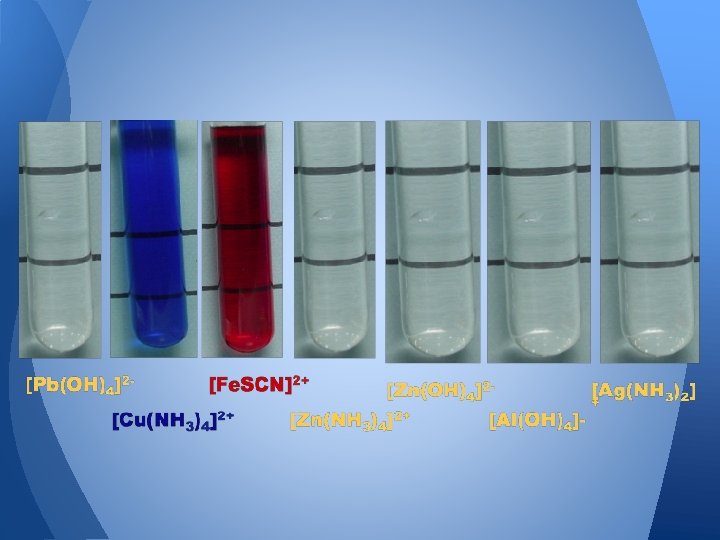
![Making "OH" Complexes [Al(OH)4][Zn(OH)4]2[Pb(OH)4]2 - These hydroxide complexes are made by adding excess hydroxide](https://slidetodoc.com/presentation_image_h2/d7c1f4f06db616a2e40a9dae249d32de/image-7.jpg "Making \"OH\" Complexes [Al(OH)4][Zn(OH)4]2[Pb(OH)4]2 - These hydroxide complexes are made by adding excess hydroxide")
![Making NH 3 Complexes [Cu(NH 3)4]2+ [Ag(NH 3)2]+ [Zn(NH 3)4]2+ These ammonia complexes are](https://slidetodoc.com/presentation_image_h2/d7c1f4f06db616a2e40a9dae249d32de/image-8.jpg "Making NH 3 Complexes [Cu(NH 3)4]2+ [Ag(NH 3)2]+ [Zn(NH 3)4]2+ These ammonia complexes are")
![[Al(OH)4]Aluminium ions + Sodium hydroxide = Aluminium hydroxide ppt - Al(OH)3 Adding excess Sodium](https://slidetodoc.com/presentation_image_h2/d7c1f4f06db616a2e40a9dae249d32de/image-9.jpg "[Al(OH)4]Aluminium ions + Sodium hydroxide = Aluminium hydroxide ppt - Al(OH)3 Adding excess Sodium")
![[Cu(NH 3)4]2+ Copper ions + Ammonia = When used in small amounts OH- react,](https://slidetodoc.com/presentation_image_h2/d7c1f4f06db616a2e40a9dae249d32de/image-10.jpg "[Cu(NH 3)4]2+ Copper ions + Ammonia = When used in small amounts OH- react,")




- Slides: 20
Complex Ions and stuff like that.
Complex Ions A complex ion is the exception to a rule. . . It is an ionic compound that has an overall charge. Complex ions are identified using square brackets. [ ]
Complex Ions Are soluble. Usually formed from solutions containing precipitates. There are 7 you need to memorise.
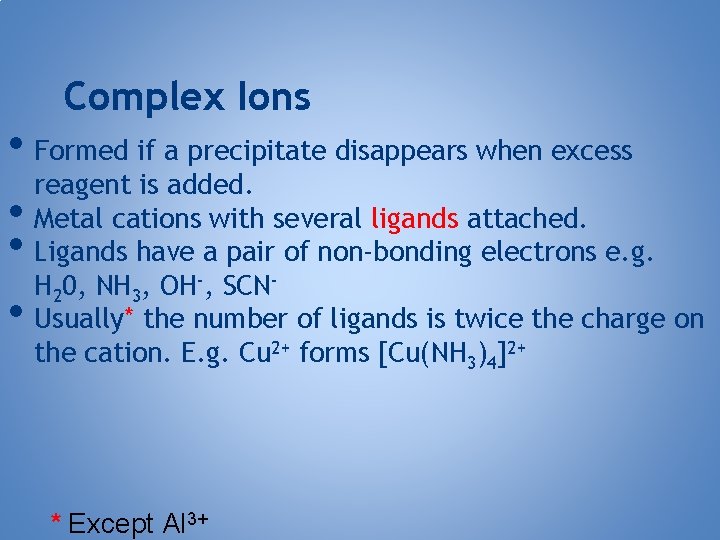
Complex Ions • Formed if a precipitate disappears when excess reagent is added. • Metal cations with several ligands attached. • Ligands have a pair of non-bonding electrons e. g. H 0, NH , OH , SCN • Usually* the number of ligands is twice the charge on 2 3 - - the cation. E. g. Cu 2+ forms [Cu(NH 3)4]2+ * Except Al 3+
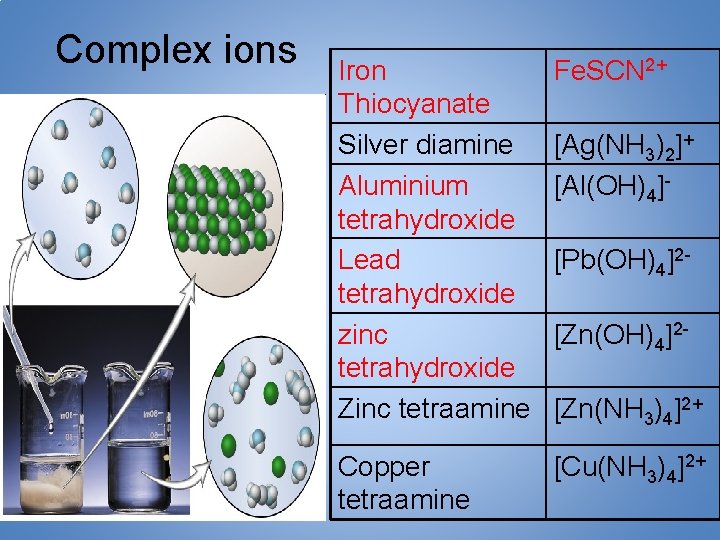
Complex ions Iron Thiocyanate Silver diamine Aluminium tetrahydroxide Lead tetrahydroxide zinc tetrahydroxide Zinc tetraamine Fe. SCN 2+ Copper tetraamine [Cu(NH 3)4]2+ [Ag(NH 3)2]+ [Al(OH)4][Pb(OH)4]2[Zn(NH 3)4]2+
Making "OH" Complexes [Al(OH)4][Zn(OH)4]2[Pb(OH)4]2 - These hydroxide complexes are made by adding excess hydroxide to a hydroxide precipitate.
Making NH 3 Complexes [Cu(NH 3)4]2+ [Ag(NH 3)2]+ [Zn(NH 3)4]2+ These ammonia complexes are made by adding excess (ammonia) ammonium hydroxide to a hydroxide precipitate.
[Al(OH)4]Aluminium ions + Sodium hydroxide = Aluminium hydroxide ppt - Al(OH)3 Adding excess Sodium hydroxide = Al(OH)3 + OH- --> [Al(OH)4]-
[Cu(NH 3)4]2+ Copper ions + Ammonia = When used in small amounts OH- react, when used in large amounts (excess) NH 3 reacts. Copper hydroxide ppt - Cu(OH)2 Adding excess Ammonia = Cu(OH)2 + 2 OH- --> [Cu(NH 3)4]2+
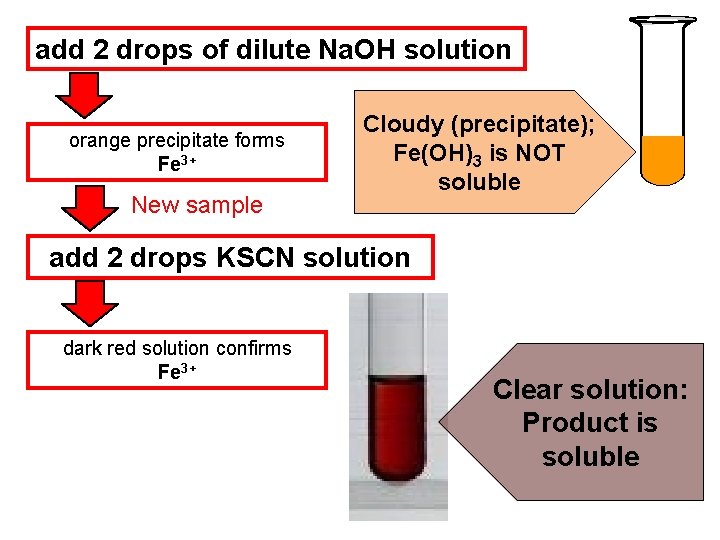
add 2 drops of dilute Na. OH solution orange precipitate forms Fe 3+ New sample Cloudy (precipitate); Fe(OH)3 is NOT soluble add 2 drops KSCN solution dark red solution confirms Fe 3+ Clear solution: Product is soluble
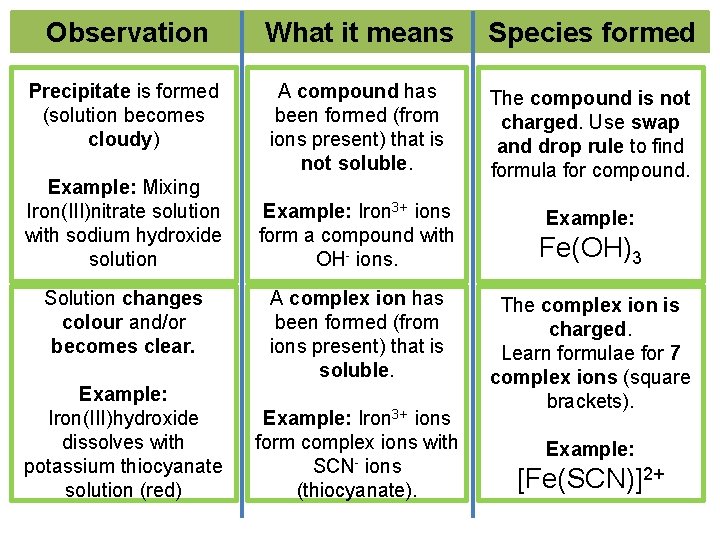
Observation What it means Species formed Precipitate is formed (solution becomes cloudy) A compound has been formed (from ions present) that is not soluble. The compound is not charged. Use swap and drop rule to find formula for compound. Example: Iron 3+ ions form a compound with OH- ions. Example: Mixing Iron(III)nitrate solution with sodium hydroxide solution Solution changes colour and/or becomes clear. Example: Iron(III)hydroxide dissolves with potassium thiocyanate solution (red) A complex ion has been formed (from ions present) that is soluble. Example: Iron 3+ ions form complex ions with SCN- ions (thiocyanate). Fe(OH)3 The complex ion is charged. Learn formulae for 7 complex ions (square brackets). Example: [Fe(SCN)]2+
Observation What it means Species formed Precipitate is formed (solution becomes cloudy) A compound has been formed (from ions present) that is not soluble. The compound is not charged. Use swap and drop rule to find formula for compound. Example: Iron 3+ ions form a compound with OH- ions. Example: Mixing Iron(III)nitrate solution with sodium hydroxide solution Solution changes colour and/or becomes clear. Example: Iron(III)hydroxide dissolves with potassium thiocyanate solution (red) A complex ion has been formed (from ions present) that is soluble. Example: Iron 3+ ions form complex ions with SCN- ions (thiocyanate). Fe(OH)3 The complex ion is charged. Learn formulae for 7 complex ions (square brackets). Example: [Fe(SCN)]2+
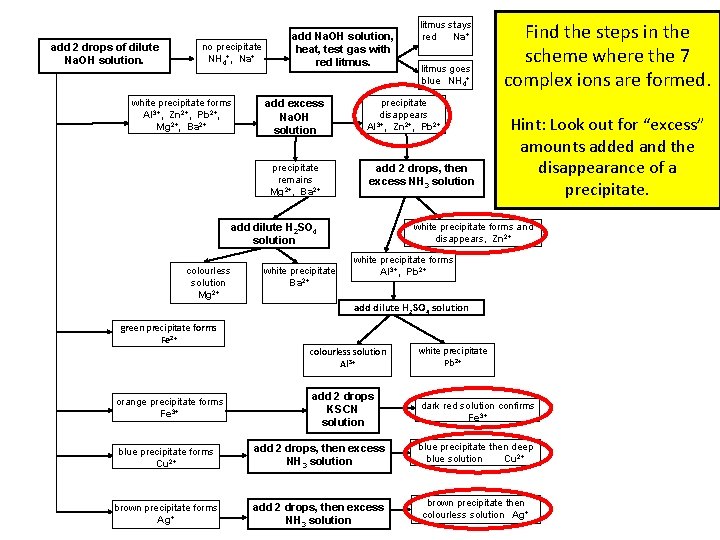
add 2 drops of dilute Na. OH solution. no precipitate NH 4+, Na+ white precipitate forms Al 3+, Zn 2+, Pb 2+, Mg 2+, Ba 2+ add Na. OH solution, heat, test gas with red litmus. add excess Na. OH solution precipitate remains Mg 2+, Ba 2+ white precipitate Ba 2+ litmus goes blue NH 4+ precipitate disappears Al 3+, Zn 2+, Pb 2+ add 2 drops, then excess NH 3 solution Find the steps in the scheme where the 7 complex ions are formed. Hint: Look out for “excess” amounts added and the disappearance of a precipitate. white precipitate forms and disappears, Zn 2+ add dilute H 2 SO 4 solution colourless solution Mg 2+ litmus stays red Na+ white precipitate forms Al 3+, Pb 2+ add dilute H 2 SO 4 solution green precipitate forms Fe 2+ orange precipitate forms Fe 3+ colourless solution Al 3+ white precipitate Pb 2+ add 2 drops KSCN solution dark red solution confirms Fe 3+ blue precipitate forms Cu 2+ add 2 drops, then excess NH 3 solution blue precipitate then deep blue solution Cu 2+ brown precipitate forms Ag+ add 2 drops, then excess NH 3 solution brown precipitate then colourless solution Ag+
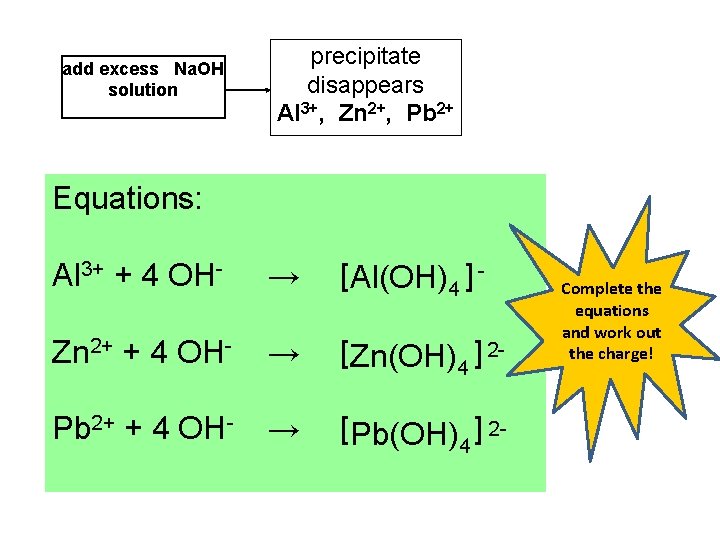
add excess Na. OH solution precipitate disappears Al 3+, Zn 2+, Pb 2+ Equations: Al 3+ + 4 OH- → [ Al(OH)4 ] - Zn 2+ + 4 OH- → [ Zn(OH)4 ] 2 - Pb 2+ + 4 OH- → [ Pb(OH)4 ] 2 - Complete the equations and work out the charge!
add 2 drops, then excess NH 3 solution White precipitate forms and disappears Zn 2+ Complete the equation and work out the charge! Equation: Zn 2+ + 4 NH 3 → [ Zn(NH 3)4 ] 2+
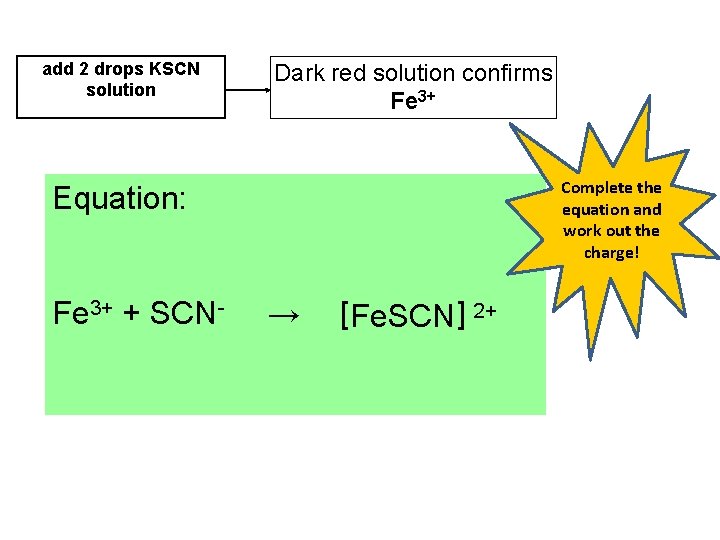
add 2 drops KSCN solution Dark red solution confirms Fe 3+ Complete the equation and work out the charge! Equation: Fe 3+ + SCN- → [ Fe. SCN ] 2+
add 2 drops, then excess NH 3 solution Blue precipitate, then deep blue solution Cu 2+ Complete the equation and work out the charge! Equation: Cu 2+ + 4 NH 3 → [ Cu(NH 3)4] 2+
add 2 drops, then excess NH 3 solution Brown precipitate, then colourless solution Ag+ Complete the equation and work out the charge! Equation: Ag+ + 2 NH 3 → [ Ag(NH 3)2 ] +
Written questions for end of assessment • You will be given a list of observations • You need to methodically follow the flow charts and make conclusions and equations as if you were actually carrying it out in real life. • Eg: Question 1 • No ppt with silver nitrate means sulfate or nitrate ion • White precipitate with barium nitrate means it must be sulfate ion • Ba 2+(aq) + SO 42 -(aq) Ba. SO 4(s)