
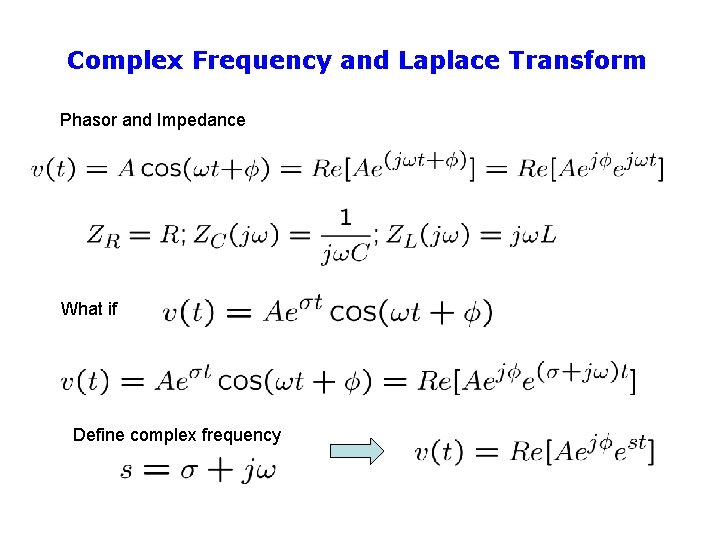
Complex Frequency and Laplace Transform Phasor and Impedance
- Slides: 27
Complex Frequency and Laplace Transform Phasor and Impedance What if Define complex frequency
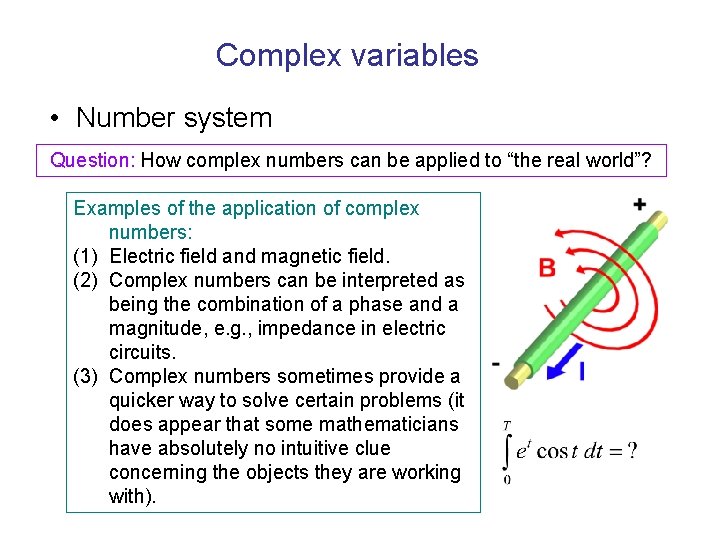
Complex variables • Number system Question: How complex numbers can be applied to “the real world”? Examples of the application of complex numbers: (1) Electric field and magnetic field. (2) Complex numbers can be interpreted as being the combination of a phase and a magnitude, e. g. , impedance in electric circuits. (3) Complex numbers sometimes provide a quicker way to solve certain problems (it does appear that some mathematicians have absolutely no intuitive clue concerning the objects they are working with).
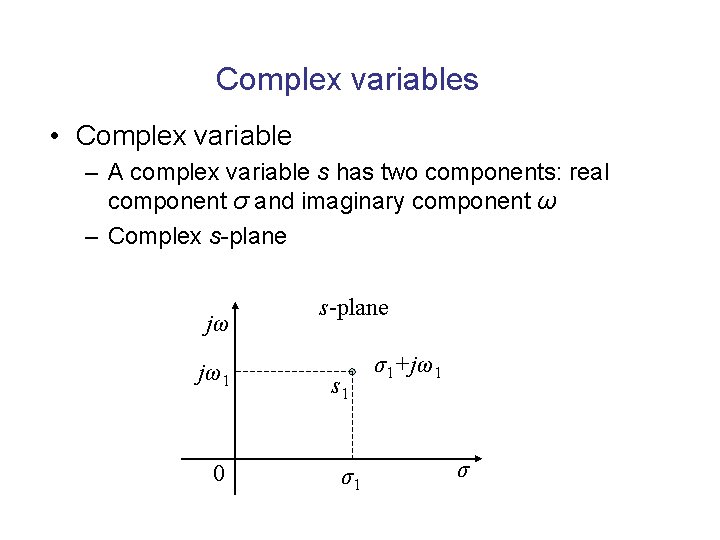
Complex variables • Complex variable – A complex variable s has two components: real component σ and imaginary component ω – Complex s-plane jω jω1 0 s-plane s 1 σ1 σ1+jω1 σ
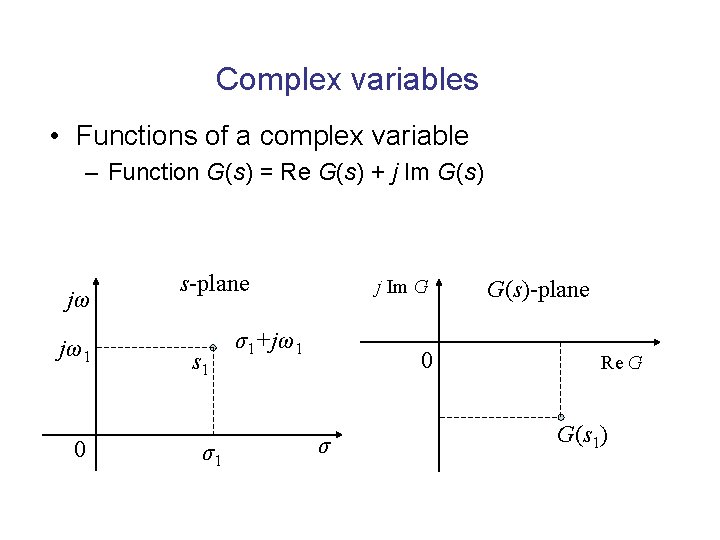
Complex variables • Functions of a complex variable – Function G(s) = Re G(s) + j Im G(s) jω jω1 0 s-plane s 1 σ1 j Im G σ1+jω1 0 σ G(s)-plane Re G G(s 1)
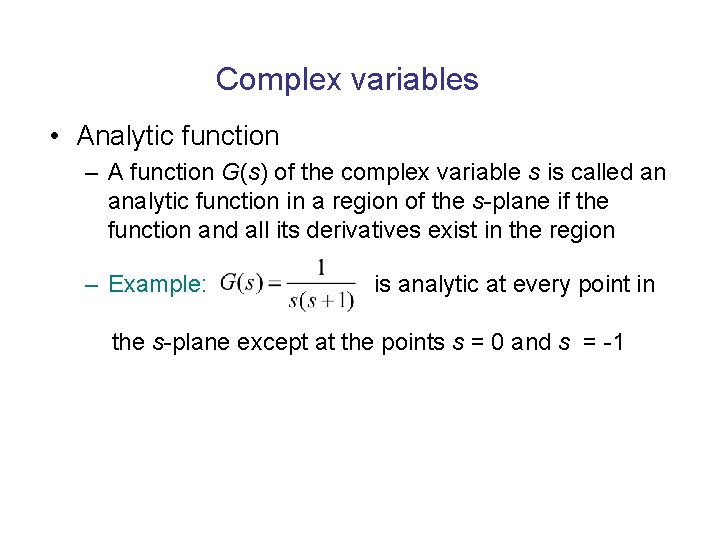
Complex variables • Analytic function – A function G(s) of the complex variable s is called an analytic function in a region of the s-plane if the function and all its derivatives exist in the region – Example: is analytic at every point in the s-plane except at the points s = 0 and s = -1
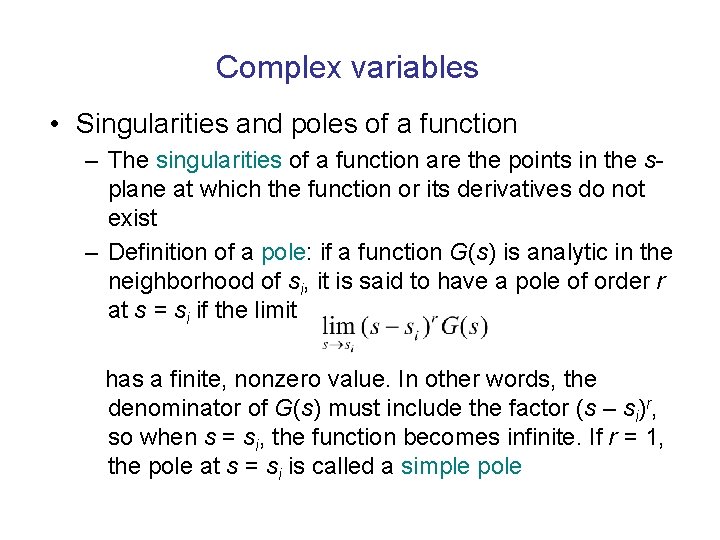
Complex variables • Singularities and poles of a function – The singularities of a function are the points in the splane at which the function or its derivatives do not exist – Definition of a pole: if a function G(s) is analytic in the neighborhood of si, it is said to have a pole of order r at s = si if the limit has a finite, nonzero value. In other words, the denominator of G(s) must include the factor (s – si)r, so when s = si, the function becomes infinite. If r = 1, the pole at s = si is called a simple pole
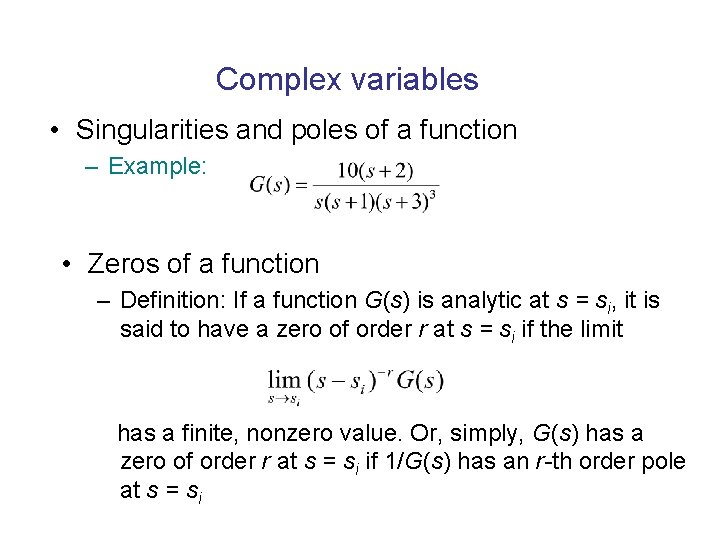
Complex variables • Singularities and poles of a function – Example: • Zeros of a function – Definition: If a function G(s) is analytic at s = si, it is said to have a zero of order r at s = si if the limit has a finite, nonzero value. Or, simply, G(s) has a zero of order r at s = si if 1/G(s) has an r-th order pole at s = si
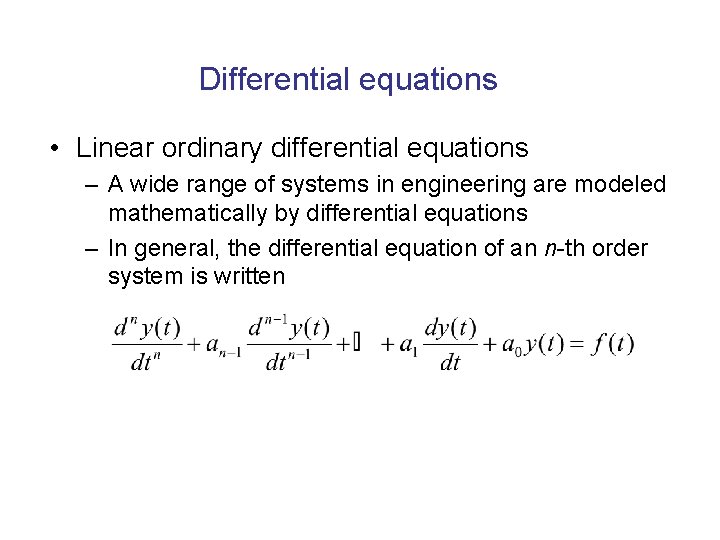
Differential equations • Linear ordinary differential equations – A wide range of systems in engineering are modeled mathematically by differential equations – In general, the differential equation of an n-th order system is written
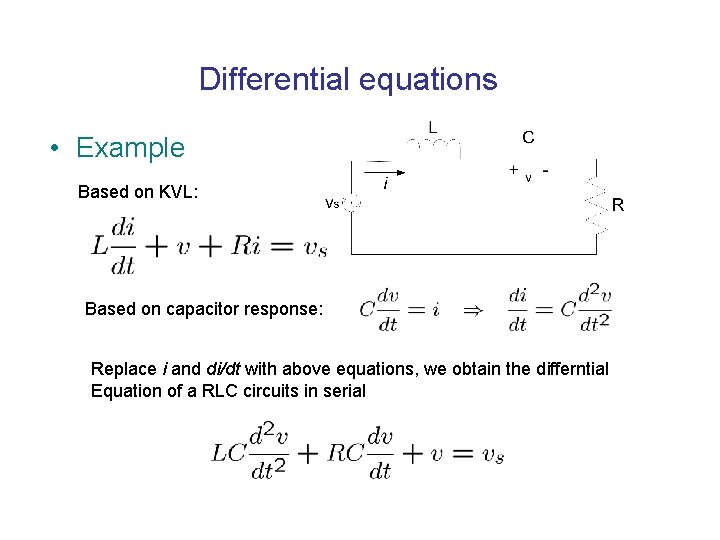
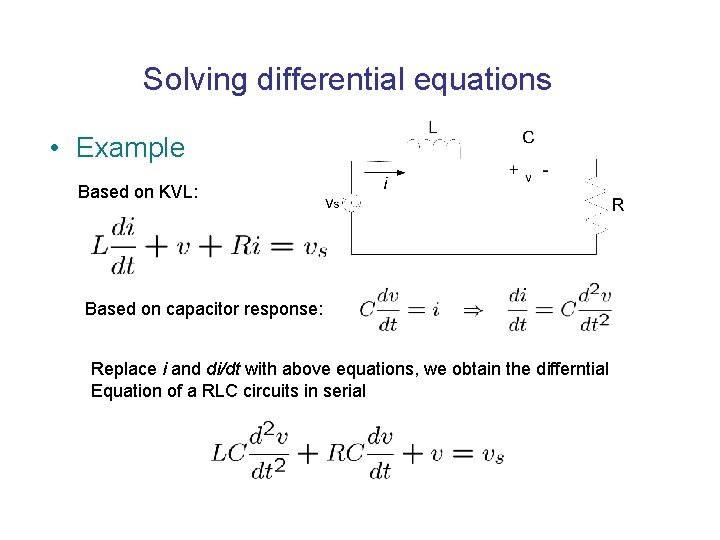
Differential equations • Example Based on KVL: Based on capacitor response: Replace i and di/dt with above equations, we obtain the differntial Equation of a RLC circuits in serial
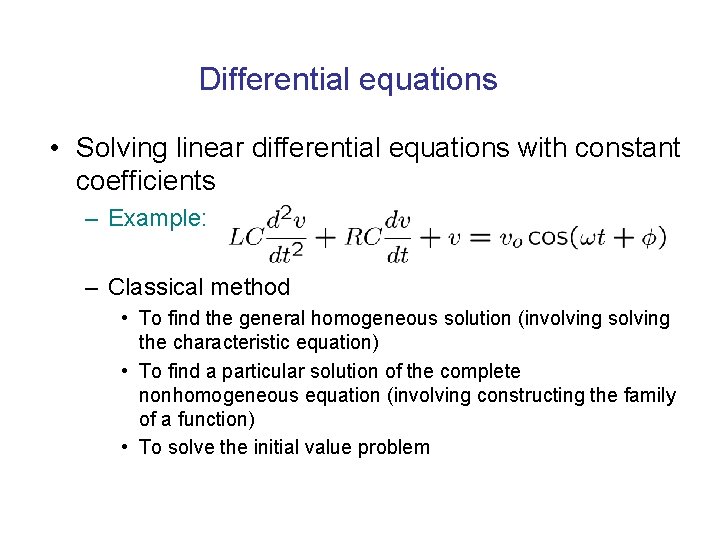
Differential equations • Solving linear differential equations with constant coefficients – Example: – Classical method • To find the general homogeneous solution (involving solving the characteristic equation) • To find a particular solution of the complete nonhomogeneous equation (involving constructing the family of a function) • To solve the initial value problem
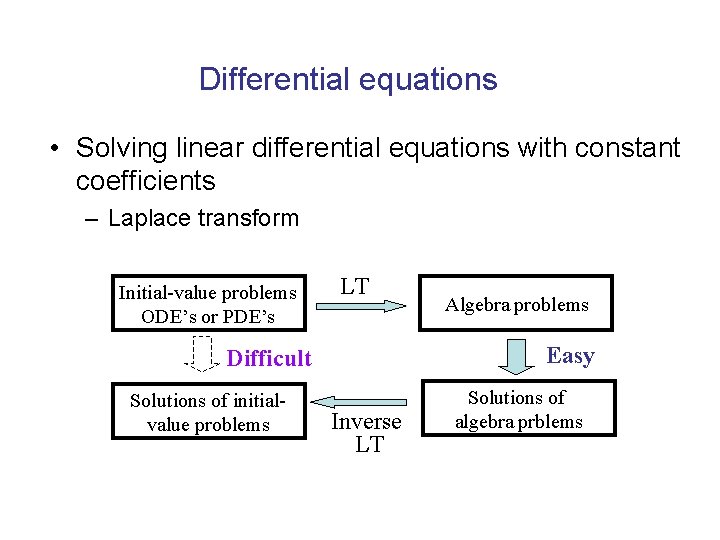
Differential equations • Solving linear differential equations with constant coefficients – Laplace transform Initial-value problems ODE’s or PDE’s LT Easy Difficult Solutions of initialvalue problems Algebra problems Inverse LT Solutions of algebra prblems
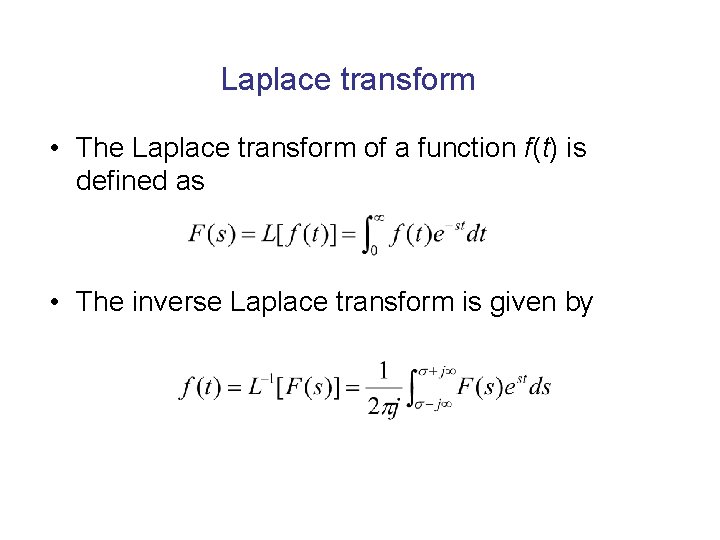
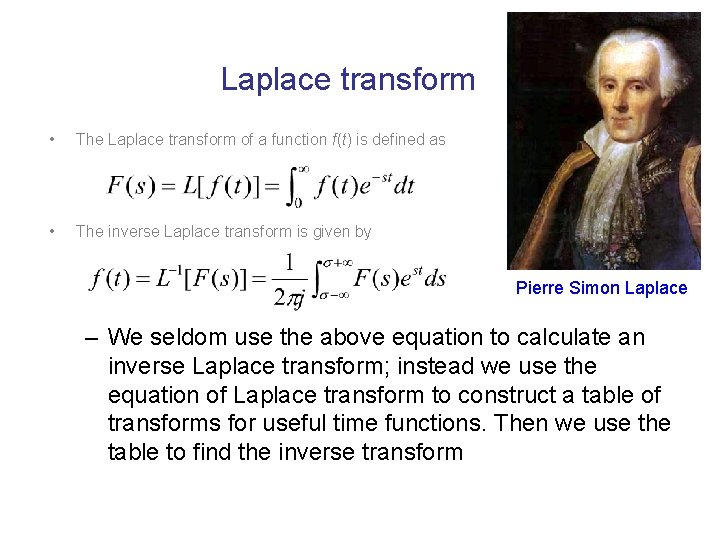
Laplace transform • The Laplace transform of a function f(t) is defined as • The inverse Laplace transform is given by
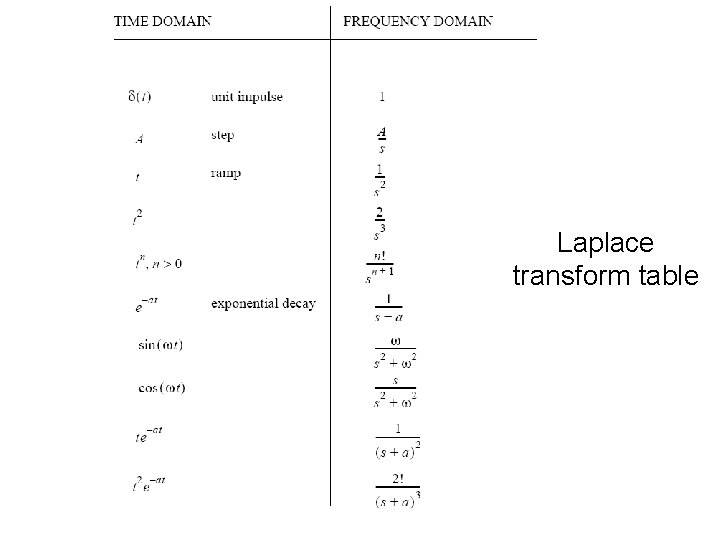
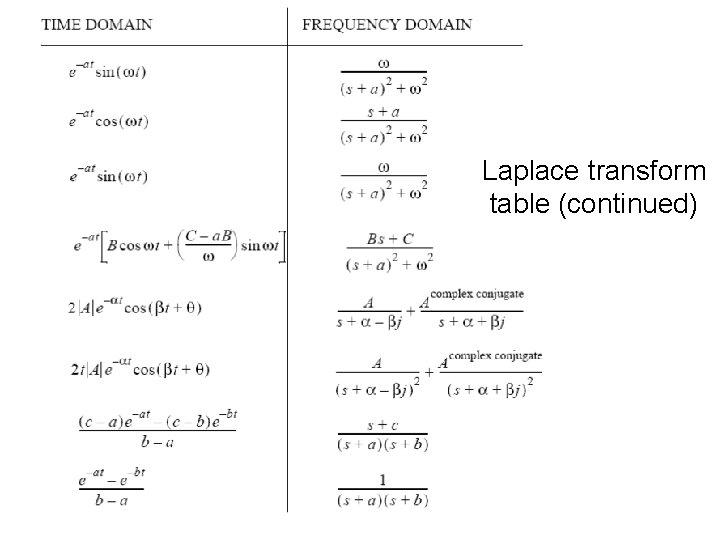
Laplace transform • The Laplace transform of a function f(t) is defined as • The inverse Laplace transform is given by Pierre Simon Laplace – We seldom use the above equation to calculate an inverse Laplace transform; instead we use the equation of Laplace transform to construct a table of transforms for useful time functions. Then we use the table to find the inverse transform
Laplace transform table
Laplace transform table (continued)
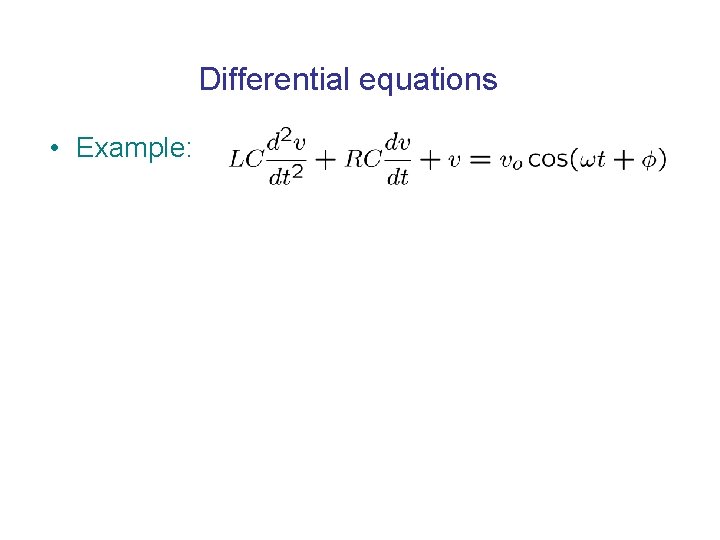
Differential equations • Example:
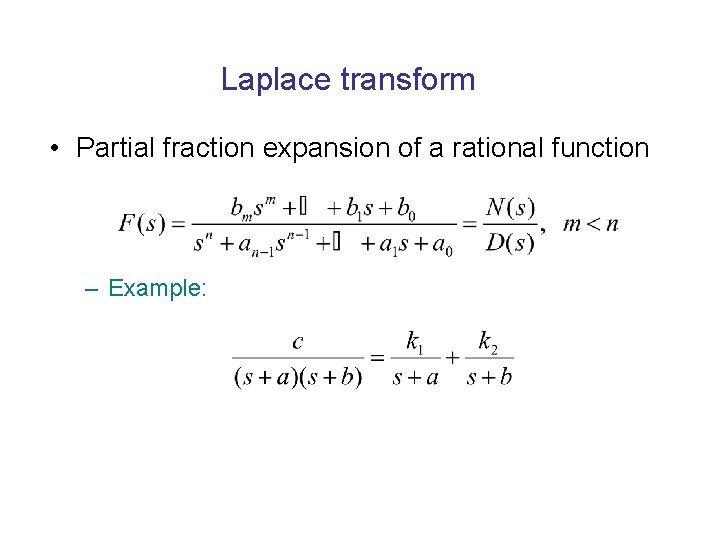
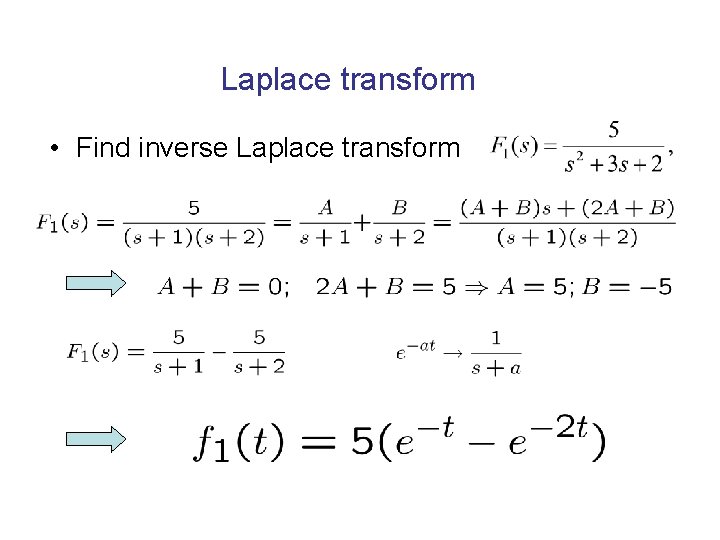
Laplace transform • Partial fraction expansion of a rational function – Example:
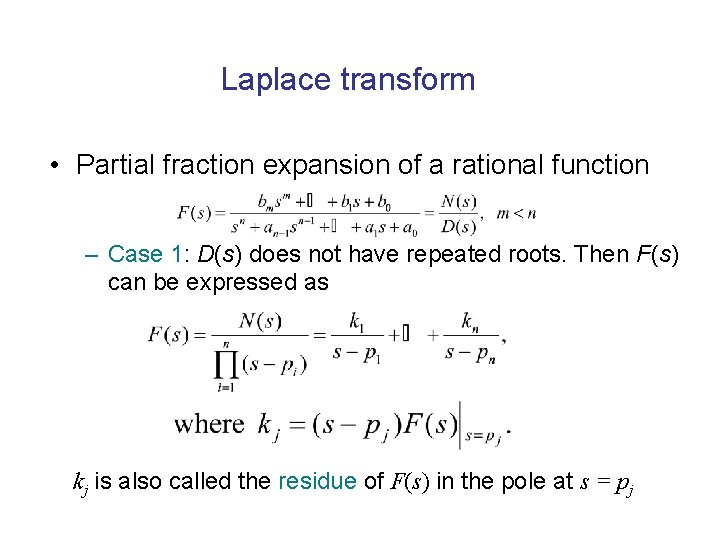
Laplace transform • Partial fraction expansion of a rational function – Case 1: D(s) does not have repeated roots. Then F(s) can be expressed as kj is also called the residue of F(s) in the pole at s = pj
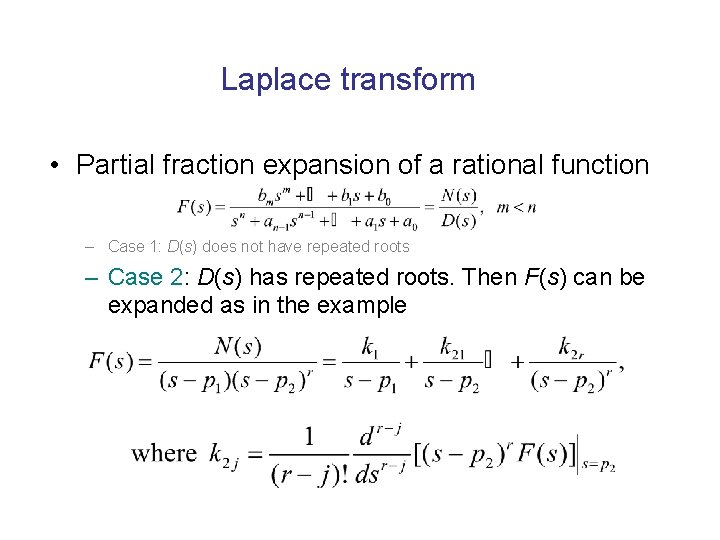
Laplace transform • Partial fraction expansion of a rational function – Case 1: D(s) does not have repeated roots – Case 2: D(s) has repeated roots. Then F(s) can be expanded as in the example
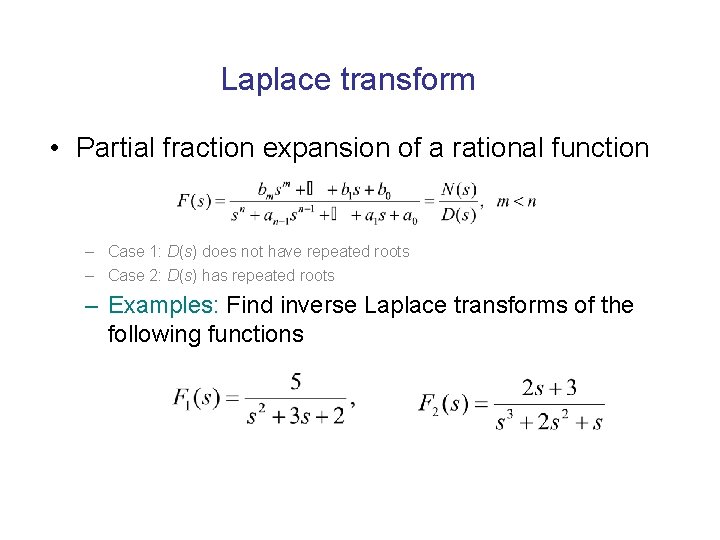
Laplace transform • Partial fraction expansion of a rational function – Case 1: D(s) does not have repeated roots – Case 2: D(s) has repeated roots – Examples: Find inverse Laplace transforms of the following functions
Laplace transform • Find inverse Laplace transform
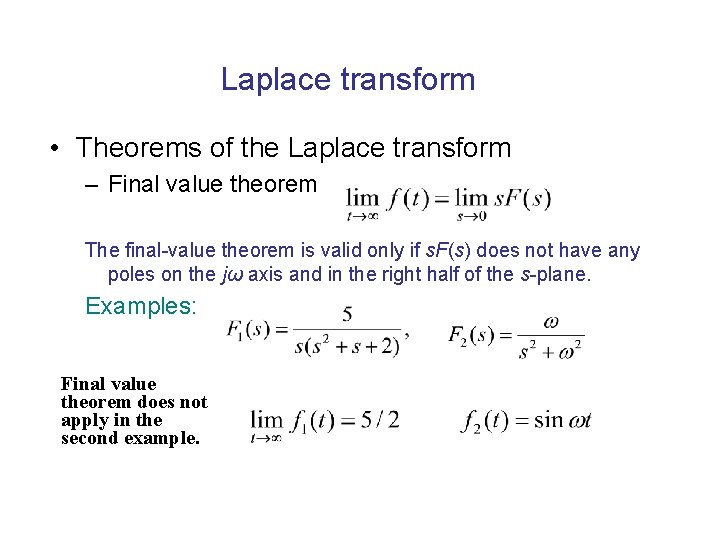
Laplace transform • Theorems of the Laplace transform – Final value theorem The final-value theorem is valid only if s. F(s) does not have any poles on the jω axis and in the right half of the s-plane. Examples: Final value theorem does not apply in the second example.
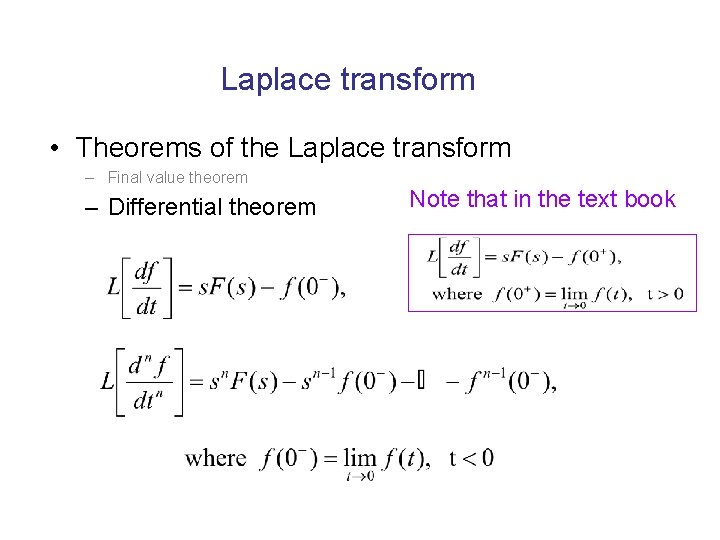
Laplace transform • Theorems of the Laplace transform – Final value theorem – Differential theorem Note that in the text book
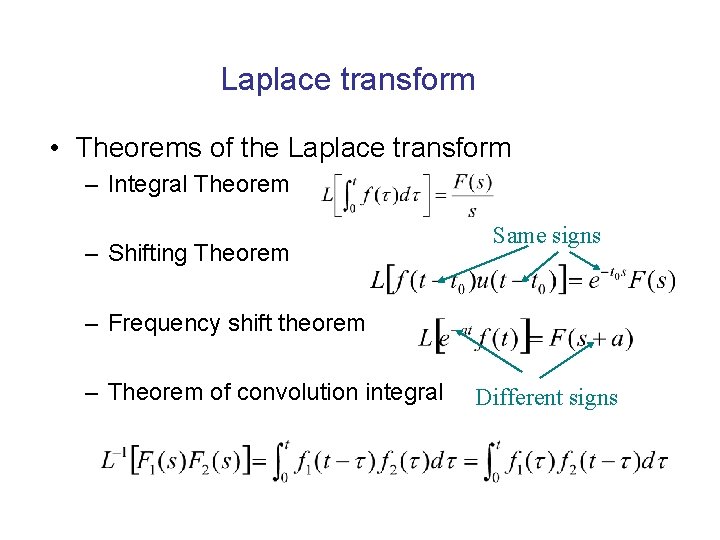
Laplace transform • Theorems of the Laplace transform – Integral Theorem – Shifting Theorem Same signs – Frequency shift theorem – Theorem of convolution integral Different signs
Solving differential equations • Example Based on KVL: Based on capacitor response: Replace i and di/dt with above equations, we obtain the differntial Equation of a RLC circuits in serial
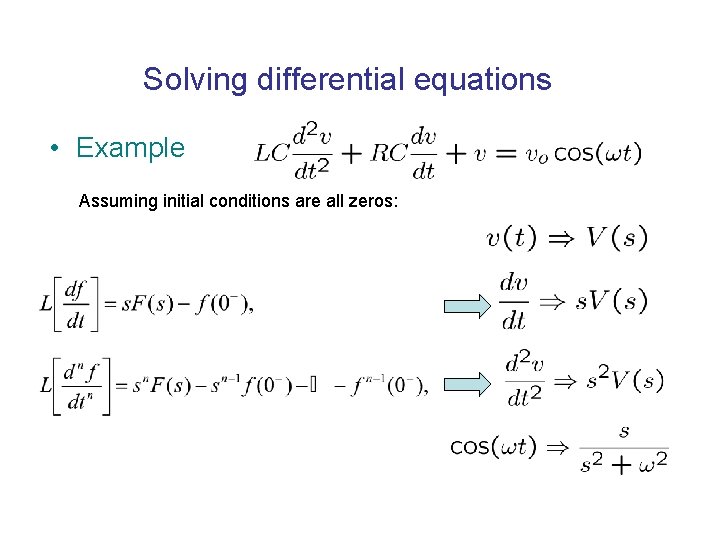
Solving differential equations • Example Assuming initial conditions are all zeros:
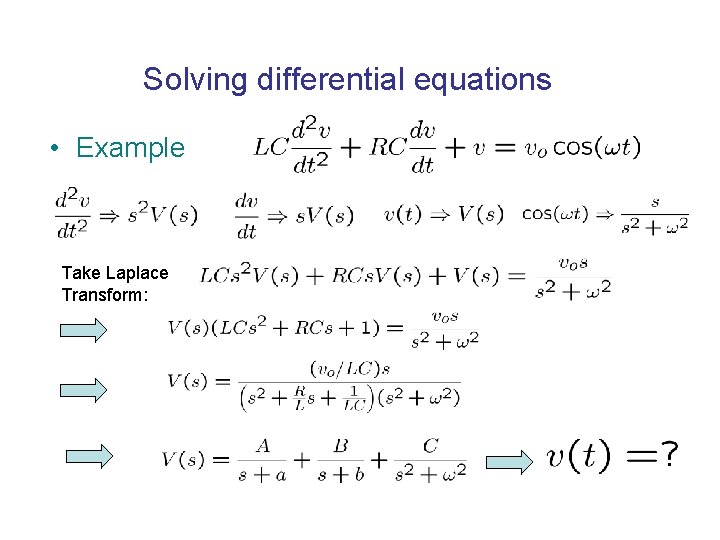
Solving differential equations • Example Take Laplace Transform: