
Complex exponentials as input to LTI systems e
![LCC Difference equation • 1 st order: y[n] - a y[n-1] = x[n] •](https://slidetodoc.com/presentation_image_h2/ca94ba6047a8487856f1c76f07c34970/image-3.jpg "LCC Difference equation • 1 st order: y[n] - a y[n-1] = x[n] •")
![LCC Difference equation • Nth order: • 1 st order: y[n] - a y[n-1]](https://slidetodoc.com/presentation_image_h2/ca94ba6047a8487856f1c76f07c34970/image-5.jpg "LCC Difference equation • Nth order: • 1 st order: y[n] - a y[n-1]")
- Slides: 5
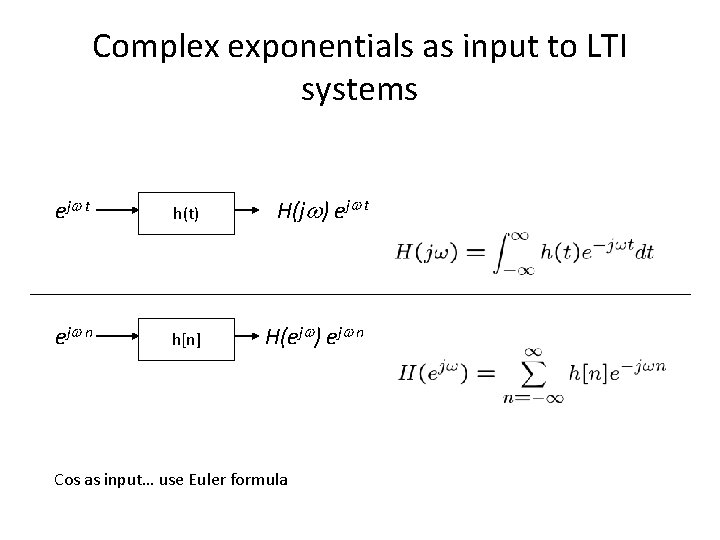
Complex exponentials as input to LTI systems e j t h(t) H(j ) ej t e j n h[n] H(ej ) ej n Cos as input… use Euler formula
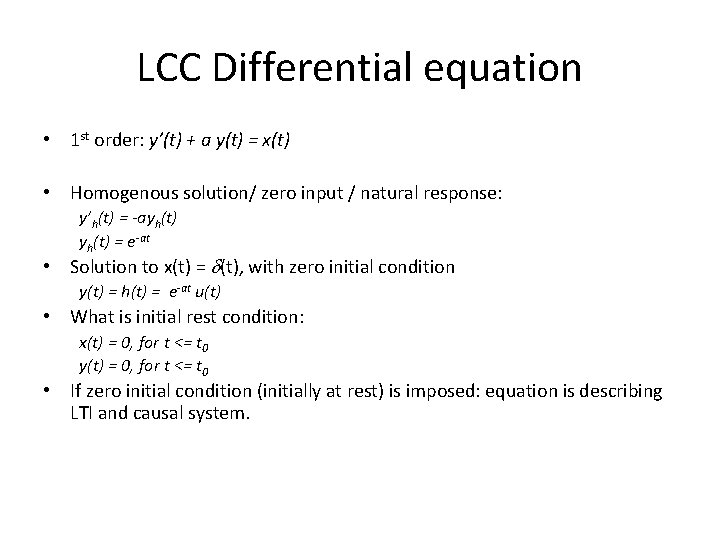
LCC Differential equation • 1 st order: y’(t) + a y(t) = x(t) • Homogenous solution/ zero input / natural response: y’h(t) = -ayh(t) = e-at • Solution to x(t) = (t), with zero initial condition y(t) = h(t) = e-at u(t) • What is initial rest condition: x(t) = 0, for t <= t 0 y(t) = 0, for t <= t 0 • If zero initial condition (initially at rest) is imposed: equation is describing LTI and causal system.
LCC Difference equation • 1 st order: y[n] - a y[n-1] = x[n] • Homogenous solution/ zero input / natural response: yh[n] = ayh[n-1] yh[n] = an • Solution to x[n] = [n], with zero initial condition y[n] = h[n] = an u[n] • Use initial rest condition to find particular solution: x[n] = 0, for n <= n 0 y[n] = 0, for n <= n 0 • If zero initial condition (initially at rest) is imposed: equation is describing LTI and causal system.
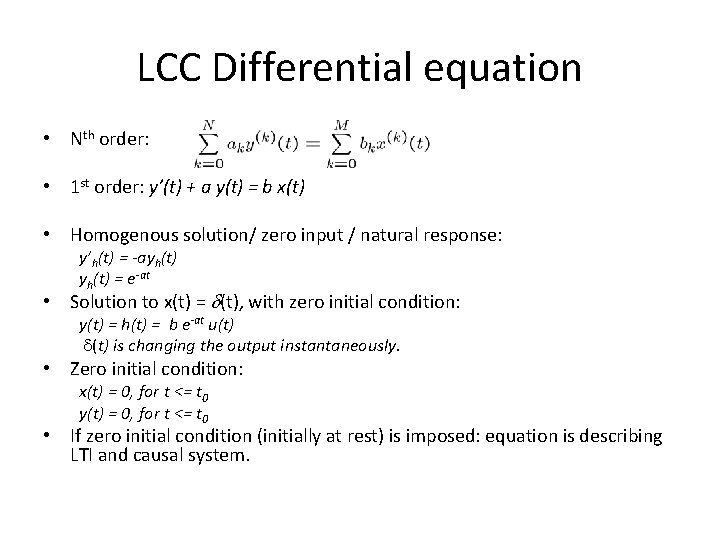
LCC Differential equation • Nth order: • 1 st order: y’(t) + a y(t) = b x(t) • Homogenous solution/ zero input / natural response: y’h(t) = -ayh(t) = e-at • Solution to x(t) = (t), with zero initial condition: y(t) = h(t) = b e-at u(t) is changing the output instantaneously. • Zero initial condition: x(t) = 0, for t <= t 0 y(t) = 0, for t <= t 0 • If zero initial condition (initially at rest) is imposed: equation is describing LTI and causal system.
LCC Difference equation • Nth order: • 1 st order: y[n] - a y[n-1] = x[n] • Homogenous solution/ zero input / natural response: yh[n] = ayh[n-1] yh[n] = an • Solution to x[n] = [n], with zero initial condition y[n] = h[n] = an u[n] • Initial rest condition: x[n] = 0, for n <= n 0 y[n] = 0, for n <= n 0 • If zero initial condition (initially at rest) is imposed: equation is describing LTI and causal system.