
Complex Experimental Designs Chapter 10 Increasing the of
- Slides: 6
Complex Experimental Designs Chapter 10
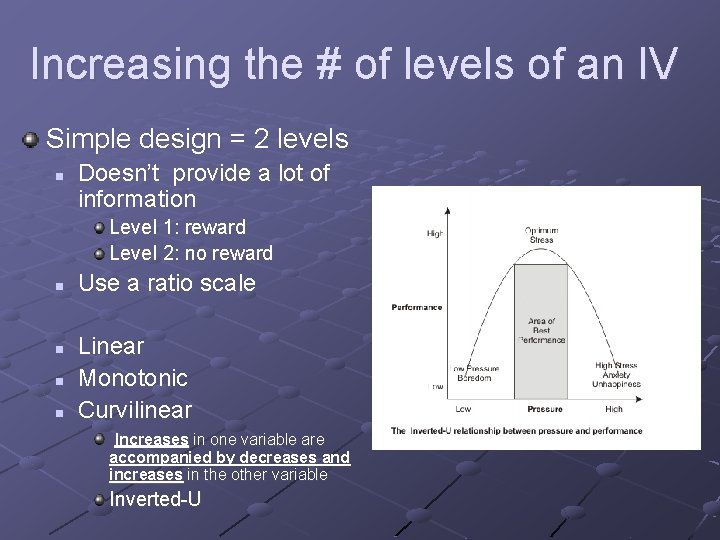
Increasing the # of levels of an IV Simple design = 2 levels n Doesn’t provide a lot of information Level 1: reward Level 2: no reward n n Use a ratio scale Linear Monotonic Curvilinear Increases in one variable are accompanied by decreases and increases in the other variable Inverted-U
Increasing the # of IVs: factorial designs Many IVs are closer to real world conditions Factorial designs – more than 1 IV 2 x 2 factorial n n 2 independent variables w/ 2 levels each 2 x 2 = 4 experimental conditions Main effects n n Effect the variable has by itself Averages across the levels of the other IV Interactions n The effects of one IV is different at different levels of the other IV
Outcomes of a 2 x 2 factorial design 1. There may or may not be a significant main effect for variable A 2. There may or may not be a significant main effect for variable B 3. There may or may not be an interaction between both variables When there is an interaction, next look at simple main effects (differences at each level of the IV) n This allows analysis of results as though there were separate experiments at each level of the other IV
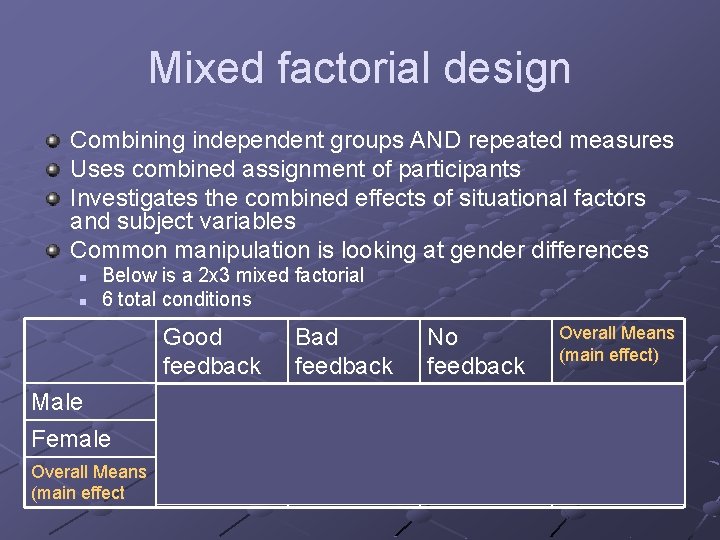
Mixed factorial design Combining independent groups AND repeated measures Uses combined assignment of participants Investigates the combined effects of situational factors and subject variables Common manipulation is looking at gender differences n n Below is a 2 x 3 mixed factorial 6 total conditions Male Female Overall Means (main effect Good feedback 80 Bad feedback 75 No feedback 79 Overall Means (main effect) 100 90 75 75 95 87 90 78
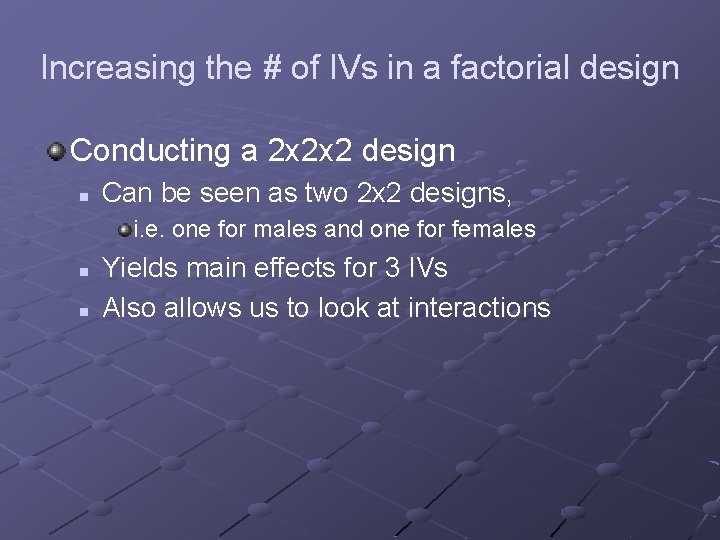
Increasing the # of IVs in a factorial design Conducting a 2 x 2 x 2 design n Can be seen as two 2 x 2 designs, i. e. one for males and one for females n n Yields main effects for 3 IVs Also allows us to look at interactions