
Complex Cognitive Processes Concepts Learning Categories of similar
- Slides: 22
Complex Cognitive Processes
Concepts Learning • Categories of similar ideas, events, objects, people, etc. • Abstractions • Ways to organize information.
Views of Concept Learning • • Defining attributes Prototype Exemplars Concepts and schemas
Strategies for Teaching Concepts: Components • • Examples and non-examples Relevant and irrelevant attributes Name of the concept Definition of the concept – General category – Defining attributes (if appropriate) • Use visual aids
Lesson Structure • Start with prototype • Less obvious examples help prevent undergeneralization • Close non-examples help prevent overgeneralization • Think back on hypothesis • Extending and connecting concepts
Teaching Concepts through Discovery • • • Understanding the structure of the subject Teacher presents examples Students discover the interrelationships Inductive reasoning Requires intuitive thinking Guided vs. unguided discovery approaches
Teaching Concepts through Exposition • • • Expository teaching model: Ausubel The concept is presented Focus on meaningful verbal learning Deductive reasoning Advance organizers help schema development
Advance Organizers • An introduction to help the students understand the coming concept • Comparative • Expository
Problem Solving • General or domain-specific? • IDEAL: Five steps of problem solving – Identify the problem – Define goals and represent the problem – Explore possible strategies – Anticipate outcomes and Act on the strategies – Look back and Learn
Identify the Problem • Identify that problem exists and treat it as an opportunity
Defining the Problem • • • Focusing attention Understanding the words Understanding the whole problem Translation and schema training Results of problem representation
Exploring Possible Solutions • Algorithms • Heuristics – Means-ends analysis – Working backwards – Analogical thinking – Verbalization
Anticipate, Act, Look Back • Anticipate the consequences • Act on the best solution • Look back and evaluate your success
Factors that Hinder Problem Solving • Functional fixedness • Response set • Lack of flexibility
Effective Problem Solvers • • • Large store of domain knowledge Quickly recognize patterns Organized knowledge schemas Condition-action schemas Elaborated and well practiced knowledge Spend time analyzing
Novice Knowledge • May possess misinformation • Intuitive ideas are incorrect • Hold on to misconceptions
Expert Students • • Are cognitively engaged Invest effort Process information deeply Monitor understanding
Learning Strategies • • Deciding what is important Creating summaries Underlining and highlighting Taking notes
Applying Learning Strategies • • Learning task must be appropriate Valuing learning Effort and efficacy Epistemological beliefs
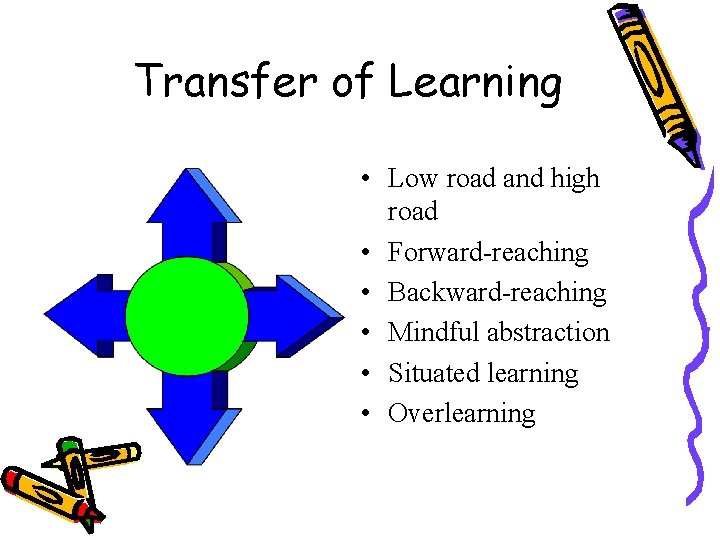
Transfer of Learning • Low road and high road • Forward-reaching • Backward-reaching • Mindful abstraction • Situated learning • Overlearning
Encouraging Transfer • Make learning meaningful • Practical applications: real life problem solving • Context • Teach critical thinking skills • Teach self-regulation skills
Stages of Transfer • Acquisition Phase – Teach a new strategy and how to use it • Retention Phase – Practice a strategy; Give feedback • Transfer Phase – Give new problems; Use the same strategy