
Complex Cognitive Processes Chapter 9 Concepts Categories Concepts
- Slides: 9
Complex Cognitive Processes Chapter 9
Concepts � Categories – � Concepts- � Role in memory � Define and Provide Examples ◦ Define ◦ Clarify ◦ Provide examples ◦ Ask for additional examples ◦ -
Thinking and Reasoning � Thinking- manipulating and transforming information in memory, often done to form concepts, reason, think critically, make decisions, think creatively, and solve problems � Reasoning- logical thinking that uses induction and deduction to reach a conclusion ◦ Inductive reasoning � Analogy ◦ Deductive reasoning � Critical thinking- thinking reflectively and productively and evaluating the evidence ◦ Mindfulness ◦ Ways to encourage critical thinking � Ask “how” and “why”, provide evidence, compare opinions and options, evaluate the truth of others, argue with reasoning instead of emotion, ask questions for more detail to create new information and ideas
Thinking and Reasoning: Continued � Decision Making- evaluating alternatives and making choices among them ◦ Cost and benefits of outcomes ◦ Biases and Flawed Heuristics �Confirmation bias �Belief Perservation �Overconfidence Bias �Hindsight Bias �-
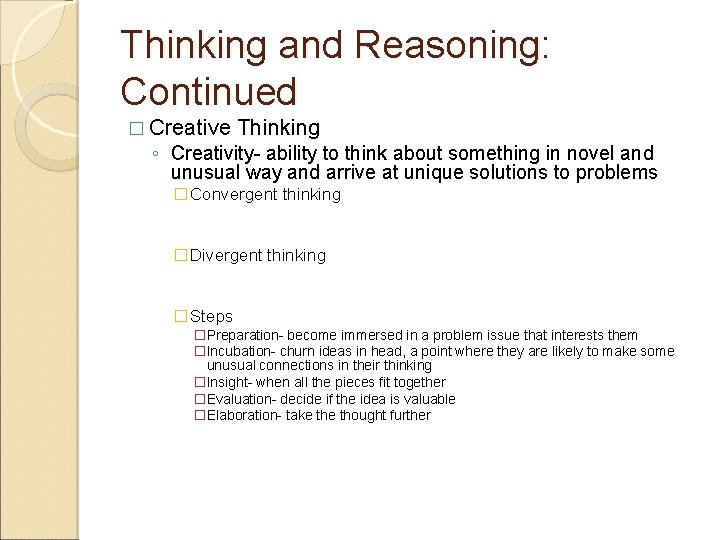
Thinking and Reasoning: Continued � Creative Thinking ◦ Creativity- ability to think about something in novel and unusual way and arrive at unique solutions to problems �Convergent thinking �Divergent thinking �Steps �Preparation- become immersed in a problem issue that interests them �Incubation- churn ideas in head, a point where they are likely to make some unusual connections in their thinking �Insight- when all the pieces fit together �Evaluation- decide if the idea is valuable �Elaboration- take thought further
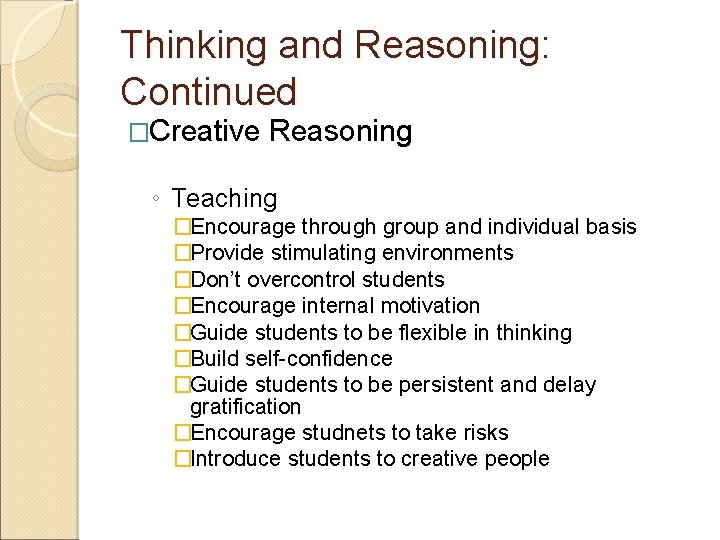
Thinking and Reasoning: Continued �Creative Reasoning ◦ Teaching �Encourage through group and individual basis �Provide stimulating environments �Don’t overcontrol students �Encourage internal motivation �Guide students to be flexible in thinking �Build self-confidence �Guide students to be persistent and delay gratification �Encourage studnets to take risks �Introduce students to creative people
Thinking and Reasoning: Continued �Problem Solving- finding an appropriate way to attain a goal
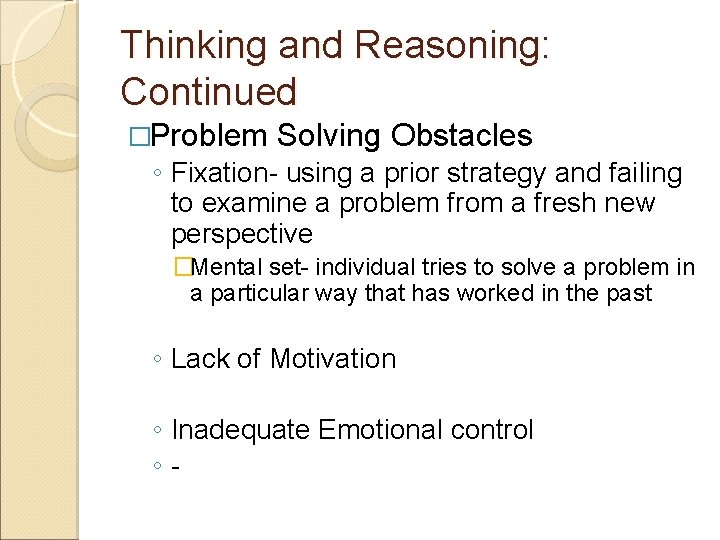
Thinking and Reasoning: Continued �Problem Solving Obstacles ◦ Fixation- using a prior strategy and failing to examine a problem from a fresh new perspective �Mental set- individual tries to solve a problem in a particular way that has worked in the past ◦ Lack of Motivation ◦ Inadequate Emotional control ◦-
Transfer � Types of Transfer ◦ Near transfer- transfer of learning to a situation that is similar to the one in which the initial learning took place ◦ Far transfer- transfer in learning to a situation that is very different from the one in which the initial learning took place ◦ Low-road transfer- automatic, often unconscious, transfer of learning to another situation ◦ High-road transfer- transfer of learning from ton e situation to another that is conscious and effortful ◦ Forward-reaching transfer- occurs when the individual looks to apply learned information to a future situation ◦ Backward-reaching transfer- occurs when the individual looks back to a previous situation for information to solve a problem in a new context