
Complex Block FloatingPoint Format with Box Encoding For
Complex Block Floating-Point Format with Box Encoding For Wordlength Reduction in Communication Systems Yeong Foong Choo, Brian L. Evans and *Alan Gatherer Embedded Signal Processing Laboratory Wireless Networking & Communications Group The University of Texas at Austin, Texas USA *Huawei Technologies, Plano, Texas, USA http: //www. wncg. org
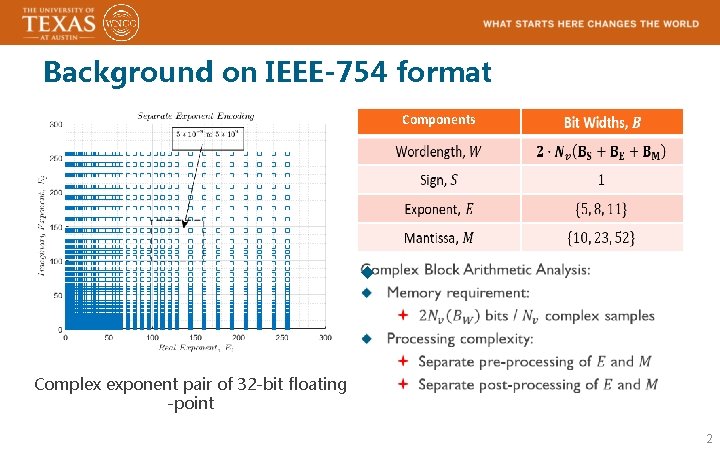
Background on IEEE-754 format Components u Complex exponent pair of 32 -bit floating -point 2
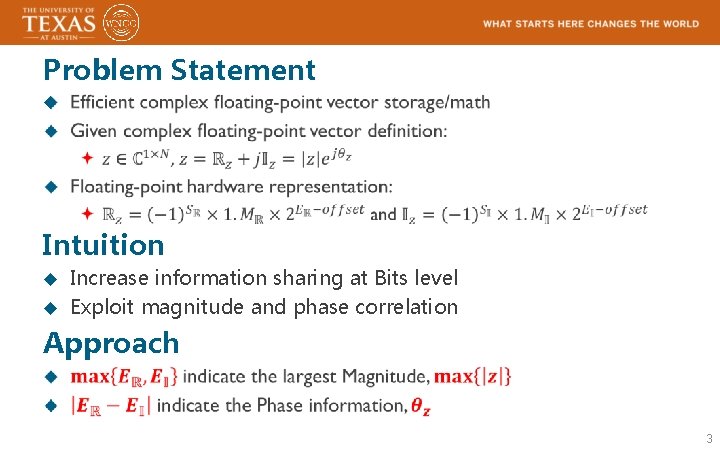
Problem Statement u Intuition Increase information sharing at Bits level u Exploit magnitude and phase correlation u Approach 3
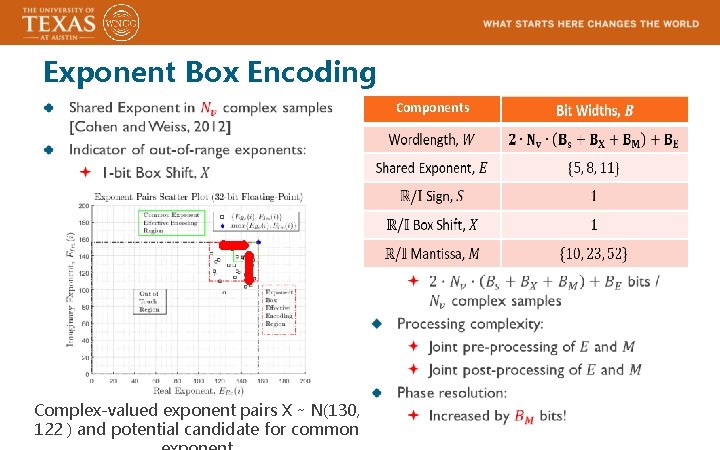
Exponent Box Encoding Components Complex-valued exponent pairs X ∼ N(130, 122 ) and potential candidate for common
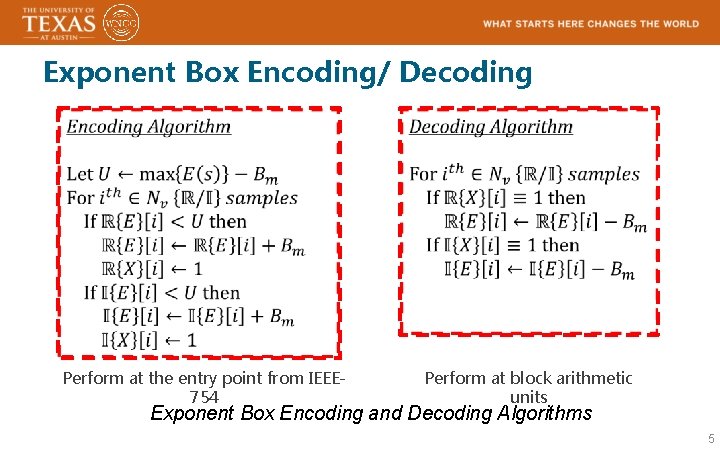
Exponent Box Encoding/ Decoding Perform at the entry point from IEEE 754 Perform at block arithmetic units Exponent Box Encoding and Decoding Algorithms 5

32 -bit Equivalent SIMD ALU Perform arithmetic operations on blocks of samples at time u Single-Instruction Multiple-Data (SIMD) operation increases instruction sets efficiency u Example Block Arithmetic Units: u Complex Block Add u Complex Block Multiply u Complex Multiply. Accumulate Example ALU diagram on complex block 32 -bit format 6
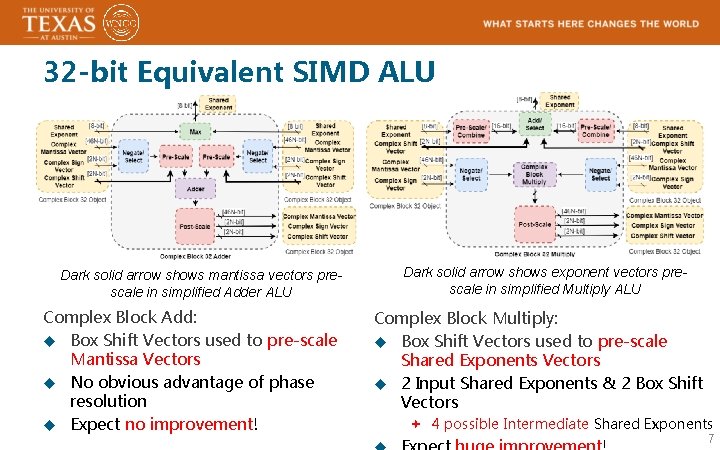
32 -bit Equivalent SIMD ALU Dark solid arrow shows mantissa vectors prescale in simplified Adder ALU Complex Block Add: u Box Shift Vectors used to pre-scale Mantissa Vectors u No obvious advantage of phase resolution u Expect no improvement! Dark solid arrow shows exponent vectors prescale in simplified Multiply ALU Complex Block Multiply: u Box Shift Vectors used to pre-scale Shared Exponents Vectors u 2 Input Shared Exponents & 2 Box Shift Vectors 4 possible Intermediate Shared Exponents 7
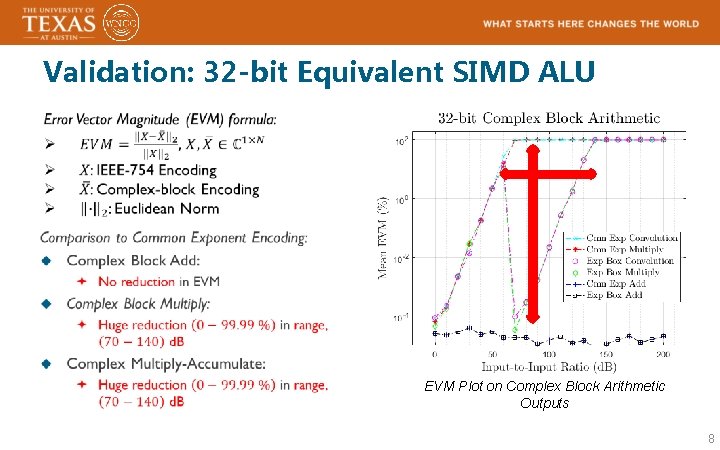
Validation: 32 -bit Equivalent SIMD ALU EVM Plot on Complex Block Arithmetic Outputs 8
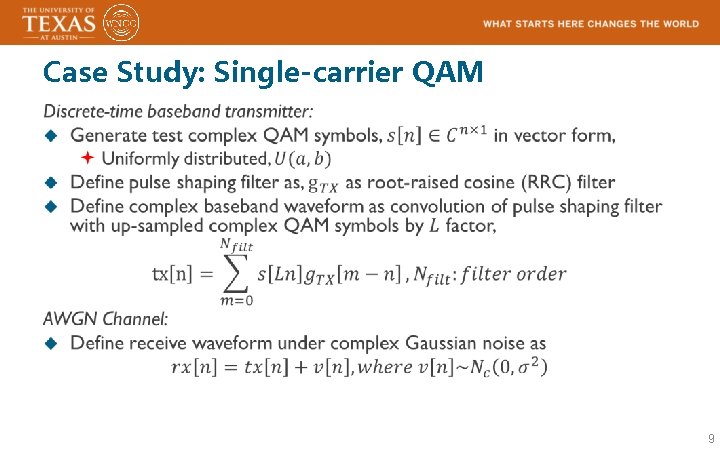
Case Study: Single-carrier QAM 9
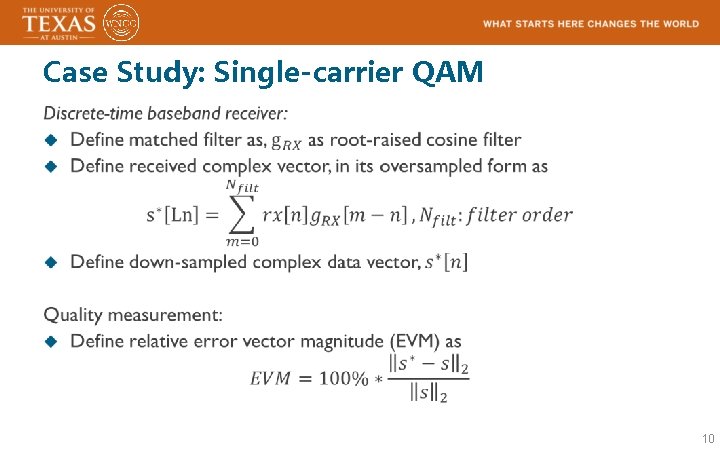
Case Study: Single-carrier QAM 10
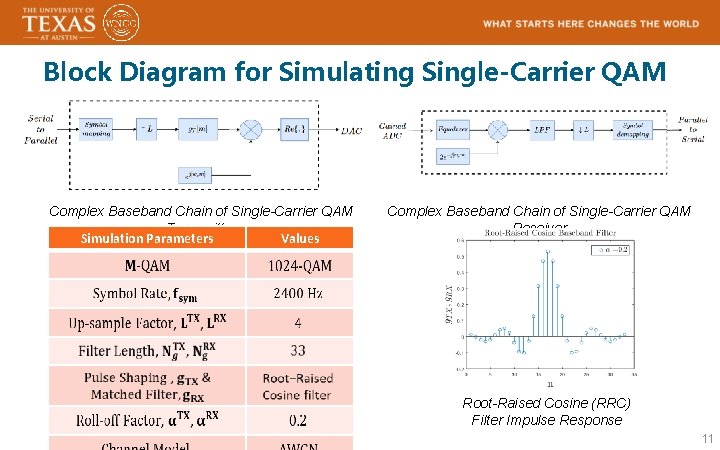
Block Diagram for Simulating Single-Carrier QAM Complex Baseband Chain of Single-Carrier QAM Transmitter Simulation Parameters Values Complex Baseband Chain of Single-Carrier QAM Receiver Root-Raised Cosine (RRC) Filter Impulse Response 11
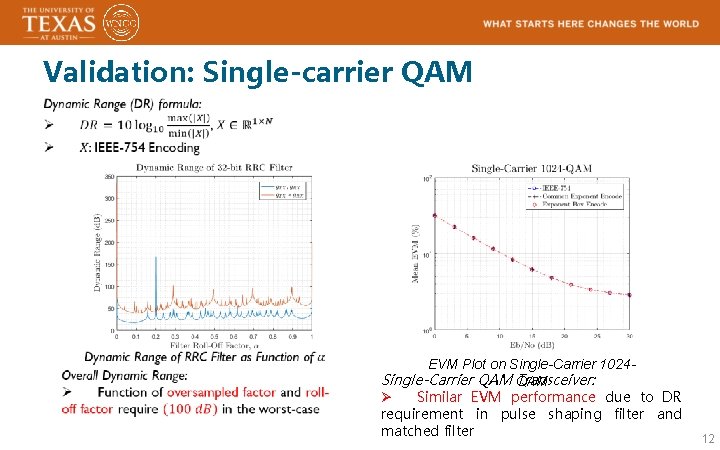
Validation: Single-carrier QAM EVM Plot on Single-Carrier 1024 Single-Carrier QAM Transceiver: Ø Similar EVM performance due to DR requirement in pulse shaping filter and matched filter 12

Conclusion 13

Thank you! Any questions ?

Appendix Derivation: I. Maximum Exponent Difference under Exponent Box Encoding II. Pre/ Post Processing Complexity of Complex-valued Convolution Table: I. Processing Complexity for Complex Block ALU II. Memory Input/ Output and Computational Rates 15
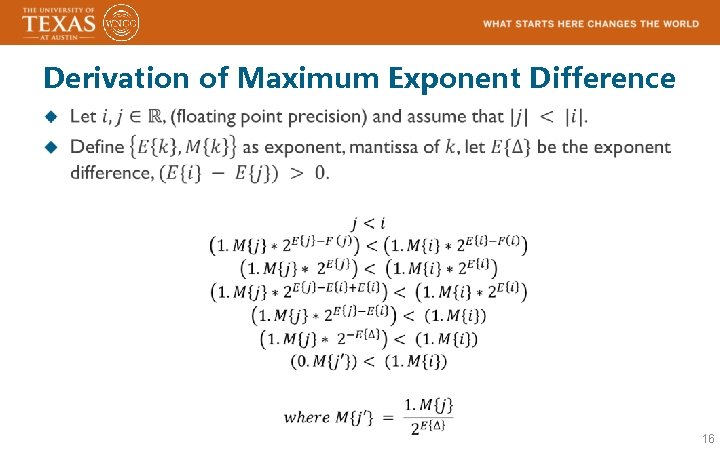
Derivation of Maximum Exponent Difference 16
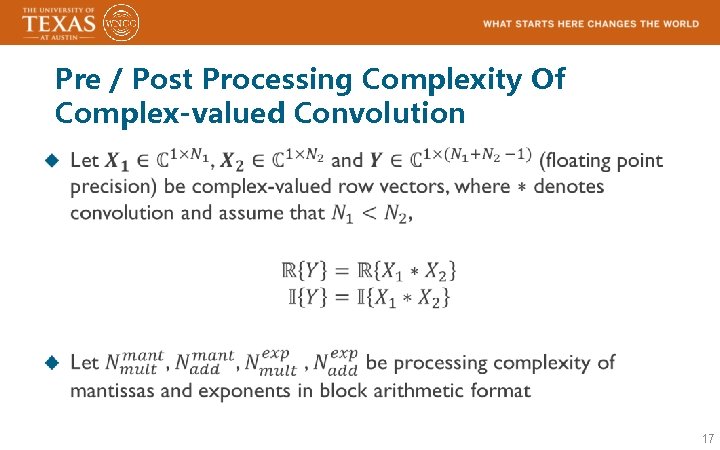
Pre / Post Processing Complexity Of Complex-valued Convolution 17
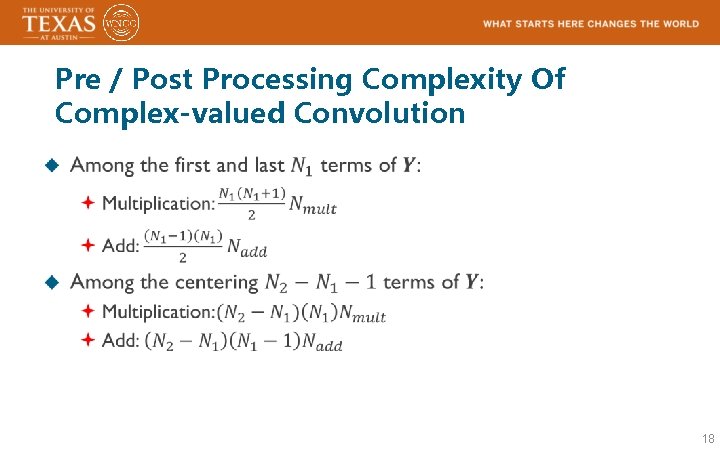
Pre / Post Processing Complexity Of Complex-valued Convolution 18
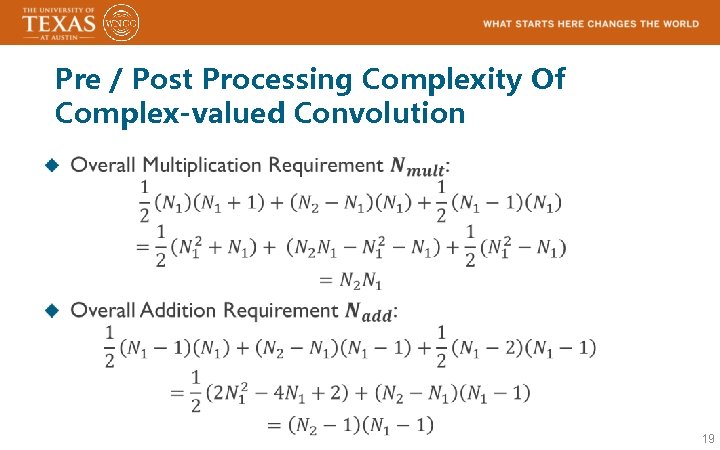
Pre / Post Processing Complexity Of Complex-valued Convolution 19
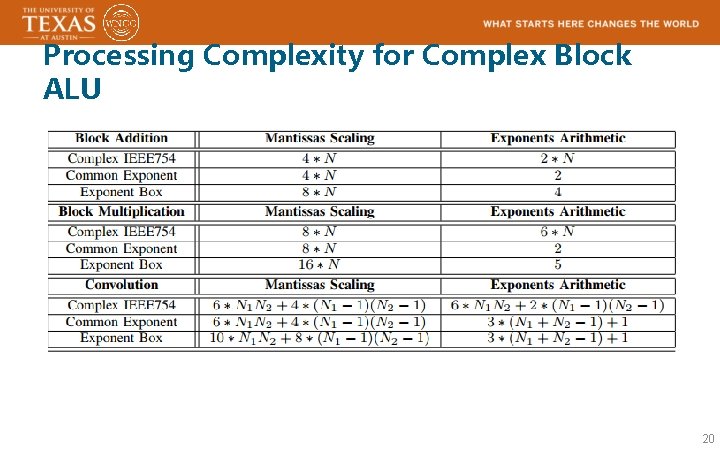
Processing Complexity for Complex Block ALU 20
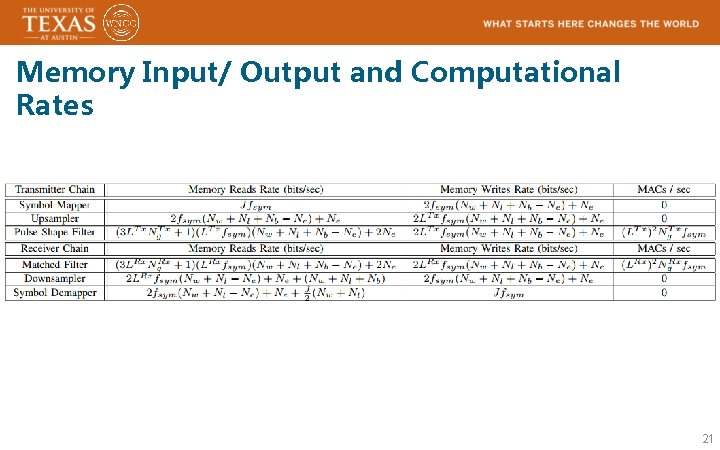
Memory Input/ Output and Computational Rates 21
- Slides: 21