
Complex Analysis in Quantum Computing By Peter Renn
Complex Analysis in Quantum Computing By Peter Renn 1
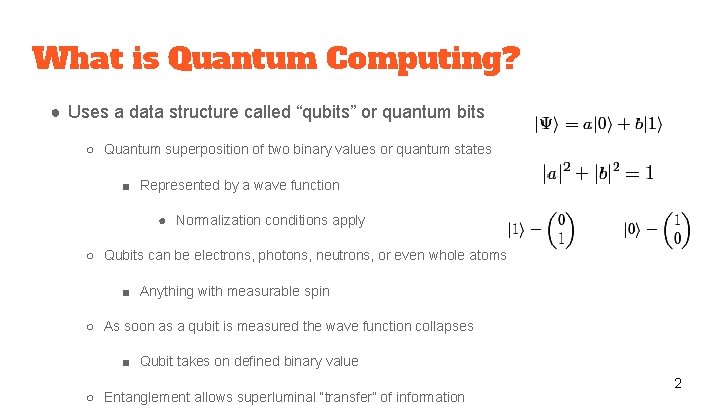
What is Quantum Computing? ● Uses a data structure called “qubits” or quantum bits ○ Quantum superposition of two binary values or quantum states ■ Represented by a wave function ● Normalization conditions apply ○ Qubits can be electrons, photons, neutrons, or even whole atoms ■ Anything with measurable spin ○ As soon as a qubit is measured the wave function collapses ■ Qubit takes on defined binary value ○ Entanglement allows superluminal “transfer” of information 2
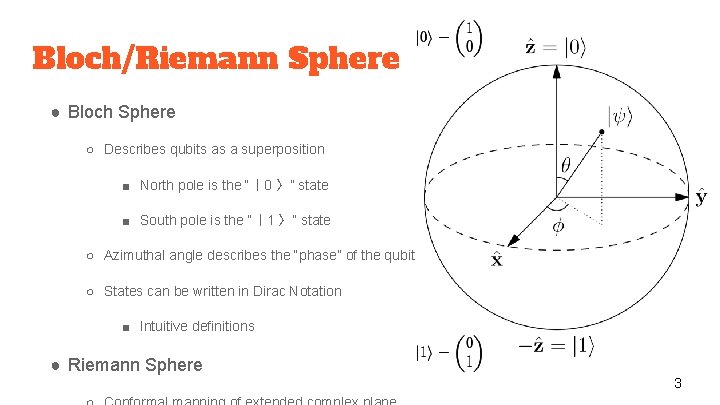
Bloch/Riemann Sphere ● Bloch Sphere ○ Describes qubits as a superposition ■ North pole is the “ㅣ 0 〉” state ■ South pole is the “ㅣ 1 〉” state ○ Azimuthal angle describes the “phase” of the qubit ○ States can be written in Dirac Notation ■ Intuitive definitions ● Riemann Sphere 3
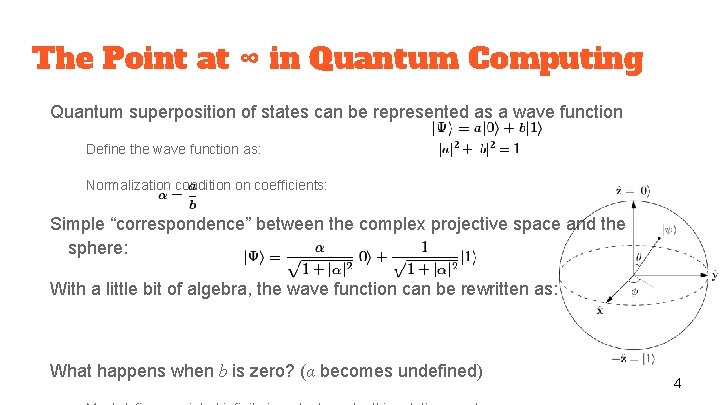
The Point at ∞ in Quantum Computing Quantum superposition of states can be represented as a wave function Define the wave function as: Normalization condition on coefficients: Simple “correspondence” between the complex projective space and the sphere: With a little bit of algebra, the wave function can be rewritten as: What happens when b is zero? (α becomes undefined) 4
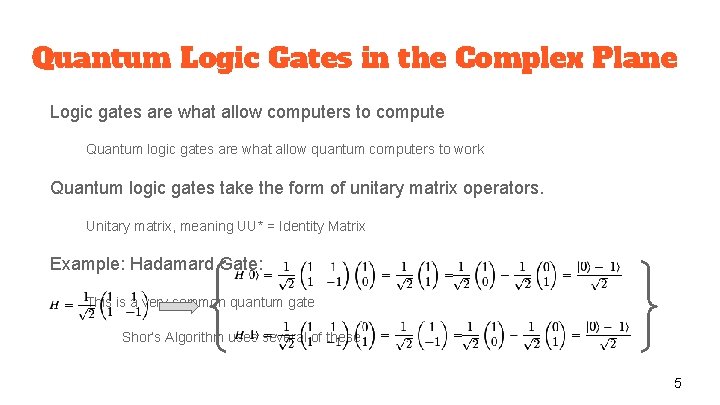
Quantum Logic Gates in the Complex Plane Logic gates are what allow computers to compute Quantum logic gates are what allow quantum computers to work Quantum logic gates take the form of unitary matrix operators. Unitary matrix, meaning UU* = Identity Matrix Example: Hadamard Gate: This is a very common quantum gate Shor’s Algorithm uses several of these 5
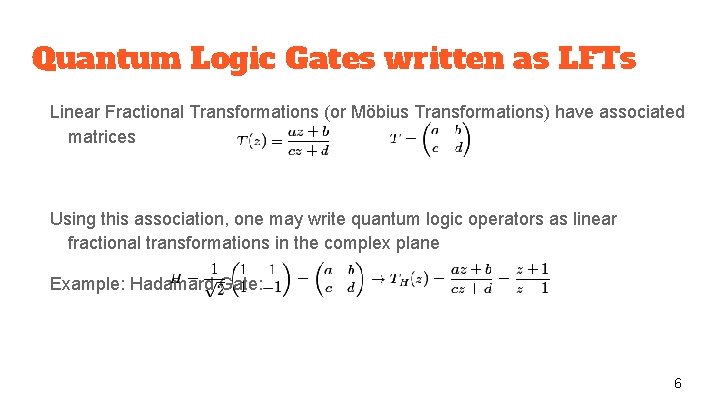
Quantum Logic Gates written as LFTs Linear Fractional Transformations (or Möbius Transformations) have associated matrices Using this association, one may write quantum logic operators as linear fractional transformations in the complex plane Example: Hadamard Gate: 6
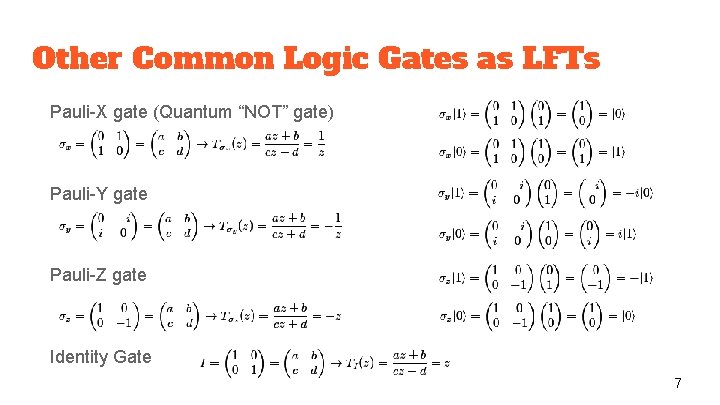
Other Common Logic Gates as LFTs Pauli-X gate (Quantum “NOT” gate) Pauli-Y gate Pauli-Z gate Identity Gate 7
Resolution & Summary Complex Analysis and Quantum Computing share quite a bit of mathematical structure, even if the connection isn’t always obvious The point at infinity is defined in quantum computing out of necessity to maintain a one-to-one mapping Taking advantage of the geometric relationship between the Riemann Sphere and the Bloch Sphere we can plot qubits on the extended complex plane Quantum logic gates can be represented as Möbius transformations This result shows the intrinsic relationship between math, nature and technology 8

Thank You! 9
Citations & References: Le Bellac, Michel. A Short Introduction to Quantum Information and Quantum Computation. Cambridge, GB: Cambridge University Press, 2006. Pro. Quest ebrary. Web. 21 April 2016. Rieffel, Eleanor, and Polak, Wolfgang. Quantum Computing. Cambridge, US: MIT Press, 2011. Pro. Quest ebrary. Web. 21 April 2016. Beardon, Alan F. A Primer on Riemann Surfaces. Cambridge: Cambridge UP, 1984. Print. Bijurkar, Rahul. "REPRESENTATION OF QUDITS ON A RIEMANN SPHERE. " (n. d. ): n. pag. Web. 21 Apr. 2016. Christian, Von Baeyer Hans. Information: The New Language of Science. Cambridge, MA: Harvard UP, 2004. Print. Griffiths, David J. Introduction to Quantum Mechanics. Upper Saddle River, NJ: Pearson Prentice Hall, 2005. Print. Kendon, Vivien M. , and William J. Munro. "Entanglement and Its Role in Shor's Algorithm. " (n. d. ): n. pag. Trusted Systems Laboratory. HP Laboratories Bristol, 5 Dec. 2005. Web. 21 Apr. 2016. Laussy, Fabrice P. Mathematical Methods II Handout 27. The Riemann and the Bloch Spheres. 23 Apr. 2014. Universidad Auto noma De Madrid, Madrid. Lee, Jae-weon, Chang Ho Kim, and Eok Kyun Lee. "Qubit Geometry and Conformal Mapping. " (n. d. ): n. pag. 16 Sept. 2002. Web. 21 Apr. 2016. Zill, Dennis G. Complex Analysis: A First Course with Applications; Third Edition. N. p. : Jones and Bartlett Learning, 2015. Print. 10
- Slides: 10