
Complex 2030 A Preferred Infrastructure Planning Scenario for

- Slides: 21
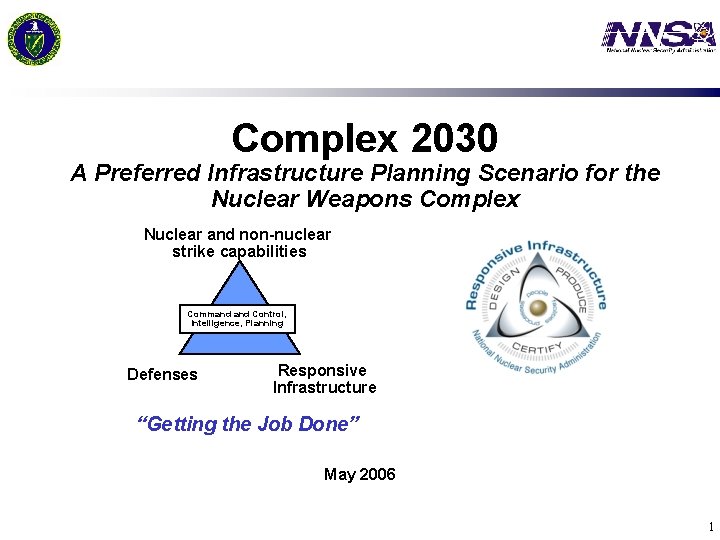
Complex 2030 A Preferred Infrastructure Planning Scenario for the Nuclear Weapons Complex Nuclear and non-nuclear strike capabilities Command Control, Intelligence, Planning Defenses Responsive Infrastructure “Getting the Job Done” May 2006 1
Vision for the Future “We can, and will, change the size, the composition, the character of our nuclear forces in a way that reflects the reality that the Cold War is over. I am committed to achieving a credible deterrent with the lowest-possible number of nuclear weapons consistent with our national security needs, including our obligations to our allies. ” President Bush, May 2001 2
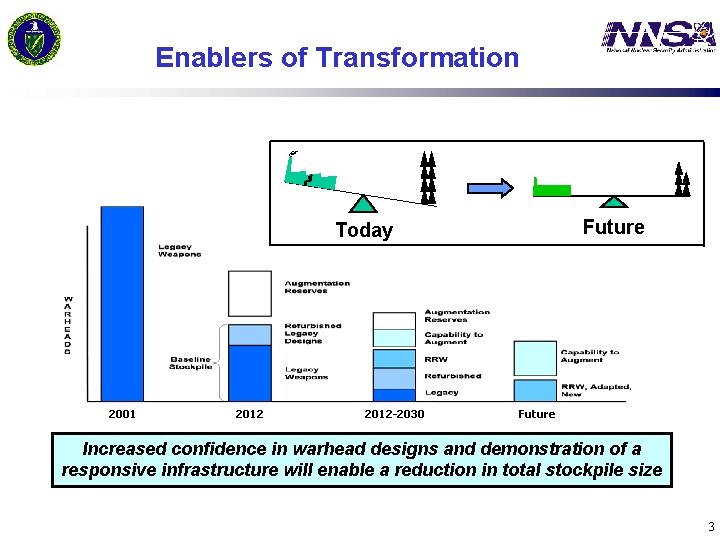
Enablers of Transformation Future Today 2001 2012 -2030 Future Increased confidence in warhead designs and demonstration of a responsive infrastructure will enable a reduction in total stockpile size 3
Principles for Change • Meet national security responsibilities to the current stockpile without interruptions. • Preserve a premier science and technology base as essential to future nuclear capabilities. • Demonstrate all phases of production required to maintain the U. S. nuclear weapons stockpile. • In partnership with the Do. D, transform the stockpile consistent with the Nuclear Posture Review through concepts such as a reliable replacement warhead (RRW). Balance current life-extension programs for legacy weapons with a transition to RRW concepts. • Transform the complex to be more responsive and cost-effective. Start plans with an assumption that no additional new funds are available for transformation. Operations of the complex will be simplified and essential capabilities/capacities maintained. 4
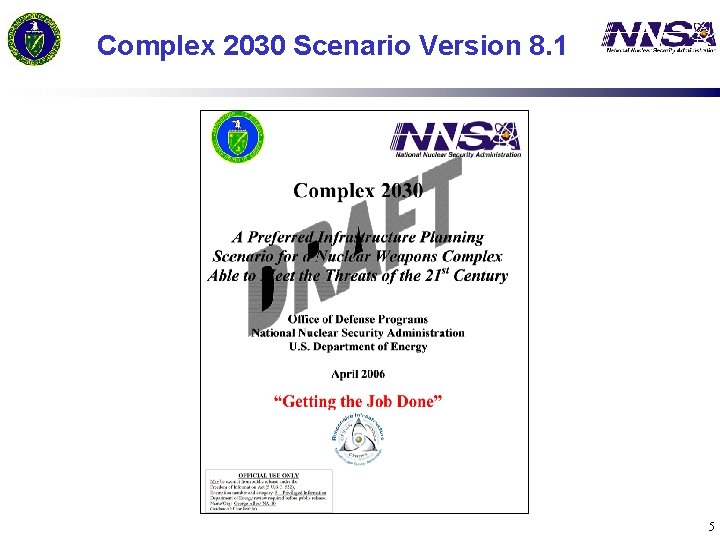
Complex 2030 Scenario Version 8. 1 5
Four Long-term Strategies and A Near-Term Commitment • In partnership with Do. D, transform the nuclear stockpile • Transform to a modernized, cost-effective nuclear weapons complex • Create a fully integrated and interdependent nuclear weapons complex • Drive the science and technology base essential for long-term national security • Build confidence in the transformation process 6
Long-term Implementation Strategies 1. In partnership with Do. D, transform the nuclear stockpile. – Transform to an RRW-stockpile by ~2030. 2. Transform to a modernized, cost-effective nuclear weapons complex. • Go to a consolidated plutonium center by 2022 with distributed modernization in place for remaining capabilities. • Start NNSA scoping of a programmatic environmental impact statement on future complex alternatives in 2006. • Consolidate CAT I/II special nuclear (SNM) materials – no CAT I/II SNM at national labs in the long-term, fewer locations within production plants. • Create a consolidated plutonium center for CAT I/II quantities of materials. • Modernize remaining production capabilities in place (e. g. , uranium at Y 12). 7
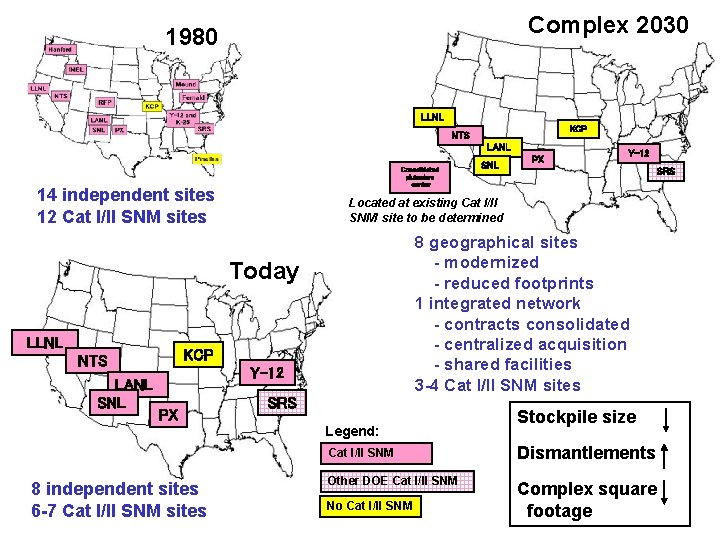
Complex 2030 1980 LLNL KCP NTS LANL Consolidated plutonium center 14 independent sites 12 Cat I/II SNM sites LANL SNL Y-12 PX SRS Legend: 8 independent sites 6 -7 Cat I/II SNM sites Y-12 SRS 8 geographical sites - modernized - reduced footprints 1 integrated network - contracts consolidated - centralized acquisition - shared facilities 3 -4 Cat I/II SNM sites KCP NTS PX Located at existing Cat I/II SNM site to be determined Today LLNL Stockpile size Cat I/II SNM Dismantlements Other DOE Cat I/II SNM Complex square footage No Cat I/II SNM
Long-term Implementation Strategies 3. Create a fully integrated and interdependent complex – Manage risk – Fewer, standard contracts – Streamline processes and uniform business practices 4. Drive the science and technology base essential for national security – Define essential long-term capabilities – Integrate with DOE Office of Science and enhance work-for-others – Eliminate duplicative facilities and programs 9
“Getting the Job Done” Building Confidence in the Transformation Process NNSA short term commitments: • Continue to deliver products to Do. D. • Eliminate backlog of surveillance units in FY 2007. • Accelerate dismantlement of retired weapons by 49% from FY 2006 to FY 2007. • Deliver B 61 -7/11 First Production Unit (FPU) in FY 2006. • Deliver W 76 FPU in FY 2007. • Certify the W 88 with a new pit and manufacture 10 pits in FY 2007. • Extract Tritium in FY 2007. • Support the science base by completing: pit lifetime estimates (2006), ASC Purple machine (2006), MESA (2008), DARHT (2008), and NIF (2010). • Support an RRW decision by the Nuclear Weapons Council in Nov 2006. • Implement starting actions to achieve Complex 2030 infrastructure vision. 10
Key Transformation Activities Involving LLNL • Support NNSA initiatives in partnership with the Department of Defense to transform the nuclear stockpile through the design and development of Reliable Replacement Warheads (RRW) • Remove CAT I/II SNM from LLNL by the end of 2014 consistent with the availability of repository sites, and support the closure of Building 332. • • Transition large-scale hydrotesting to NTS and support closure of Site 300. Rely on capability computing at a single site at any one time (accessible complex-wide) and distributed capacity computing at multiple sites. Operate high-energy density physics facilities (e. g. , NIF), as well as other major science assets, as national, shared user facilities. Establish a Supply Chain Management Center by end of 2007. • • • Create a more integrated and interdependent system of laboratories, plants, and test sites. 11
Backup 12
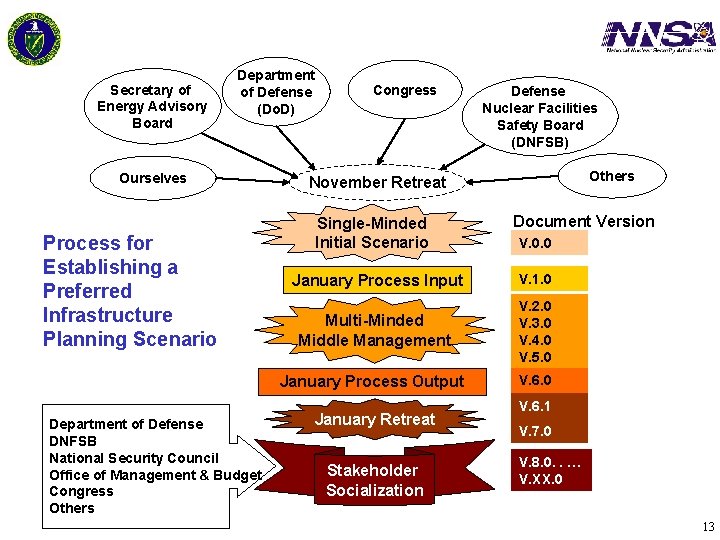
Secretary of Energy Advisory Board Department of Defense (Do. D) Ourselves Process for Establishing a Preferred Infrastructure Planning Scenario Department of Defense DNFSB National Security Council Office of Management & Budget Congress Others Congress Defense Nuclear Facilities Safety Board (DNFSB) Others November Retreat Single-Minded Initial Scenario Document Version V. 0. 0 January Process Input V. 1. 0 Multi-Minded Middle Management V. 2. 0 V. 3. 0 V. 4. 0 V. 5. 0 January Process Output V. 6. 0 January Retreat Stakeholder Socialization V. 6. 1 V. 7. 0 V. 8. 0. . … V. XX. 0 13
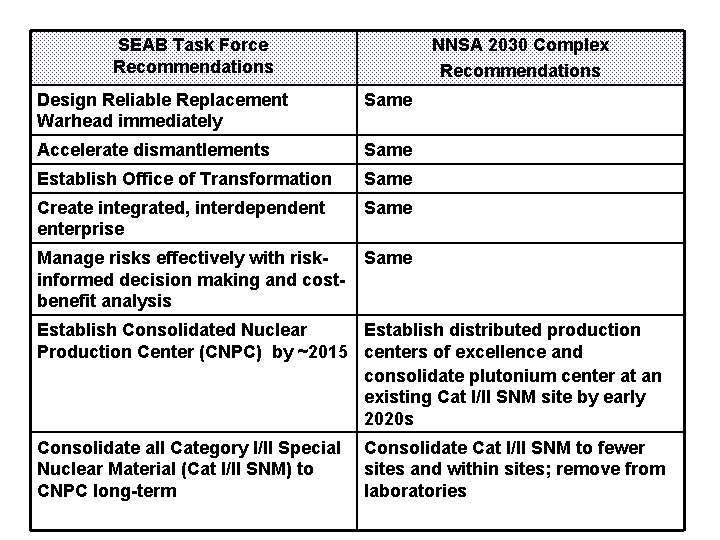
SEAB Task Force Recommendations NNSA 2030 Complex Recommendations Design Reliable Replacement Warhead immediately Same Accelerate dismantlements Same Establish Office of Transformation Same Create integrated, interdependent enterprise Same Manage risks effectively with riskinformed decision making and costbenefit analysis Same Establish Consolidated Nuclear Establish distributed production Production Center (CNPC) by ~2015 centers of excellence and consolidate plutonium center at an existing Cat I/II SNM site by early 2020 s Consolidate all Category I/II Special Nuclear Material (Cat I/II SNM) to CNPC long-term Consolidate Cat I/II SNM to fewer sites and within sites; remove from laboratories
Transform the Nuclear Stockpile Legacy Stockpile Program of Record Smaller but all Legacy Stockpile Program of Record Smaller, Transformed, RRW Stockpile Transformed, Smaller RRW Stockpile – Component reuse as near -term option with new components later Things we will do: • Maintain the viability of legacy weapons until replaced. Assure confidence in the reliability, safety, security, and performance of the nuclear deterrent without underground nuclear testing. • Accelerate dismantlement completion from 2034 to 2023 of legacy weapons currently planned for retirement. • Engage in partnership with the Department of Defense to deploy reliable replacement warhead (RRW) concepts. Work with Do. D to modify legacy stockpile Program of Record: – Suggest limiting number of W 76 -1 warheads completed in the Life Extension Program (LEP). – Suggest canceling the W 80 LEP now and reducing warhead numbers. – Suggest reducing the number of B 61 -7 refurbishments and canceling the B 61 non-nuclear LEP. – Suggest canceling the W 78 LEP. • Implement a continuous design/deployment cycle that exercises the design and production capabilities and enables responsiveness of the nuclear weapons complex. • Sustain capability to test. 15
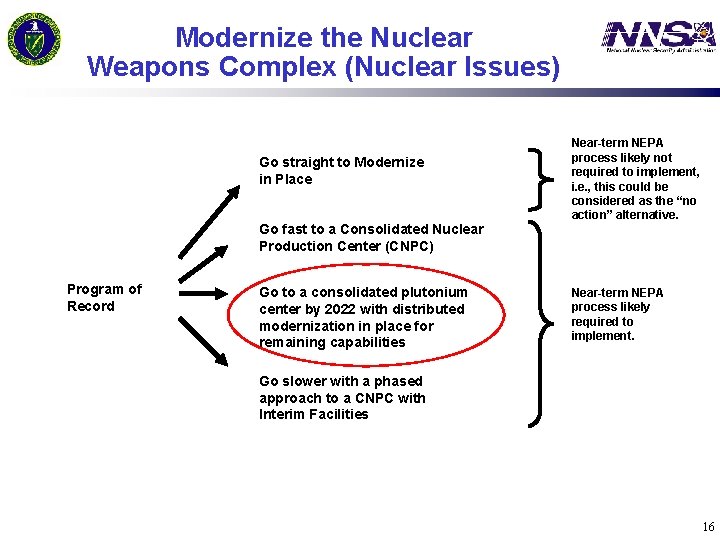
Modernize the Nuclear Weapons Complex (Nuclear Issues) Go straight to Modernize in Place Go fast to a Consolidated Nuclear Production Center (CNPC) Program of Record Go to a consolidated plutonium center by 2022 with distributed modernization in place for remaining capabilities Near-term NEPA process likely not required to implement, i. e. , this could be considered as the “no action” alternative. Near-term NEPA process likely required to implement. Go slower with a phased approach to a CNPC with Interim Facilities 16
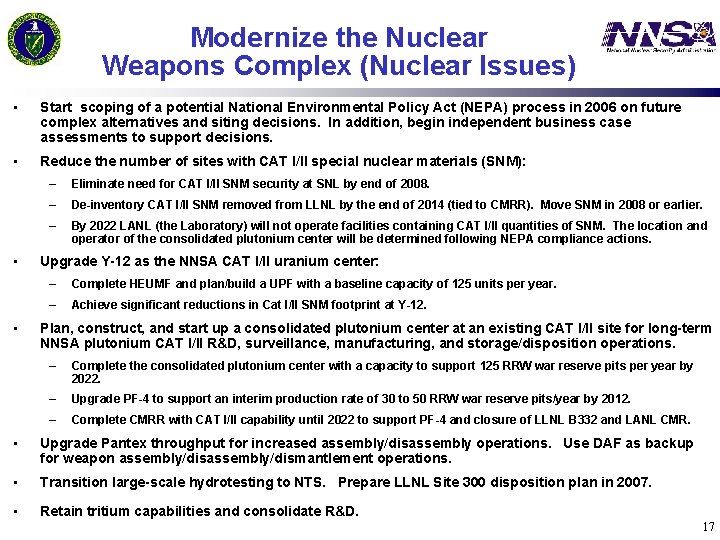
Modernize the Nuclear Weapons Complex (Nuclear Issues) • Start scoping of a potential National Environmental Policy Act (NEPA) process in 2006 on future complex alternatives and siting decisions. In addition, begin independent business case assessments to support decisions. • Reduce the number of sites with CAT I/II special nuclear materials (SNM): • • – Eliminate need for CAT I/II SNM security at SNL by end of 2008. – De-inventory CAT I/II SNM removed from LLNL by the end of 2014 (tied to CMRR). Move SNM in 2008 or earlier. – By 2022 LANL (the Laboratory) will not operate facilities containing CAT I/II quantities of SNM. The location and operator of the consolidated plutonium center will be determined following NEPA compliance actions. Upgrade Y-12 as the NNSA CAT I/II uranium center: – Complete HEUMF and plan/build a UPF with a baseline capacity of 125 units per year. – Achieve significant reductions in Cat I/II SNM footprint at Y-12. Plan, construct, and start up a consolidated plutonium center at an existing CAT I/II site for long-term NNSA plutonium CAT I/II R&D, surveillance, manufacturing, and storage/disposition operations. – Complete the consolidated plutonium center with a capacity to support 125 RRW war reserve pits per year by 2022. – Upgrade PF-4 to support an interim production rate of 30 to 50 RRW war reserve pits/year by 2012. – Complete CMRR with CAT I/II capability until 2022 to support PF-4 and closure of LLNL B 332 and LANL CMR. • Upgrade Pantex throughput for increased assembly/disassembly operations. Use DAF as backup for weapon assembly/dismantlement operations. • Transition large-scale hydrotesting to NTS. Prepare LLNL Site 300 disposition plan in 2007. • Retain tritium capabilities and consolidate R&D. 17
Modernize the Nuclear Weapons Complex (Non-Nuclear Issues) • Establish a Supply Chain Management Center by end of 2007. • Create a smaller non-nuclear production facility that is occupied by 2012 for components that cannot be outsourced. • Outsource synthesis and formulation of high explosive (HE) materials as practical, outsource or consolidate large-scale HE production pressing, and consolidate HE machining to Pantex. • Consolidate HE R&D and laboratory-scale testing (without Cat I/II SNM). • Maintain secure transportation assets to support DOE-wide requirements. • Rely on capability computing at a single site at any one time (accessible complex-wide) and distributed capacity computing at multiple sites. • Operate high-energy density physics facilities (e. g. , LANSCE, Omega, Z, and NIF), as well as other major science assets, as national, shared user facilities. • Cease NNSA operations at Tonopah Test Range by end of 2009 through use of alternative, non-NNSA operated ranges and elimination of joint test assemblies containing SNM through alternative designs and/or test techniques. 18
Create a Fully Integrated and Interdependent Complex • Create a more integrated and interdependent system of laboratories, plants, and test sites. – Use fewer, more standard, contracts to incentivize sharing of risks & rewards across the complex and implement approaches that balance mission, safety and security. – Use an independent, national-level organization to lead requirements development and cost estimating for construction projects and use a recognized contract management firm. – Implement uniformity across the nuclear weapon complex in business practices, information management, program management, risk management, and RTBF. • Ensure NNSA Leadership works in a uniform, integrated manner that balances competing priorities. – Establish structure (e. g. , systems engineering and integration contractor and clear roles/responsibilities) to balance competing priorities across missions, risks, program elements, and distributed sites. – Implement an approach and culture that manages risk rather than seeks to eliminate it. Apply risk-informed decision-making to safety and security (both physical and cyber) decisions. – Implement actions in response to Defense Science Board February 2006 recommendations. • • Ensure intellectual competition, peer review, and essential nuclear capabilities are sustained during consolidation of missions and elimination of redundancies. Implement predictive surveillance evaluations to reduce flight-test requirements. 19
Drive Science and Technology Base • Establish a science and technology model by the end of 2007 that defines the needed capabilities required to sustain the stockpile in the long term. • Recognize that Work for Others plays an essential role in maintaining capabilities required for the NNSA mission. Encourage stronger Work for Others in key mission areas. • Manage the transition to a lower cost NNSA national laboratory complex. Develop a plan by the end of 2007 to eliminate duplicative facilities and programs and maintain key capabilities. Partner with the Office of Science and other leading national R&D sponsors regarding the national laboratory complex. Define options and recommended path forward by the end of 2007. Develop jointly funded, integrated programs within NNSA and the DOE Office of Science that develop the leading edge science and engineering capabilities needed for national security. Implement joint planning between the Office of Science and NNSA starting a pilot in the FY 2008 budget cycle. • • • 20
Responsive Infrastructure Objectives • Identify, understand, and fix stockpile problems in time to assure continued confidence in the reliability and safety of the stockpile. • Dismantle warheads on a timescale consistent with policy requirements. • Ensure warheads are available to augment the operationally deployed force on a timescale that supports Do. D requirements. • Design, develop, certify, and complete first production units of refurbished or replacement warheads on a frequency that both sustains the stockpile and exercises the supporting infrastructure and critical skills. • Improve the capability to design, develop, certify, and complete production of new or adapted warheads in the event of new military requirements. • Produce required quantities of warheads in time to meet military requirements. • Demonstrate nuclear competencies that assure allies, dissuade adversaries, and ensure against technological surprise. • Sustain readiness to conduct underground nuclear tests. • Ensure an economically sustainable nuclear weapons enterprise. 21