
Completely Randomized Design Outline n Reviews for later
- Slides: 20
Completely Randomized Design Outline n Reviews for later topics – Model parameterization (estimability) – Contrasts (power analysis) n Analysis with contrasts – Orthogonal polynomial contrasts – Polynomial goodness-of-fit
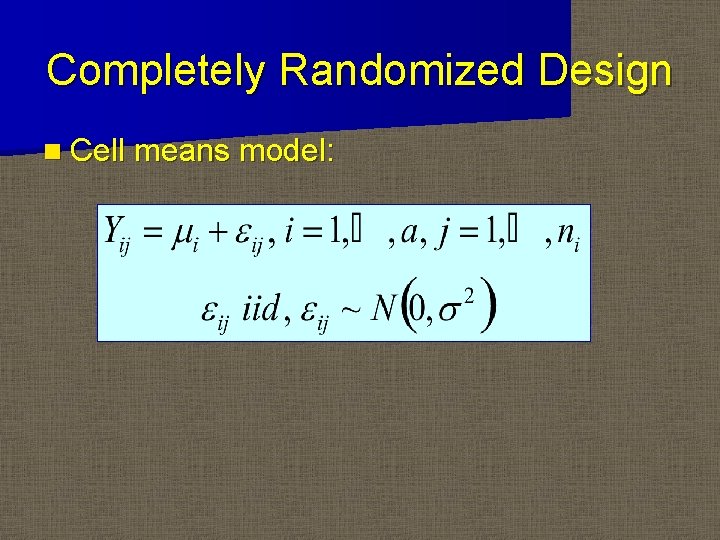
Completely Randomized Design n Cell means model:
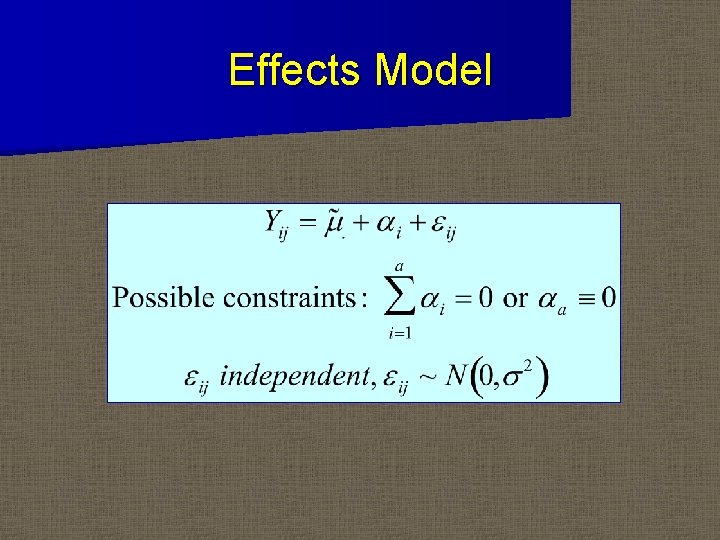
Effects Model
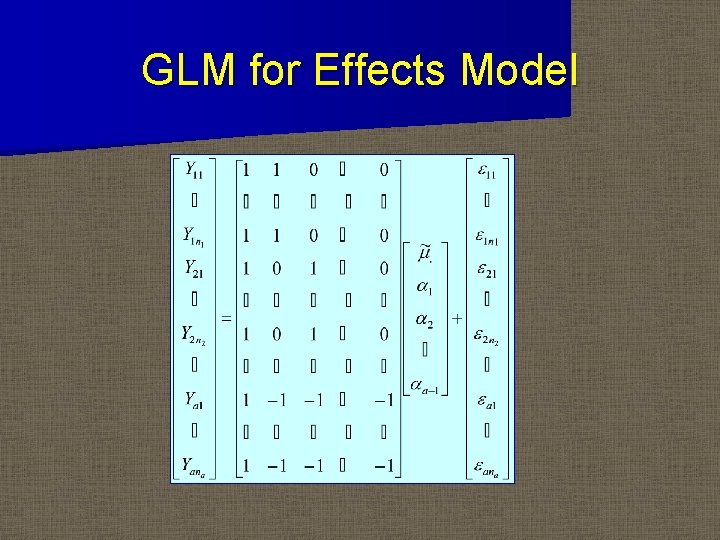
GLM for Effects Model
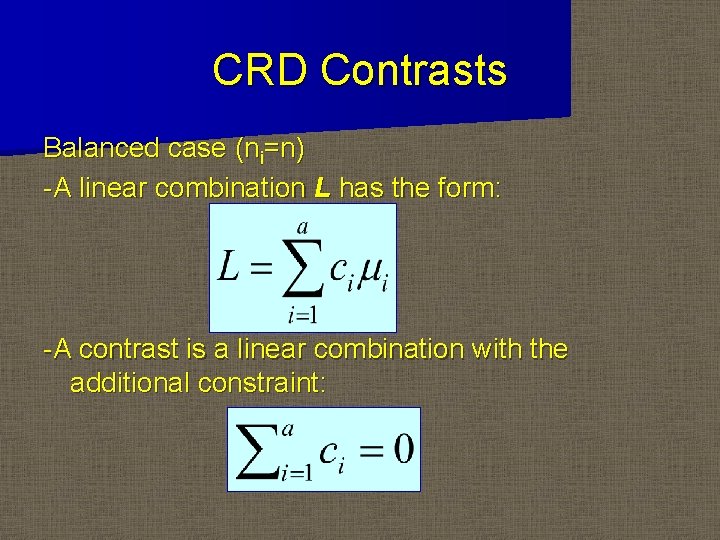
CRD Contrasts Balanced case (ni=n) -A linear combination L has the form: -A contrast is a linear combination with the additional constraint:
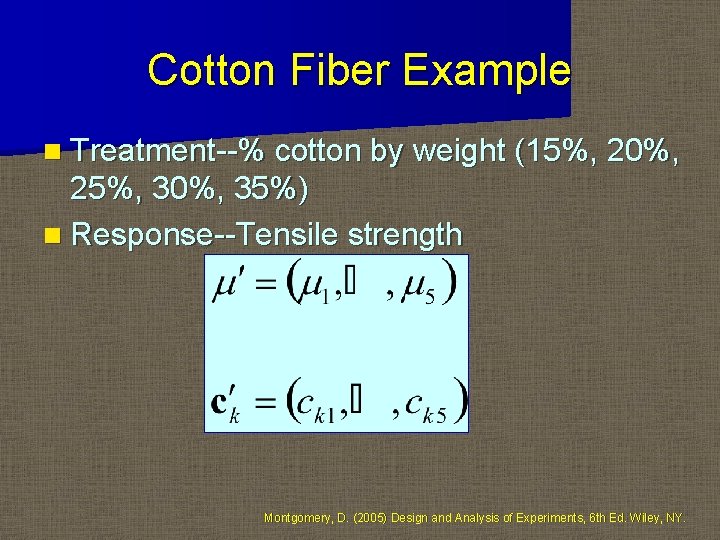
Cotton Fiber Example n Treatment--% cotton by weight (15%, 20%, 25%, 30%, 35%) n Response--Tensile strength Montgomery, D. (2005) Design and Analysis of Experiments, 6 th Ed. Wiley, NY.
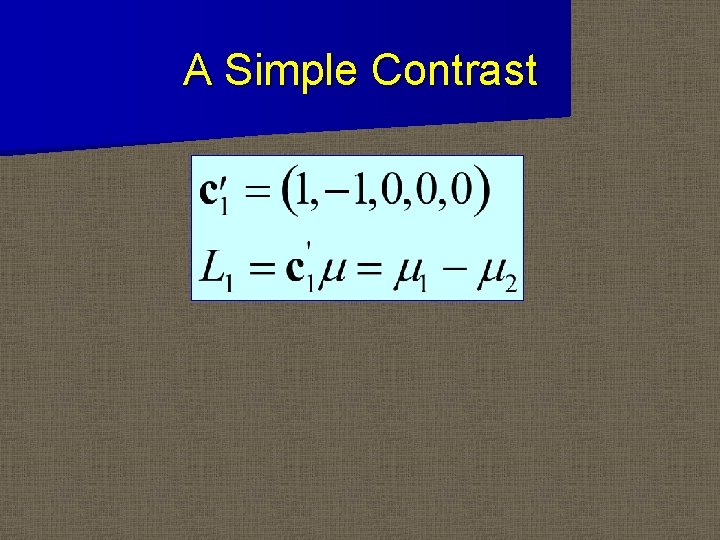
A Simple Contrast
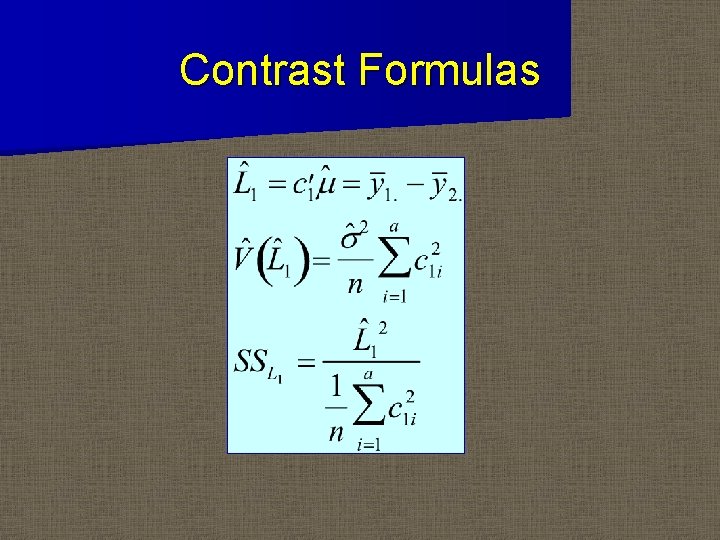
Contrast Formulas
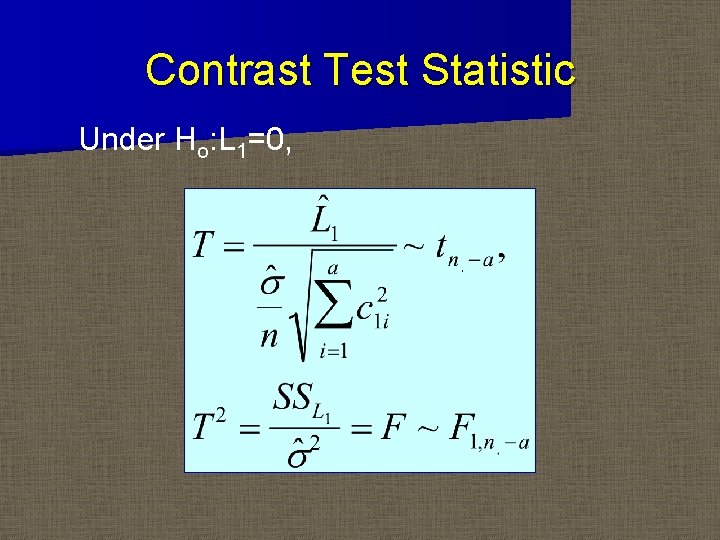
Contrast Test Statistic Under Ho: L 1=0,
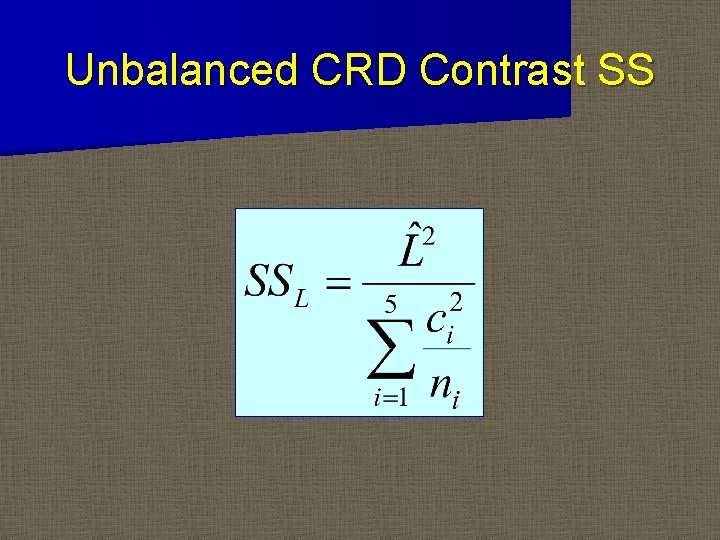
Unbalanced CRD Contrast SS
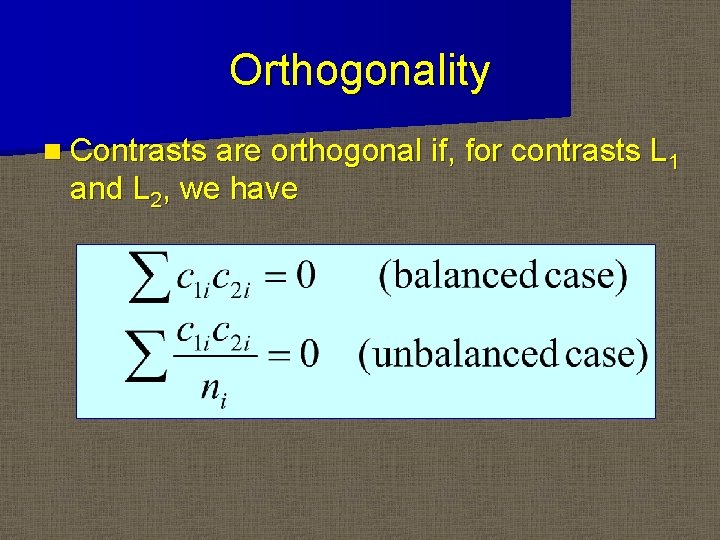
Orthogonality n Contrasts are orthogonal if, for contrasts L 1 and L 2, we have
Orthogonality Discussion, I n The usual a-1 ANOVA contrasts are not orthogonal (though columns are linearly independent) n Orthogonality implies effect estimates are unaffected by presence/absence of other model terms
Orthogonality Discussion, II n Sums of squares for orthogonal contrasts are additive, allowing treatment sums of squares to be partitioned n Mathematically attractive, though not all contrasts will be interesting to the researcher
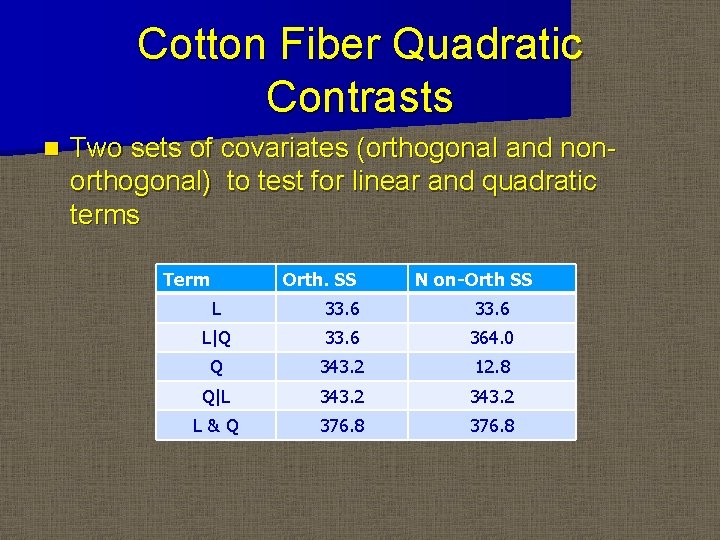
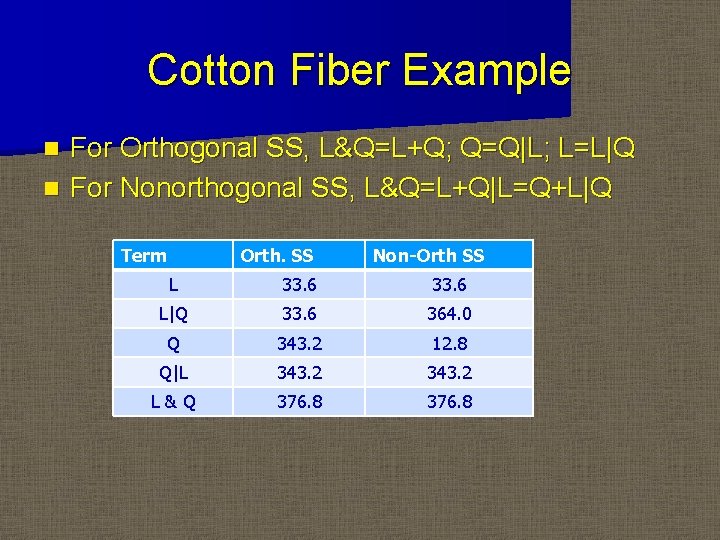
Cotton Fiber Quadratic Contrasts n Two sets of covariates (orthogonal and nonorthogonal) to test for linear and quadratic terms Term Orth. SS N on-Orth SS L 33. 6 L|Q 33. 6 364. 0 Q 343. 2 12. 8 Q|L 343. 2 L&Q 376. 8
Cotton Fiber Example For Orthogonal SS, L&Q=L+Q; Q=Q|L; L=L|Q n For Nonorthogonal SS, L&Q=L+Q|L=Q+L|Q n Term Orth. SS Non-Orth SS L 33. 6 L|Q 33. 6 364. 0 Q 343. 2 12. 8 Q|L 343. 2 L&Q 376. 8
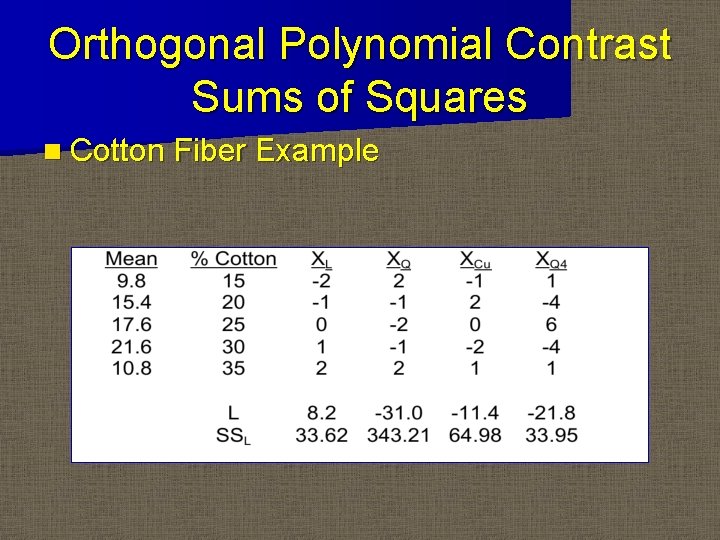
Orthogonal polynomial contrasts n Require quantitative factors n Equal spacing of factor levels (d) n Equal ni n Usually, only the linear and quadratic contrasts are of interest
Orthogonal Polynomial Contrast Sums of Squares n Cotton Fiber Example
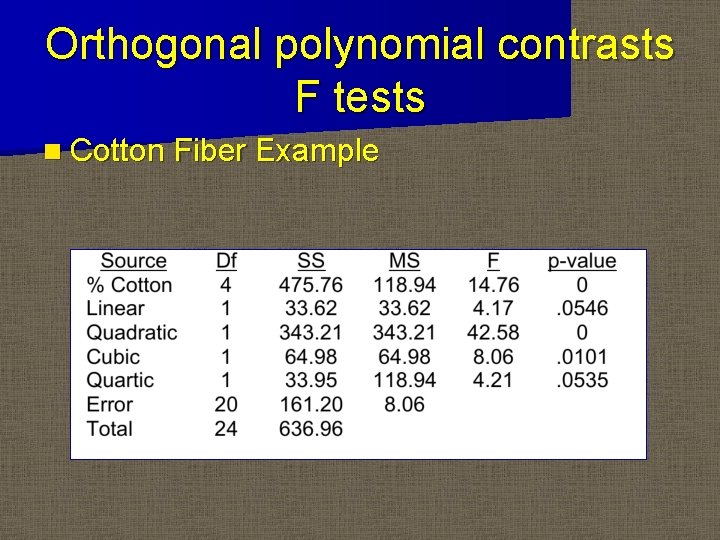
Orthogonal polynomial contrasts F tests n Cotton Fiber Example
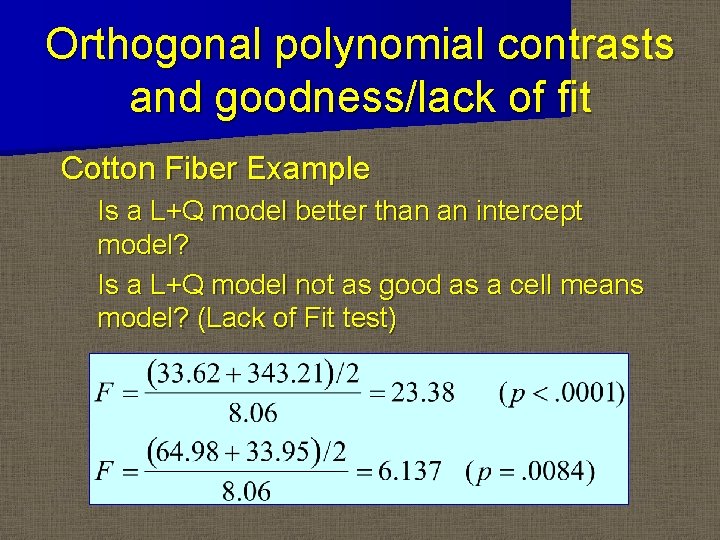
Orthogonal polynomial contrasts and goodness/lack of fit Cotton Fiber Example Is a L+Q model better than an intercept model? Is a L+Q model not as good as a cell means model? (Lack of Fit test)
Orthogonal polynomial contrasts —another approach n Yandell has an interesting approach to reconstructing these tests – Construct the first (linear) term – Include a quadratic term that is neither orthogonal, nor a contrast – Do not construct higher-order contrasts at all – Use a Type I analysis for testing