
Complete the following sentences with the proper tense





- Slides: 36
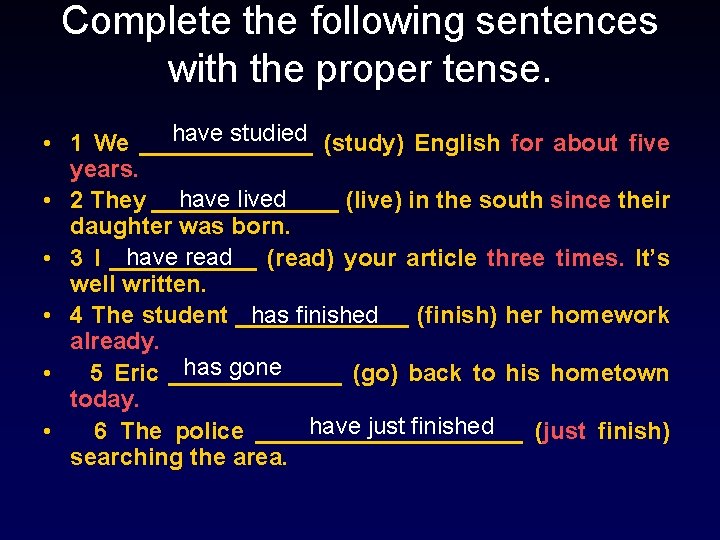
Complete the following sentences with the proper tense. have studied (study) English for about five • 1 We _______ years. have lived • 2 They _______ (live) in the south since their daughter was born. have read (read) your article three times. It’s • 3 I ______ well written. has finished • 4 The student _______ (finish) her homework already. has gone • 5 Eric _______ (go) back to his hometown today. have just finished • 6 The police __________ (just finish) searching the area.
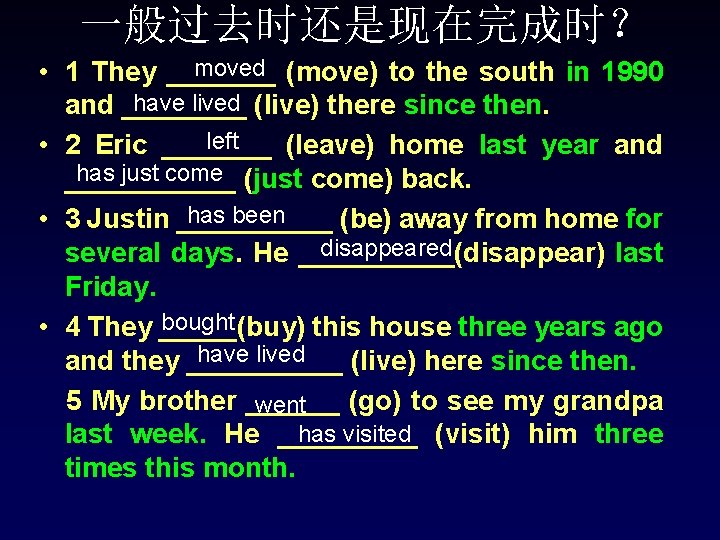
一般过去时还是现在完成时? moved (move) to the south in 1990 • 1 They _______ have lived (live) there since then. and ____ left • 2 Eric _______ (leave) home last year and has just come (just come) back. ______ has been • 3 Justin _____ (be) away from home for disappeared several days. He _____(disappear) last Friday. bought • 4 They _____(buy) this house three years ago have lived and they _____ (live) here since then. 5 My brother ______ (go) to see my grandpa went has visited (visit) him three last week. He _____ times this month.
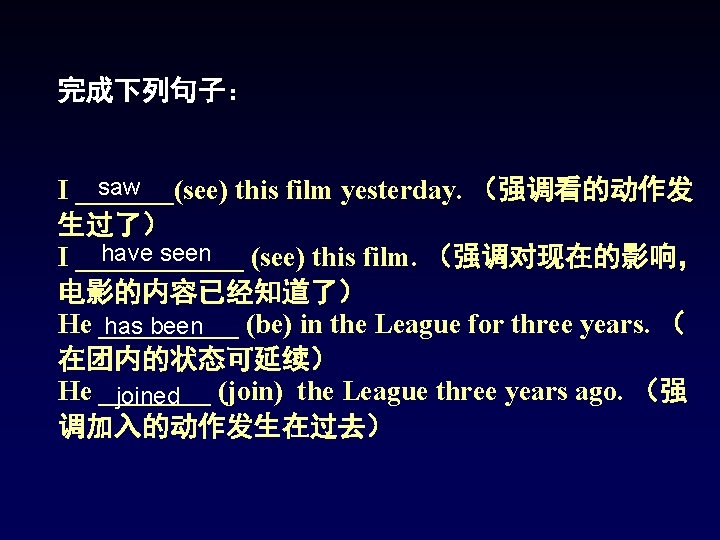
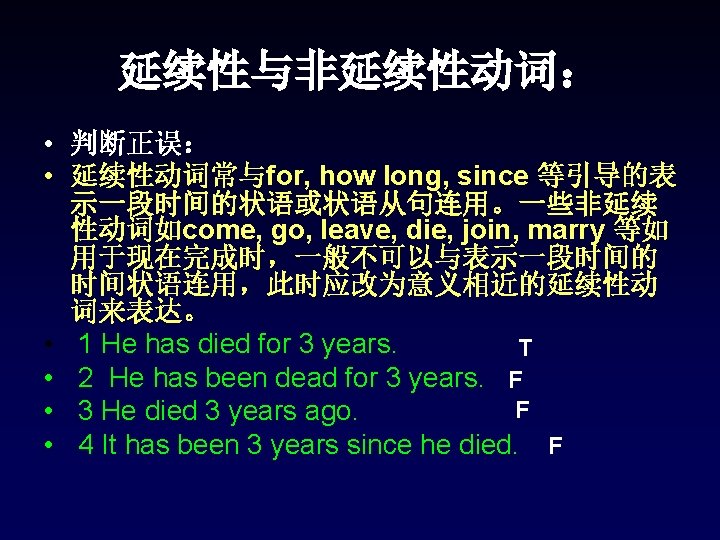
注意:非延续性动词的否定形式可以与表示延 续时间的状语连用。即动作不发生的状态是可 以持续的。 判断正误: ( 错 )I have received his letter for a month. ( 对 )I received this letter a month ago. ( 对 )I haven't received his letter for almost a month.
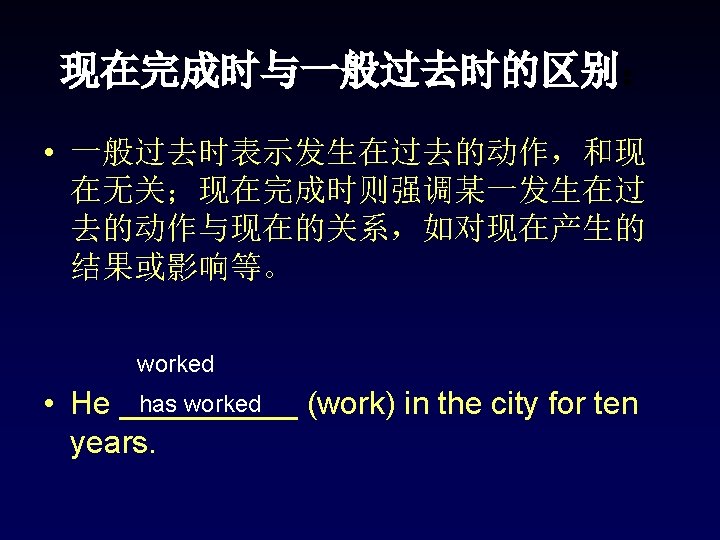
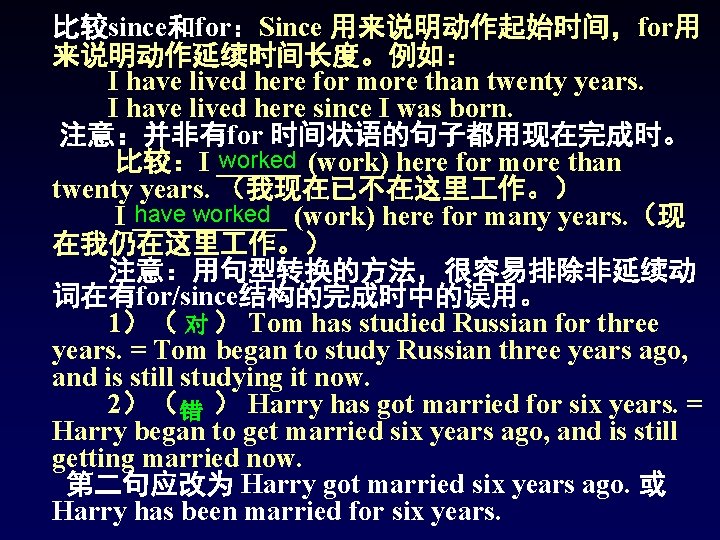
比较since和for:Since 用来说明动作起始时间,for用 来说明动作延续时间长度。例如: I have lived here for more than twenty years. I have lived here since I was born. 注意:并非有for 时间状语的句子都用现在完成时。 worked (work) here for more than 比较:I ______ twenty years. (我现在已不在这里 作。) have worked (work) here for many years. (现 I ______ 在我仍在这里 作。) 注意:用句型转换的方法,很容易排除非延续动 词在有for/since结构的完成时中的误用。 1)( 对 ) Tom has studied Russian for three years. = Tom began to study Russian three years ago, and is still studying it now. 2)( 错 ) Harry has got married for six years. = Harry began to get married six years ago, and is still getting married now. 第二句应改为 Harry got married six years ago. 或 Harry has been married for six years.
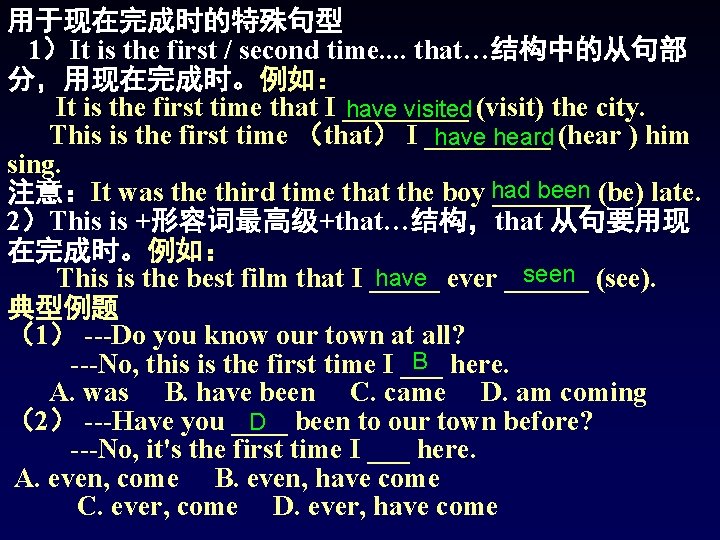
用于现在完成时的特殊句型 1)It is the first / second time. . that…结构中的从句部 分,用现在完成时。例如: It is the first time that I _____ have visited (visit) the city. This is the first time (that) I _____ have heard (hear ) him sing. been (be) late. 注意:It was the third time that the boy had _______ 2)This is +形容词最高级+that…结构,that 从句要用现 在完成时。例如: seen (see). have ever ______ This is the best film that I _____ 典型例题 (1) ---Do you know our town at all? B here. ---No, this is the first time I ___ A. was B. have been C. came D. am coming (2) ---Have you ____ D been to our town before? ---No, it's the first time I ___ here. A. even, come B. even, have come C. ever, come D. ever, have come
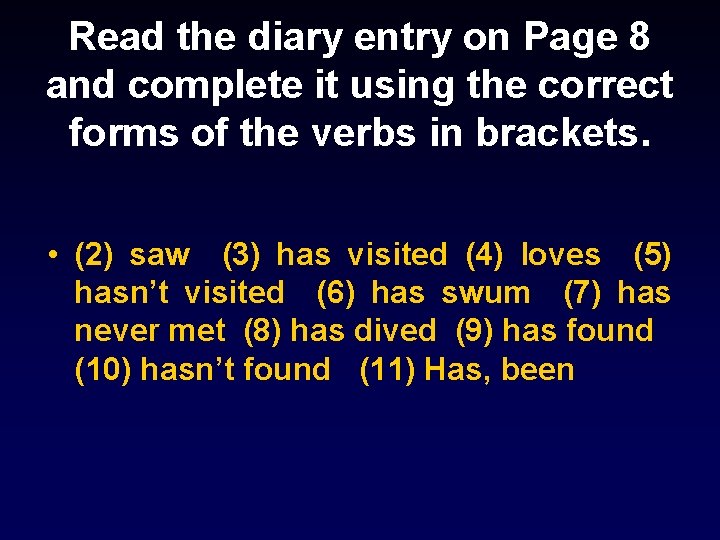
Read the diary entry on Page 8 and complete it using the correct forms of the verbs in brackets. • (2) saw (3) has visited (4) loves (5) hasn’t visited (6) has swum (7) has never met (8) has dived (9) has found (10) hasn’t found (11) Has, been
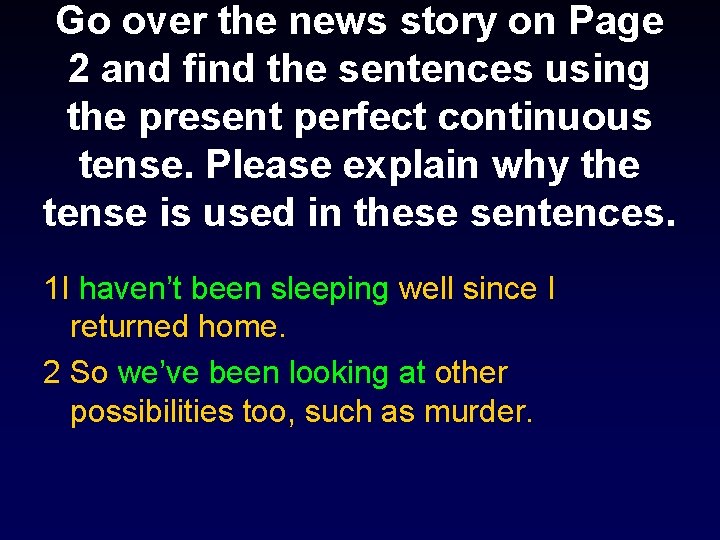
Go over the news story on Page 2 and find the sentences using the present perfect continuous tense. Please explain why the tense is used in these sentences. 1 I haven’t been sleeping well since I returned home. 2 So we’ve been looking at other possibilities too, such as murder.
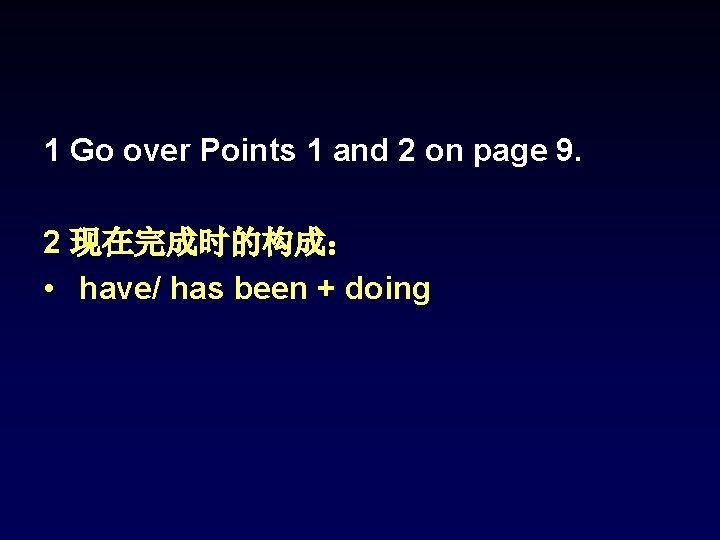
1 Go over Points 1 and 2 on page 9. 2 现在完成时的构成: • have/ has been + doing
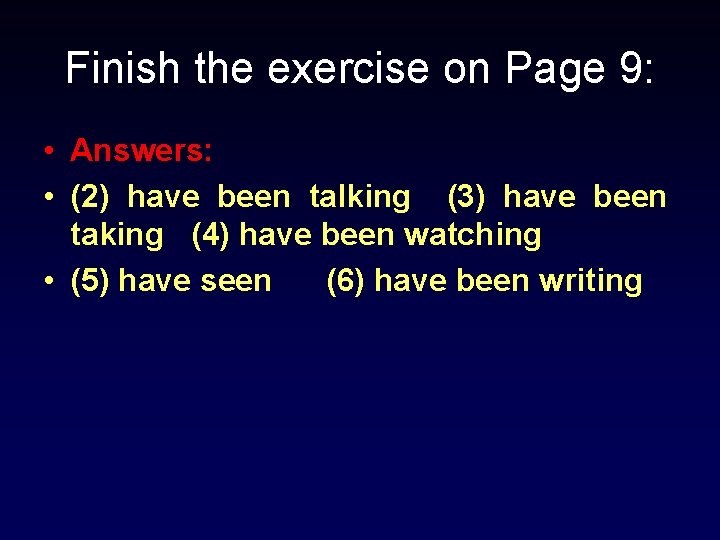
Finish the exercise on Page 9: • Answers: • (2) have been talking (3) have been taking (4) have been watching • (5) have seen (6) have been writing
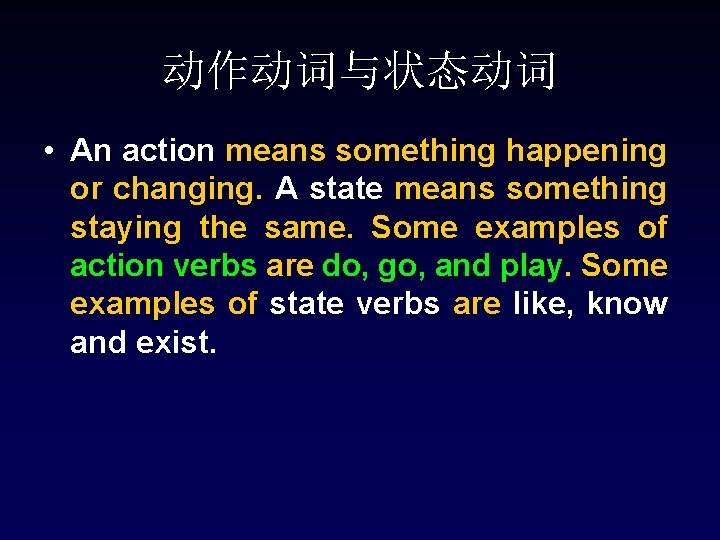
动作动词与状态动词 • An action means something happening or changing. A state means something staying the same. Some examples of action verbs are do, go, and play. Some examples of state verbs are like, know and exist.
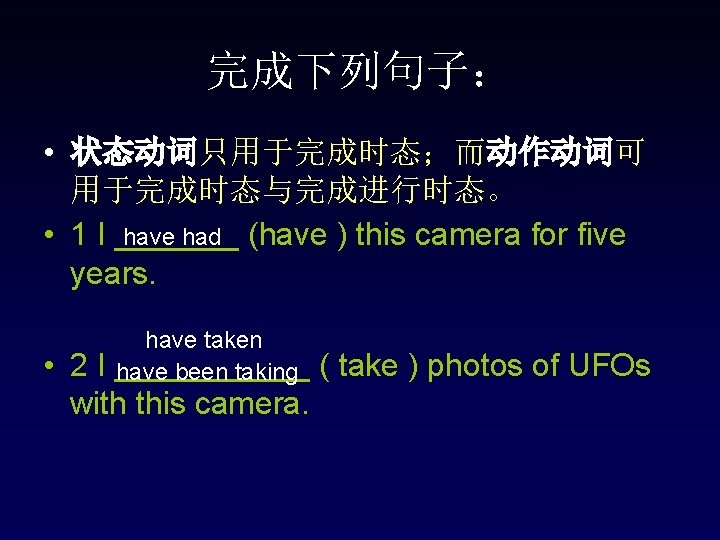
完成下列句子: • 状态动词只用于完成时态;而动作动词可 用于完成时态与完成进行时态。 have had (have ) this camera for five • 1 I _______ years. have taken ______ have been taking • 2 I ( take ) photos of UFOs with this camera.
• twice等表示次数的词只与完成时连用;而 for 则可以与完成进行时连用。 have visited • 1 I_____ (visit) Egypt twice this month. have been touring (tour) Egypt for two • 2 I_____ months.
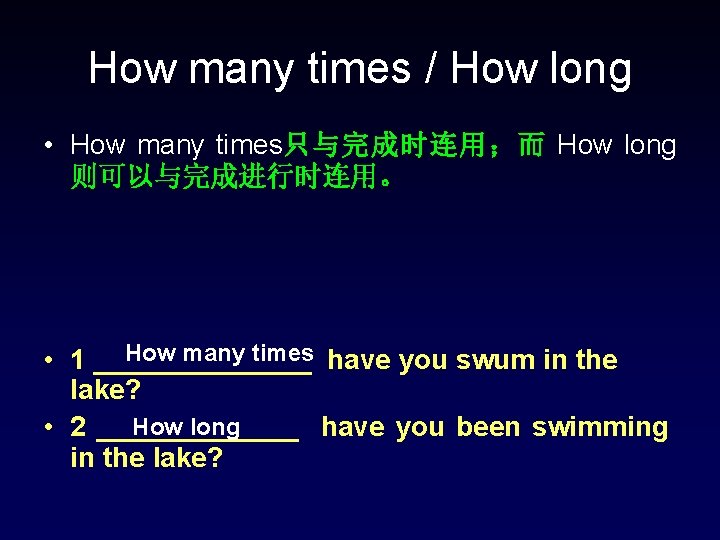
How many times / How long • How many times只与完成时连用;而 How long 则可以与完成进行时连用。 How many times have you swum in the • 1 _______ lake? How long • 2 _______ have you been swimming in the lake?
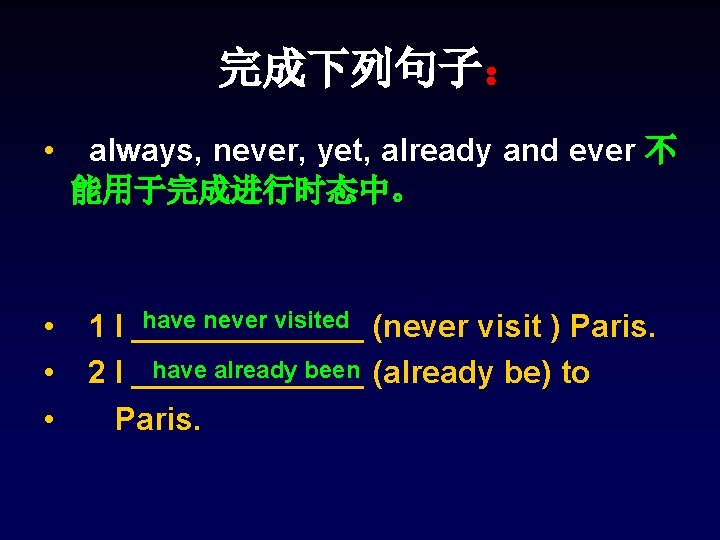
完成下列句子: • always, never, yet, already and ever 不 能用于完成进行时态中。 • • • have never visited (never visit ) Paris. 1 I _______ have already been (already be) to 2 I _______ Paris.
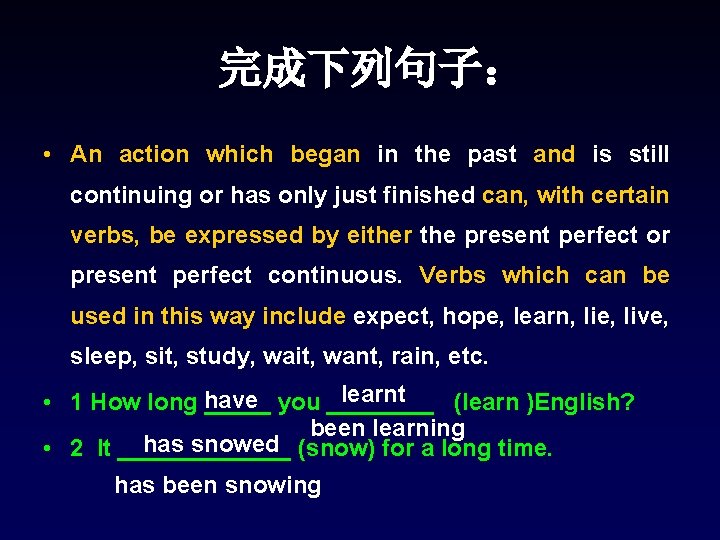
完成下列句子: • An action which began in the past and is still continuing or has only just finished can, with certain verbs, be expressed by either the present perfect or present perfect continuous. Verbs which can be used in this way include expect, hope, learn, lie, live, sleep, sit, study, wait, want, rain, etc. learnt • 1 How long have _____ you ____ (learn )English? been learning has snowed (snow) for a long time. • 2 It _______ has been snowing
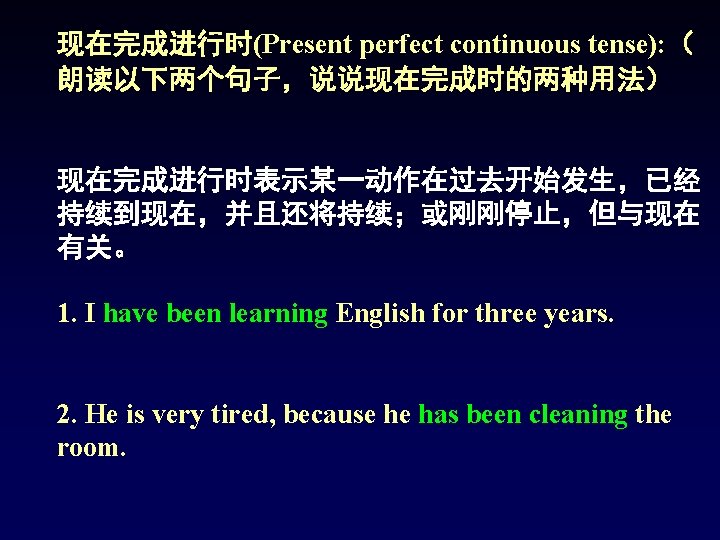
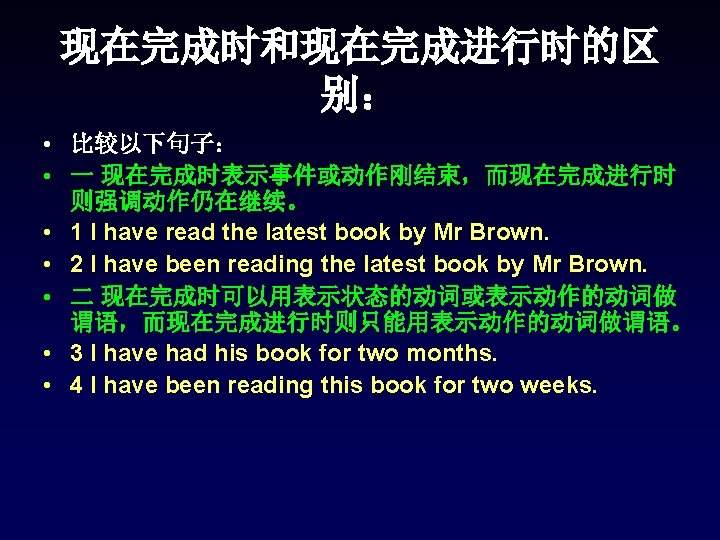
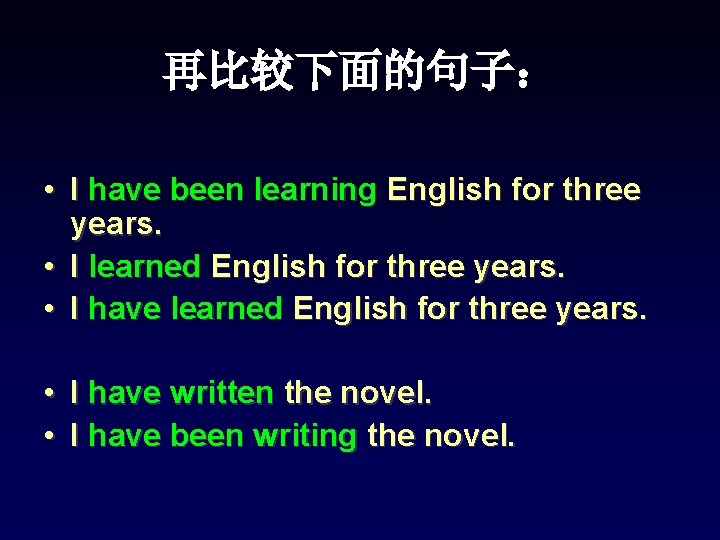
再比较下面的句子: • I have been learning English for three years. • I learned English for three years. • I have written the novel. • I have been writing the novel.
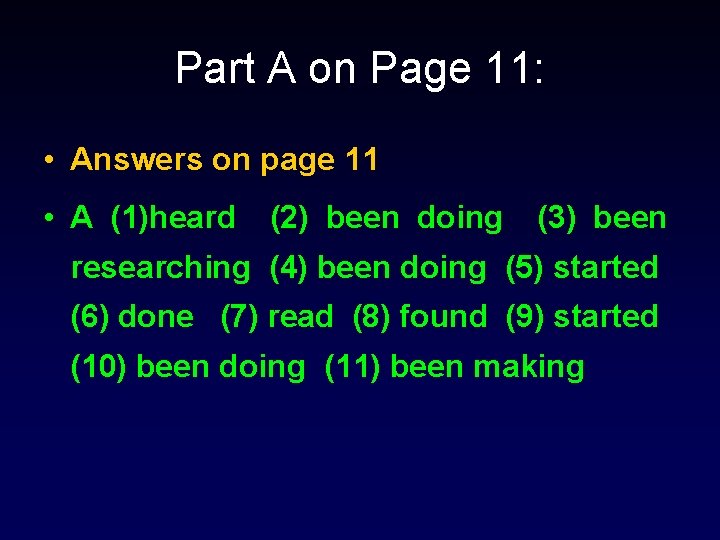
Part A on Page 11: • Answers on page 11 • A (1)heard (2) been doing (3) been researching (4) been doing (5) started (6) done (7) read (8) found (9) started (10) been doing (11) been making
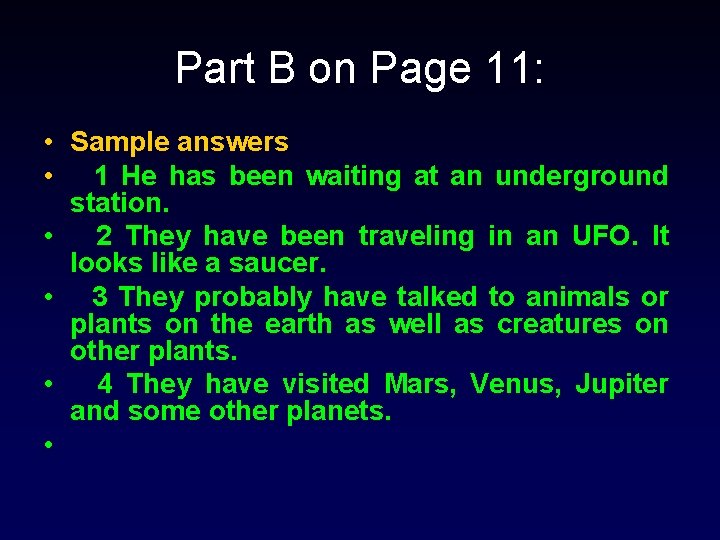
Part B on Page 11: • Sample answers • 1 He has been waiting at an underground station. • 2 They have been traveling in an UFO. It looks like a saucer. • 3 They probably have talked to animals or plants on the earth as well as creatures on other plants. • 4 They have visited Mars, Venus, Jupiter and some other planets. •
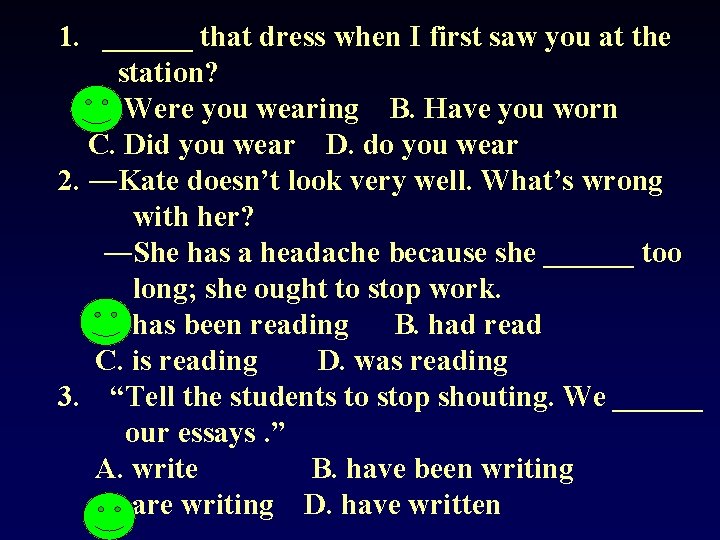
1. ______ that dress when I first saw you at the station? A. Were you wearing B. Have you worn C. Did you wear D. do you wear 2. ―Kate doesn’t look very well. What’s wrong with her? ―She has a headache because she ______ too long; she ought to stop work. A. has been reading B. had read C. is reading D. was reading 3. “Tell the students to stop shouting. We ______ our essays. ” A. write B. have been writing C. are writing D. have written
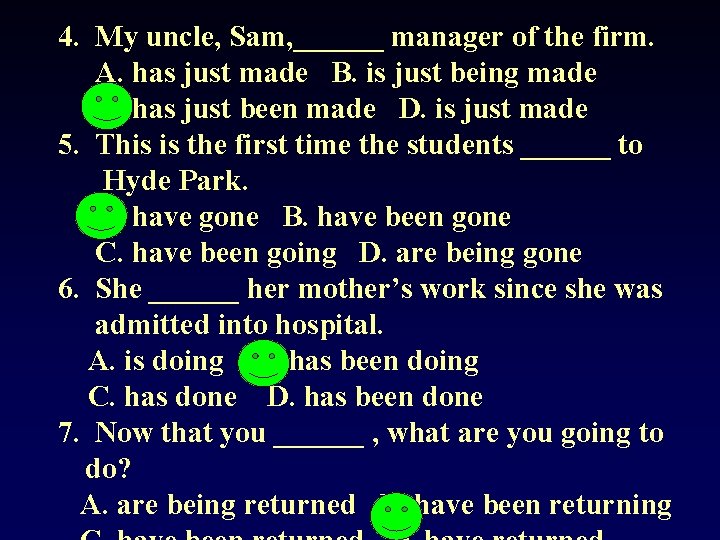
4. My uncle, Sam, ______ manager of the firm. A. has just made B. is just being made C. has just been made D. is just made 5. This is the first time the students ______ to Hyde Park. A. have gone B. have been gone C. have been going D. are being gone 6. She ______ her mother’s work since she was admitted into hospital. A. is doing B. has been doing C. has done D. has been done 7. Now that you ______ , what are you going to do? A. are being returned B. have been returning
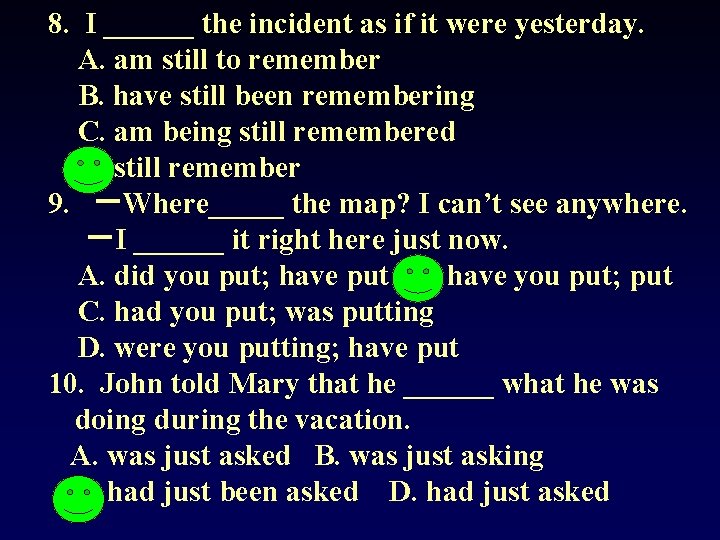
8. I ______ the incident as if it were yesterday. A. am still to remember B. have still been remembering C. am being still remembered D. still remember 9. -Where_____ the map? I can’t see anywhere. -I ______ it right here just now. A. did you put; have put B. have you put; put C. had you put; was putting D. were you putting; have put 10. John told Mary that he ______ what he was doing during the vacation. A. was just asked B. was just asking C. had just been asked D. had just asked
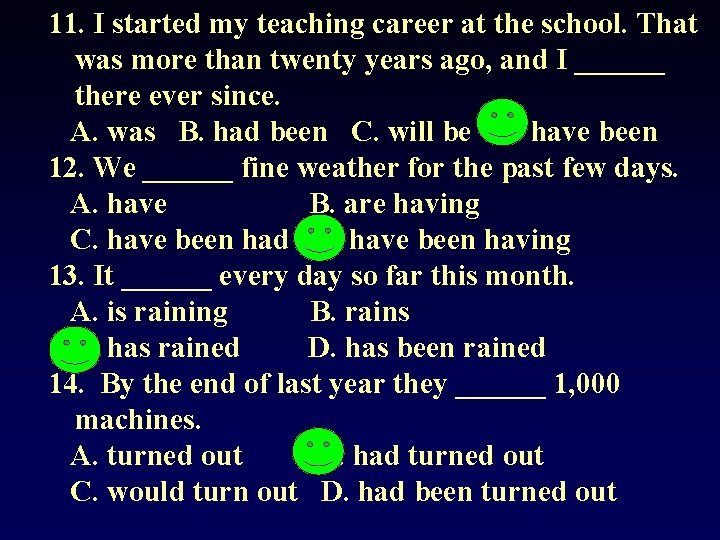
11. I started my teaching career at the school. That was more than twenty years ago, and I ______ there ever since. A. was B. had been C. will be D. have been 12. We ______ fine weather for the past few days. A. have B. are having C. have been had D. have been having 13. It ______ every day so far this month. A. is raining B. rains C. has rained D. has been rained 14. By the end of last year they ______ 1, 000 machines. A. turned out B. had turned out C. would turn out D. had been turned out
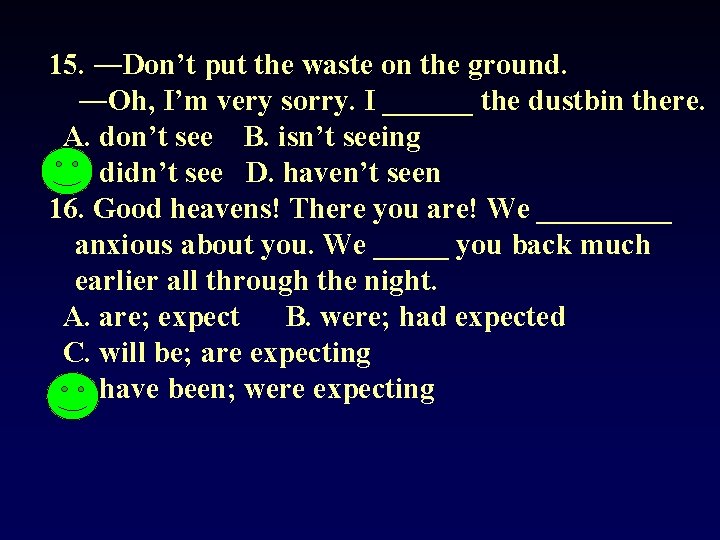
15. ―Don’t put the waste on the ground. ―Oh, I’m very sorry. I ______ the dustbin there. A. don’t see B. isn’t seeing C. didn’t see D. haven’t seen 16. Good heavens! There you are! We _____ anxious about you. We _____ you back much earlier all through the night. A. are; expect B. were; had expected C. will be; are expecting D. have been; were expecting
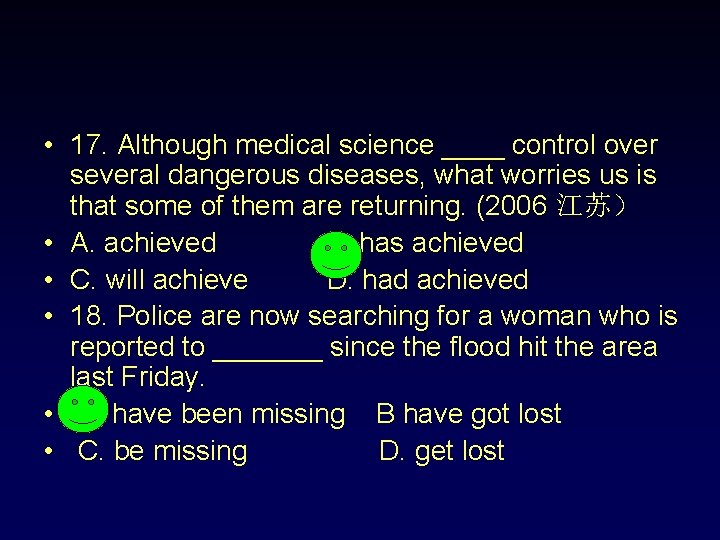
• 17. Although medical science ____ control over several dangerous diseases, what worries us is that some of them are returning. (2006 江苏) • A. achieved B. has achieved • C. will achieve D. had achieved • 18. Police are now searching for a woman who is reported to _______ since the flood hit the area last Friday. • A. have been missing B have got lost • C. be missing D. get lost
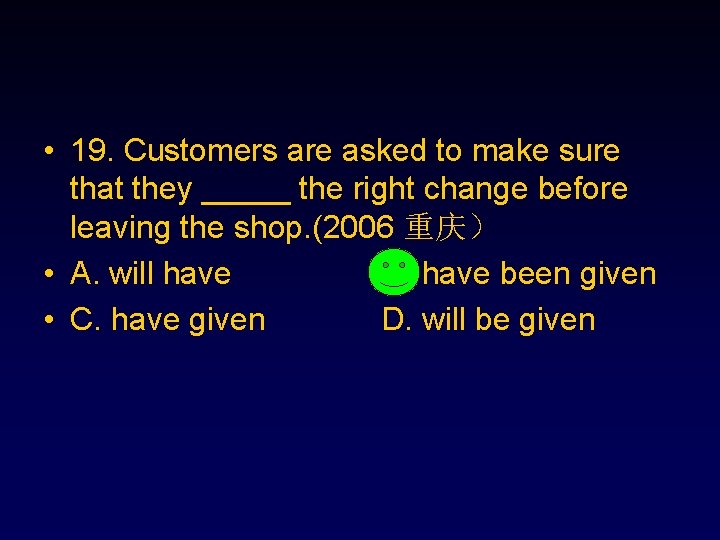
• 19. Customers are asked to make sure that they _____ the right change before leaving the shop. (2006 重庆) • A. will have B. have been given • C. have given D. will be given
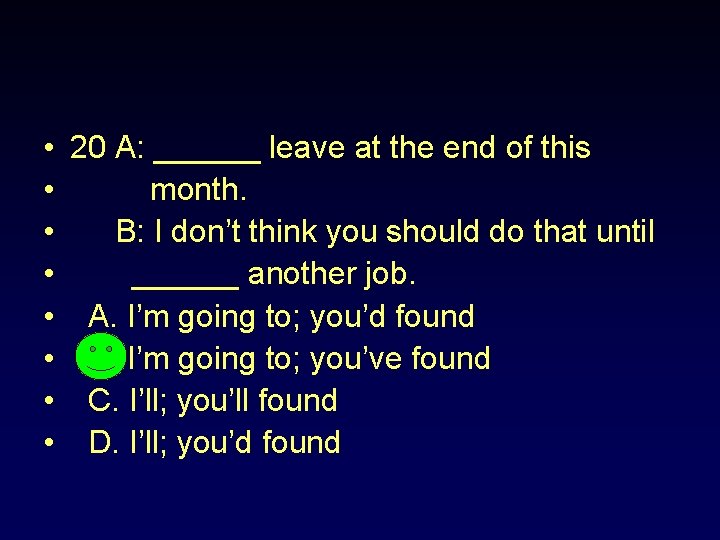
• 20 A: ______ leave at the end of this • month. • B: I don’t think you should do that until • ______ another job. • A. I’m going to; you’d found • B. I’m going to; you’ve found • C. I’ll; you’ll found • D. I’ll; you’d found
• Homework • Part C 1 and Workbook • Prepare Task C 2 on page 88 in