
Complete the first aid steps Primary Survey Number
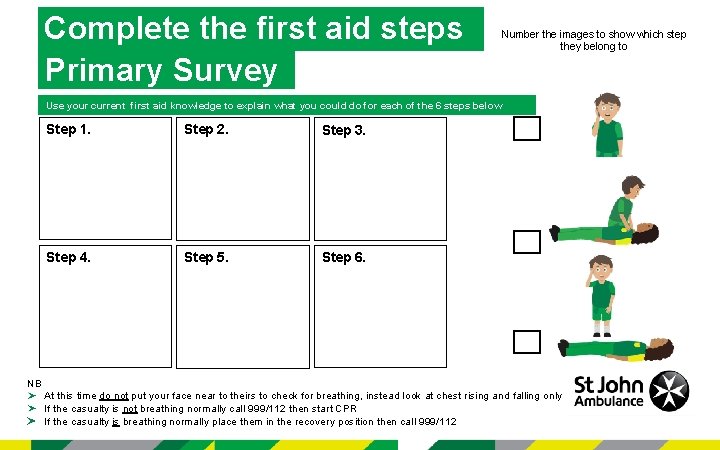
Complete the first aid steps Primary Survey Number the images to show which step they belong to Use your current first aid knowledge to explain what you could do for each of the 6 steps below Step 1. Step 2. Step 3. Step 4. Step 5. Step 6. NB At this time do not put your face near to theirs to check for breathing, instead look at chest rising and falling only If the casualty is not breathing normally call 999/112 then start CPR If the casualty is breathing normally place them in the recovery position then call 999/112
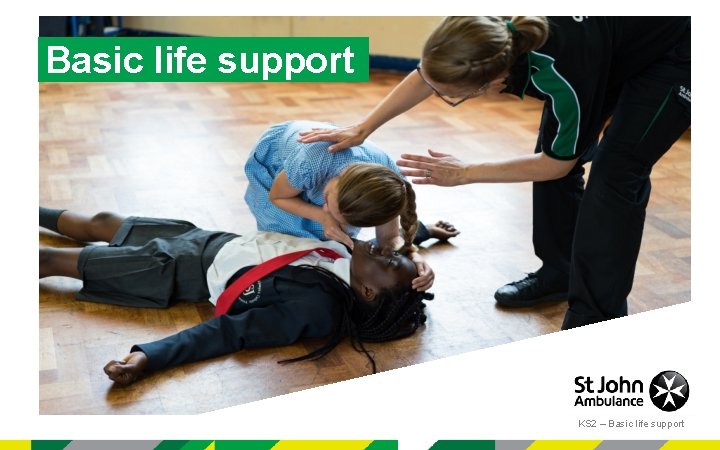
Basic life support KS 2 – Basic life support
A short course to learn… ➤How to conduct a Primary survey ➤How to place an unresponsive casualty, who is breathing normally into the Recovery position ➤CPR Awareness (only if +year 5)
Learning outcomes ➤ I am able to conduct a primary survey ➤ I can place an unresponsive casualty, who is breathing normally, in the recovery position ➤ I know when and how to deliver CPR to an unresponsive casualty who is not breathing normally ➤ I can seek medical help
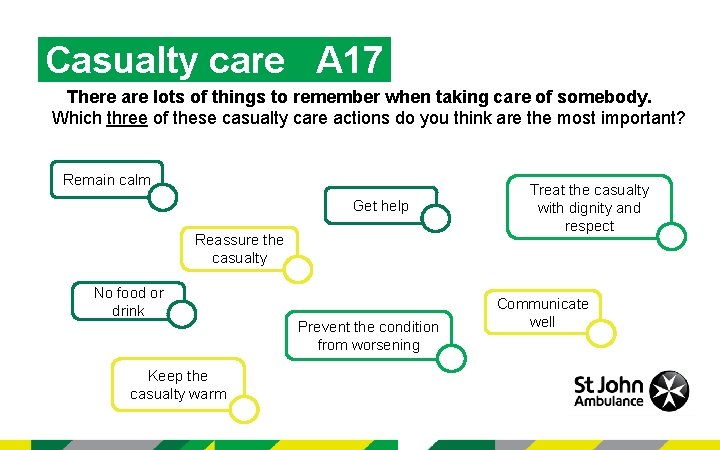
Casualty care A 17 There are lots of things to remember when taking care of somebody. Which three of these casualty care actions do you think are the most important? Remain calm Get help Reassure the casualty No food or drink Keep the casualty warm Prevent the condition from worsening Treat the casualty with dignity and respect Communicate well
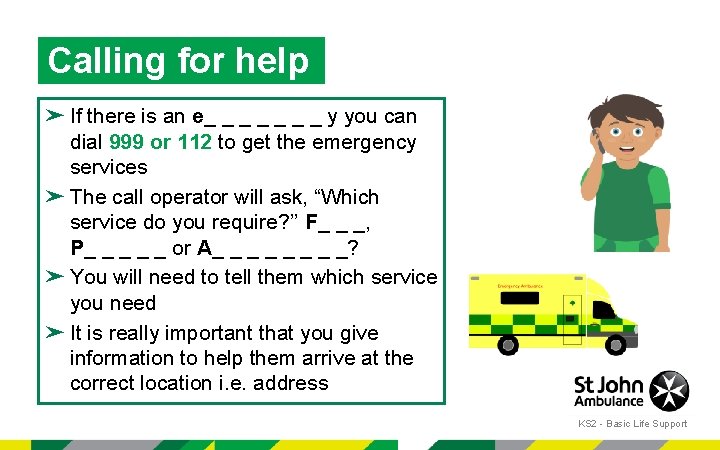
Calling for help ➤ If there is an e_ _ _ _ y you can dial 999 or 112 to get the emergency services ➤ The call operator will ask, “Which service do you require? ’’ F_ _ _, P_ _ _ or A_ _ _ _ _? ➤ You will need to tell them which service you need ➤ It is really important that you give information to help them arrive at the correct location i. e. address KS 2 - Basic Life Support

Remember LIONEL ➤ Location. Tell them where the emergency is and where you want them to arrive ➤ Incident. Tell them what has happened ➤ Other services. Do you need more than one? ➤ Number of people that are involved ➤ Extent of the injuries. What types of injuries do people have? ➤ Location. Repeat again where they need to arrive Question: Do you know the correct addresses for two or three places you often visit? KS 2 - Basic Life Support
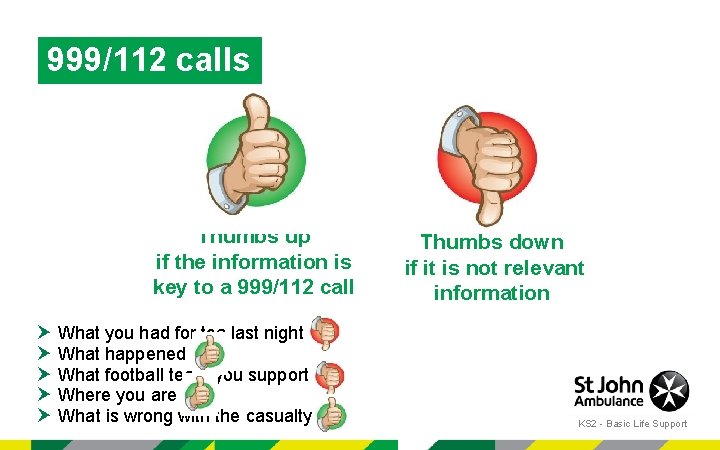
999/112 calls Thumbs up if the information is key to a 999/112 call What you had for tea last night What happened What football team you support Where you are What is wrong with the casualty Thumbs down if it is not relevant information KS 2 - Basic Life Support
When things go wrong A 12 Think of something that may have happened to make someone unresponsive.
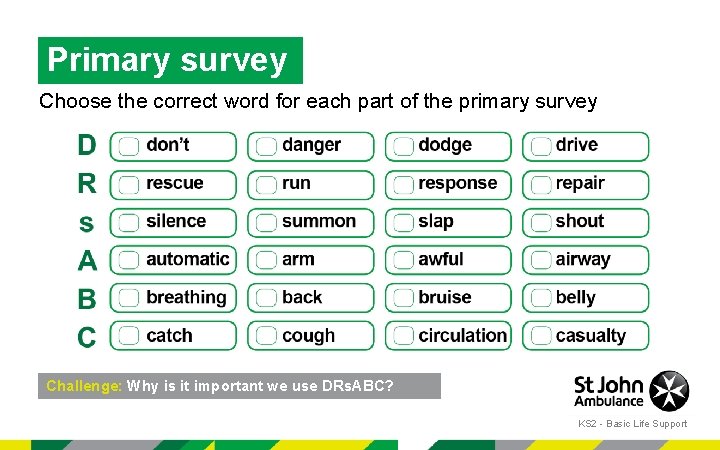
Primary survey Choose the correct word for each part of the primary survey Challenge: Why is it important we use DRs. ABC? KS 2 - Basic Life Support

Primary survey Check your answers Challenge: Why is it important we use DRs. ABC? KS 2 – Basic Life Support
Watch this video Primary Survey This video was filmed before the COVID-19 pandemic. At this time please do not put your face next to theirs to check for breathing, instead only look carefully for the chest rising and falling. KS 2 – Basic life support
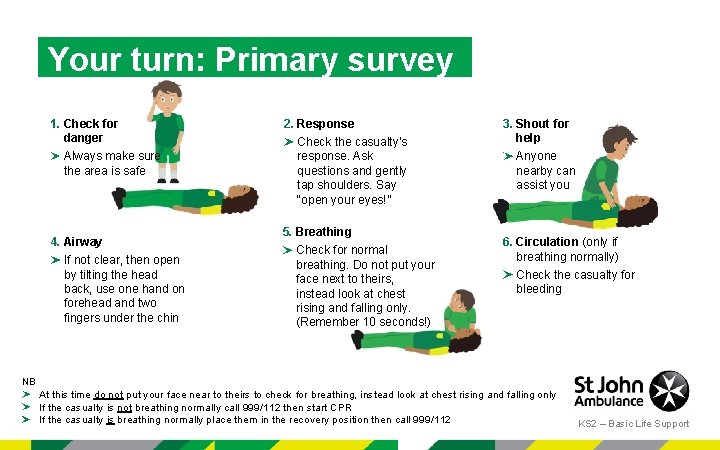
Your turn: Primary survey 1. Check for danger Always make sure the area is safe 4. Airway If not clear, then open by tilting the head back, use one hand on forehead and two fingers under the chin 2. Response Check the casualty’s response. Ask questions and gently tap shoulders. Say “open your eyes!” 5. Breathing Check for normal breathing. Do not put your face next to theirs, instead look at chest rising and falling only. (Remember 10 seconds!) 3. Shout for help Anyone nearby can assist you 6. Circulation (only if breathing normally) Check the casualty for bleeding NB At this time do not put your face near to theirs to check for breathing, instead look at chest rising and falling only If the casualty is not breathing normally call 999/112 then start CPR If the casualty is breathing normally place them in the recovery position then call 999/112 KS 2 – Basic Life Support
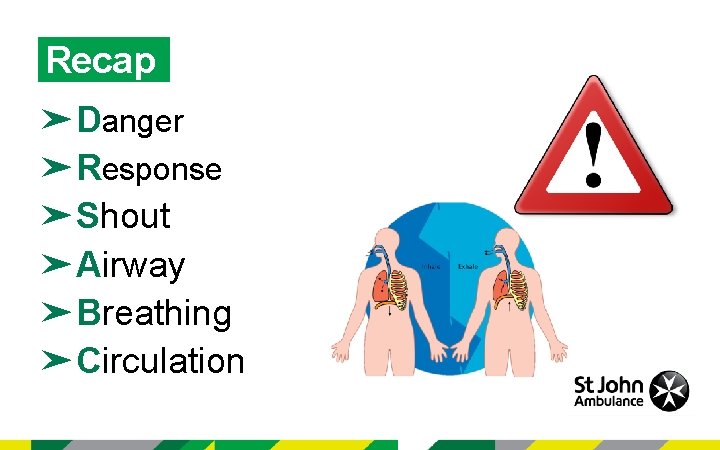
Recap ➤Danger ➤Response ➤Shout ➤Airway ➤Breathing ➤Circulation
Watch this video Recovery Position This video was filmed before the COVID-19 pandemic. At this time please do not put your face next to theirs to check for breathing, instead only look carefully for the chest rising and falling. KS 2 – Basic life support
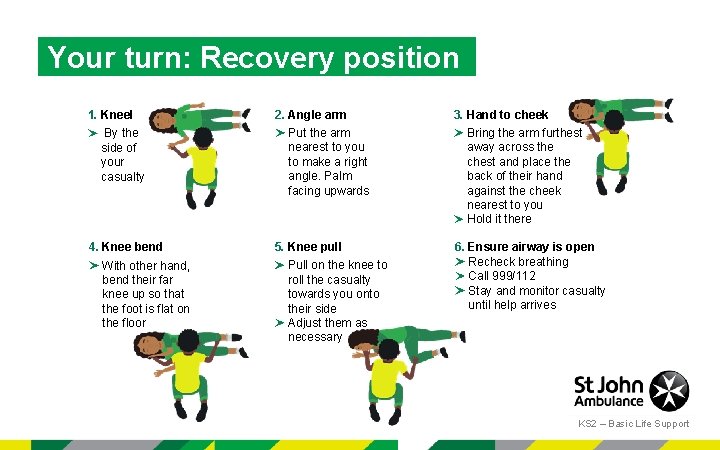
Your turn: Recovery position 1. Kneel By the side of your casualty 4. Knee bend With other hand, bend their far knee up so that the foot is flat on the floor 2. Angle arm Put the arm nearest to you to make a right angle. Palm facing upwards 5. Knee pull Pull on the knee to roll the casualty towards you onto their side Adjust them as necessary 3. Hand to cheek Bring the arm furthest away across the chest and place the back of their hand against the cheek nearest to you Hold it there 6. Ensure airway is open Recheck breathing Call 999/112 Stay and monitor casualty until help arrives KS 2 – Basic Life Support
Watch this video CPR KS 2 – Basic life support
CPR ➤ If you are a young person , you may not be strong enough to do CPR. That’s OK, you can tell someone else what they need to do ➤ It’s important to know that sometimes even CPR cannot help someone if they are really poorly ➤ Anything you can do to help, even just calling for help, will be really useful ➤ Never do CPR on someone if they are awake and breathing normally
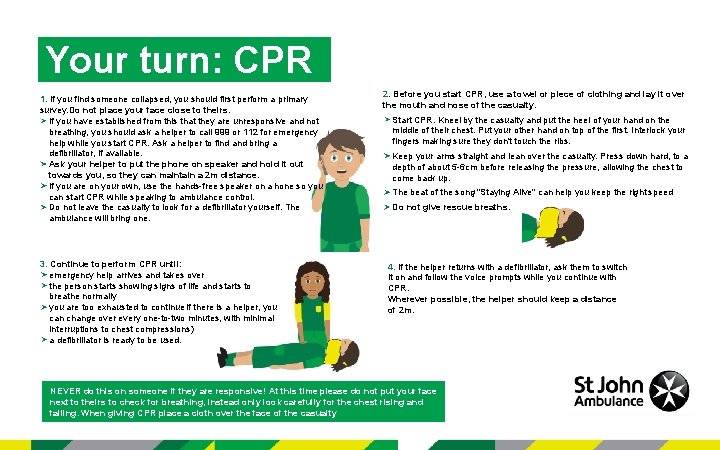
Your turn: CPR 1. If you find someone collapsed, you should first perform a primary survey. Do not place your face close to theirs. If you have established from this that they are unresponsive and not breathing, you should ask a helper to call 999 or 112 for emergency help while you start CPR. Ask a helper to find and bring a defibrillator, if available. Ask your helper to put the phone on speaker and hold it out towards you, so they can maintain a 2 m distance. If you are on your own, use the hands-free speaker on a hone so you can start CPR while speaking to ambulance control. Do not leave the casualty to look for a defibrillator yourself. The ambulance will bring one. 3. Continue to perform CPR until: emergency help arrives and takes over the person starts showing signs of life and starts to breathe normally you are too exhausted to continue if there is a helper, you can change over every one-to-two minutes, with minimal interruptions to chest compressions) a defibrillator is ready to be used. 2. Before you start CPR, use a towel or piece of clothing and lay it over the mouth and nose of the casualty. Start CPR. Kneel by the casualty and put the heel of your hand on the middle of their chest. Put your other hand on top of the first. Interlock your fingers making sure they don't touch the ribs. Keep your arms straight and lean over the casualty. Press down hard, to a depth of about 5 -6 cm before releasing the pressure, allowing the chest to come back up. The beat of the song "Staying Alive" can help you keep the right speed Do not give rescue breaths. 4. If the helper returns with a defibrillator, ask them to switch it on and follow the voice prompts while you continue with CPR. Wherever possible, the helper should keep a distance of 2 m. NEVER do this on someone if they are responsive! At this time please do not put your face next to theirs to check for breathing, instead only look carefully for the chest rising and falling. When giving CPR place a cloth over the face of the casualty
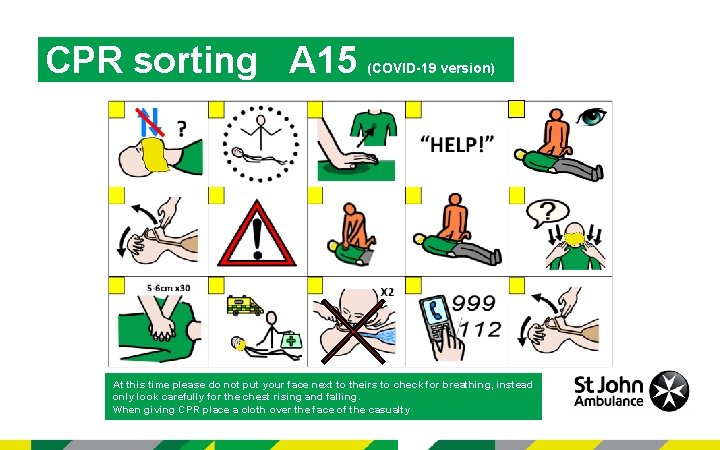
CPR sorting A 15 (COVID-19 version) At this time please do not put your face next to theirs to check for breathing, instead only look carefully for the chest rising and falling. When giving CPR place a cloth over the face of the casualty
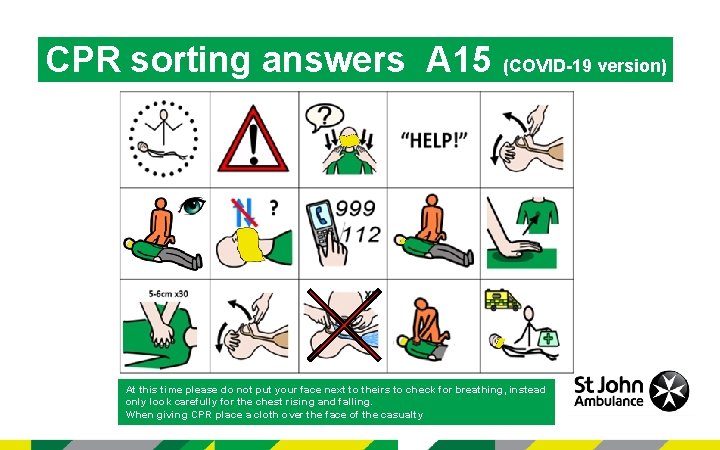
CPR sorting answers A 15 (COVID-19 version) At this time please do not put your face next to theirs to check for breathing, instead only look carefully for the chest rising and falling. When giving CPR place a cloth over the face of the casualty

Recap Primary Survey Breathing normally Not breathing normally Recovery position Call for help and send a bystander for an AED if available Make sure help is coming and give the casualty care CPR
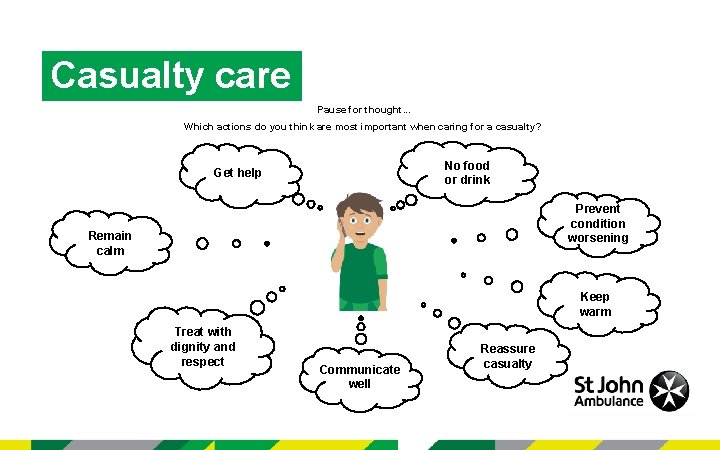
Casualty care Pause for thought. . . Which actions do you think are most important when caring for a casualty? No food or drink Get help Prevent condition worsening Remain calm Keep warm Treat with dignity and respect Communicate well Reassure casualty
Check your learning I am able to: ➤ I am able to do a primary survey ➤ I can place an unresponsive casualty, who is breathing normally, in to the recovery position ➤ I know when and how to deliver CPR to an unresponsive casualty who is not breathing normally (+year 5) ➤ I can get help and tell someone else how to deliver CPR to an unresponsive casualty who is not breathing normally ( -year 5) YES NO
Information and support If any of the content in this session has upset or concerned you please discuss this with one of the teachers at your school Further support can be found at: www. childline. org. uk www. youngminds. org. uk www. samaritans. org Further information linked to first aid can be found at: www. sja. org. uk www. asthma. org. uk
Thank you!
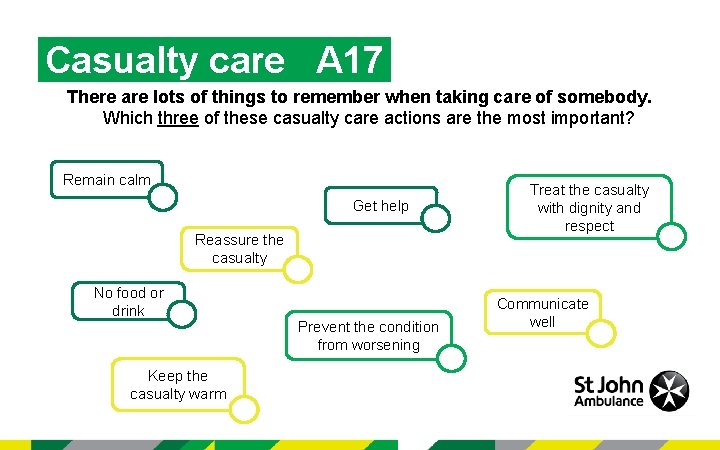
Casualty care A 17 There are lots of things to remember when taking care of somebody. Which three of these casualty care actions are the most important? Remain calm Get help Reassure the casualty No food or drink Keep the casualty warm Prevent the condition from worsening Treat the casualty with dignity and respect Communicate well
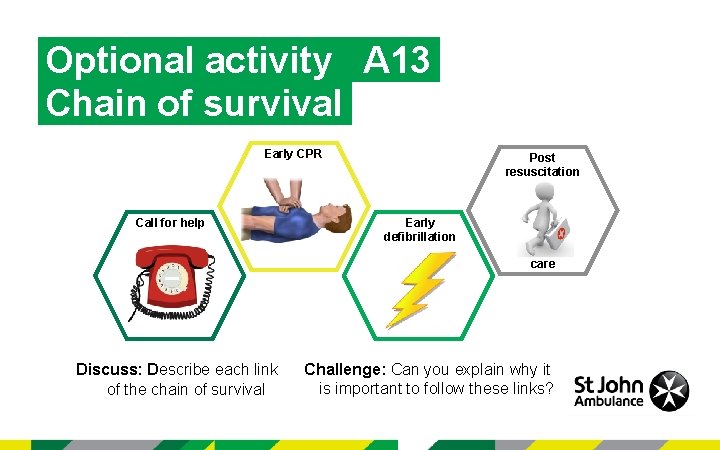
Optional activity A 13 Chain of survival Early CPR Call for help Post resuscitation Early defibrillation care Discuss: Describe each link of the chain of survival Challenge: Can you explain why it is important to follow these links?
Optional activity Roll the dice 1. Name something you have learnt from this session 2. Tell me why you think what you have learnt is important 3. Explain the chain of survival 4. Tell me the first thing you would do if you found an unresponsive casualty, who is breathing normally, and why? 5. How confident are you now at dealing with a casualty who is unresponsive and not breathing normally, compared to before? 6. How could you tell if someone required resuscitation?
Optional activity A 16 The human body You now have the option to learn more about the human body and how it works. Use activity sheets A 16 ‘the human body’ for both students and teacher instructions. Downloadable worksheets can be found on the St John Ambulance website.
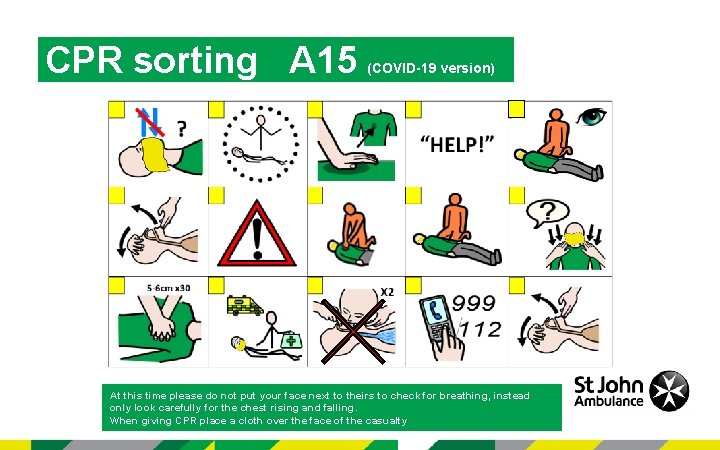
CPR sorting A 15 (COVID-19 version) At this time please do not put your face next to theirs to check for breathing, instead only look carefully for the chest rising and falling. When giving CPR place a cloth over the face of the casualty
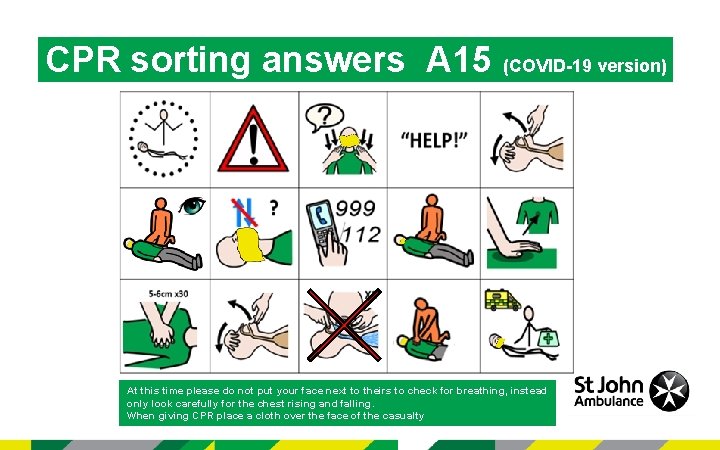
CPR sorting answers A 15 (COVID-19 version) At this time please do not put your face next to theirs to check for breathing, instead only look carefully for the chest rising and falling. When giving CPR place a cloth over the face of the casualty
When things go wrong A 12 Think of something that may have happened to make someone unresponsive.
- Slides: 33