
Complete MemorySafety with Soft Bound CETS Slides courtesy

Complete Memory-Safety with Soft. Bound. CETS Slides courtesy of Prof. Santosh Nagarakatte
Project goal: Make C/C++ safe and secure Why? Lack of memory safety is the root cause of serious bugs and security vulnerabilities

Security Vulnerabilities due to Lack of Memory Safety Adobe Acrobat – buffer overflow CVE-2013 -1376 - Severity: 10. 0 (High) January 30, 2014 Oracle My. SQL – buffer overflow CVE-2014 -0001 - Severity: 7. 5 (High) January 31, 2014 Firefox – use-after-free vulnerability CVE-2014 -1486 - Severity: 10. 0 (High) February 6, 2014 Google Chrome– use-after-free vulnerability CVE-2013 -6649 - Severity: 7. 5 (High) January 28, 2014 DHS/NIST National Vulnerability Database: • Last three months: 92 buffer overflow and 23 use-after-free disclosures • Last three years: 1135 buffer overflows and 425 use-after-free disclosures
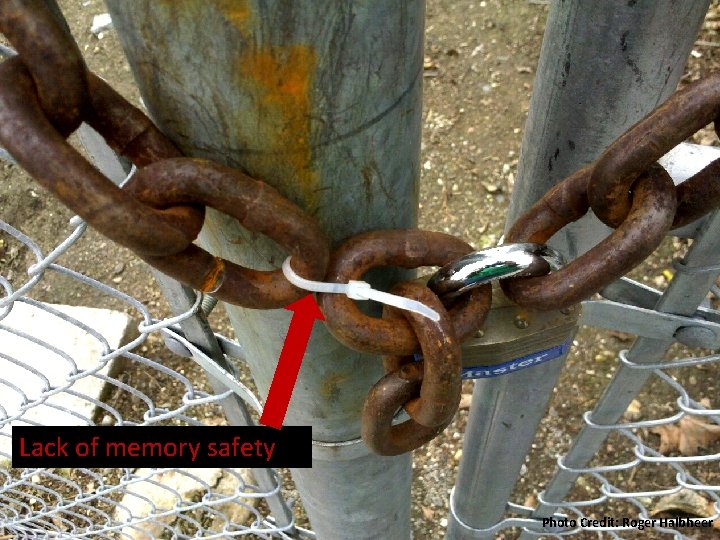
Lack of memory safety Photo Credit: Roger Halbheer

Nobody Writes New C Code, Right? • More than a million new C-based applications! • Over last few years, publically available. Evidence?
Background on Enforcing Memory Safety
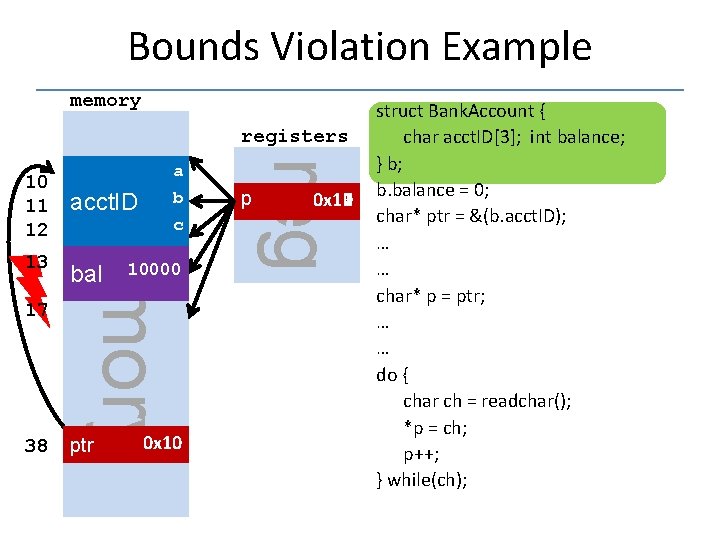
Bounds Violation Example memory registers 17 38 acct. ID bal id ptr 0 10000 0 x 10 p reg 13 a b c memory 10 11 12 0 x 13 0 x 12 0 x 11 0 x 10 0 x 17 struct Bank. Account { char acct. ID[3]; int balance; } b; b. balance = 0; char* ptr = &(b. acct. ID); … … char* p = ptr; … … do { char ch = readchar(); *p = ch; p++; } while(ch);
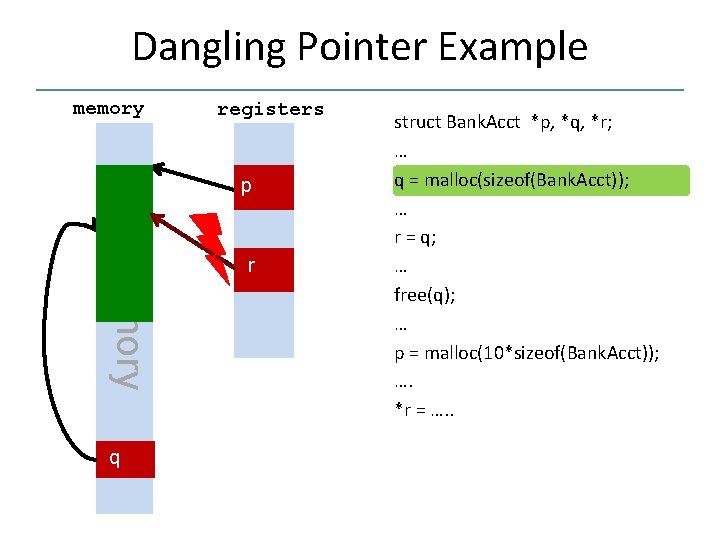
Dangling Pointer Example memory registers p memory q rr struct Bank. Acct *p, *q, *r; … q = malloc(sizeof(Bank. Acct)); … r = q; … free(q); … p = malloc(10*sizeof(Bank. Acct)); …. *r = …. .
What is Void * C? int foo (void * c);
Abstractions Not Enforced!
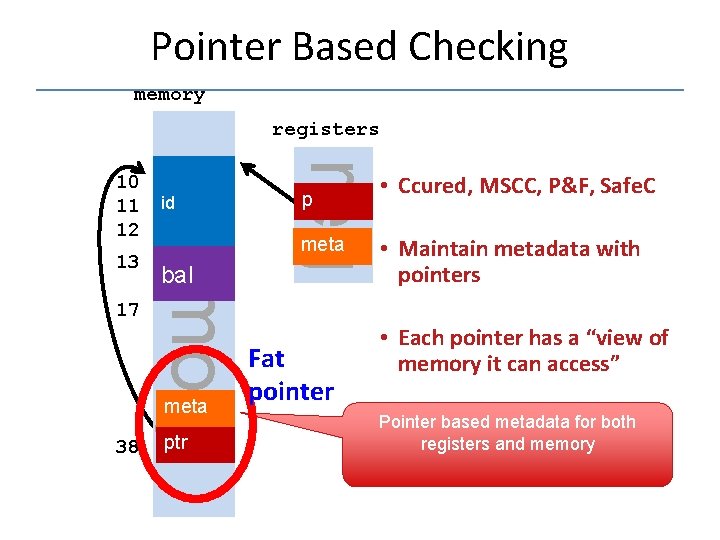
Pointer Based Checking memory registers 17 meta 38 p id bal ptr reg 13 memory 10 11 12 meta 0 Fat pointer • Ccured, MSCC, P&F, Safe. C • Maintain metadata with pointers • Each pointer has a “view of memory it can access” Pointer based metadata for both registers and memory
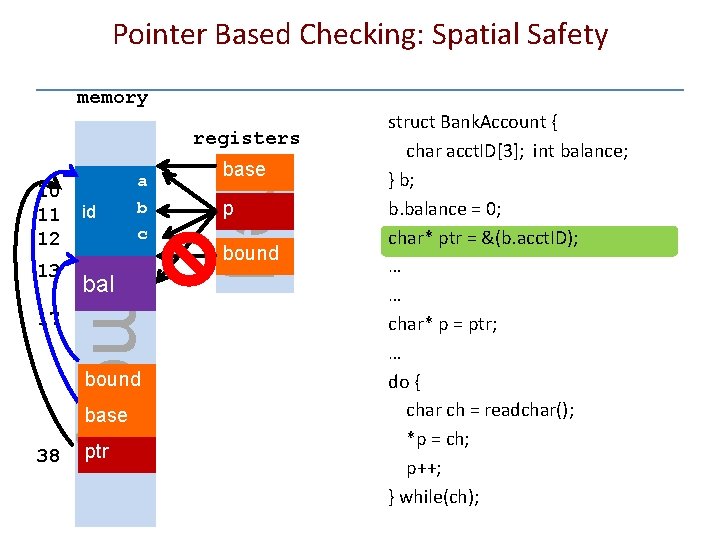
Pointer Based Checking: Spatial Safety memory registers 17 id bal bound base 38 ptr reg 13 memory 10 11 12 base a b c p 0 x 13 0 x 12 0 x 11 0 x 10 0 x 17 bound 0 id struct Bank. Account { char acct. ID[3]; int balance; } b; b. balance = 0; char* ptr = &(b. acct. ID); … … char* p = ptr; … do { char ch = readchar(); *p = ch; p++; } while(ch);
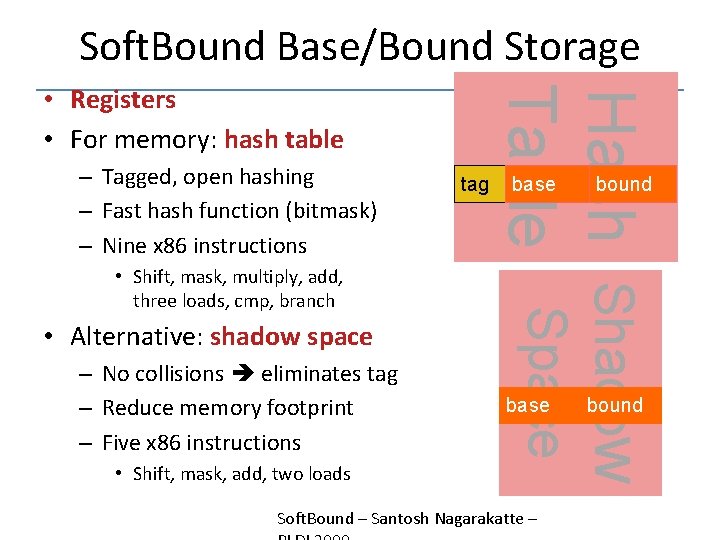
Soft. Bound Base/Bound Storage – Tagged, open hashing – Fast hash function (bitmask) – Nine x 86 instructions • Shift, mask, multiply, add, three loads, cmp, branch • Alternative: shadow space – No collisions eliminates tag – Reduce memory footprint – Five x 86 instructions • Shift, mask, add, two loads tag Hash Shadow Table Space • Registers • For memory: hash table base Soft. Bound – Santosh Nagarakatte – bound
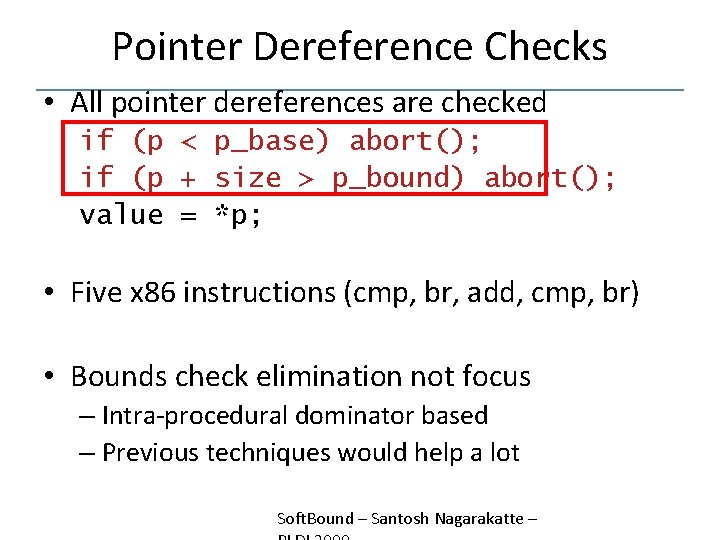
Pointer Dereference Checks • All pointer dereferences are checked if (p < p_base) abort(); if (p + size > p_bound) abort(); value = *p; • Five x 86 instructions (cmp, br, add, cmp, br) • Bounds check elimination not focus – Intra-procedural dominator based – Previous techniques would help a lot Soft. Bound – Santosh Nagarakatte –
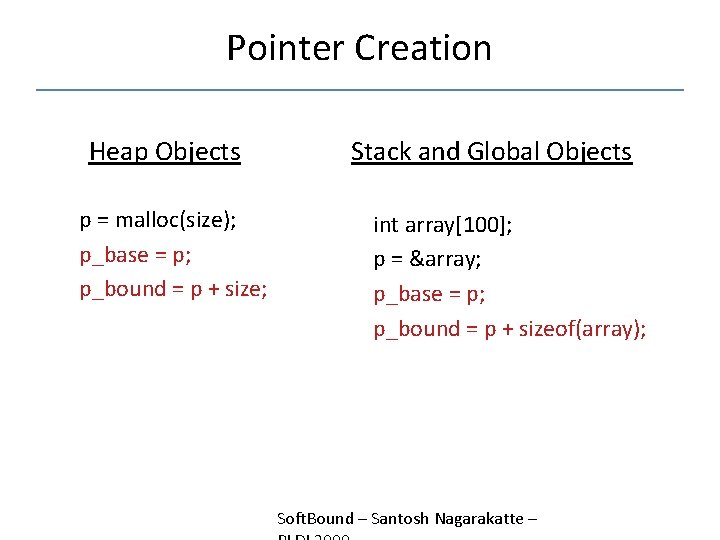
Pointer Creation Heap Objects p = malloc(size); p_base = p; p_bound = p + size; Stack and Global Objects int array[100]; p = &array; p_base = p; p_bound = p + sizeof(array); Soft. Bound – Santosh Nagarakatte –
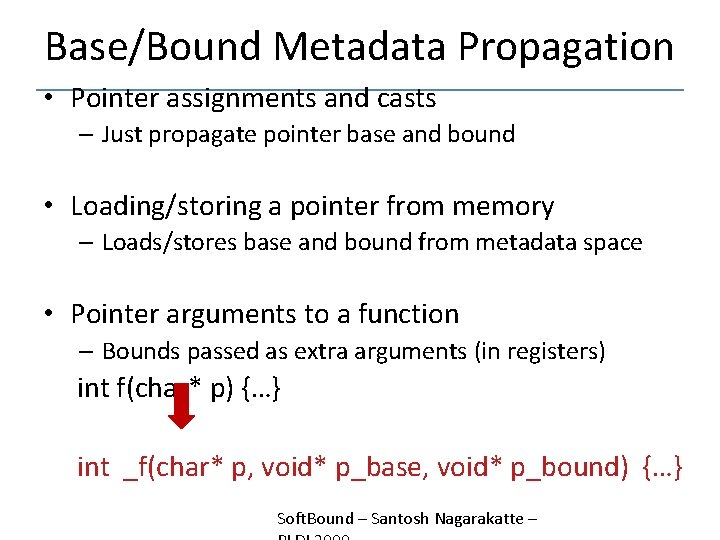
Base/Bound Metadata Propagation • Pointer assignments and casts – Just propagate pointer base and bound • Loading/storing a pointer from memory – Loads/stores base and bound from metadata space • Pointer arguments to a function – Bounds passed as extra arguments (in registers) int f(char* p) {…} int _f(char* p, void* p_base, void* p_bound) {…} Soft. Bound – Santosh Nagarakatte –
![Pointers to Structure Fields struct { char acct. ID[3]; int balance; } *ptr; char*](http://slidetodoc.com/presentation_image_h2/4de7a1e8abf962c0897eba224dff7493/image-17.jpg "Pointers to Structure Fields struct { char acct. ID[3]; int balance; } *ptr; char*")
Pointers to Structure Fields struct { char acct. ID[3]; int balance; } *ptr; char* id = &(ptr->acct. ID); option #1 Entire Structure option #2 Shrink to Field Only id_base = &(ptr->acct. ID); id_bound = &(ptr->acct. ID) + 3; id_base = ptr_base; id_bound = ptr_bound; Programmer intent ambiguous; optional shrinking of bounds Soft. Bound – Santosh Nagarakatte –
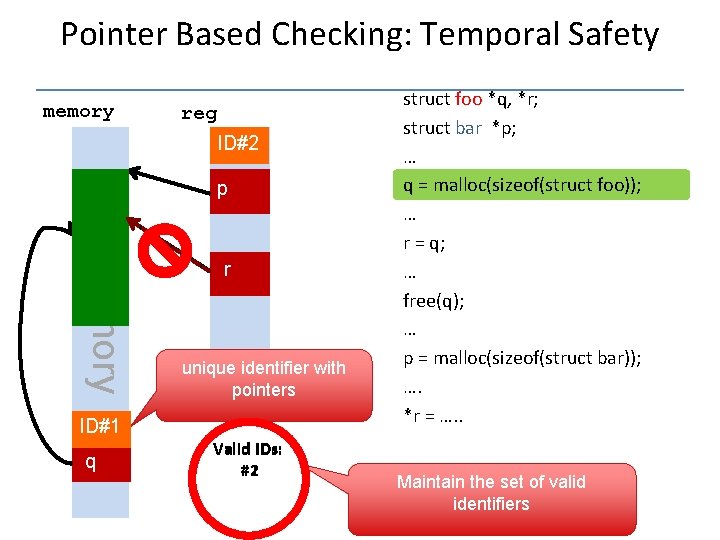
Pointer Based Checking: Temporal Safety memory reg ID#2 p memory ID#1 q rr unique identifier with pointers Valid IDs: #1 #2 struct foo *q, *r; struct bar *p; … q = malloc(sizeof(struct foo)); … r = q; … free(q); … p = malloc(sizeof(struct bar)); …. *r = …. . Maintain the set of valid identifiers
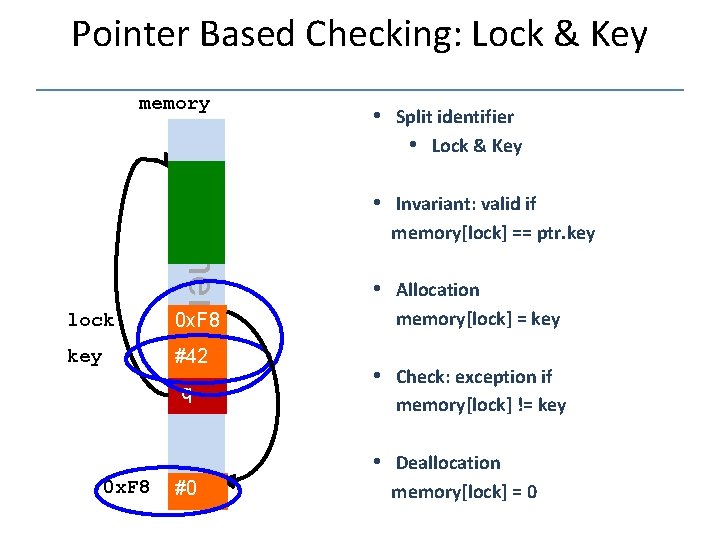
Pointer Based Checking: Lock & Key memory • Split identifier • Lock & Key • Invariant: valid if memory lock 0 x. F 8 key ID#1 #42 q memory[lock] == ptr. key • Allocation memory[lock] = key • Check: exception if memory[lock] != key • Deallocation 0 x. F 8 #0 #42 memory[lock] = 0
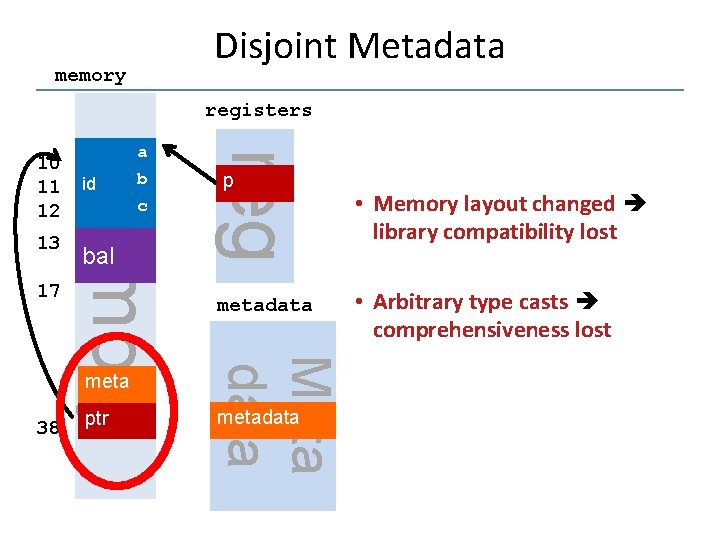
Disjoint Metadata memory registers 17 id bal 38 ptr p 0 metadata Meta data meta reg 13 a b c memory 10 11 12 metadata • Memory layout changed library compatibility lost • Arbitrary type casts comprehensiveness lost
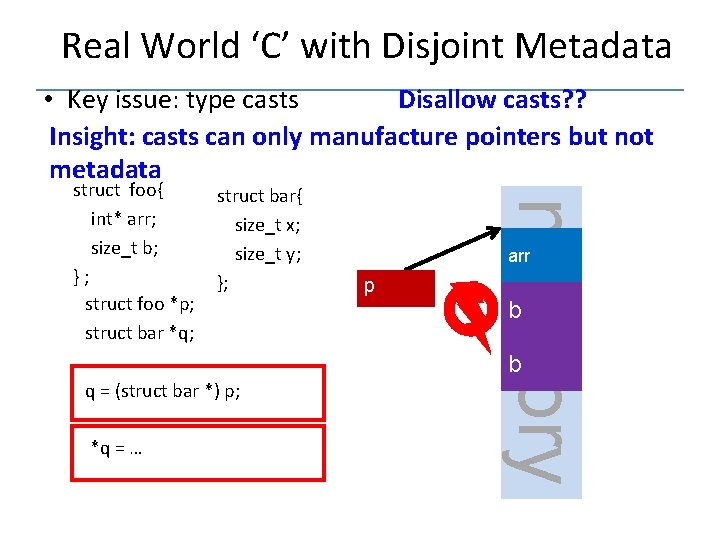
Real World ‘C’ with Disjoint Metadata Disallow casts? ? • Key issue: type casts Insight: casts can only manufacture pointers but not metadata memory struct foo{ struct bar{ int* arr; size_t x; size_t b; size_t y; }; }; struct foo *p; struct bar *q; . . . q = (struct bar *) p; … *q = … arr p meta b b
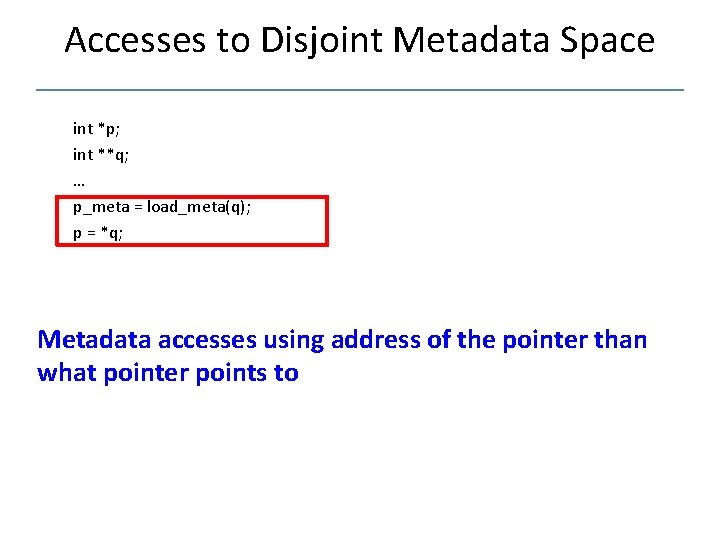
Accesses to Disjoint Metadata Space int *p; int **q; … p_meta = load_meta(q); p = *q; Metadata accesses using address of the pointer than what pointer points to
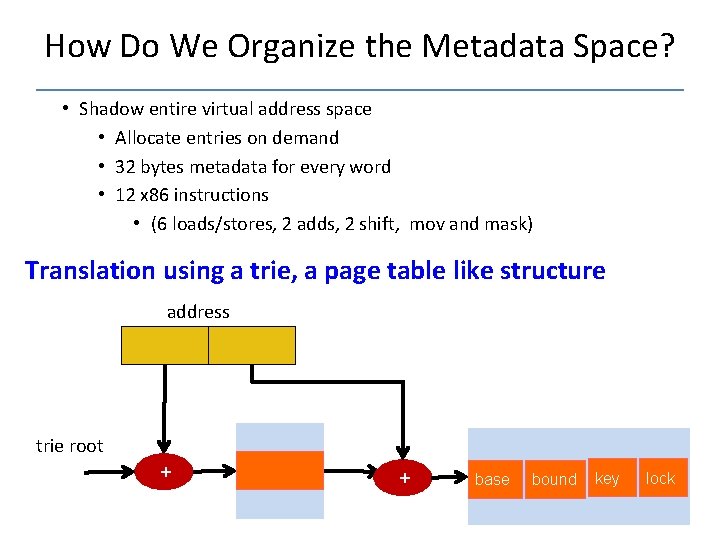
How Do We Organize the Metadata Space? • Shadow entire virtual address space • Allocate entries on demand • 32 bytes metadata for every word • 12 x 86 instructions • (6 loads/stores, 2 adds, 2 shift, mov and mask) Translation using a trie, a page table like structure address trie root + r + base bound key lock
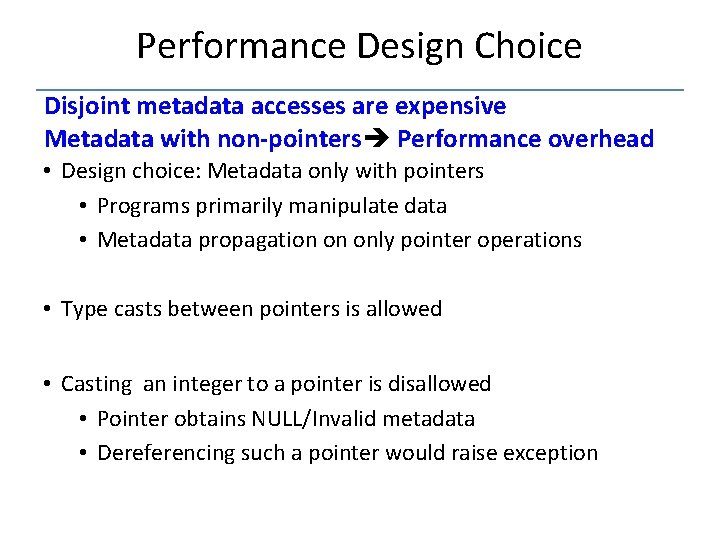
Performance Design Choice Disjoint metadata accesses are expensive Metadata with non-pointers Performance overhead • Design choice: Metadata only with pointers • Programs primarily manipulate data • Metadata propagation on only pointer operations • Type casts between pointers is allowed • Casting an integer to a pointer is disallowed • Pointer obtains NULL/Invalid metadata • Dereferencing such a pointer would raise exception
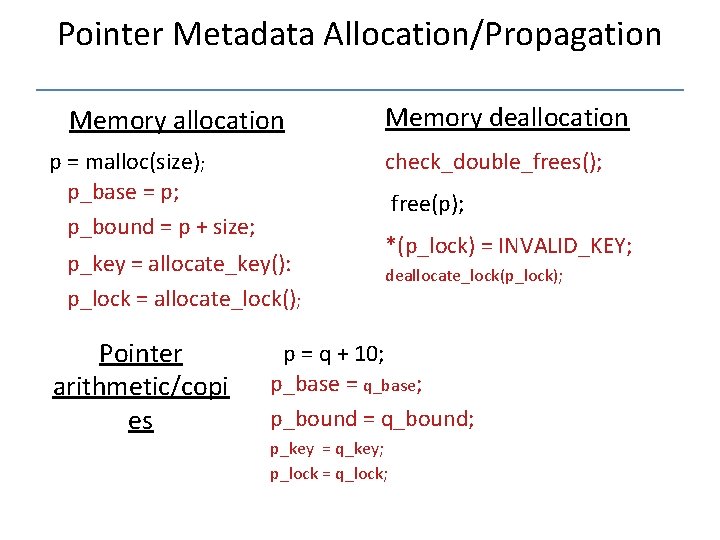
Pointer Metadata Allocation/Propagation Memory allocation p = malloc(size); p_base = p; p_bound = p + size; check_double_frees(); free(p); p_key = allocate_key(): p_lock = allocate_lock(); Pointer arithmetic/copi es Memory deallocation *(p_lock) = INVALID_KEY; deallocate_lock(p_lock); p = q + 10; p_base = q_base; p_bound = q_bound; p_key = q_key; p_lock = q_lock;
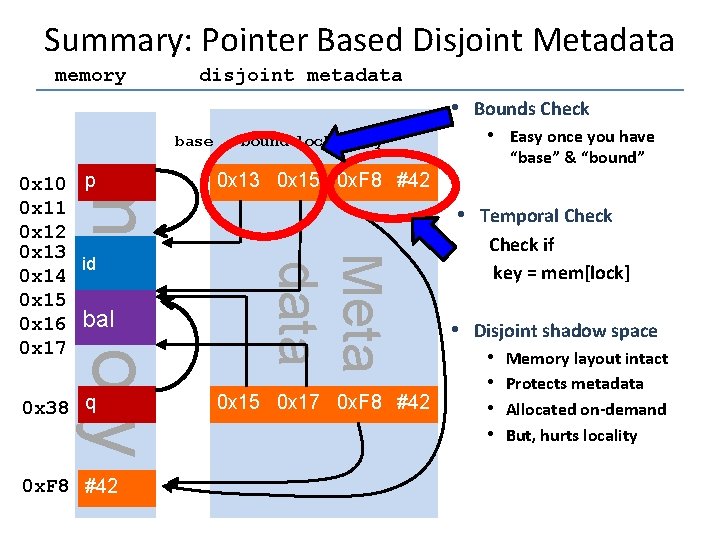
Summary: Pointer Based Disjoint Metadata memory disjoint metadata • Bounds Check base 0 x 38 q 0 x. F 8 #42 key • Easy once you have “base” & “bound” 0 x 13 0 x 15 0 x. F 8 #42 • Temporal Check 0 Meta data memory 0 x 10 p 0 x 11 0 x 12 0 x 13 id 0 x 14 0 x 15 0 x 16 bal 0 x 17 bound lock 0 x 15 0 x 17 0 x. F 8 #42 Check if key = mem[lock] • Disjoint shadow space • • Memory layout intact Protects metadata Allocated on-demand But, hurts locality
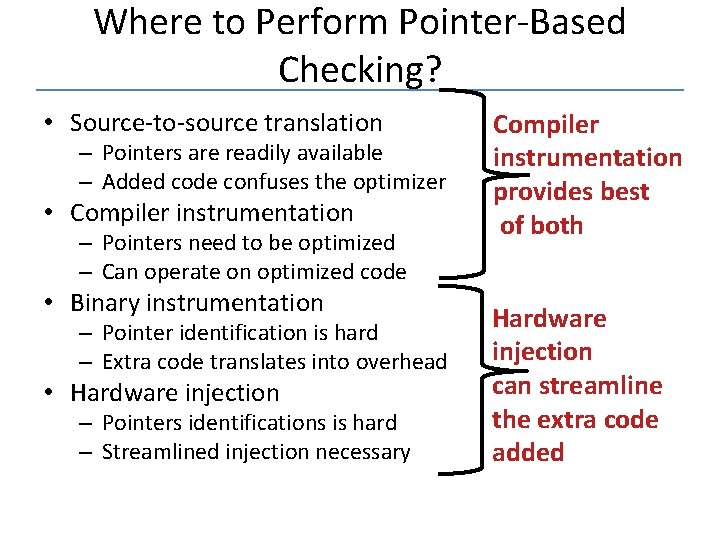
Where to Perform Pointer-Based Checking? • Source-to-source translation – Pointers are readily available – Added code confuses the optimizer • Compiler instrumentation – Pointers need to be optimized – Can operate on optimized code • Binary instrumentation – Pointer identification is hard – Extra code translates into overhead • Hardware injection – Pointers identifications is hard – Streamlined injection necessary Compiler instrumentation provides best of both Hardware injection can streamline the extra code added
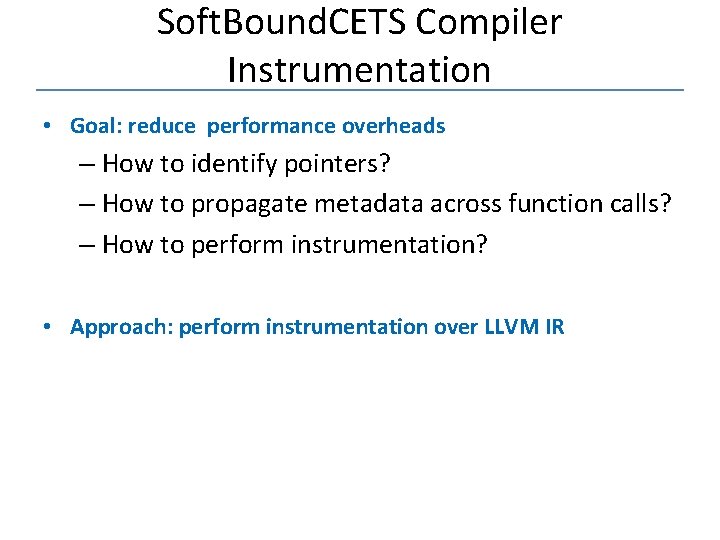
Soft. Bound. CETS Compiler Instrumentation • Goal: reduce performance overheads – How to identify pointers? – How to propagate metadata across function calls? – How to perform instrumentation? • Approach: perform instrumentation over LLVM IR
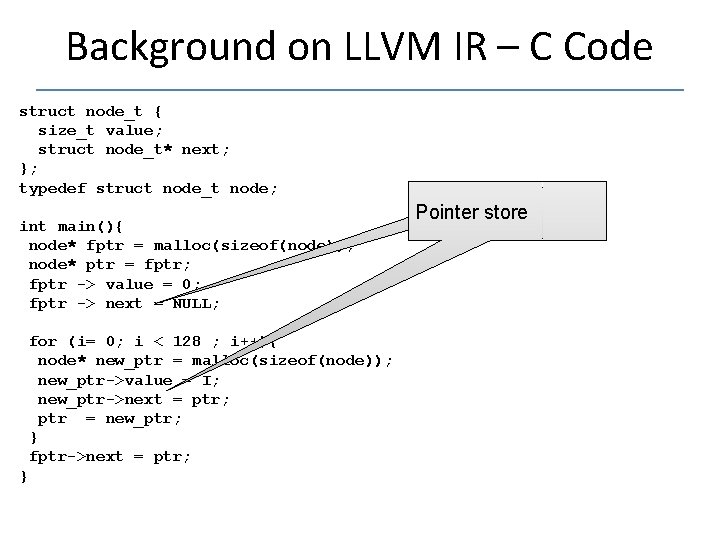
Background on LLVM IR – C Code struct node_t { size_t value; struct node_t* next; }; typedef struct node_t node; int main(){ node* fptr = malloc(sizeof(node)); node* ptr = fptr; fptr -> value = 0; fptr -> next = NULL; for (i= 0; i < 128 ; i++){ node* new_ptr = malloc(sizeof(node)); new_ptr->value = I; new_ptr->next = ptr; ptr = new_ptr; } fptr->next = ptr; } Pointer store
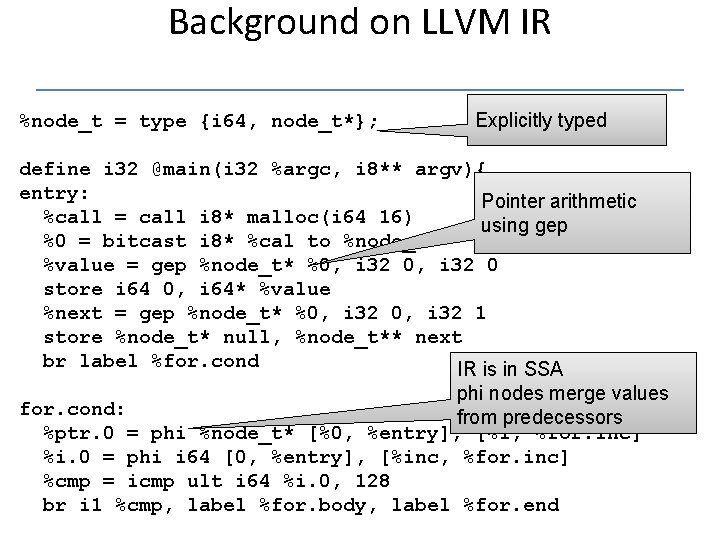
Background on LLVM IR %node_t = type {i 64, node_t*}; Explicitly typed define i 32 @main(i 32 %argc, i 8** argv){ entry: Pointer arithmetic %call = call i 8* malloc(i 64 16) using gep %0 = bitcast i 8* %cal to %node_t* %value = gep %node_t* %0, i 32 0 store i 64 0, i 64* %value %next = gep %node_t* %0, i 32 1 store %node_t* null, %node_t** next br label %for. cond IR is in SSA phi nodes merge values for. cond: from predecessors %ptr. 0 = phi %node_t* [%0, %entry], [%1, %for. inc] %i. 0 = phi i 64 [0, %entry], [%inc, %for. inc] %cmp = icmp ult i 64 %i. 0, 128 br i 1 %cmp, label %for. body, label %for. end
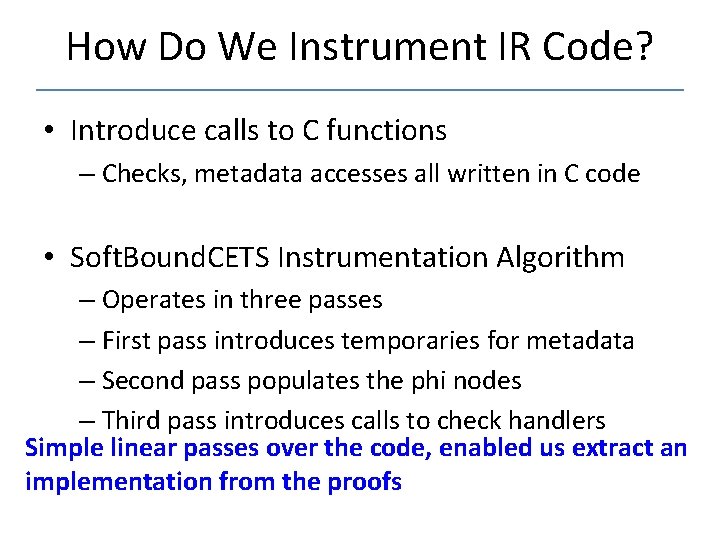
How Do We Instrument IR Code? • Introduce calls to C functions – Checks, metadata accesses all written in C code • Soft. Bound. CETS Instrumentation Algorithm – Operates in three passes – First pass introduces temporaries for metadata – Second pass populates the phi nodes – Third pass introduces calls to check handlers Simple linear passes over the code, enabled us extract an implementation from the proofs
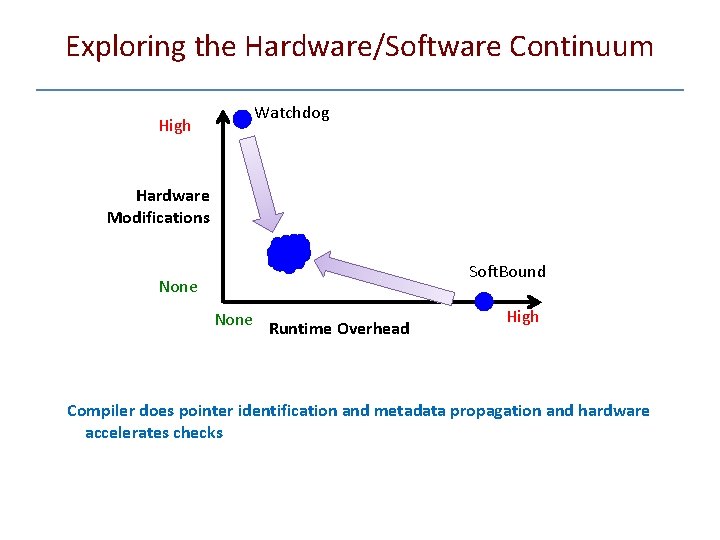
Exploring the Hardware/Software Continuum Watchdog High Hardware Modifications Soft. Bound None Runtime Overhead High Compiler does pointer identification and metadata propagation and hardware accelerates checks
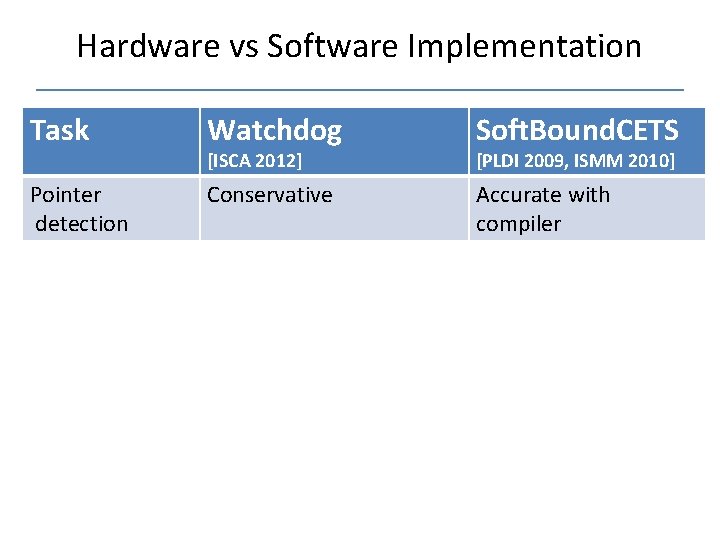
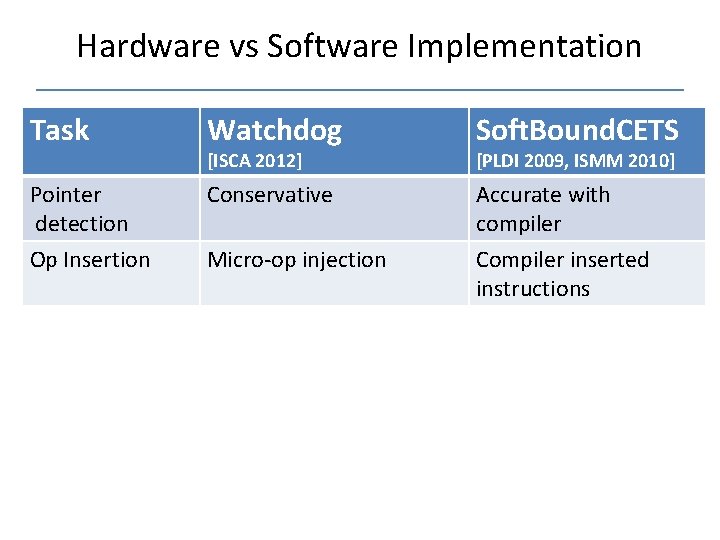
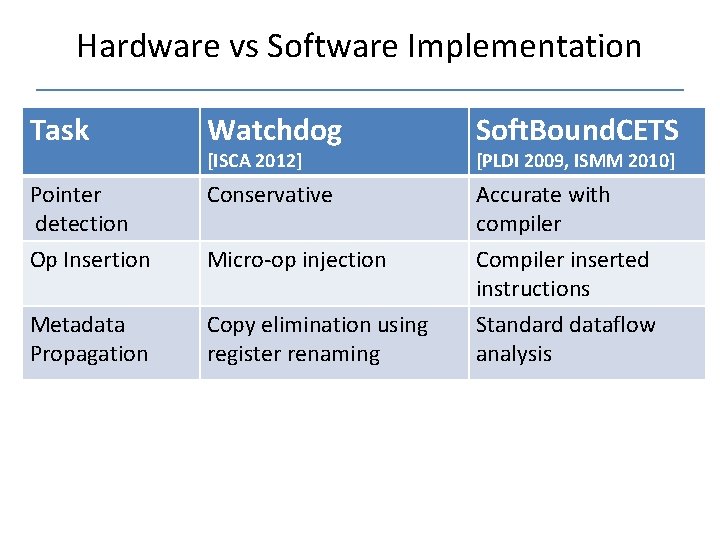
Hardware vs Software Implementation Task Watchdog Soft. Bound. CETS Pointer detection Conservative Accurate with compiler Op Insertion Micro-op injection Compiler inserted instructions Metadata Propagation Copy elimination using register renaming Standard dataflow analysis Checks + fast checks (implicit) - no check optimization - Instruction overhead + Check optimization Metadata Loads/Stores + Fast lookups - Instruction overhead [ISCA 2012] [PLDI 2009, ISMM 2010]
Hardware vs Software Implementation Task Watchdog Soft. Bound. CETS Pointer detection Conservative Accurate with compiler Op Insertion Micro-op injection Compiler inserted instructions Metadata Propagation Copy elimination using register renaming Standard dataflow analysis Checks + fast checks (implicit) - no check optimization - Instruction overhead + Check optimization Metadata Loads/Stores + Fast lookups - Instruction overhead [ISCA 2012] [PLDI 2009, ISMM 2010]
Hardware vs Software Implementation Task Watchdog Soft. Bound. CETS Pointer detection Conservative Accurate with compiler Op Insertion Micro-op injection Compiler inserted instructions Metadata Propagation Copy elimination using register renaming Standard dataflow analysis Checks + fast checks (implicit) - no check optimization - Instruction overhead + Check optimization Metadata Loads/Stores + Fast lookups - Instruction overhead [ISCA 2012] [PLDI 2009, ISMM 2010]
![Hardware vs Software Implementation Task Watchdog Pointer detection Conservative [ISCA 2012] Op Insertion Micro-op](http://slidetodoc.com/presentation_image_h2/4de7a1e8abf962c0897eba224dff7493/image-36.jpg "Hardware vs Software Implementation Task Watchdog Pointer detection Conservative [ISCA 2012] Op Insertion Micro-op")
Hardware vs Software Implementation Task Watchdog Pointer detection Conservative [ISCA 2012] Op Insertion Micro-op injection Hardware can accelerate checks & Metadata Copy elimination using metadata accesses Propagation register renaming Compiler can do these tasks Soft. Bound. CETS efficiently [PLDI 2009, ISMM 2010] Accurate with compiler Compiler inserted instructions Standard dataflow analysis Checks + fast checks (implicit) - no check optimization - Instruction overhead + Check optimization Metadata Loads/Stores + Fast lookups - Instruction overhead
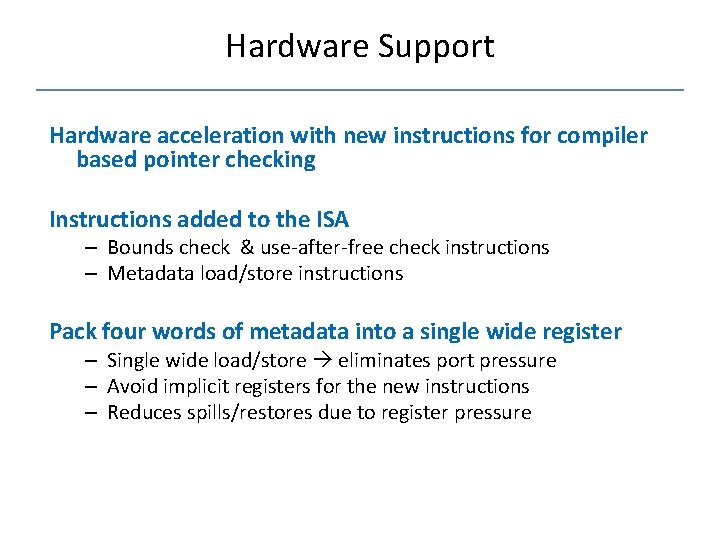
Hardware Support Hardware acceleration with new instructions for compiler based pointer checking Instructions added to the ISA – Bounds check & use-after-free check instructions – Metadata load/store instructions Pack four words of metadata into a single wide register – Single wide load/store eliminates port pressure – Avoid implicit registers for the new instructions – Reduces spills/restores due to register pressure
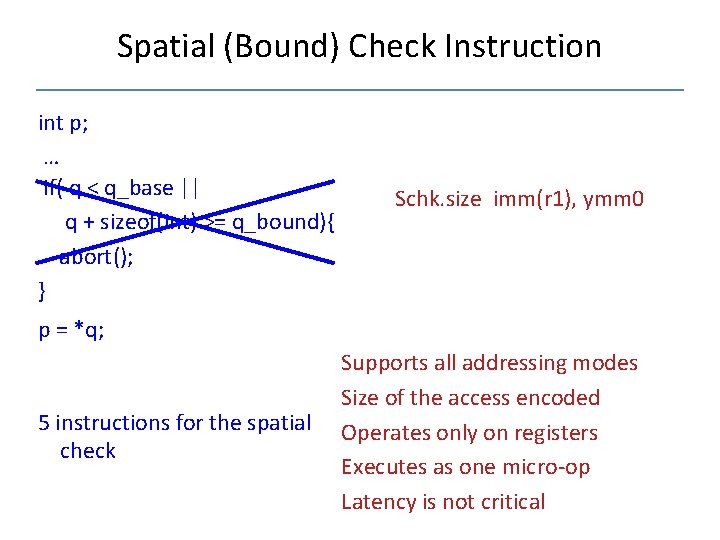
Spatial (Bound) Check Instruction int p; … if( q < q_base || q + sizeof(int) >= q_bound){ abort(); } Schk. size imm(r 1), ymm 0 p = *q; 5 instructions for the spatial check Supports all addressing modes Size of the access encoded Operates only on registers Executes as one micro-op Latency is not critical
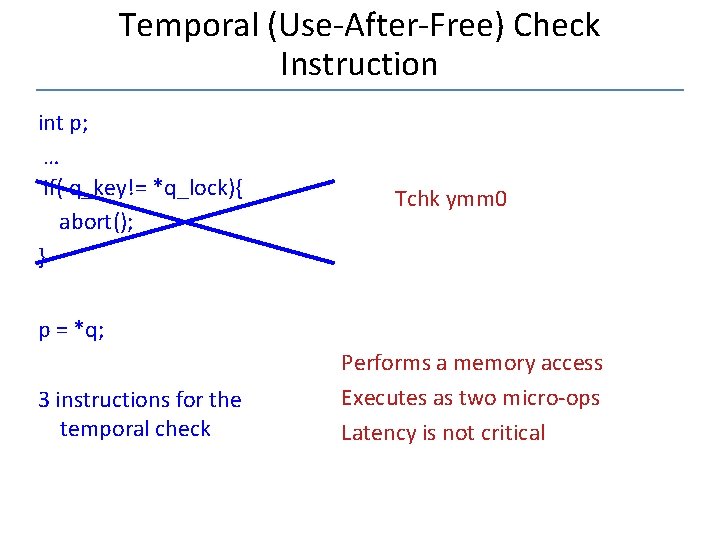
Temporal (Use-After-Free) Check Instruction int p; … if( q_key!= *q_lock){ abort(); } Tchk ymm 0 p = *q; 3 instructions for the temporal check Performs a memory access Executes as two micro-ops Latency is not critical
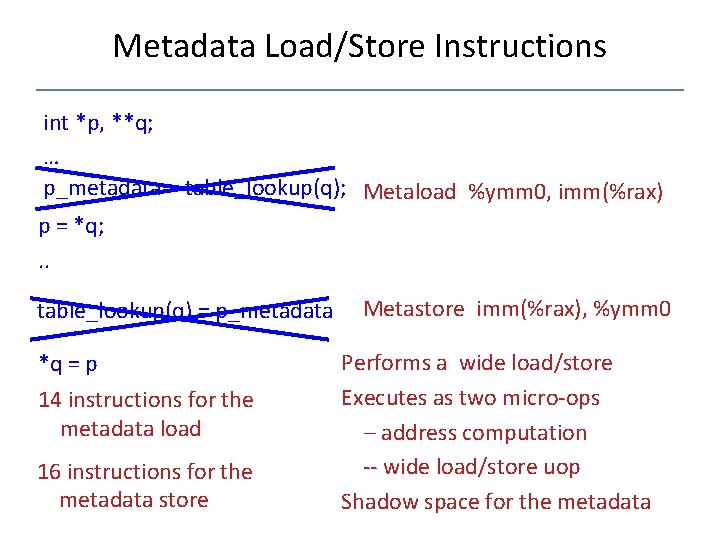
Metadata Load/Store Instructions int *p, **q; … p_metadata = table_lookup(q); Metaload %ymm 0, imm(%rax) p = *q; . . table_lookup(q) = p_metadata *q = p 14 instructions for the metadata load 16 instructions for the metadata store Metastore imm(%rax), %ymm 0 Performs a wide load/store Executes as two micro-ops – address computation -- wide load/store uop Shadow space for the metadata

See Papers For …. • • • Compiler transformation to use wide metadata Metadata organization Check elimination effectiveness Effectiveness in detecting errors Narrow mode instructions Comparison of related work

Evaluation
• Three questions – Effective in detecting errors? – Compatible with existing C code? – Reasonable overheads?
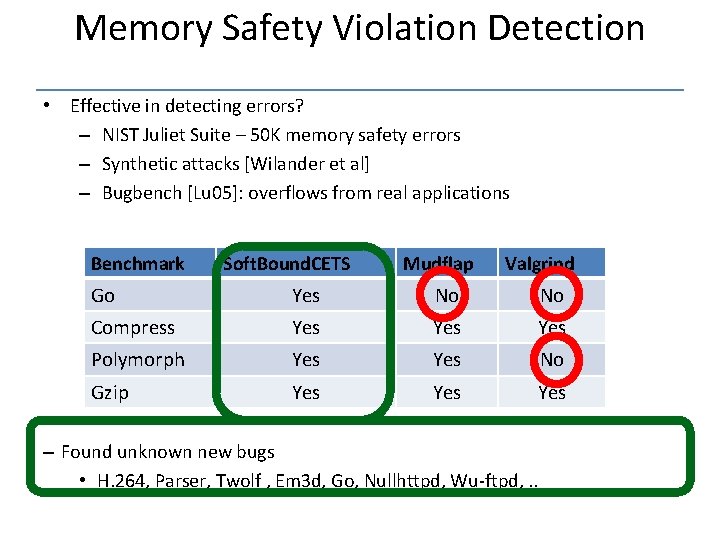
Memory Safety Violation Detection • Effective in detecting errors? – NIST Juliet Suite – 50 K memory safety errors – Synthetic attacks [Wilander et al] – Bugbench [Lu 05]: overflows from real applications Benchmark Soft. Bound. CETS Mudflap Valgrind Go Yes No No Compress Yes Yes Polymorph Yes No Gzip Yes Yes – Found unknown new bugs • H. 264, Parser, Twolf , Em 3 d, Go, Nullhttpd, Wu-ftpd, . .
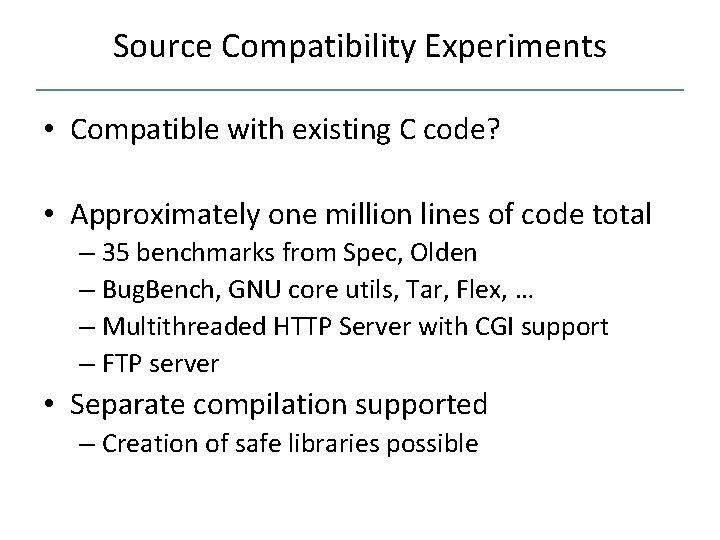
Source Compatibility Experiments • Compatible with existing C code? • Approximately one million lines of code total – 35 benchmarks from Spec, Olden – Bug. Bench, GNU core utils, Tar, Flex, … – Multithreaded HTTP Server with CGI support – FTP server • Separate compilation supported – Creation of safe libraries possible
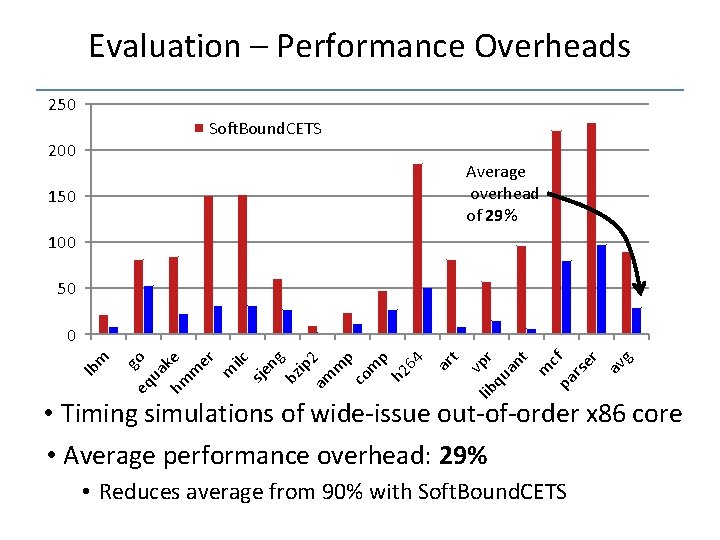
Evaluation – Performance Overheads 250 Soft. Bound. CETS 200 Watchdog. Lite Average overhead of 29% 150 100 50 g av ua k hm e m er m ilc sje ng bz ip am 2 m p co m p h 2 64 ar t lib vpr qu an t m c pa f rs er go eq lb m 0 • Timing simulations of wide-issue out-of-order x 86 core • Average performance overhead: 29% • Reduces average from 90% with Soft. Bound. CETS
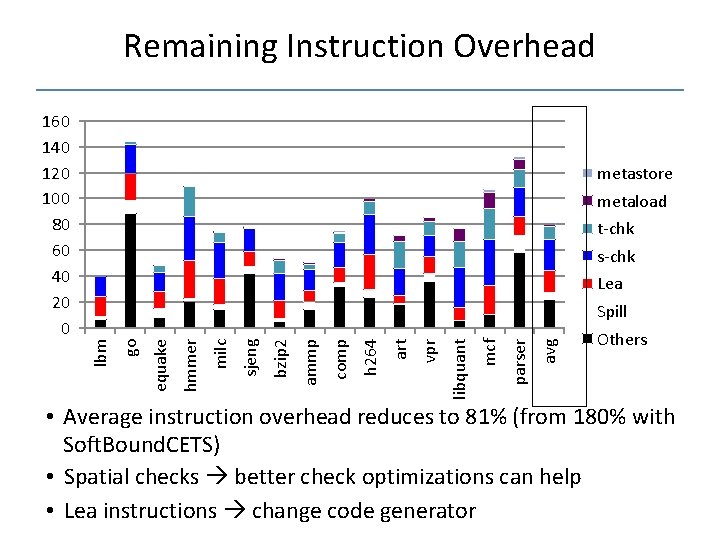
Remaining Instruction Overhead 160 140 120 100 80 60 40 20 0 metastore metaload t-chk s-chk Lea avg parser mcf libquant vpr art h 264 comp ammp bzip 2 sjeng milc hmmer equake go lbm Spill Others • Average instruction overhead reduces to 81% (from 180% with Soft. Bound. CETS) • Spatial checks better check optimizations can help • Lea instructions change code generator
Intel MPX • In July 2013, Intel MPX announced ISA specification – Similar hardware/software approach • Pointer-based checking: base and bounds metadata • Disjoint metadata in shadow space • Adds new instructions for bounds checking – Differences • Adds new bounds registers vs reusing existing AVX registers • Changes calling conventions to avoid shadow stack • Backward compatibility features – Interoperability with un-instrumented and instrumented code – Validates metadata by redundantly encoding pointer in metadata – Calling un-instrumented code clears bounds registers • Does not perform use-after-free checking
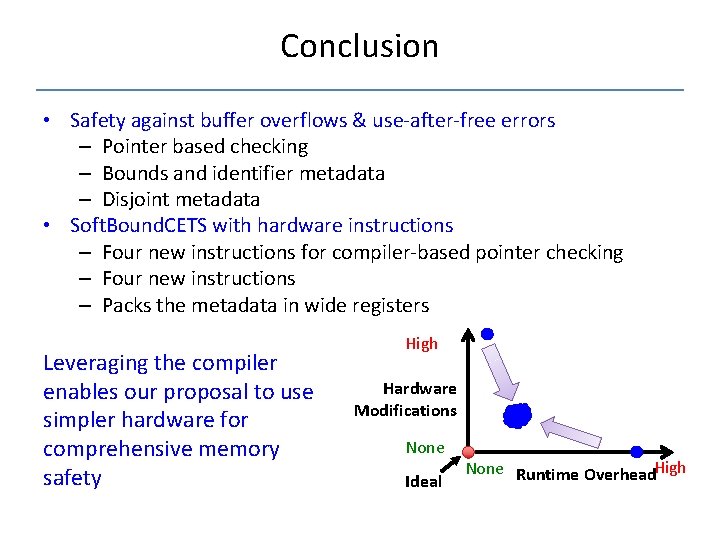
Conclusion • Safety against buffer overflows & use-after-free errors – Pointer based checking – Bounds and identifier metadata – Disjoint metadata • Soft. Bound. CETS with hardware instructions – Four new instructions for compiler-based pointer checking – Four new instructions – Packs the metadata in wide registers Leveraging the compiler enables our proposal to use simpler hardware for comprehensive memory safety High Hardware Modifications None Ideal None Runtime Overhead. High
Thank You Try Soft. Bound. CETS for LLVM-3. 4 http: //github. com/santoshn/softboundcets-34/
- Slides: 50