
Complete Characterization of subpixel Response of NearInfrared Detectors
Complete Characterization of subpixel Response of Near-Infrared Detectors (Spots-O-Matic) Tomasz Biesiadzinski, Greg Tarlé, Michael Howe, Curtis Weaverdyck, Michael Schubnell, Wolfgang Lorenzon October 14, 2009 Detectors for Astronomy, Garching
Outline n n Why do we care about sub-pixel response? The Spot-O-Matic q Our first look at intra-pixel response q Barron et al. , “Subpixel Response Measurement of Near-Infrared Detectors”, PASP (2007) Spots-O-Matic q Concept Effects of sub-pixel structure q Simulation of errors on point source photometry and simulated Spots-O-Matic correction q Weak lensing considerations n n n Possible errors Shape projection capabilities Spots-O-Matic Progress q Lens characterization October 14, 2009 Detectors for Astronomy, Garching
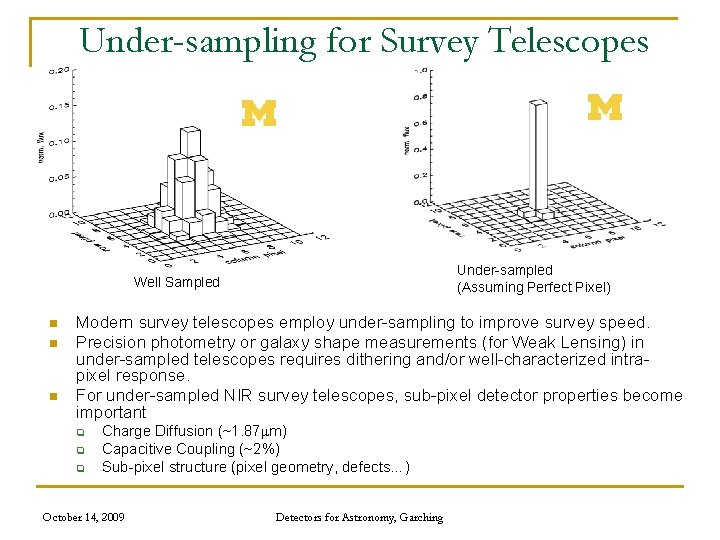
Under-sampling for Survey Telescopes Under-sampled (Assuming Perfect Pixel) Well Sampled n n n Modern survey telescopes employ under-sampling to improve survey speed. Precision photometry or galaxy shape measurements (for Weak Lensing) in under-sampled telescopes requires dithering and/or well-characterized intrapixel response. For under-sampled NIR survey telescopes, sub-pixel detector properties become important q q q Charge Diffusion (~1. 87 mm) Capacitive Coupling (~2%) Sub-pixel structure (pixel geometry, defects…) October 14, 2009 Detectors for Astronomy, Garching
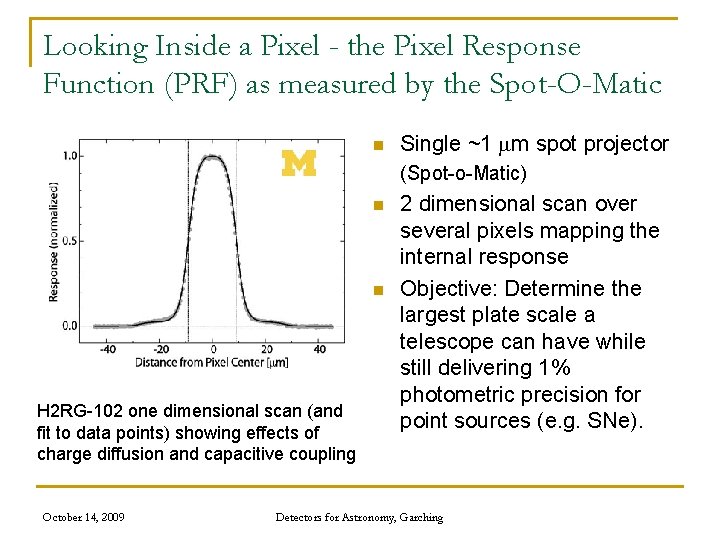
Looking Inside a Pixel - the Pixel Response Function (PRF) as measured by the Spot-O-Matic n Single ~1 mm spot projector (Spot-o-Matic) n n H 2 RG-102 one dimensional scan (and fit to data points) showing effects of charge diffusion and capacitive coupling October 14, 2009 2 dimensional scan over several pixels mapping the internal response Objective: Determine the largest plate scale a telescope can have while still delivering 1% photometric precision for point sources (e. g. SNe). Detectors for Astronomy, Garching
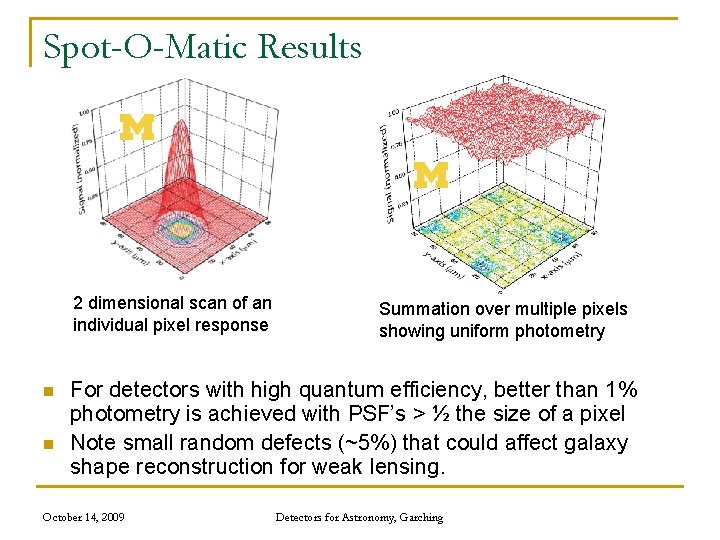
Spot-O-Matic Results 2 dimensional scan of an individual pixel response n n Summation over multiple pixels showing uniform photometry For detectors with high quantum efficiency, better than 1% photometry is achieved with PSF’s > ½ the size of a pixel Note small random defects (~5%) that could affect galaxy shape reconstruction for weak lensing. October 14, 2009 Detectors for Astronomy, Garching
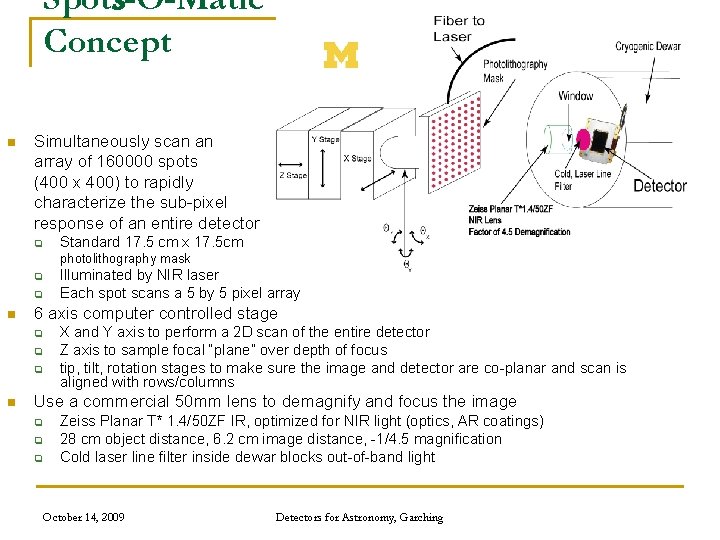
Spots-O-Matic Concept n Simultaneously scan an array of 160000 spots (400 x 400) to rapidly characterize the sub-pixel response of an entire detector q Standard 17. 5 cm x 17. 5 cm photolithography mask q q n 6 axis computer controlled stage q q q n Illuminated by NIR laser Each spot scans a 5 by 5 pixel array X and Y axis to perform a 2 D scan of the entire detector Z axis to sample focal “plane” over depth of focus tip, tilt, rotation stages to make sure the image and detector are co-planar and scan is aligned with rows/columns Use a commercial 50 mm lens to demagnify and focus the image q q q Zeiss Planar T* 1. 4/50 ZF IR, optimized for NIR light (optics, AR coatings) 28 cm object distance, 6. 2 cm image distance, -1/4. 5 magnification Cold laser line filter inside dewar blocks out-of-band light October 14, 2009 Detectors for Astronomy, Garching
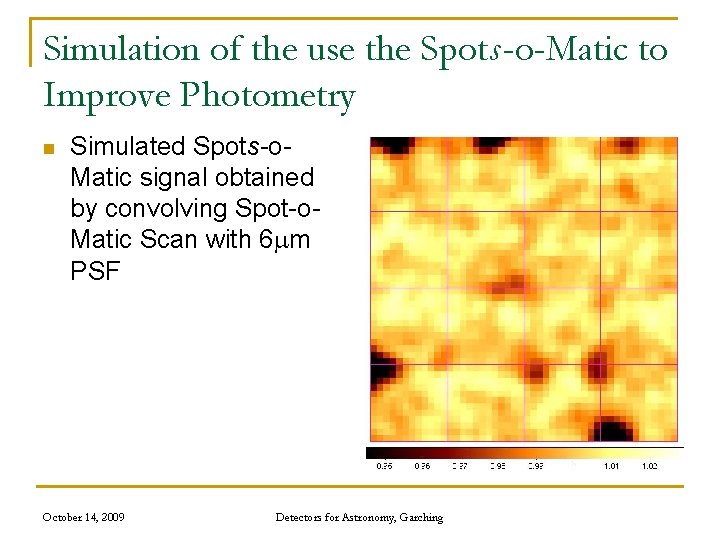
Simulation of the use the Spots-o-Matic to Improve Photometry n Simulated Spots-o. Matic signal obtained by convolving Spot-o. Matic Scan with 6 mm PSF October 14, 2009 Detectors for Astronomy, Garching
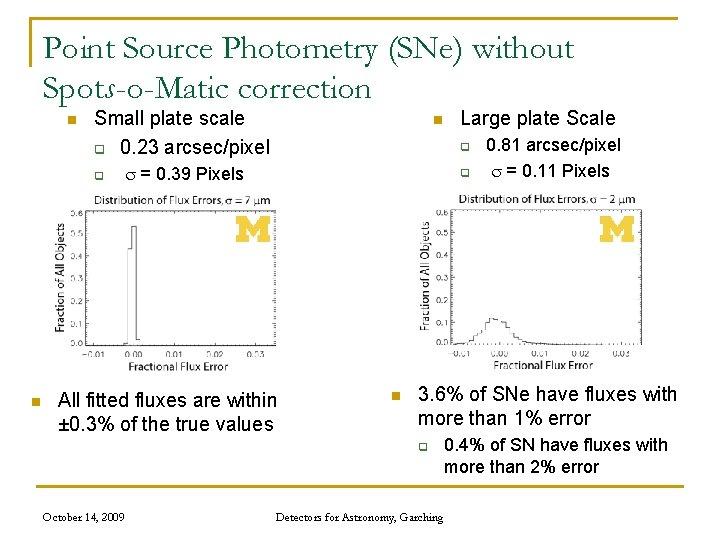
Point Source Photometry (SNe) without Spots-o-Matic correction n Small plate scale q 0. 23 arcsec/pixel q n n q = 0. 39 Pixels q All fitted fluxes are within ± 0. 3% of the true values n 0. 81 arcsec/pixel = 0. 11 Pixels 3. 6% of SNe have fluxes with more than 1% error q October 14, 2009 Large plate Scale Detectors for Astronomy, Garching 0. 4% of SN have fluxes with more than 2% error
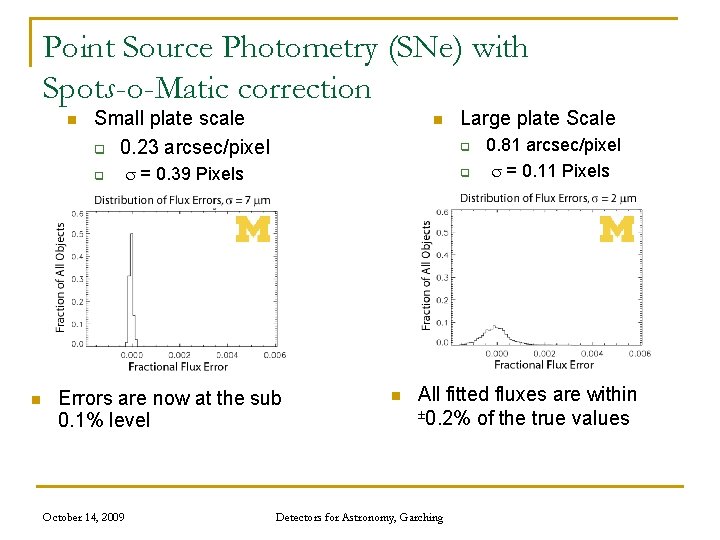
Point Source Photometry (SNe) with Spots-o-Matic correction n Small plate scale q 0. 23 arcsec/pixel q n n q = 0. 39 Pixels q Errors are now at the sub 0. 1% level October 14, 2009 Large plate Scale n 0. 81 arcsec/pixel = 0. 11 Pixels All fitted fluxes are within ± 0. 2% of the true values Detectors for Astronomy, Garching
Spots-O-Matic & Weak Lensing n Dithering q q n Reconstructs diffraction limited seeing in under-sampled telescopes at the expense of survey speed Compensates for intrapixel structure A complete Spots-o-Matic scan reduce the number of dithers required to achieve a given level of shape discrimination Simulations have yet to be performed to quantify this Can large plate scale Hg. Cd. Te detectors be used for shape reconstruction? Spots-o-Matic data will provide the answer q q Elliptical “galaxies” and point sources (PSF calibration “stars”) will be projected onto real detectors and shapes will be extracted Sub-pixel features mapped by the Spots-O-Matic will be used to correct the shapes for known intrapixel response and determine the errors after correction October 14, 2009 Detectors for Astronomy, Garching
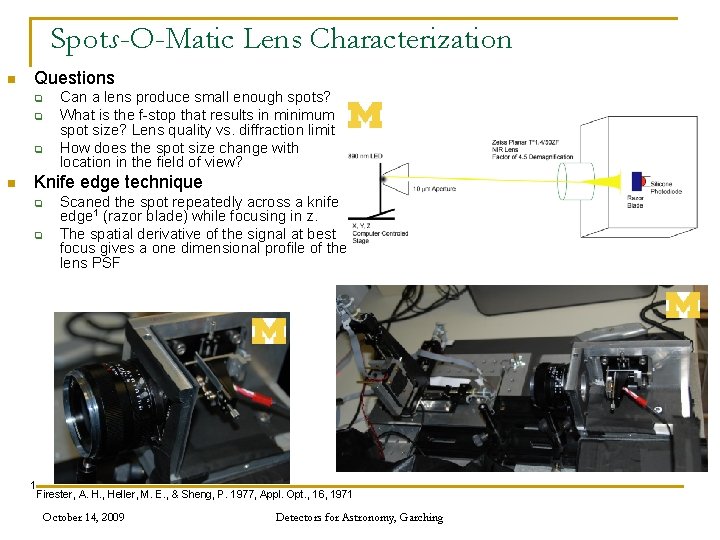
Spots-O-Matic Lens Characterization n Questions q q q n Can a lens produce small enough spots? What is the f-stop that results in minimum spot size? Lens quality vs. diffraction limit How does the spot size change with location in the field of view? Knife edge technique q q 1 Scaned the spot repeatedly across a knife edge 1 (razor blade) while focusing in z. The spatial derivative of the signal at best focus gives a one dimensional profile of the lens PSF Firester, A. H. , Heller, M. E. , & Sheng, P. 1977, Appl. Opt. , 16, 1971 October 14, 2009 Detectors for Astronomy, Garching
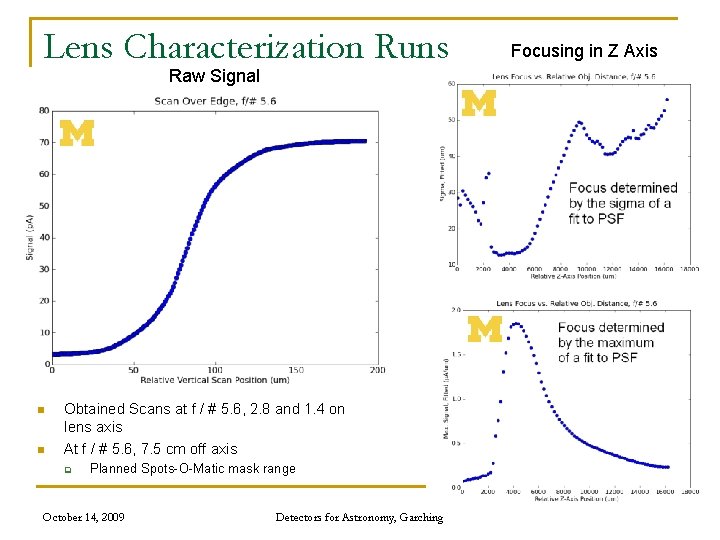
Lens Characterization Runs Raw Signal n n Obtained Scans at f / # 5. 6, 2. 8 and 1. 4 on lens axis At f / # 5. 6, 7. 5 cm off axis q Planned Spots-O-Matic mask range October 14, 2009 Detectors for Astronomy, Garching Focusing in Z Axis
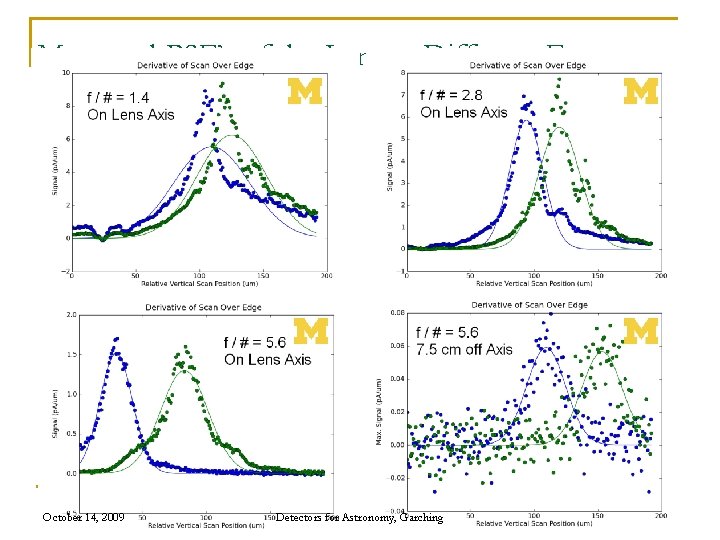
Measured PSF’s of the Lens at Different F-stops October 14, 2009 Detectors for Astronomy, Garching
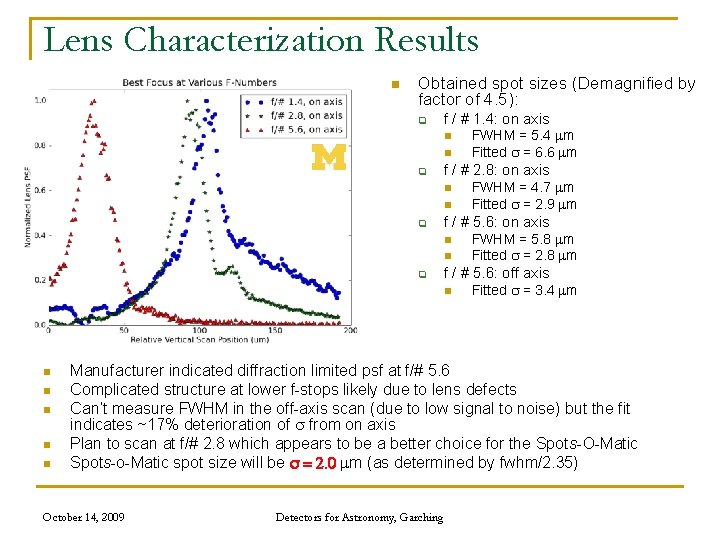
Lens Characterization Results n Obtained spot sizes (Demagnified by factor of 4. 5): q f / # 1. 4: on axis n n q f / # 2. 8: on axis n n q n n n FWHM = 5. 8 mm Fitted = 2. 8 mm f / # 5. 6: off axis n n FWHM = 4. 7 mm Fitted = 2. 9 mm f / # 5. 6: on axis n q FWHM = 5. 4 mm Fitted = 6. 6 mm Fitted = 3. 4 mm Manufacturer indicated diffraction limited psf at f/# 5. 6 Complicated structure at lower f-stops likely due to lens defects Can’t measure FWHM in the off-axis scan (due to low signal to noise) but the fit indicates ~17% deterioration of from on axis Plan to scan at f/# 2. 8 which appears to be a better choice for the Spots-O-Matic Spots-o-Matic spot size will be s = 2. 0 mm (as determined by fwhm/2. 35) October 14, 2009 Detectors for Astronomy, Garching
Conclusion n The Spots-O-Matic will provide ~ 2 mm resolution scans of an entire Hg. Cd. Te detector in ~ 1 day. q n n n With a standard lens it can be used on visible CCDs with likely better resolution The spot size is not significantly degraded at the periphery of the field of view Now that we have characterized the optics we are proceeding with final design and construction of the Spots-o-Matic. We expect first scans by Spring 2010 in time to influence JDEM instrument design. October 14, 2009 Detectors for Astronomy, Garching
- Slides: 15