
Competitive voucher schemes to increase access to and








- Slides: 26
Competitive voucher schemes to increase access to and quality of sexual and reproductive health care for marginalized and/or vulnerable populations Anna Gorter Julienne Mc. Kay Instituto Centro. Americano de la Salud – ICAS Reproductive health in Latin America: costs, outcomes and policies London School of Economics and Political Sciences – Sept 20, 2007
Outline of presentation What are competitive voucher schemes Strengths of competitive vouchers in developing countries Comparison of vouchers with: n franchising programmes Conclusion, can vouchers be used to increase access to quality services for marginalized and vulnerable populations
Why develop competitive voucher schemes? Market failure to serve certain poor, marginalised and / or vulnerable populations, even if services are associated with positive externalities, e. g. HIV/AIDS services for sex workers or family planning for young people Search for alternative approaches – engagement of private providers through competitive vouchers
Competitive voucher schemes in Nicaragua 1995 - 1998 voucher trial with sex workers in Managua successful Development of more schemes in Nicaragua n n n Clients of sex workers, drug addicts, gay men, young glue-sniffers, mobile populations Adolescents, YP, especially poor “high-risk” Older, poor, rural women at risk for cervical cancer
SUBSIDIES Eg. Tax revenue or donation PAYMENT ORGANIZATION PROVIDER ORGANIZATION Eg. Mo. H, Social Security, other. Eg. RIGHT TO SUBSIDY INPUTS Eg. Salaries, Drugs, etc Eg. Vouchers, capitation payment, fee subsidies Payments USERS PROVIDERS Co-payments Voucher Agency Free or subsidized services USERS SUPPLY SIDE FINANCING Invoice for Subsidies on Goods and /or services Redemption of the right for subsidy PROVIDERS DEMAND SIDE FINANCING
Competitive vouchers in other sectors Education (US, Europe, LA, Netherlands) Employment (Argentina, US, Netherlands) Training (LA, Kenya, Zimbabwe, USA) Elderly care (Spain) Housing (USA) Pension (Bolivia) Welfare (UK, USA)
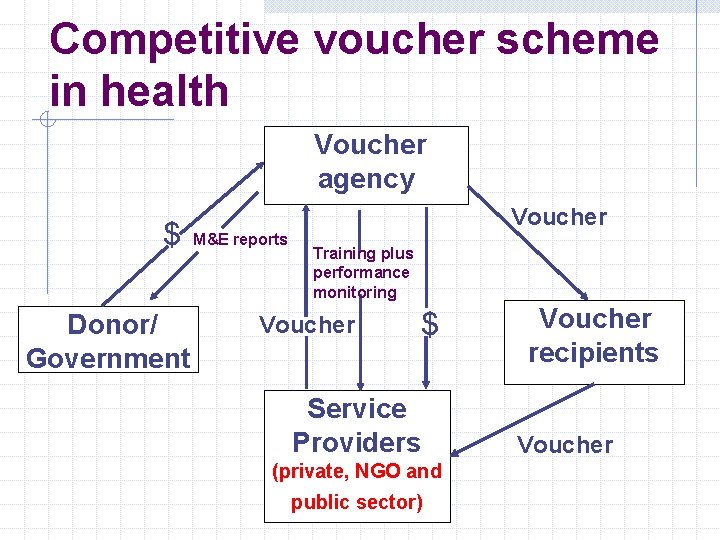
Competitive voucher scheme in health Voucher agency $ Donor/ Government Voucher M&E reports Training plus performance monitoring Voucher $ Service Providers (private, NGO and public sector) Voucher recipients Voucher
Some examples of vouchers
Strengths of competitive vouchers Targeting of population sub-groups Encourage use of specific services Can increase operating efficiency Can improve service standards / quality Payment for services actually provided n Possible to pay only incremental cost Facilitates monitoring and evaluation
Targeting Of identifiable groups ‘at risk’ / in need: Marginalised groups n drug-addicts, sex workers, streetkids Groups who fear stigmatization n MSM, or people with TB, Leprosy, AIDS Vulnerable groups, e. g. because of age, gender, behaviour or poverty n n n Adolescents, young people Clients of sex workers Poor pregnant women
Encourage use (incl. of services with positive externalities) When demand is limited by barriers to access (cost, lack of knowledge, stigma. . ) Vouchers inform about services and guide users to where services can be obtained Remove cost barriers (incl. eg transport costs) Power of choice increases client satisfaction n n Encourages use and positive experience leads to repeat use ‘Worth of mouth’ recommendation to others
Nicaraguan schemes target those most at risk or underserved & encourage use STI-HIV-AIDS prevention & treatment n n sex workers and their clients men who have sex with men and other populations which are difficult to reach Sexual & Reproductive Health care n poor adolescents and young people Cervical Cancer screening and treatment n older women in rural and remote areas
Other schemes target and encourage use of safe motherhood services Providing safe motherhood services through vouchers to reduce maternal mortality (MDG 5): Indonesia: services delivered by private midwifes to poor rural women Kenya: services delivered by public, private & mission providers to poor women India / Gujarat: private gynaecologists provide services to poor women from remote areas India / Uttar Pradesh, private nursing homes provide maternal care to poor women
Vouchers can increase efficiency & service standards Increased utilization of private sector resources Reduced input costs Competition between participating providers (private, NGO/mission, public) : n n n Reduced price Increased service quality Increased clients satisfaction
When do vouchers increase efficiency / standards most? Providers with excess capacity, increased utilization gives economies of scale Strong competition between providers (more than one provider available) Where contracts specify ‘best practice’ service package /‘social’ protocols & staff required to undergo training only cost-effective services are provided medical supplies are procured centrally vouchers are distributed by third parties
Potential drawbacks of vouchers High start-up costs Set-up is complex, needs highly trained staff at the start, ‘devil in the detail’ Not feasible: cost of services is variable or unpredictable; need for services difficult to verify May be susceptible to abuse (black market, collusion between providers and distributors. . ) Program development takes time Once established easy to run and to scaleup, and costs go down
Vouchers facilitate monitoring and evaluation Mechanics of a scheme incorporate: Regular monitoring of provider performance against contract specifications n n n Interviews with redeemers, ‘mystery patients’ Medical record review Tracking redemption rates / follow-up consultations Providers report to voucher agency Voucher agency reports to donor/Government Program impact assessed by tracking voucher use and linking changes to health outcomes
Impact of treatment rounds on STI prevalence in sex workers voucher scheme in Nicaragua (long periods between treatment rounds – high bounce back of STIs) Measured STI Prevalence 35% 30% 25% 20% 15% 10% 5% 0% 0 1 2 3 4 5 6 7 8 9 Round 10 11 12 13 14 15 16 17 18 19 20 21 Mc. Kay et al, AJPH 2006; 96: 7 -9
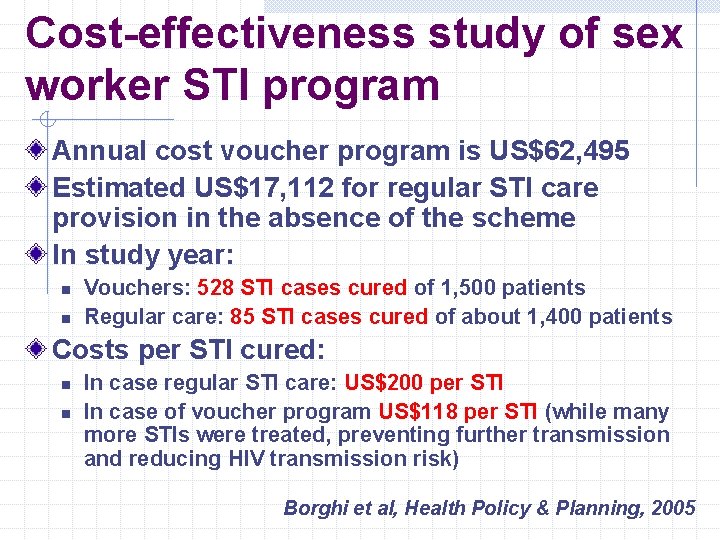
Cost-effectiveness study of sex worker STI program Annual cost voucher program is US$62, 495 Estimated US$17, 112 for regular STI care provision in the absence of the scheme In study year: n n Vouchers: 528 STI cases cured of 1, 500 patients Regular care: 85 STI cases cured of about 1, 400 patients Costs per STI cured: n n In case regular STI care: US$200 per STI In case of voucher program US$118 per STI (while many more STIs were treated, preventing further transmission and reducing HIV transmission risk) Borghi et al, Health Policy & Planning, 2005
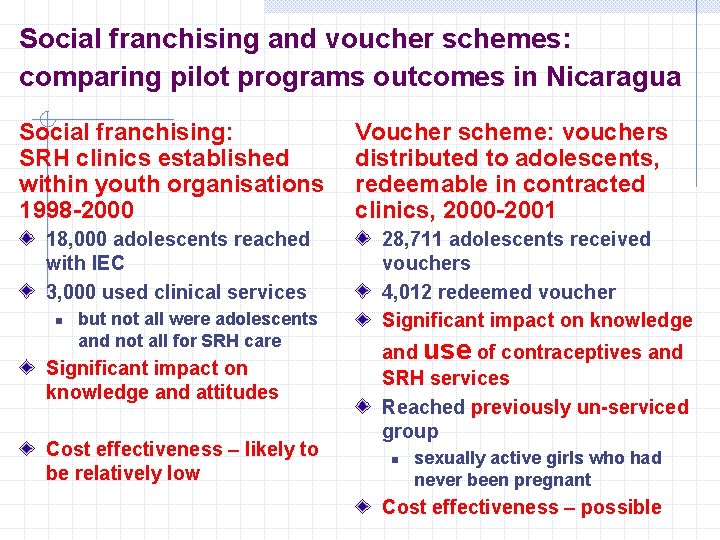
Social franchising and voucher schemes: comparing pilot programs outcomes in Nicaragua Social franchising: SRH clinics established within youth organisations 1998 -2000 18, 000 adolescents reached with IEC 3, 000 used clinical services n but not all were adolescents and not all for SRH care Significant impact on knowledge and attitudes Cost effectiveness – likely to be relatively low Voucher scheme: vouchers distributed to adolescents, redeemable in contracted clinics, 2000 -2001 28, 711 adolescents received vouchers 4, 012 redeemed voucher Significant impact on knowledge and use of contraceptives and SRH services Reached previously un-serviced group n sexually active girls who had never been pregnant Cost effectiveness – possible
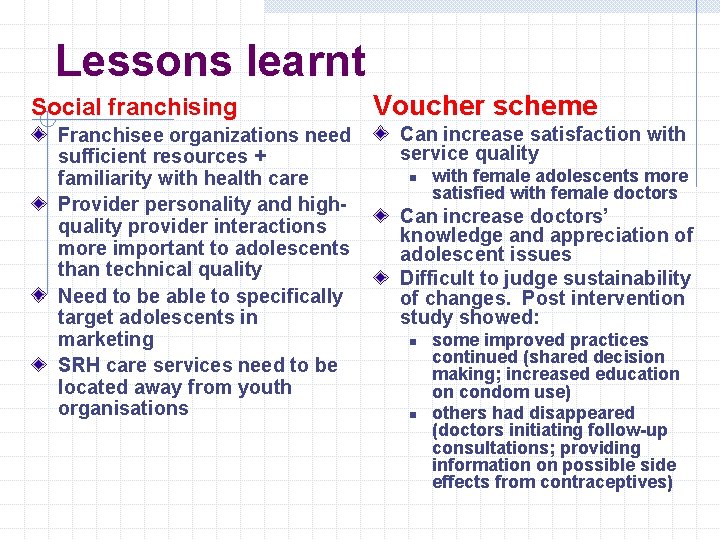
Lessons learnt Social franchising Franchisee organizations need sufficient resources + familiarity with health care Provider personality and highquality provider interactions more important to adolescents than technical quality Need to be able to specifically target adolescents in marketing SRH care services need to be located away from youth organisations Voucher scheme Can increase satisfaction with service quality n with female adolescents more satisfied with female doctors Can increase doctors’ knowledge and appreciation of adolescent issues Difficult to judge sustainability of changes. Post intervention study showed: n n some improved practices continued (shared decision making; increased education on condom use) others had disappeared (doctors initiating follow-up consultations; providing information on possible side effects from contraceptives)
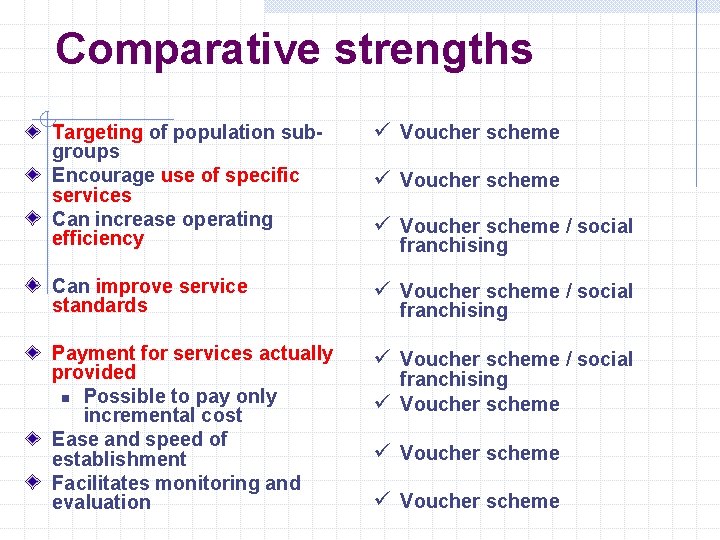
Comparative strengths Targeting of population subgroups Encourage use of specific services Can increase operating efficiency ü Voucher scheme Can improve service standards ü Voucher scheme / social Payment for services actually provided n Possible to pay only incremental cost Ease and speed of establishment Facilitates monitoring and evaluation ü Voucher scheme / social franchising ü Voucher scheme
Comparison of vouchers with franchise and insurance
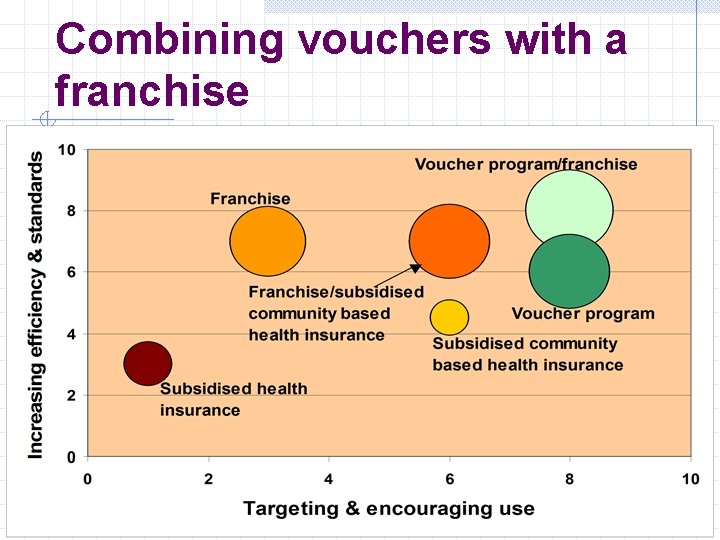
Combining vouchers with a franchise
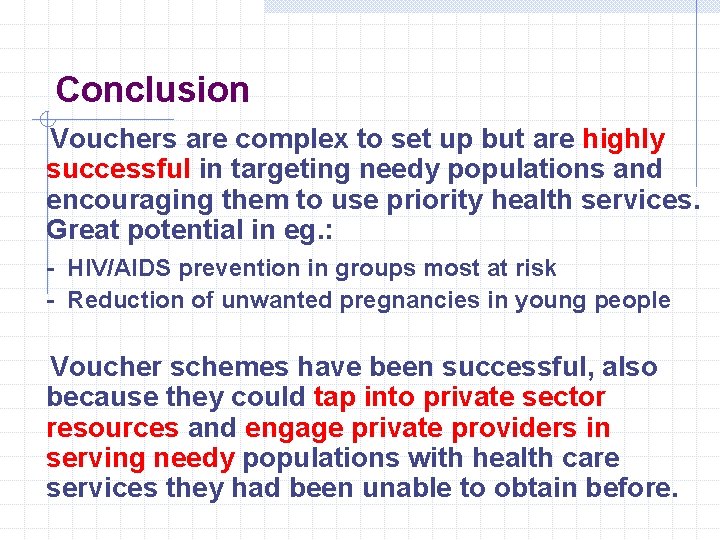
Conclusion Vouchers are complex to set up but are highly successful in targeting needy populations and encouraging them to use priority health services. Great potential in eg. : - HIV/AIDS prevention in groups most at risk - Reduction of unwanted pregnancies in young people Voucher schemes have been successful, also because they could tap into private sector resources and engage private providers in serving needy populations with health care services they had been unable to obtain before.
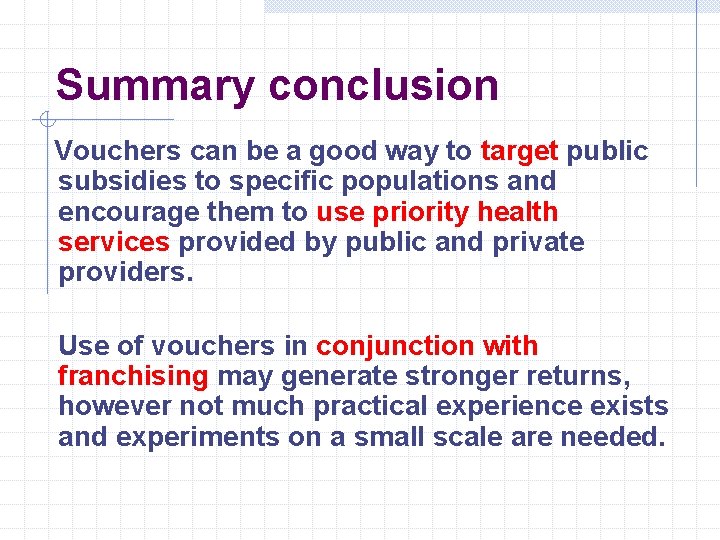
Summary conclusion Vouchers can be a good way to target public subsidies to specific populations and encourage them to use priority health services provided by public and private providers. Use of vouchers in conjunction with franchising may generate stronger returns, however not much practical experience exists and experiments on a small scale are needed.