
COMPETITIVE DEBATE AN INTRODUCTION ESSENTIAL QUESTION WHAT ARE
COMPETITIVE DEBATE: AN INTRODUCTION ESSENTIAL QUESTION – WHAT ARE THE DIFFERENT EVENTS AVAILABLE IN COMPETITIVE DEBATE?
SPEECH AND DEBATE • Events are split into two types • Debate – attacking and defending a certain topic or various topics • Policy, LD, PF, Congress • Individual Events – Speech/Performance based competition versus others • US/International Extemporaneous, Dramatic/Humorous/Oral/Duo Interpretation, Original Oratory
POLICY DEBATE – “TEAM DEBATE” • One pair of debaters face off a second pair of debaters • Affirmative – agrees with resolution • Negative – Agrees with status quo • Aff must come up with plan to solve for problems given in arguments • Use evidence and statistics to prove side is correct • Strict time limits – cannot go over time!
POLICY DEBATE • Affirmative must present prima facie case – must make sense to everyday person • Negative must poke holes in Aff. case to show it is not as concrete as it seems • Aff. – burden of proof; Neg. – burden of rejoinder • Topic same all year round

POLICY DEBATE TOPIC • RESOLVED – The United States federal government should substantially increase its nonmilitary exploration and/or development of the Earth’s oceans.
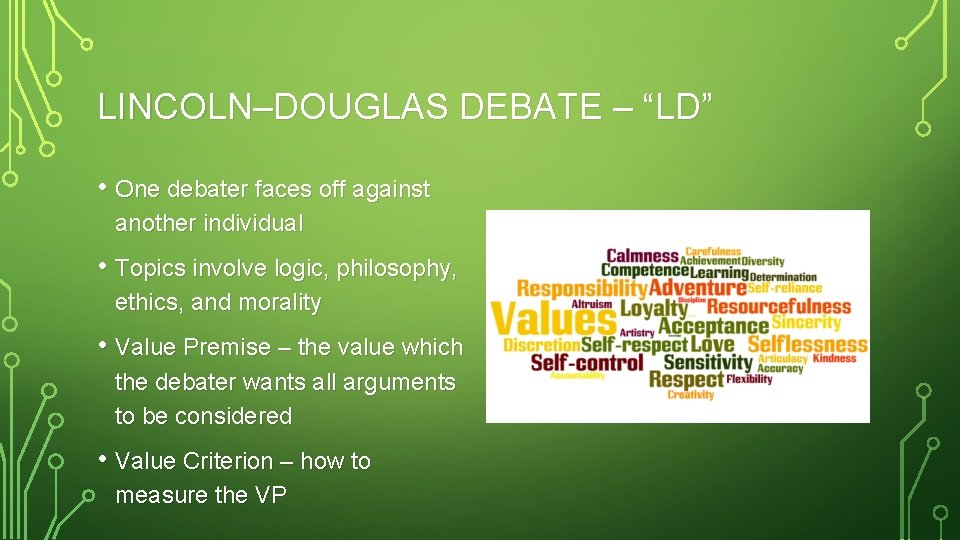
LINCOLN–DOUGLAS DEBATE – “LD” • One debater faces off against another individual • Topics involve logic, philosophy, ethics, and morality • Value Premise – the value which the debater wants all arguments to be considered • Value Criterion – how to measure the VP
LINCOLN-DOUGLAS DEBATE • Aff. – agrees with the resolution; Neg. – agrees with status quo • Strict time limit • Not as intense as policy, but more focused on philosophy • Winner goes to person able to prove that logically he or she should win • Topics change monthly
LINCOLN-DOUGLAS TOPICS – SEPTEMBER/OCTOBER • Varsity • Novice • A just society ought • Civil disobedience to presume consent for organ procurement of the deceased in a democracy is morally justified
PUBLIC FORUM DEBATE – “PF” • Newest event in competitive debate • Team of 2 debaters compete vs. second team • Topics are more relevant to everyday person • Affirmative may NTO always go first • Use a combination of logic, philospophy, evidence and/or • No burden on either side – whoever articulates arguments most effectively wins • Very similar to televised debates (i. e. Crossfire) • Topics change monthly
PUBLIC FORUM TOPIC – SEPTEMBER/OCTOBER • RESOLVED: On balance, public subsidies for professional athletic organizations in the United States benefit their local communities
EXTEMPORANEOUS SPEAKING – “USX” & “IX” • Competitor is given a question at competition • He or she will have 30 minutes to research and create a 7 -10 minute speech on the topic • Using articles and research previously done beforehand • Cannot research during competition
EXTEMPORANEOUS SPEAKING • Event questions are NOT given in advance • Competitor must constantly research for most up-to-date information for speeches • Student will speak only to judge and/or timekeeper • Round is ranked by judge – 1 st, 2 nd, 3 rd, etc.
U. S. EXTEMPORANEOUS SPEAKING - TOPICS • What do new concerns over lethal injection mean for the future of the death penalty? • What explains the US economy’s poor Q 1 performance? • Is NASA's Curiosity Mars rover delivering on expectations? • Is Jeb Bush emerging as the GOP frontrunner? • Is Obamacare doing better than expected? • Is Barack Obama already a lame duck? • Would raising the minimum wage successfully reduce poverty? • Should the US continue to cut military spending? • How is inequality in K-12 education affecting the United States? • Should the NBA force Donald Sterling to sell his team?
INTERNATIONAL EXTEMPORANEOUS - TOPICS • How should Ukraine’s government • Will Thailand’s July elections ease respond to Russian separatists? or exacerbate political tensions? • Will sanctions against Russia achieve their goal? • What is driving China’s problems with internal ethnic conflict? • Has the world forgotten about Syria? • What does the failure of peace talks with the Palestinians mean for Israel’s future? • What is at stake in Iraq’s nationwide parliamentary elections? • What are the greatest challenges facing the United States’ foreign policy toward Asia? • Why are Dilma Rousseff’s approval ratings slipping? • Why is violence overwhelming South Sudan?
INTERPRETATION – “DI”, “HI”, “OI”, “DUO” • Competitor recreates scene or reads literature for a judge • Compete in flights – group settings up to 7 in a grouping • Judging based on acting and recreation of scene • Competitor MAY NOT USE PROPS OR MAKE-UP • Movement space restricted to one-step in any direction
INTERPRETATION • DI – Dramatic Interpretation; dramatic pieces w/o humor • HI – Humorous Interpretation; scenes with humor • OI – Oral Interpretation; dramatic or humorous reading of prose AND poetry – dependent on the round • DUO – Duo Interpretation; dramatic or humorous scenes
RULES OF INTERPRETATION • Time Limit – 7 to 10 minutes • Editing extremely important for time restraints • OI – Need both prose and poetry; alternate in each round • Focus on tone of voice, facial expressions, body movement in small space • DI/HI/DUO require memorization of the script; OI may have a folder with story and poem(s) in it • Some authors/playwrights are off -limits (ex. – Neil Simon) • Stay within time constraints – points can be deducted for going UNDER time • Competitors are ranked at end of
ORIGINAL ORATORY • Competitor competes against a group of other orators • Competitor writes an original speech on any topic of his or her choosing • Time limit – 7 -10 minutes • Judging based on content of speech and effectiveness of delivery
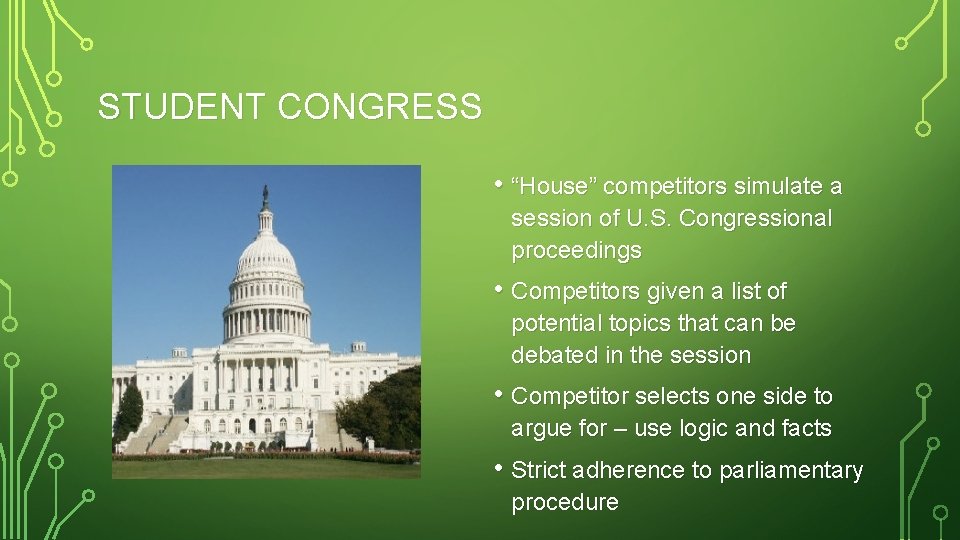
STUDENT CONGRESS • “House” competitors simulate a session of U. S. Congressional proceedings • Competitors given a list of potential topics that can be debated in the session • Competitor selects one side to argue for – use logic and facts • Strict adherence to parliamentary procedure
STUDENT CONGRESS • One competitor is selected as presiding officer – oversees the decorum of the chamber • Presiding officer selects who will speak in the chamber • Competitor can speak as often as the P. O. selects him or her to speak • Judging based on effectiveness of speech – NOT ranked against • Time limit – 3 minutes • End of session – Up to 3 are nominated for best speaker • Popular vote determines winner • Usually 2 sessions in each chamber (morning/afternoon) • MUST FOLLOW PARLIAMENTARY PROCEDURES LAID OUT IN ROBERT’S RULES OF ORDER
WRITING A BILL/RESOLUTION • Bill – Proposed law with executive force • Resolution – Proposed suggestion; something that “should” happen, but has not executive force of law • Competitors can submit bills and resolutions to be debated in chamber • Writer will always given opportunity • After speaker delivers speech, rest of chamber is given opportunity to cross-examine • 1 question per competitor • Any topic can be “tabled” – put off from debate • Must be motioned by chamber and passed by a vote of the chamber • • If not tabled, debate continues If tabled, move to next topic
- Slides: 21