
Competitive Buffer Management with Packet Dependencies Alex Kesselman
Competitive Buffer Management with Packet Dependencies Alex Kesselman, Google Boaz Patt-Shamir, Tel Aviv University Gabriel Scalosub, University of Toronto
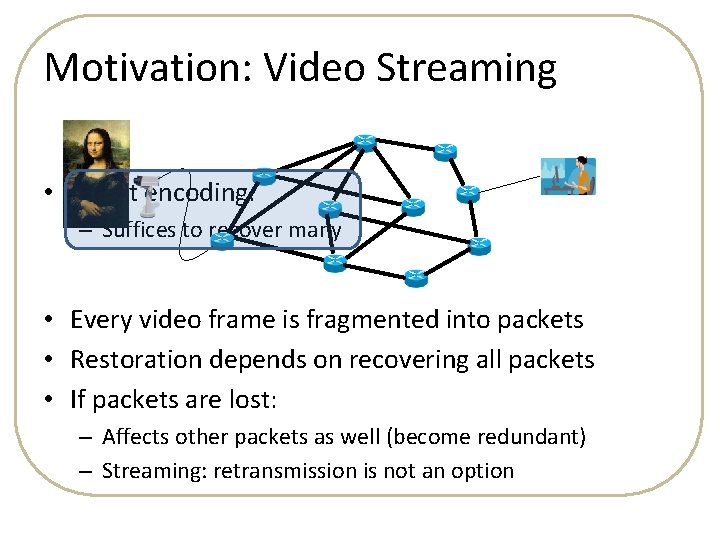
Motivation: Video Streaming • Smart encoding: – Suffices to recover many • Every video frame is fragmented into packets • Restoration depends on recovering all packets • If packets are lost: – Affects other packets as well (become redundant) – Streaming: retransmission is not an option
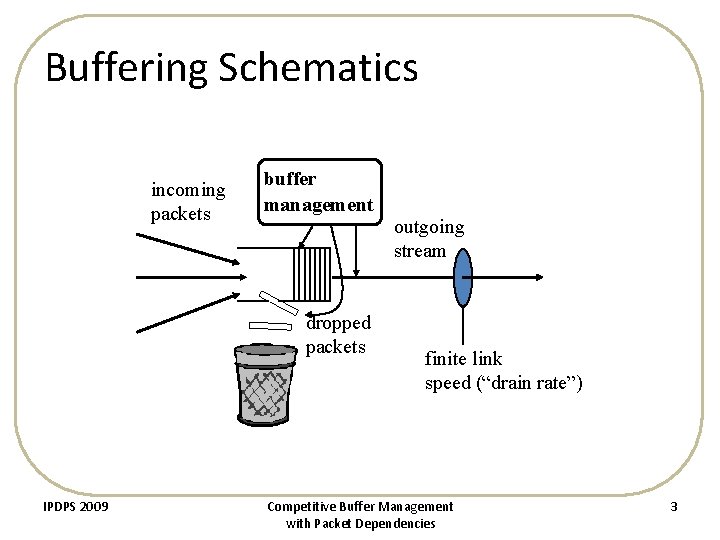
Buffering Schematics incoming packets buffer management dropped packets IPDPS 2009 outgoing stream finite link speed (“drain rate”) Competitive Buffer Management with Packet Dependencies 3
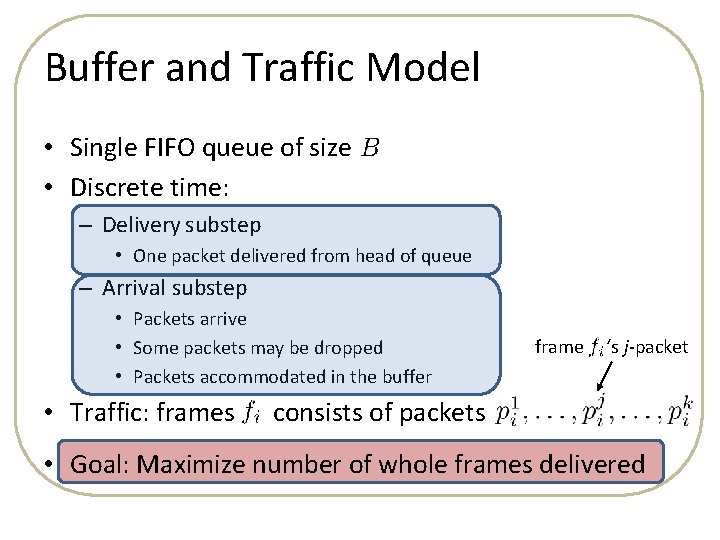
Buffer and Traffic Model • Single FIFO queue of size • Discrete time: – Delivery substep • One packet delivered from head of queue – Arrival substep • Packets arrive • Some packets may be dropped • Packets accommodated in the buffer • Traffic: frames frame ‘s j-packet consists of packets • Goal: Maximize number of whole frames delivered
Previous Work • Buffer management for Qo. S – Multi-valued packets – Constant competitive ratio for finite values [Lapid et al. , 2000], [Kesselman et al. , 2004], [Englert & Westerman, 2006], and many more • Some results for multiple buffers • No results about co-dependent packets!
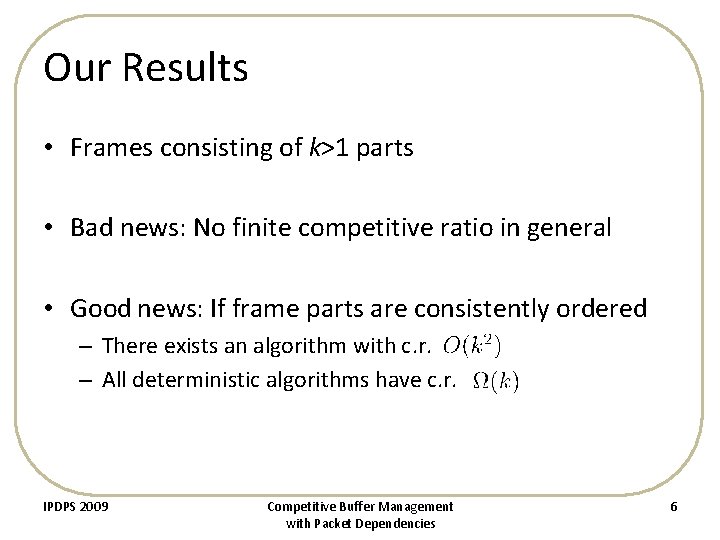
Our Results • Frames consisting of k>1 parts • Bad news: No finite competitive ratio in general • Good news: If frame parts are consistently ordered – There exists an algorithm with c. r. – All deterministic algorithms have c. r. IPDPS 2009 Competitive Buffer Management with Packet Dependencies 6
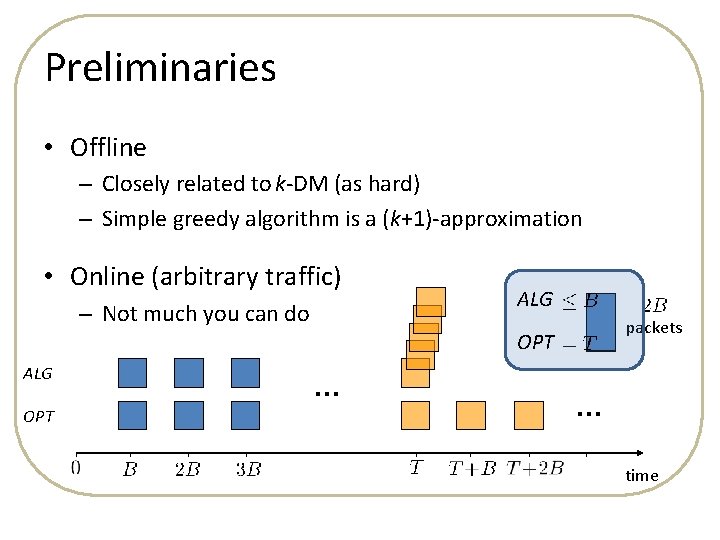
Preliminaries • Offline – Closely related to k-DM (as hard) – Simple greedy algorithm is a (k+1)-approximation • Online (arbitrary traffic) – Not much you can do ALG packets OPT ALG OPT … … time
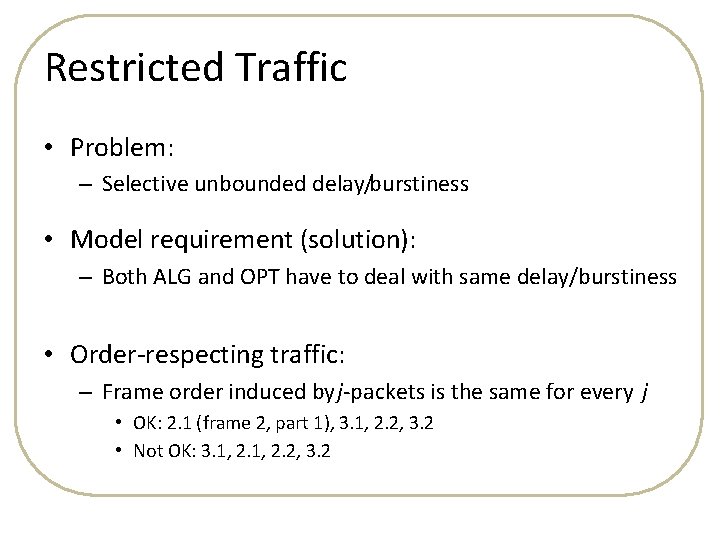
Restricted Traffic • Problem: – Selective unbounded delay/burstiness • Model requirement (solution): – Both ALG and OPT have to deal with same delay/burstiness • Order-respecting traffic: – Frame order induced by j-packets is the same for every j • OK: 2. 1 (frame 2, part 1), 3. 1, 2. 2, 3. 2 • Not OK: 3. 1, 2. 2, 3. 2
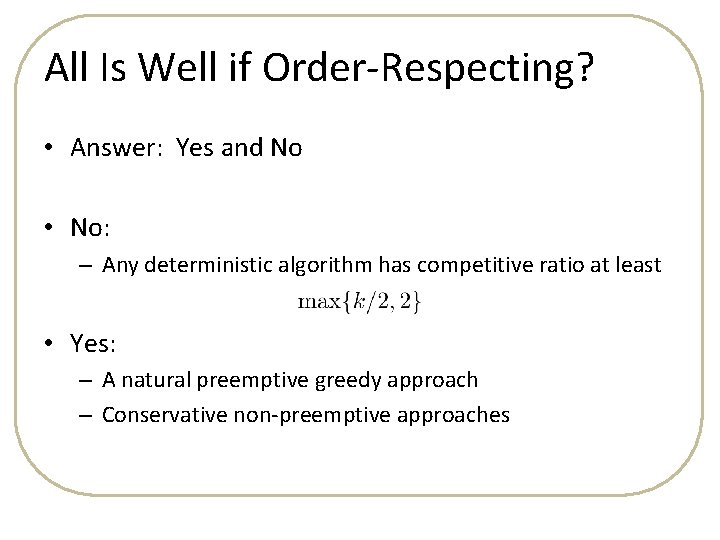
All Is Well if Order-Respecting? • Answer: Yes and No • No: – Any deterministic algorithm has competitive ratio at least • Yes: – A natural preemptive greedy approach – Conservative non-preemptive approaches
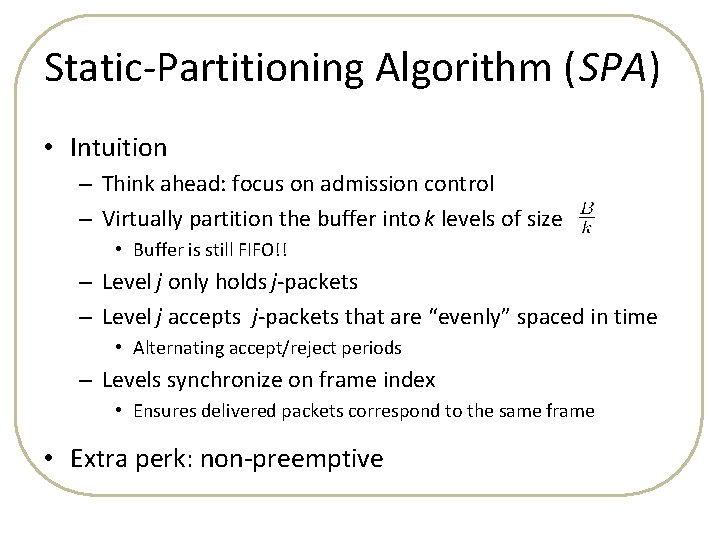
Static-Partitioning Algorithm (SPA) • Intuition – Think ahead: focus on admission control – Virtually partition the buffer into k levels of size • Buffer is still FIFO!! – Level j only holds j-packets – Level j accepts j-packets that are “evenly” spaced in time • Alternating accept/reject periods – Levels synchronize on frame index • Ensures delivered packets correspond to the same frame • Extra perk: non-preemptive
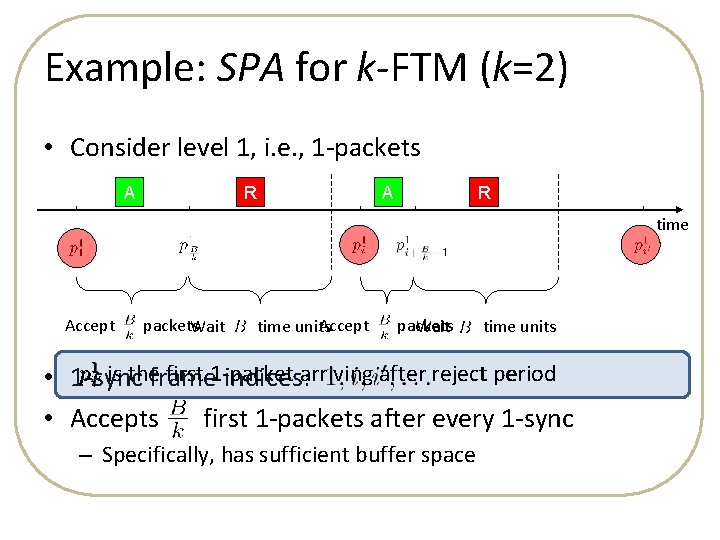
Example: SPA for k-FTM (k=2) • Consider level 1, i. e. , 1 -packets A R time Accept packets. Wait Accept time units packets Wait time units is theframe first 1 -packet • 1 -sync indices: arriving after reject period • Accepts first 1 -packets after every 1 -sync – Specifically, has sufficient buffer space
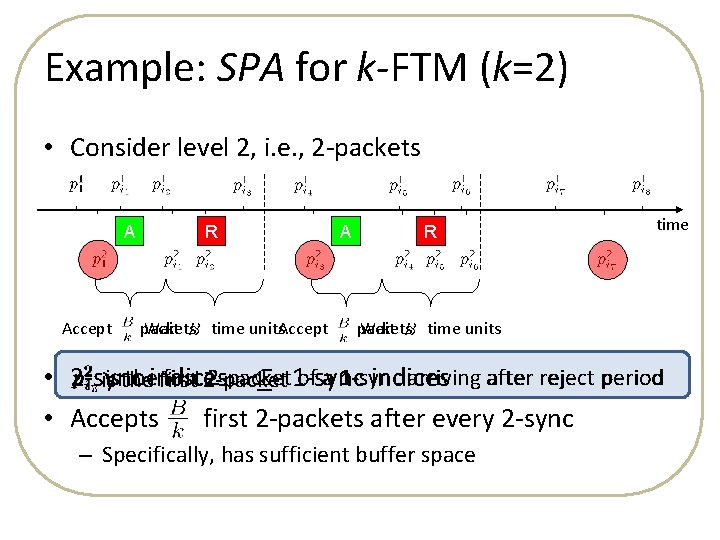
Example: SPA for k-FTM (k=2) • Consider level 2, i. e. , 2 -packets A Accept R packets Wait time units. Accept A R time packets Wait time units theindices first 2 -packet 1 -sync of a 1 -sync arriving after reject period • 2 -sync indices isis the first • Accepts first 2 -packets after every 2 -sync – Specifically, has sufficient buffer space
Summary • A new model in buffer management – Traffic has inter-packet dependencies • Highly applicable to, e. g. , video streaming • First analytic results (still a lot to discover…) – Competitive algorithms (and lower bounds) – Complexity
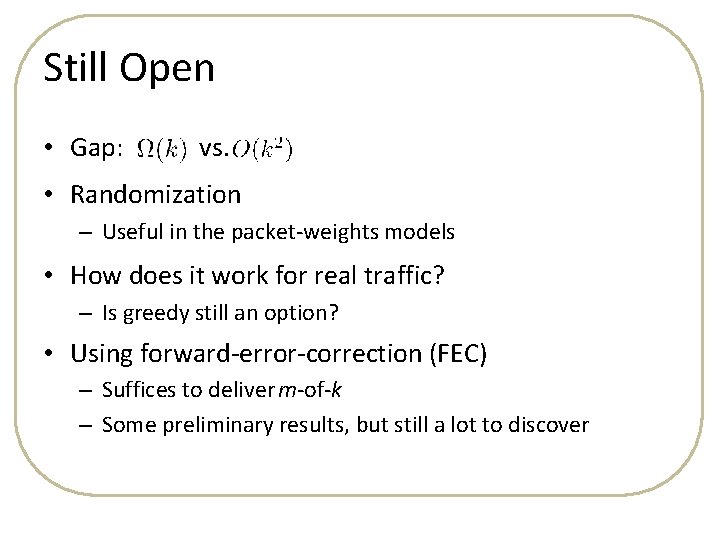
Still Open • Gap: vs. • Randomization – Useful in the packet-weights models • How does it work for real traffic? – Is greedy still an option? • Using forward-error-correction (FEC) – Suffices to deliver m-of-k – Some preliminary results, but still a lot to discover
Thank You!
- Slides: 15