
Competitive Advantage Management Level Paper E 2 Project
- Slides: 45
Competitive Advantage Management Level – Paper E 2 Project and Relationship Management Lecture - 004 Vidya Rajawasam ACMA CGMA MBA
Competitive Advantage q We have discussed the concept of strategy and various approaches related to developing corporate strategy. q In this lecture, we will discuss Sustainable Competitive Advantage.
Competitive Advantage q The business has to decide whether it should compete across the whole market place or only in certain segments. q What is competitiveness? It is the ability of a firm, sector or economy to compete against other firms, sectors or economies.
Competitive Advantage q The number of firms competing in an industry, entry barriers and their strengths have an impact on following; § The level of choice for consumers § The degree of competition in terms of promotion, price and new product developments.
Competitive Advantage q The number of firms competing in an industry, entry barriers and their strengths have an impact on following; § The profitability of the firms in the industry. § The likelihood of Collusive illegal agreements.
Competitive Advantage q What is competitive advantage? § Anything that provides an organization with an edge over its rivals. § Which can be sustained over time. § In order to be sustainable, the organization should seek activities that cannot be easily copied or imitate.
Competitive Advantage q What is sustained over time ; § Should have a product/service that can cater for customer needs for a long period of time. § Organizations may enjoy short term competitive advantage by introducing new product to a market.
Competitive Advantage q What is sustained over time ; § Introducing a new product to a market does not support the long term sustainability. § Therefore, the firm should seek to acquire patent or licenses, which cannot be easily copied by competitors.
Competitive Advantage q What is sustained over time ; § Furthermore, the competitive advantage obtained through reputation, branding and customer loyalty cannot be easily copied by competitors.
Competitive Advantage q Sustainable Competitive advantage ; § Therefore, the organizations must continuously monitor and develop its competitive advantage which sustain for a longer period of time.
Competitive Advantage q Porter’s Generic Strategies § Porter identified Three generic strategies that generate superior competitive performance. o Cost leadership – Same quality, Low price o Differentiation – enabling innovation and differentiation. o Focus – concentrating on small part of the market.
Competitive Advantage q Porter’s Generic Strategies § Cost leadership o Offers lower prices for the customers. o The quality of the goods/services will not be compromised. o The company can expand its market share. o Wal-Mart is one of the good examples.
Competitive Advantage q Porter’s Generic Strategies § Cost leadership o Wal-Mart is one of the good examples. o The company uses its massive buying power to influence the suppliers to be more efficient and sell their products at lower prices.
Competitive Advantage q Porter’s Generic Strategies § Differentiation – o A marketing strategy that focuses on distinguishing the product/service from similar offerings in the market. o Provides the competitive advantage for markets dominated by larger companies.
Competitive Advantage q Porter’s Generic Strategies § Differentiation – o Creates Brand loyalty among customers. o If the firm is unable to maintain the quality of the product/service, the customers may move with competitors.
Competitive Advantage q Porter’s Generic Strategies § Differentiation Focus – o Focuses on narrow segment of the market. o The target market segment should have unusual customer needs or production & delivery system that suits the buyers requirements.
Competitive Advantage q Porter’s Generic Strategies § Differentiation Focus – o Examples – Market for Organic fruits and vegetables. o Hybrid / Electrical Vehicles o Herbal tea / Flavored tea
Competitive Advantage q Porter’s Generic Strategies § Porter argued that the firm should adapt one of the three strategies by analyzing; o Opportunities & Threats in the market o Assessment of internal Strengths & Weaknesses. o Assessment of General environment.
Competitive Strategy Review MCQs The correct statement with reference to Sustainable Competitive Advantage is? a. b. c. d. The strategy focuses on short term gains. Frequent continuous monitoring not required. Focuses on new product developments Develop products/services which cannot be easily copied by competition.
Competitive Strategy Review MCQs The correct statement with reference to Sustainable Competitive Advantage is? a. b. c. d. The strategy focuses on short term gains. Frequent continuous monitoring not required. Focuses on new product developments Develop products/services which cannot be easily copied by competition.
Alternative Approaches to Strategy Review MCQs Porter’s three generic strategies are? a. b. c. d. e. Cost leadership. Differentiation Hybrid Differentiation focus Muddling through
Alternative Approaches to Strategy Review MCQs Porter’s three generic strategies are? a. b. c. d. e. Cost leadership. Differentiation Hybrid Differentiation focus Muddling through
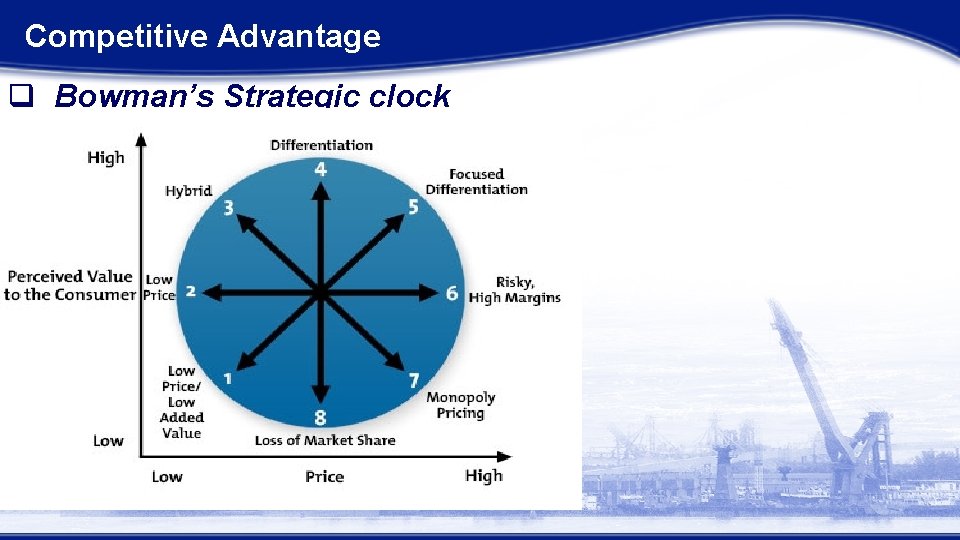
Competitive Advantage q Bowman’s Strategic clock § Bowman & Faulkner expanded the Porter’s work and introduced the strategic clock; o Shows eight strategic positions o Application is dependent on price and perceived value to customers. o Helps the businesses to understand where to compete in the chosen market.
Competitive Advantage q Bowman’s Strategic clock
Competitive Advantage q Explanation of eight strategic positions. § Position -1: Low Price / Low Value; o Bargain based approach o Difficult to achieve sustainable competitive advantage. o Survival depends on high volume sales and continually attracting new customers.
Competitive Advantage q Explanation of eight strategic positions. § Position -2: Low Price ; o Cost leadership position o Based on low cost high volume strategy. o Lower margins. o Some large retailers use this strategy. E. g. Primark , Lidl
Competitive Advantage q Explanation of eight strategic positions. § Position -3: Hybrid ; o Moderate price/ Moderate differentiation, o Companies competing can build up reputation and customer loyalty. o Offer reasonable quality goods at fair price. E. g. High street clothing retailers.
Competitive Advantage q Explanation of eight strategic positions. § Position -4: Differentiation ; o High perceived value for customers. o Branding plays an important role. o The firm can target higher prices since the customers value the product/ service. o Possibility to gain market share with lower margins. E. g. Apple
Competitive Advantage q Explanation of eight strategic positions. § Position -5: Focused Differentiation ; o Strategy focuses on designer products. o Firms operate with high margins and highly targeted markets. o Customers will value the uniqueness of the products and willing to pay higher prices. E. g. Gucci , Channel
Competitive Advantage q Explanation of eight strategic positions. § Position -6: Increased price/ Standard product; o Focuses on short term gains. o Some Firms gamble on increasing the product/service prices without increasing the perceived value. E. g. Pop up shops.
Competitive Advantage q Explanation of eight strategic positions. § Position -7: High price/ low value products; o Monopoly pricing. o Only possible, when there is only one supplier in the market or customers faced with very limited choice. E. g. Catering services at events.
Competitive Advantage q Explanation of eight strategic positions. § Position -8: Standard price/ low value; o Unsustainable business strategy. o Possibility of loosing market share. o If the firm have low value products, the only option is to sell them at standard prices. E. g. Local convenience stores.
Competitive Advantage q The Positioning view & Resource based view. The Positioning view and Resource based view focuses on how an organization formulate strategies to gain competitive advantage.
Competitive Advantage q The Positioning view focuses on gaining competitive advantage from its position in relation to its competitors, customers and stakeholders. o The strategy tries to adapt to fit into its environment.
Competitive Advantage q The Positioning view. The strategy focuses on following o High Market share compared to it’s rivals o Offers a differentiated product o At Lower cost
Competitive Advantage q The Positioning view § Criticisms ; o Competitive advantage is not sustainable. o Advantages are easily copied by the rivals. o Environments are too dynamic for the strategy to be effective.
Competitive Advantage q The Positioning view § Criticisms ; o Markets are continually changing due to technological advances, faster product life cycles etc. . o Difficulties in changing the size and shape of organization frequently.
Competitive Advantage q The resource based view. The Resource based view focuses on gaining competitive advantage by possessing unique assets or competencies. o The strategy is called inside-out view. o The firm should search the environment to harness its internal competencies.
Competitive Advantage q The resource based view. The Principles of RBV; o The strategy is called inside-out view. o The firm should search the environment to harness its internal competencies.
Competitive Strategy Review MCQs The correct statement with reference to Bowman’s strategic clock position number one? a. b. c. d. Lower price and lower quality. Lower quality and higher price. Higher price and higher quality Higher quality and lower price.
Competitive Strategy Review MCQs The correct statement with reference to Bowman’s strategic clock position number one? a. b. c. d. Lower price and lower quality. Lower quality and higher price. Higher price and higher quality Higher quality and lower price.
Competitive Strategy Review MCQs Porters three generic strategies related to competitive advantage are? a. b. c. d. Differentiation focus Differentiation Market development. Cost Leadership
Competitive Strategy Review MCQs Porters three generic strategies related to competitive advantage are? a. b. c. d. Differentiation focus Differentiation Market development. Cost Leadership
Competitive Advantage Lecture Summary § § § Sustainable competitive advantage Porter’s Generic strategies Bowman’s strategic clock Position based view Resource based view
Competitive Advantage Management Level – Paper E 2 Project and Relationship Management Lecture - 004 Vidya Rajawasam ACMA CGMA MBA