
Competition Market Structure Antitrust Laws Market Structure as

- Slides: 10
Competition Market Structure Antitrust Laws
Market Structure as Competition What is Competition? ? ? Market Structure is how a market is organized based on the number of businesses competing for sales in an industry. Four basic market structures: Monopoly Oligopoly Perfect Competition Monopolistic Competition
Monopoly is a market structure with one businesses that has complete control of a market’s entire supply of goods or services. They prevent healthy competition, if at all. Result is higher prices Inferior products Are there any monopolies in the US? Monopoly Video
Oligopoly is a market structure with a small number of large companies selling the same or similar product. Like Monopolies but instead of ONE company controlling the market there at least TWO. What are some Oligopolies in the US? Oligopoly Video
Perfect Competition is characterized by a large number of small businesses selling the same products at the same prices. Most ideal BUT NOT realistic. 5 criteria must be present to exist: All firms sell same product. All firms are price takers (cannot control market price) All firms have relatively low market share Buyers have complete information about products Freedom to enter and exit the industry. Perfect Competition Video
Monopolistic Competition is a large number of small businesses selling similar, but not the same, products at different prices. No ONE company can sell all of the products or control the prices. Competitors work on Product Appeal and Price. Most companies operate in either monopolistic competition or oligopoly market structures. Monopolistic Competition Video
Antitrust Laws Corporate Trust or trust company is usually a division or an associated company of a commercial bank. Collusion occurred when businesses worked together to remove their competition, set prices, and control distribution. Laws were created to regulate business competition and prevent monopolies. Antitrust was created in an effort to fight the big corporate trusts that operated as monopolies.
The Goal of Antitrust Laws The goal of Antitrust Laws were to make sure markets remain open and competitive. They prevent corporate trusts from: Buying out competitors Setting high prices to block competition Forcing customers to sign long-term agreements Forcing customers to buy unwanted products
Antitrust Laws Sherman Antitrust Act (1980) Removed limits on competitive trade and kept companies from monopolizing markets. Clayton Antitrust Act (1914) Gave federal government more power to detect companies of creating corporate trusts and be able to prevent it.
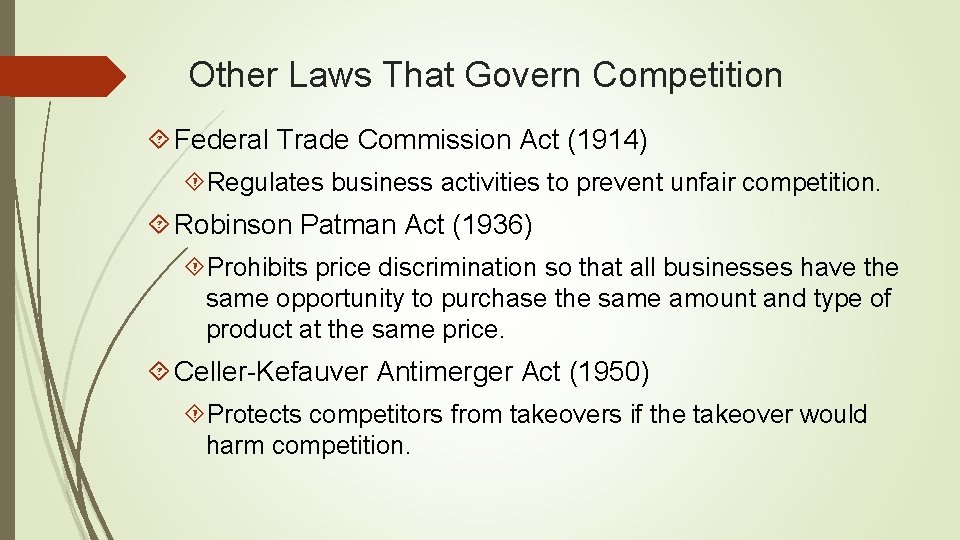
Other Laws That Govern Competition Federal Trade Commission Act (1914) Regulates business activities to prevent unfair competition. Robinson Patman Act (1936) Prohibits price discrimination so that all businesses have the same opportunity to purchase the same amount and type of product at the same price. Celler-Kefauver Antimerger Act (1950) Protects competitors from takeovers if the takeover would harm competition.