
Competition in Infrastructure Sector by Vinod Dhall Former
Competition in Infrastructure Sector by Vinod Dhall, Former Member & actg Chairman, Competition Commission of India at Forum of Indian Regulators (FOIR), Chennai, 31 January, 2009 1
Organisation of the Presentation • Competition- why and how? • Evolution of Competition Policy and Law in India • Competition in Infrastructure • Competition Law and Infrastructure • Competition Act, 2002 • Suggestions 2
Competition- why and how? What is Competition (in economic field)? • Striving for the custom and business of people in the market place (Prof Whish) • The situation in which firms or sellers independently strive for buyers’ patronage in order to achieve a particular business objective (World Bank-OECD) 3
Competition- why and how? Benefits of competition (economic theory): • Promotes efficiency: productive, allocative • Maximises ‘consumer welfare’; more choice, better prices • Incentivises innovation Competition is not an end in itself, but a means to achieve societal goals 4
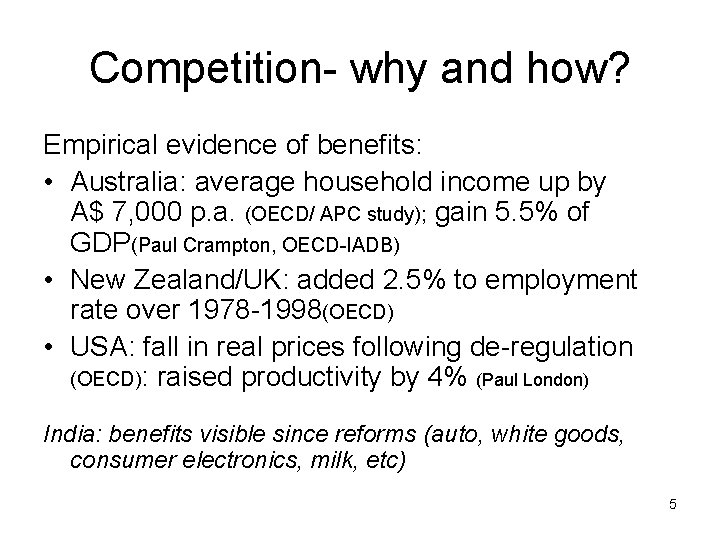
Competition- why and how? Empirical evidence of benefits: • Australia: average household income up by A$ 7, 000 p. a. (OECD/ APC study); gain 5. 5% of GDP(Paul Crampton, OECD-IADB) • New Zealand/UK: added 2. 5% to employment rate over 1978 -1998(OECD) • USA: fall in real prices following de-regulation (OECD): raised productivity by 4% (Paul London) India: benefits visible since reforms (auto, white goods, consumer electronics, milk, etc) 5
Competition- why and how? Competition framework: • Competition policy: set of government and regulatory policies / laws that facilitate competition; need for legal framework • Competition law: to prohibit anticompetitive practices / activities 6
Competition- why and how? Competition Policy permeates various areas e. g. : • Industrial policy • Trade policy • Financial sector policies (interest rate, forex allocation, entry of banks, etc) • Privatisation (dis-investment) • State aid: subsidies, guarantees, tax incentives • Policy towards to SOEs (PSUs) 7
Competition- why and how? Legal framework includes laws for: • Property rights • Contracts • Firm structures (company law) • Insolvency (bankruptcy, BIFR) • Capital markets ( SEBI, SEs) • IPRs • Consumer protection • Competition law 8
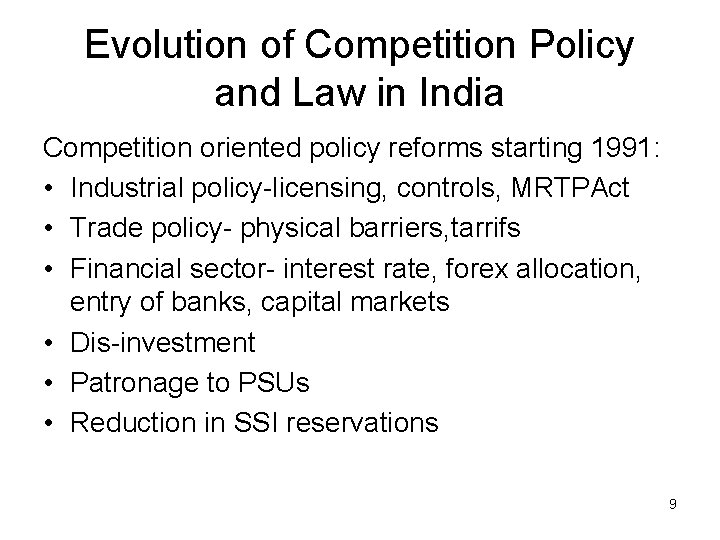
Evolution of Competition Policy and Law in India Competition oriented policy reforms starting 1991: • Industrial policy-licensing, controls, MRTPAct • Trade policy- physical barriers, tarrifs • Financial sector- interest rate, forex allocation, entry of banks, capital markets • Dis-investment • Patronage to PSUs • Reduction in SSI reservations 9
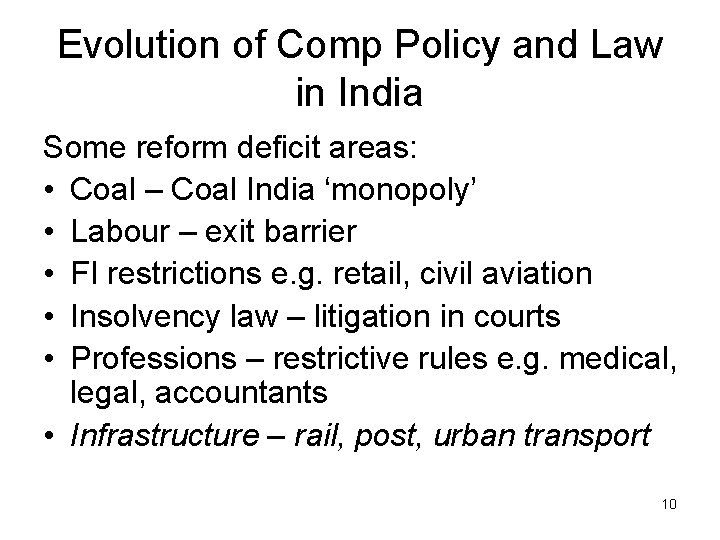
Evolution of Comp Policy and Law in India Some reform deficit areas: • Coal – Coal India ‘monopoly’ • Labour – exit barrier • FI restrictions e. g. retail, civil aviation • Insolvency law – litigation in courts • Professions – restrictive rules e. g. medical, legal, accountants • Infrastructure – rail, post, urban transport 10
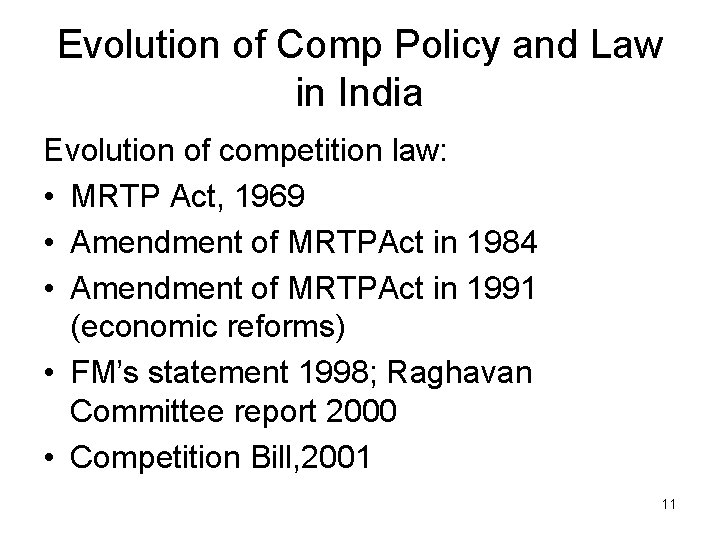
Evolution of Comp Policy and Law in India Evolution of competition law: • MRTP Act, 1969 • Amendment of MRTPAct in 1984 • Amendment of MRTPAct in 1991 (economic reforms) • FM’s statement 1998; Raghavan Committee report 2000 • Competition Bill, 2001 11
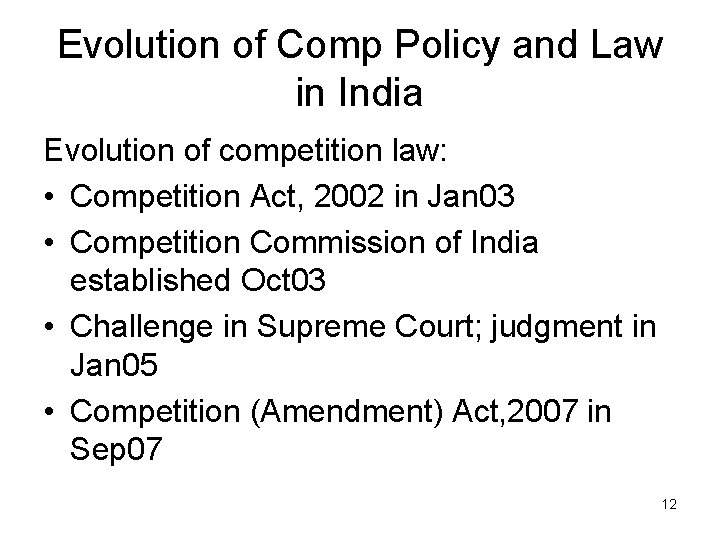
Evolution of Comp Policy and Law in India Evolution of competition law: • Competition Act, 2002 in Jan 03 • Competition Commission of India established Oct 03 • Challenge in Supreme Court; judgment in Jan 05 • Competition (Amendment) Act, 2007 in Sep 07 12
Evolution of Comp Policy and Law in India Highlights of Competition Act, 2003 (as amended): • Prohibits: ü Anti-competitive agreements ü Abuse of dominance • Regulates mergers (mandatory notification) • Mandates competition advocacy 13
Evolution of Competition Policy and Law in India Activities of Commission: • Competition advocacy (post, shipping, telecom) • Groundwork for: ü Enforcement ( draft Regulations, internal guidelines, processes) ü Institution building ( training, organisational structure) Actual enforcement cannot start till government notifies enforcement provisions. India only major economy without functioning Competition Commission ! 14
Competition and Infrastructure • Competition principles apply across all sectors • However, certain features distinguish infrastructure sectors, e. g. : ü Natural monopoly ü Network effects ü Switching costs ü Heavy capital costs 15
Competition and Infrastructure Some infrastructure sectors also have individual characteristics that affect competition, e. g in electricity: • Cannot be stored • Relatively inelastic demand • Demand fluctuations - within day and interseasonal 16
Competition and Infrastructure Measures that promote competition: • Vertical separation (unbundling) of ‘natural monopoly’ from contestable parts • Horizontal separation to encourage inter se competition and ‘yardstick competition’ • Open access (essential facility doctrine) • Remove entry barriers; facilitate entry • Mitigate switching costs (number portability, bank account portability ? ) 17
Competition and Infrastructure • Competition ‘for-the-market’ vis-à-vis competition ‘in-the-market’ (competitive bidding): ü Maximise number of bidders, consistent with qualification parameters ü Level playing field for new bidders ü Concession agreement to avoid ‘monopoly’ strengthening provisions • Competition oriented Regulation 18
Competition law and Infrastructure • • Competition law generally has overarching jurisdiction in all sectors, though picture varies across countries/ industries-Australia, Mexico, USA Examples of application of competition law: ü Merger: EC prohibited (2004) proposed acquisition of GDP by EDP and ENI ü Merger: EC allowed (2000) merger of German electricity companies VEBA/VIAG subject to commitments to divest holdings and drop T-component transmission charges 19
Competition law and Infrastructure ü AOD Divestiture: UK Competition Commission’s interim order (2008) requiring BAA to divest Gatwick and Stanstead airports in London, and abide by behavioural remedies. ü AOD: Energy company ENI fined EUR 290 mn for abusing its dominant position in gas transport through its subsidiary TTPC; also ordered it to allow transport of 6. 5 bn c. m. per year and guarantee time bound completion of gas pipe expansion. ü AOD: EC has objected (Dec 08) to French state-controlled power giant EDF’s long term contracts for sale of electricity to customers ü AOD: Aeroporto de Roma required to provide non-discriminatory access to rival caterers 20
Competition law and Infrastructure ü Cartel: Korea FTC imposed huge penalty (2003) on price cartel between telecom companies KT and Hanaro Telecom ü Cartel: French antitrust authorities slapped record fines amounting to Euro 534 m on mobile operators Orange, SFR and Bouygues for illegally sharing sales data and conspiring to undermine competition 21
Competition Act 2002 Enforcement not commenced, but live concerns exist in markets: • Cartels alleged in shipping, steel, cement, Copper-T, explosives, civil aviation, brake linings • Abuse of Dominance alleged in coal, telecom, post, airports • M & As proceeding without prior review: civil aviation, cement, alcoholic beverages 22
Competition Act 2002 • Applies to all sectors, alongside sector regulation where existing • Especially relevant provisions: AOD and Mergers • Sec 21 and Sec 21 A, CA 02 provide for mutual consultation between Commission and sector Regulator • Consultation to be at two levels: ü Individual cases ü Broader policy level 23
Some suggestions • Needed a National Competition Policy: competition impact assessment, competition neutrality, essential facility doctrine, separation of policy/operation/regulation, incentives for reform at state level, etc • Sector Regulation’s primary objective should include a duty to promote effective competition, and in assessing the interests of consumers, the Regulator should have due regard to the views of enterprises • Immediate commencement of enforcement of Competition Act • Mandate close co-operation between Sector Regulators and Competition Commission of India 24
Thank you Vinod Dhall, DHALL LAW CHAMBERS, Dewan Manohar House, B-88, Sector 51, NOIDA (U. P. ), India – 201301 Phones: +91 -(0)-120 -4547550 / 1, Telefax: +91 -(0)-120 -4547550, Mobile: +91 -9811322324 Email: dhall. vinod 1@gmail. com 25
- Slides: 25