
Competition in Banking Industry Types of Banks Commercial

Competition in Banking Industry
Types of Banks • Commercial banks • Accept deposits • Fund business requirements • Transfer funds • Trustee services
Investment banks • Underwriting securities, issuing instruments, broking and trading of government securities, bank and corporate debt securities. • Research analysis and investment management. • Corporate advisory services, mergers and acquisitions and corporate restructuring. • Bridge finance.
Competition in Commercial Banks • Reserve Bank of India plays a crucial role in the establishment of banks. • Competitive nature of a bank is based on size of bank capital, size of deposits mobilized by banks. • Trust on ability of banks to fulfil its deposit obligations • Services offered by banks.
Competition in Investment Banks Competitive nature of banks are based on • Types of services offered by banks • Flexibility of services provided • Cost of services offered by the banks • Reputation of the banks • Confidence in the banks • Number of clients handled by the banks
![Changes in Bank Operations New Customer Needs Rebuilding Human Resources [ Change [ Utilizing](http://slidetodoc.com/presentation_image_h/295e4e6f48b1f8ddc3bc3655a03eac60/image-6.jpg "Changes in Bank Operations New Customer Needs Rebuilding Human Resources [ Change [ Utilizing")
Changes in Bank Operations New Customer Needs Rebuilding Human Resources [ Change [ Utilizing New Opportunities ] in Skills ] New Players [ Increased Competition ] Change in Mindset New Regulation [ Increased [ New Rules ] Marketing ] New Technology [ Change New Services [ Shift in Structure] Knowledgeable Customer [Change in Customer Loyalty] in Efficiency Measure]
New Players • Business opportunities • Earnings expectation • Segmented players in the market • Globalization of banking business
New Regulations • Changing economic prospects • Changing Government outlook • Changes in global banking business expectations • Increased risks assumed by banks • Need for assessing and reducing bank risks based on social expectations.
New Technology • Innovations in banking technology. • Application of new systems and practices in technologies for the banking system. • Unprecedented risks requiring technological interventions. • Need for improving customer relations and confidence.
Knowledgeable Customer • Customized banking practices. • Increased transparency of bank services. • Large number of bank participants in the market. • Multiple services offered by banks. • Scope for reducing banking costs.
New Services • Complex business practices in the production and service sectors. • Increased reliance on banks as service providers. • Innovation in banking practices. • Need for banks to meet changing economic functions.
Changing Mindset • Customer relationships. • Role of marketing practices. • Need for promotion of banking business. • Innovative methods of accessing and servicing customers.
Change in Skills • Human resource potential. • Change in human resource practices in banks. • Need for coping with technological changes. • Flexible structure of bank operations. • Need for promoting the banks as market makers besides financial intermediaries.
Changed Customer Needs • Flexibility requirement of customer banking habits. • Customization of banking services. • Types of business ranging from family units, agencies, trusts and corporate houses. • Changes in evaluation pattern of customers.
Managing Competition • Introduce new technology through additional investments by the banks to meet the efficiency requirements. • Bring in efficiency of bank operations by reducing the cost structure and increasing income generation capacity. • Increase customer base to increase the income possibility of banks and segmenting the customer services to support the bank operations.
Managing Competition • Improving the bank’s processes and people performance through adoption of advanced methods and systems. • Enlarge banking operations through service based functions besides core banking functions. • Introduce new banking products to meet the customer needs. • Evaluate the risk structure of banking business and identify possible measures of risk management to improve bank performance.
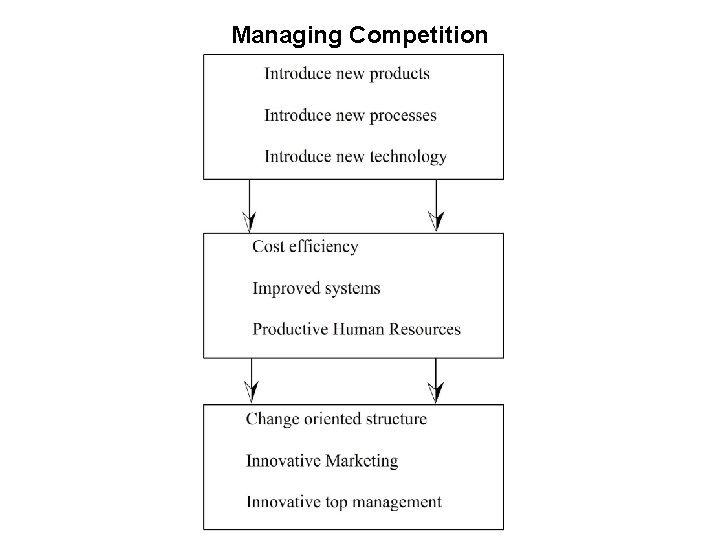
Managing Competition
Optimal Competition • Measurement of market concentration. • Herfindahl-Hirschman Index (HHI). • Proportion of total assets / deposits / sales by each bank in the economy. • Each bank’s market share is squared to compute the index. • HHI = Sum of squared market share for all banks in a defined locality or economy.
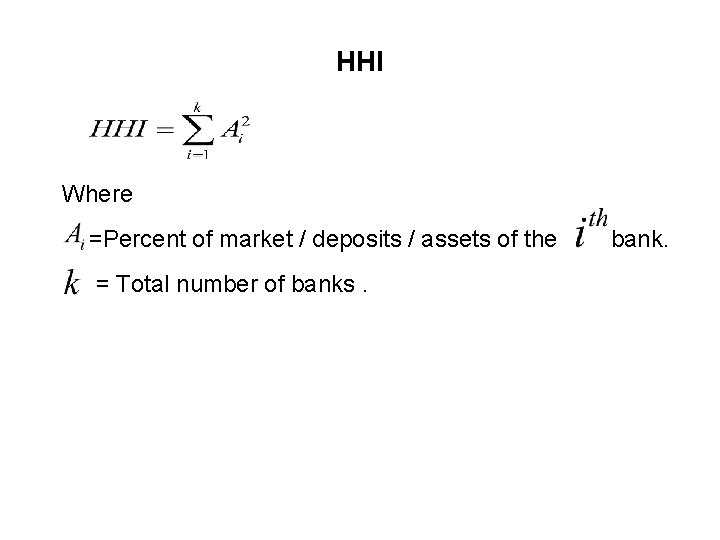
HHI Where =Percent of market / deposits / assets of the = Total number of banks. bank.
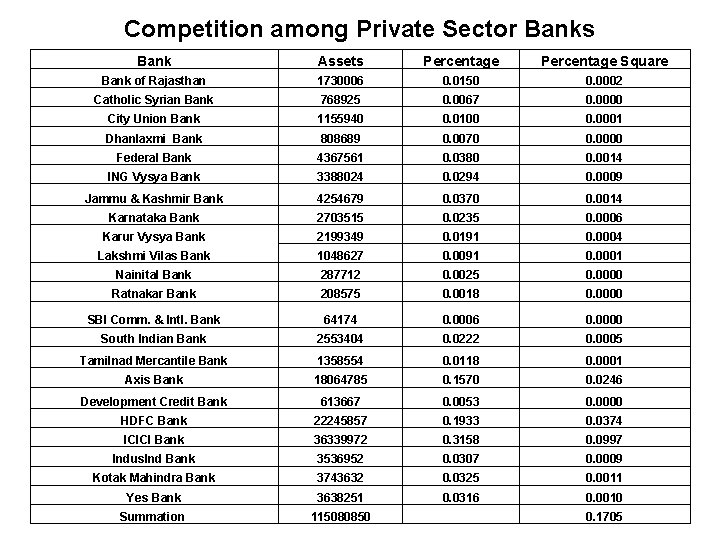
Competition among Private Sector Banks Bank Assets Percentage Square Bank of Rajasthan 1730006 0. 0150 0. 0002 Catholic Syrian Bank 768925 0. 0067 0. 0000 City Union Bank 1155940 0. 0100 0. 0001 Dhanlaxmi Bank 808689 0. 0070 0. 0000 Federal Bank 4367561 0. 0380 0. 0014 ING Vysya Bank 3388024 0. 0294 0. 0009 Jammu & Kashmir Bank 4254679 0. 0370 0. 0014 Karnataka Bank 2703515 0. 0235 0. 0006 Karur Vysya Bank 2199349 0. 0191 0. 0004 Lakshmi Vilas Bank 1048627 0. 0091 0. 0001 Nainital Bank 287712 0. 0025 0. 0000 Ratnakar Bank 208575 0. 0018 0. 0000 SBI Comm. & Intl. Bank 64174 0. 0006 0. 0000 South Indian Bank 2553404 0. 0222 0. 0005 Tamilnad Mercantile Bank 1358554 0. 0118 0. 0001 Axis Bank 18064785 0. 1570 0. 0246 Development Credit Bank 613667 0. 0053 0. 0000 HDFC Bank 22245857 0. 1933 0. 0374 ICICI Bank 36339972 0. 3158 0. 0997 Indus. Ind Bank 3536952 0. 0307 0. 0009 Kotak Mahindra Bank 3743632 0. 0325 0. 0011 Yes Bank 3638251 0. 0316 0. 0010 Summation 115080850 0. 1705
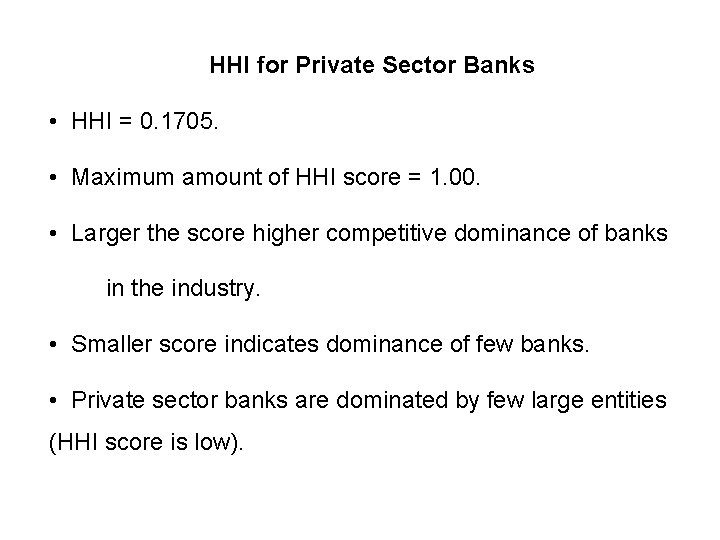
HHI for Private Sector Banks • HHI = 0. 1705. • Maximum amount of HHI score = 1. 00. • Larger the score higher competitive dominance of banks in the industry. • Smaller score indicates dominance of few banks. • Private sector banks are dominated by few large entities (HHI score is low).
- Slides: 21