
COMPETITION AND CONSUMER PROTECTION COMMISSION CCPC The Role


- Slides: 18
COMPETITION AND CONSUMER PROTECTION COMMISSION CCPC The Role of Industrial and Competition Policies in Regional Integration- Case of COMESA Presented by Eunice Phiri Hamavhwa Senior Investigator Competition and Consumer Protection Commission – Zambia 2 nd ACER Week-Livingstone
Presentation Outline �What is Regional Integration �Why do Governments Enter into Regional Agreements �Industrial Policy �Competition Policy �How does Industrial and Competition Policy Interact �Opportunities of Regional Integration �Challenges of Regional Integration �Conclusion �Recommendations
Regional Integration �RI = A process in which states enter into a regional agreement in order to enhance regional cooperation through regional institutions and rules. Examples of RECs �SACU-1910 �East African Community (EAC) in 1919. �ASEAN) in 1967 �Currently about 10 or more RECs in Africa, each country belonging to one / two RECs �COMESA – 1994 with 19 MS �With booming regional trade (formal intra-COMESA trade in goods at US$ 3. 1 billion in 2000, up to US$19. 3 billion in 2012). Population = 458 million & combined GDP = US$572 billion, �Largest REC in Africa.
Why do Governments Enter into Regional Agreements To derive benefits of collaborative actions and regional approaches to achieve development goals ie: �Reaping economies of scale due to large markets �Integrated/harmonized treatment of trans-boundary issues e. g. trade, regulatory frameworks and policies, regional infrastructure and other cross border issues; and; �Management of shared natural resources. Industrial and competition policies are key to achieving RI goals 28/10/2021 Competition and Consumer Protection Commission 4
Industrial Policy �IP not equal to policies aimed at developing the manufacturing sector �IP = Policies seen as covering all economic activities, more importantly as they relate to the structure of an economy �Therefore, IP = Relatively lasting arrangements affecting the use of resources and patterns of production and trade resulting from them. �Value of products exported =level of country’s development experience. 28/10/2021 Competition and Consumer Protection Commission 5
INDUSTRIAL POLICY � COMESA draft IP = Tool to guide the region towards self-sustained balanced growth and improve competitiveness of the industrial sector in the 19 Member bloc. � Article 99 - COMESA Treaty addresses objectives of co-operation in industrial development i. e: Ø Promote self-sustained and balanced growth; Ø Increase the availability of industrial goods and services for intra-Common Market trade; Ø Improve the competitiveness of the industrial sector; and Ø Develop industrialists that would acquire ownership and management of the industries. � Article 100 - COMESA Treaty addresses strategy to implement IP. � Need to reverse jobless growth & transform the regional economy through industrialisation = Rationale for the COMESA IP. � Gains of industrialisaton are seen in increased cross-border trade. 28/10/2021 Competition and Consumer Protection Commission 6
INDUSTRIAL POLICY � The COMESA IP will be harmonised with other COMESA Policies and Strategies to ensure coherence between policies � The COMESA IP policy encompasses investment, CP among other policies with relevant institutions to achieve objectives of the REC � Benefits of IP in COMESA are felt in many MS like Zambia, through RISM project � Specific objective of RISM =Support MS participate more fully in the COMESA, EAC and SADC Tripartite free trade areas with minimum disruption to public expenditure commitments as well as enabling them implement economic reform programmes in the context of regional integration. � RISM beneficiaries = Government ministries, Government agencies, private sector and civil society organisations, eg. CCPC through training of over 30 judges and magistrates in Competition Regulations; � ZABS: initiation of the equipment procurement processes of Mobile Testing Laboratory. 28/10/2021 Competition and Consumer Protection Commission 7
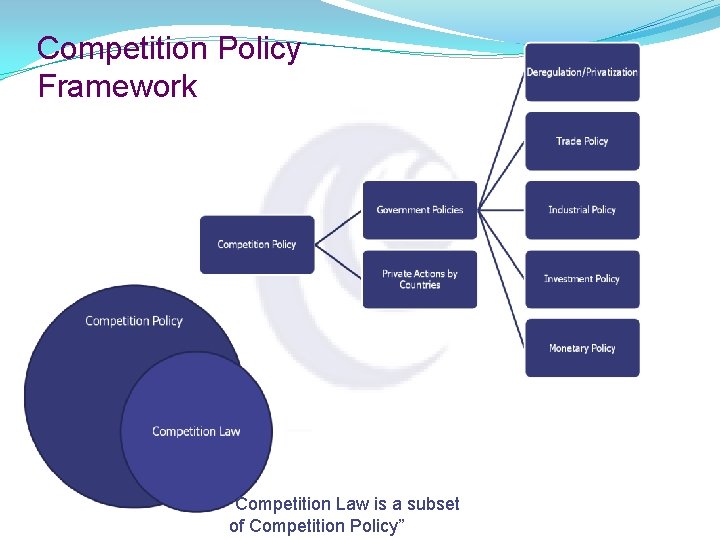
Competition Policy �Competition = rivalry or potential rivalry among firms in the market place; �CP= Government policy to preserve or promote competition among market players �Also to promote other government policies i. e. deregulation, privatisation, trade policy, industrial policy, investment policy and monetary policy. �These enable a competitive environment for businesses to flourish. �CL = An important piece of legislation needed to enforce competition policy �CCC handled the Holcim/Lafarge merger 28/10/2021 Competition and Consumer Protection Commission 8
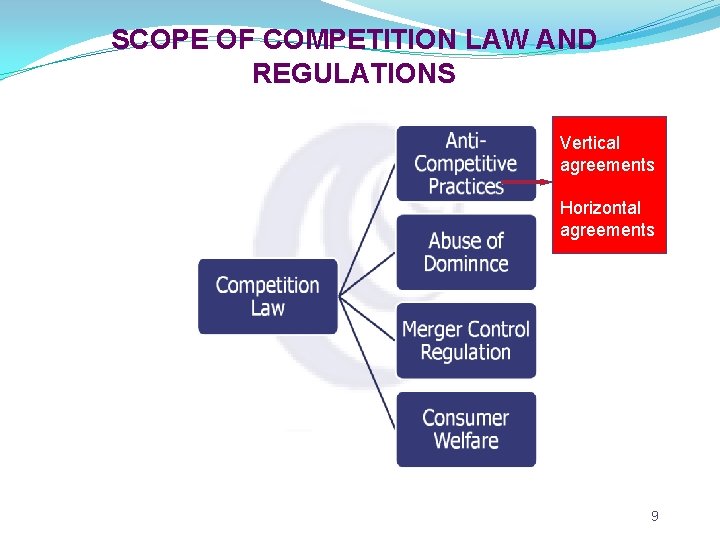
SCOPE OF COMPETITION LAW AND REGULATIONS Vertical agreements Horizontal agreements 9
Competition Policy � Sec. 55 of the Comesa Treaty affirms competition policy in COMESA Competition Regulations and the CCC provides a regulatory and institutional framework to implement competition law � CCC was formed in December, 2004 as supra national CA, with aim of regulating competition matters involving two or more MS. � The CCC started operating in 2013. MS with CA include: Egypt, Burundi, Rwanda, Malawi, Ethiopia, Zimbabwe, Kenya, Zambia, Swaziland, Mauritius, Seychelles and Uganda. � The Kenyan, Malawian and Zambian competition laws are similar as they take into account similar elements of competition law These laws are consistent with the COMESA law on competition which have similar tenets. Both the national laws and the international law aim at enhancing consumer welfare. � CCC handled the Holcim/ Lafarge merger under Article 24(1) of Comesa Rules & Regulations 28/10/2021 Competition and Consumer Protection Commission 10
Interface between IP & CP �As governments develop their industries through having SOE, in some cases the SOE have been in contravention of the CL �As such, governments have ensured that the CL provides for no discrimination against SOE �Eg. Sec 3(2) of the CCPA in Zambia binds the State insofar as the State or an enterprise owned, wholly or in part, by the State engages in trade or business for the production, supply, or distribution of goods or the provision of any service within a market that is open to participation by other enterprises. �This is in order to harness benefits of industrialisation 28/10/2021 Competition and Consumer Protection Commission 11
Competition Policy Framework “Competition Law is a subset of Competition Policy”
Opportunities �Member States to benefit from big market, also with the TFTA and towards a Continental Free Trade Area �Member States have an opportunity to increase trade volumes among themselves in view of low trade volumes currently �MS have opportunity to grow at the same level of development with the Common IP in place; thereby each benefiting in exports and imports as well �MS to produce efficiently by analysing trade flows and capitalising on their competitive advantage in production and hence in trade �MS have opportunity to harness benefits of industrialisation with CL & the CCC in place i. e. no actp. 28/10/2021 Competition and Consumer Protection Commission 13
Challenges �COMESA Treaty not domesticated by the Member States. �Lack of awareness of the law binding MS to the objectives of the Treaty, due to lack of awareness from stakeholders such as lawyers. �Fear of loss of sovereignty is reason of resistance to the objectives of the Treaty. �Poor culture of compliance levels by MS is a challenge in implementation of COMESA Treaty with regards to policy and competition. �MS mainly export products which are raw, eg agricultural products, like malawi, therefore, no value addition �Low trade volumes among MS, e. g. Egypt exports 26. 8% to COMESA MS but imports only 7. 8% from COMESA MS; Kenya exports 20. 2% but only imports 7. 2% 28/10/2021 Competition and Consumer Protection Commission 14
Conclusion �IP & CP = complementary and necessary tools for the enhancement of RI. �However, need for MS to adopt Common IP which include: �The promotion of self-sustained and balanced growth; �Increase in the availability of industrial goods and services for intra. Common Market trade; �Improvement of the competitiveness of the industrial sector; and �Develop industrialists that would acquire ownership and management of the industries. �Also need for all MS to have CP and Law; in order to achieve benefits of RI: i. e. Reaping economies of scale due to large markets, harmonized treatment of cross border issues, regional infrastructure, etc. �Therefore, IP & CP are cornerstones to achieving RI among other factors. 28/10/2021 Competition and Consumer Protection Commission 15
Recommendations �MS to develop means to attract the labour intensive industries by among others, granting appropriate incentives to those industries. �Need of cordinated national, regional and continental efforts to promote value chains at all levels. �Creation of new and strengthening of existing institutions at both national and regional levels to spearhead success in the implementation of the IP. �Need for the CCC and national competition authorities to engage in serious advocacy with stakeholders in order to educate them on the benefits of competition policy. 28/10/2021 Competition and Consumer Protection Commission 16
The End Thank you for your attention and God richly bless you ALL!!! The Executive Director Competition and Consumer Protection Commission 4 th Floor Main Post Office, Cairo Road P. O. Box 34919, Lusaka Tel : 222787 Fax : 222789 Toll Free : 5678 Website : www. ccpc. org. zm Email : zcomp@ccpc. org. zm
28/10/2021 Competition and Consumer Protection Commission 18