
Competing Values Model Content based on the work
Competing Values Model Content based on the work of Robert E. Quinn (1988), in Beyond Rational Management: Mastering the Paradoxes and Competing Demands of High Performance. Presentation materials drawn from work by Pamela Johnson, Ph. D. & Shelly Drogin, Ph. D, Leadership Institute of Seattle. 1
Paradoxes of Organizing & Leading • Need for predictability, order, reliability. . . But also for adaptability and change. • Need for focus on task, productivity, goal achievement. . . But also for social system maintenance. • Need for stability/continuity. . . But also adaptability and discretion. • Need internal focus and integration. . . But also external focus and differentiation. 2
Janusian Thinking and Mastery • Early on, contradictions lead to confusion and uncertainty. • Further on, contradictions lead to rational tradeoffs. • Eventually, one develops multiple frames to apply to complex situations. • One increases one’s tolerance for ambiguity and engagement of contradiction. • That is the essence of “Janusian” thinking – the world of “Both/And” rather than “Either/Or” Janus: The god of gates and doors, beginnings and endings. 3
Paradoxes of Organizing & Leading • Need internal focus and integration. . . And also external focus and differentiation. • Need for stability/continuity. . . And also adaptability and discretion. • Need for focus on task, productivity, goal achievement. . . And also for social system maintenance. • Need for predictability, order, reliability. . . And also for adaptability and change. 4

Competing Values Towards Flexibility and Discretion Towards Internal Focus and Integration Towards External Focus and Differentiation Towards Stability and Control 5
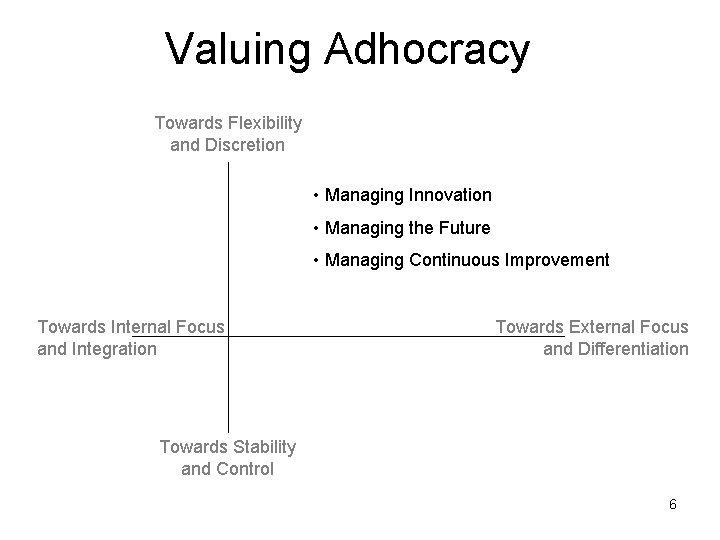
Valuing Adhocracy Towards Flexibility and Discretion • Managing Innovation • Managing the Future • Managing Continuous Improvement Towards Internal Focus and Integration Towards External Focus and Differentiation Towards Stability and Control 6
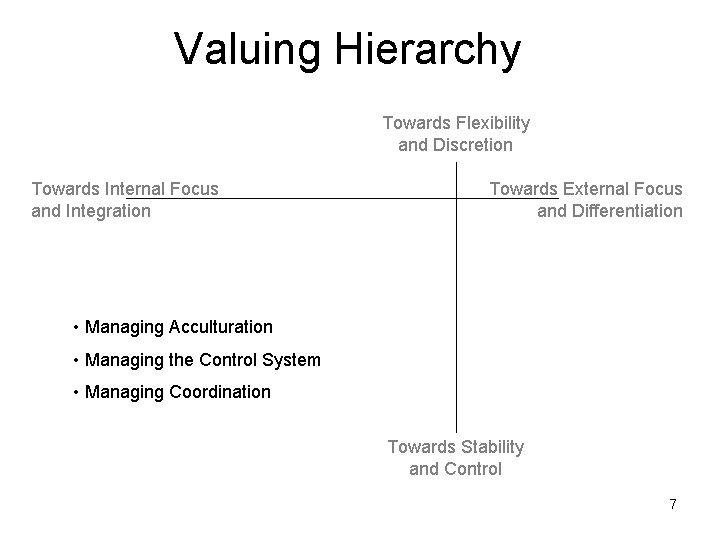
Valuing Hierarchy Towards Flexibility and Discretion Towards Internal Focus and Integration Towards External Focus and Differentiation • Managing Acculturation • Managing the Control System • Managing Coordination Towards Stability and Control 7
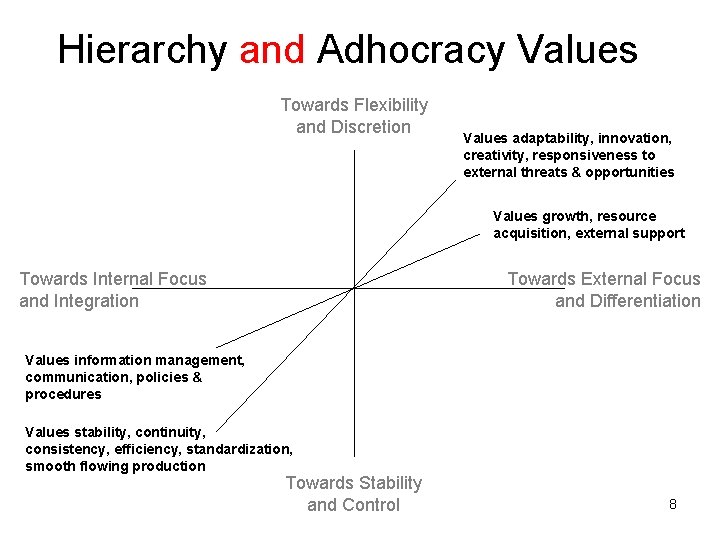
Hierarchy and Adhocracy Values Towards Flexibility and Discretion Values adaptability, innovation, creativity, responsiveness to external threats & opportunities Values growth, resource acquisition, external support Towards Internal Focus and Integration Towards External Focus and Differentiation Values information management, communication, policies & procedures Values stability, continuity, consistency, efficiency, standardization, smooth flowing production Towards Stability and Control 8
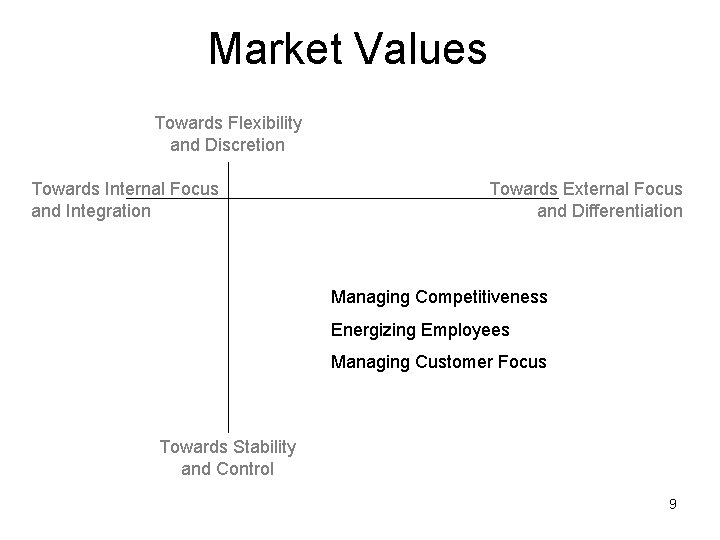
Market Values Towards Flexibility and Discretion Towards Internal Focus and Integration Towards External Focus and Differentiation Managing Competitiveness Energizing Employees Managing Customer Focus Towards Stability and Control 9
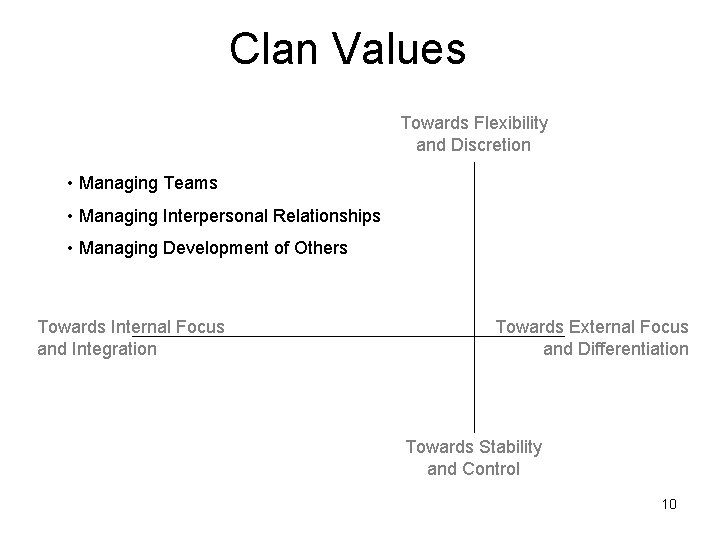
Clan Values Towards Flexibility and Discretion • Managing Teams • Managing Interpersonal Relationships • Managing Development of Others Towards Internal Focus and Integration Towards External Focus and Differentiation Towards Stability and Control 10
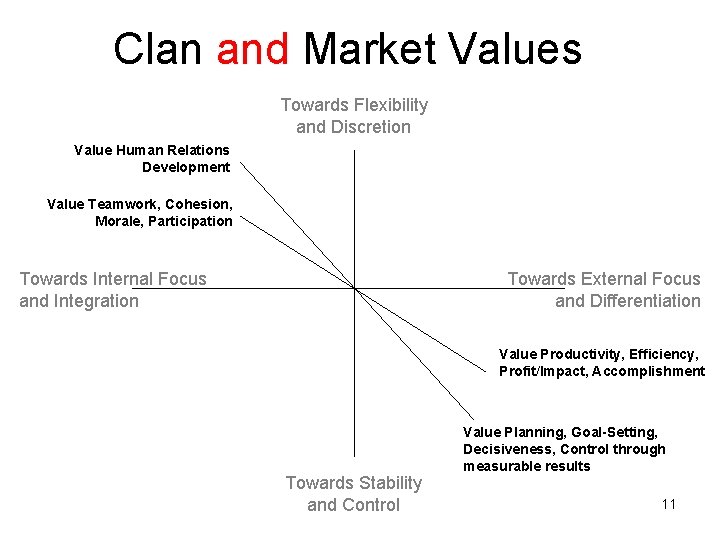
Clan and Market Values Towards Flexibility and Discretion Value Human Relations Development Value Teamwork, Cohesion, Morale, Participation Towards Internal Focus and Integration Towards External Focus and Differentiation Value Productivity, Efficiency, Profit/Impact, Accomplishment Towards Stability and Control Value Planning, Goal-Setting, Decisiveness, Control through measurable results 11
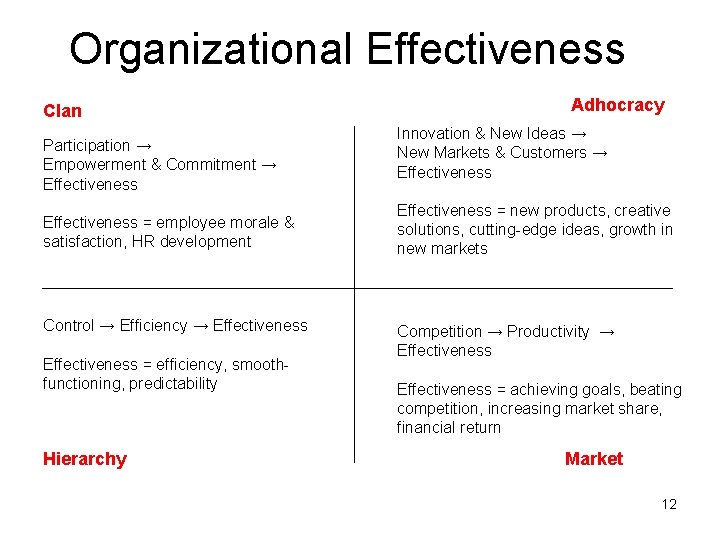
Organizational Effectiveness Clan Participation → Empowerment & Commitment → Effectiveness = employee morale & satisfaction, HR development Control → Efficiency → Effectiveness = efficiency, smoothfunctioning, predictability Hierarchy Adhocracy Innovation & New Ideas → New Markets & Customers → Effectiveness = new products, creative solutions, cutting-edge ideas, growth in new markets Competition → Productivity → Effectiveness = achieving goals, beating competition, increasing market share, financial return Market 12
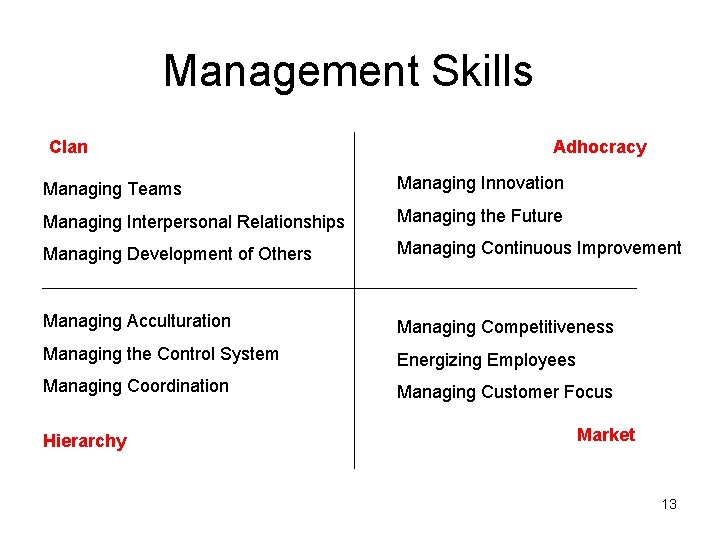
Management Skills Clan Adhocracy Managing Teams Managing Innovation Managing Interpersonal Relationships Managing the Future Managing Development of Others Managing Continuous Improvement Managing Acculturation Managing Competitiveness Managing the Control System Energizing Employees Managing Coordination Managing Customer Focus Hierarchy Market 13
Self-Organize • Go to the corner where you see yourself drawn most often • Where do you find yourself relative to your peers? • How does looking at your management values help frame how you look at your own strengths and weaknesses? • How do your own management values frame how you look at your manager? 14
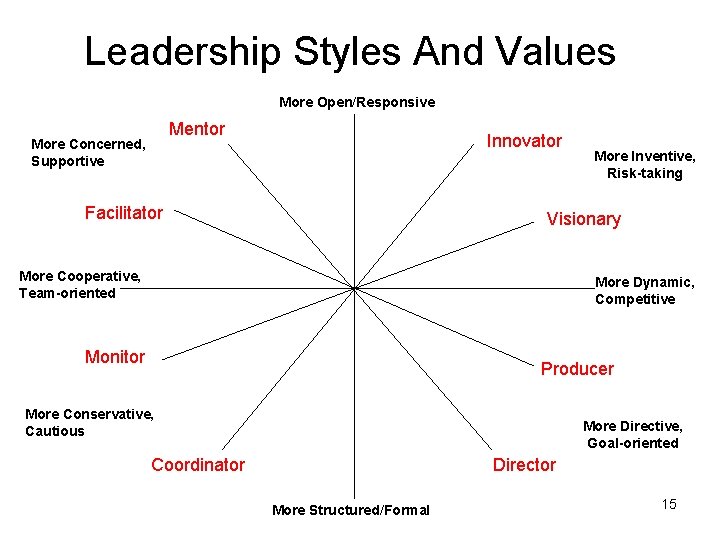
Leadership Styles And Values More Open/Responsive Mentor More Concerned, Supportive Innovator Facilitator More Inventive, Risk-taking Visionary More Cooperative, Team-oriented More Dynamic, Competitive Monitor Producer More Conservative, Cautious More Directive, Goal-oriented Coordinator Director More Structured/Formal 15
Style of Leadership: Adhocracy • Innovator: Very clever and creative. This person envisions change. Influence is based on anticipation of a better future and generating hope in others. Innovation and adaptation are actively pursued. • Visionary: Future oriented in thinking. Focuses on where the organization is going and emphasizes possibilities and probabilities. Strategic direction and continuous improvement of current activities is the hallmark of this style. 16
Style of Leadership: Hierarchy • Monitor: Technically expert and well informed. Keeps track of all details and contributes expertise. Influence is based on information control. Tracks compliance with rules, policies, procedures; oriented to documentation, technical analysis and logical problem solving. • Coordinator: Maintains structure and control of the work. Influence is based on managing schedules, giving assignments, physical layout, liaising between groups or functions. Stability and control are actively pursued. 17
Style of Leadership: Market • Producer: Very task-oriented and work-focused. This person gets things done through hard-work. Encourages employees to accept responsibility and complete assignments. Influence is based on intensity and rational arguments around accomplishing things. Productivity is pursued. • Director: Highly decisive. Actively pursues goals, targets, measurable results. Influence through planning, goal setting, results-orientation. Energized by competitive situations with focus on external competitors and marketplace position. 18
Market Style: Clan • Facilitator: Oriented to people and process. Manages conflict and seeks consensus. Builds cohesion and teamwork. Influence based on involving people in decision making and problem solving. Participation and openness are actively pursued. • Mentor: Caring and empathetic – listens, supports legitimate requests, conveys appreciation. Provides feedback, helps with personal and professional development of human resources. Influence is based on mutual respect and trust. Morale and commitment are actively pursued. 19
Self-Assessment ? • Fill out the Competing Values questionnaire. • Enter your answers on the charts. • Does the diagram match your personal belief about how you see yourself? (e. g. : do you find it credible, accurate, or valuable? ) • Solicit feedback from your peers. • What does it mean if their views of your leadership style diverge? • What does it mean if their views of your leadership style converge? 20
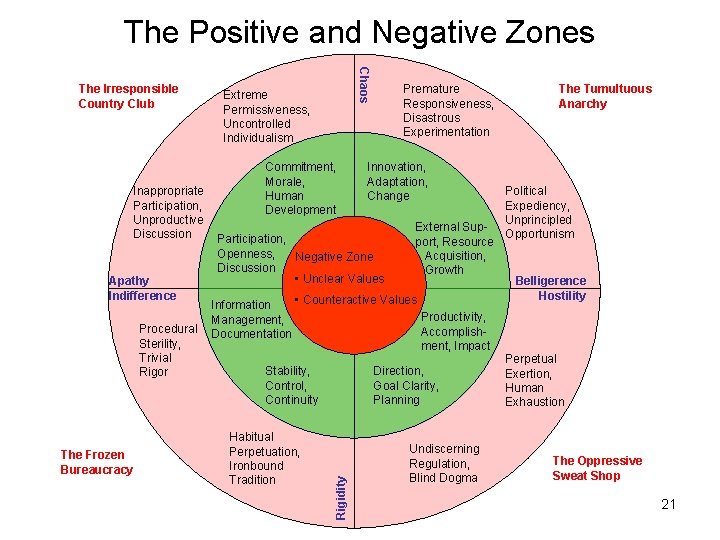
The Positive and Negative Zones Apathy Indifference Procedural Sterility, Trivial Rigor The Frozen Bureaucracy Extreme Permissiveness, Uncontrolled Individualism Commitment, Morale, Human Development Premature Responsiveness, Disastrous Experimentation Innovation, Adaptation, Change Participation, Openness, Negative Zone Discussion • Unclear Values External Support, Resource Acquisition, Growth • Counteractive Values Information Productivity, Management, Accomplish. Documentation ment, Impact Stability, Control, Continuity Habitual Perpetuation, Ironbound Tradition Direction, Goal Clarity, Planning Rigidity Inappropriate Participation, Unproductive Discussion Chaos The Irresponsible Country Club Undiscerning Regulation, Blind Dogma The Tumultuous Anarchy Political Expediency, Unprincipled Opportunism Belligerence Hostility Perpetual Exertion, Human Exhaustion The Oppressive Sweat Shop 21
- Slides: 21