
Competing in the Global Marketplace Chapter 3 Chapter
Competing in the Global Marketplace Chapter 3
Chapter Overview 1. Measuring Global Trade 2. Barriers to, and Promotion of, Global Trade 3. International Economic Communities 4. Participating in the Global Marketplace 5. Impact of Multinational Corporations 6. Trends in Global Trade
Global Vision: • responsiveness to international business opportunities • awareness of threats from foreign competition • use international networks for production and distribution – Coca-Cola derives 80% of its profits from overseas (Source: Fortune, Sept. 28, 1998, p. 313)
Measuring Trade Between Nations 1. Exports and Imports 2. Balance of Trade – trade surplus vs. trade deficit 3. Balance of Payments the difference between total payments to other countries and total receipts from other countries 4. Changing Value of Currency
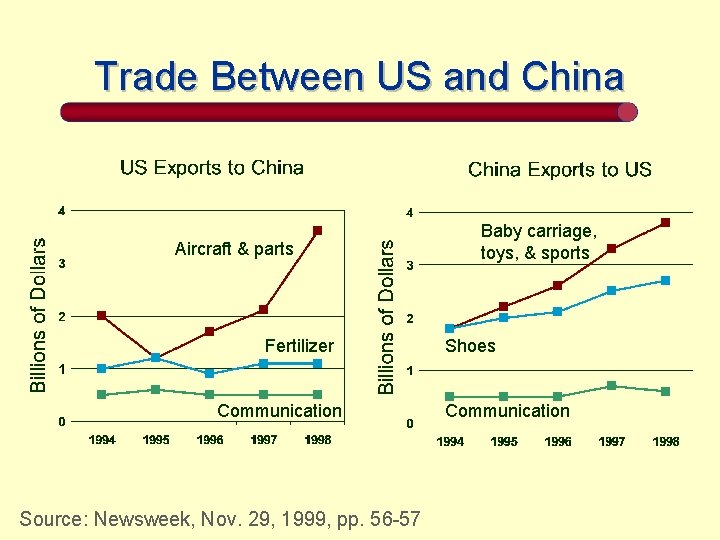
Trade Between US and China Aircraft & parts Fertilizer Communication Source: Newsweek, Nov. 29, 1999, pp. 56 -57 Baby carriage, toys, & sports Shoes Communication
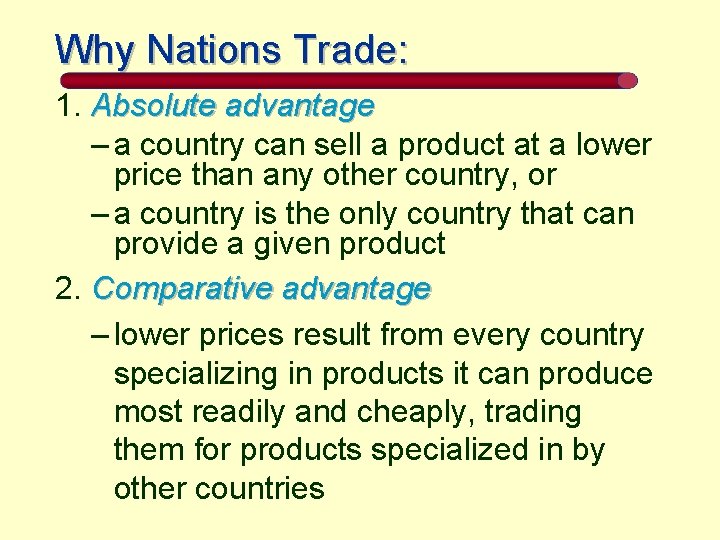
Why Nations Trade: 1. Absolute advantage – a country can sell a product at a lower price than any other country, or – a country is the only country that can provide a given product 2. Comparative advantage – lower prices result from every country specializing in products it can produce most readily and cheaply, trading them for products specialized in by other countries
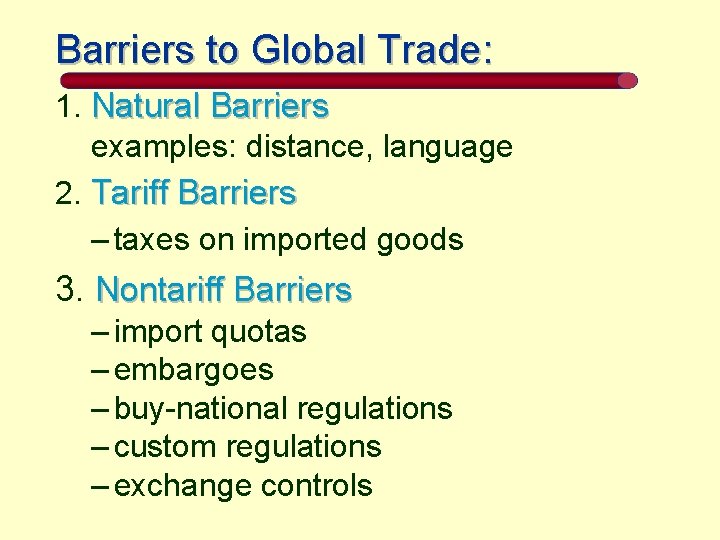
Barriers to Global Trade: 1. Natural Barriers examples: distance, language 2. Tariff Barriers – taxes on imported goods 3. Nontariff Barriers – import quotas – embargoes – buy-national regulations – custom regulations – exchange controls
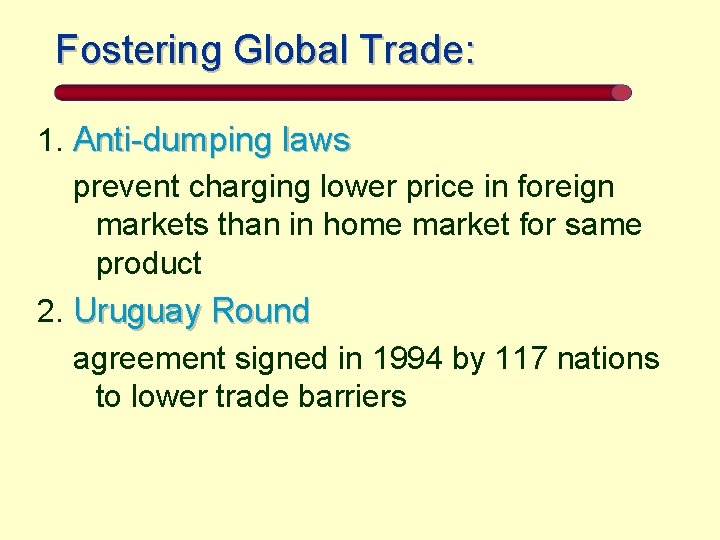
Fostering Global Trade: 1. Anti-dumping laws prevent charging lower price in foreign markets than in home market for same product 2. Uruguay Round agreement signed in 1994 by 117 nations to lower trade barriers
Fostering Global Trade: 3. World Trade Organization provides lower trade barriers among member nations, and helps resolve trade disputes 4. World Bank & International Monetary Fund lend money to developing nations and troubled nations
10 Benefits of the WTO • • • Helps promote peace Handles disputes constructively Its rules increase efficiency Its rules make functioning easier Free trade cuts cost of living Permits more choice of products Trade raises incomes Trade stimulates economic growth Shields governments from lobbying Encourages good government Source: World Trade Organization: www. wto. org
International Economic Communities 1. North American Free Trade Agreement (NAFTA) 1993 agreement creating free-trade zone including Canada, Mexico, and United States 2. The European Union organization of 15 European nations (as of 1999) that fosters political and economic integration of Europe the eurodollar is a new currency to be distributed in 11 of the countries
Industries With High Export Growth Potential • • Automobile parts & services Apparel Dental equipment Construction equipment Electronic components Toys & games Building products Industrial chemicals Sources: US Department of Commerce & North American Forum, www. nafta. net
Participating in the Global Marketplace 1. Exporting 2. Licensing 3. Contract Manufacturing 4. Joint Ventures 5. Direct Foreign Investment 6. Countertrade
Countertrade Example • Nestle had a surplus of After Eight dinner mints packaged for Christmas • Atwood Richards helped distribute the mints in Eastern Europe, a place where the packaging would appear to represent winter rather than Christmas specifically Source: Atwood Richards, www. atwoodrichards. com
Threats and Opportunities in the Global Marketplace Threats: • intense nationalism • language barriers • cultural misunderstanding Opportunities: • ability to overcome trade problems • can sidestep regulatory problems • flexibility to shift production as conditions change • tap new technology from other countries • save labor costs
Trends Affecting Global Trade: 1. Market Expansion Forecasting International has predicted that all industries will go global (Source: HR News: The Society for Human Resource Management, Dec. 1999, p. 17) 2. Resource Acquisition 3. Competition 4. Technological Change 5. Government Actions
- Slides: 16