
Competent and Qualified New Roles New Resources New






- Slides: 42
§Competent and Qualified: New Roles, New Resources, New Results § NHSTE - Nashua, NH § December 3, 2002 § Don Knezek - ISTE CEO - dknezek@iste. org
AGENDA v. A little about ISTE v. A little about National Standards v. A little about Tech Integration v. A little more about You
§A Little About ISTE… The International Society for Technology in Education www. iste. org
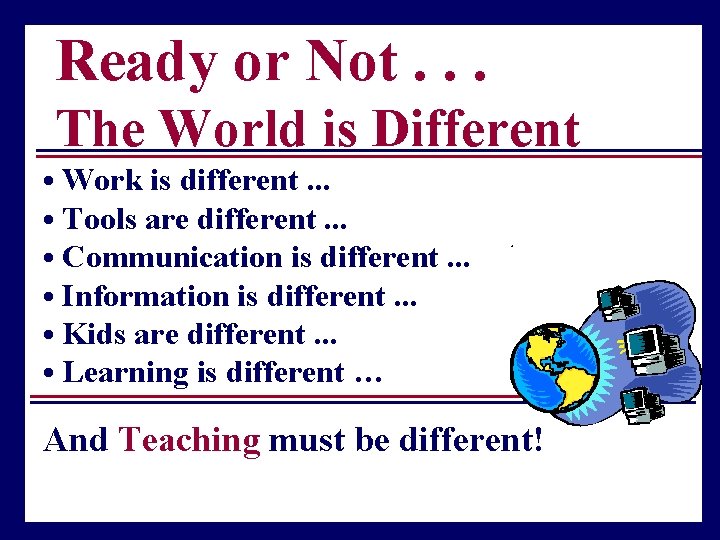
Ready or Not. . . The World is Different • Work is different. . . • Tools are different. . . • Communication is different. . . • Information is different. . . • Kids are different. . . • Learning is different … And Teaching must be different!
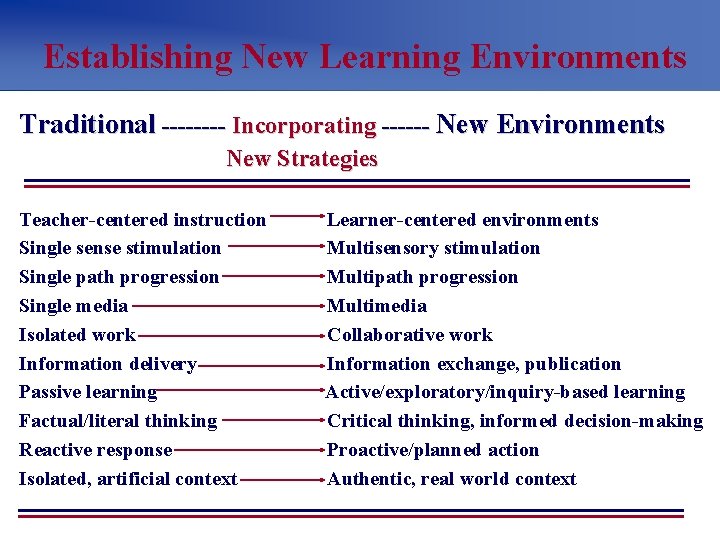
Establishing New Learning Environments Traditional ---- Incorporating ------ New Environments New Strategies Teacher-centered instruction Single sense stimulation Single path progression Single media Isolated work Information delivery Passive learning Factual/literal thinking Reactive response Isolated, artificial context Learner-centered environments Multisensory stimulation Multipath progression Multimedia Collaborative work Information exchange, publication Active/exploratory/inquiry-based learning Critical thinking, informed decision-making Proactive/planned action Authentic, real world context
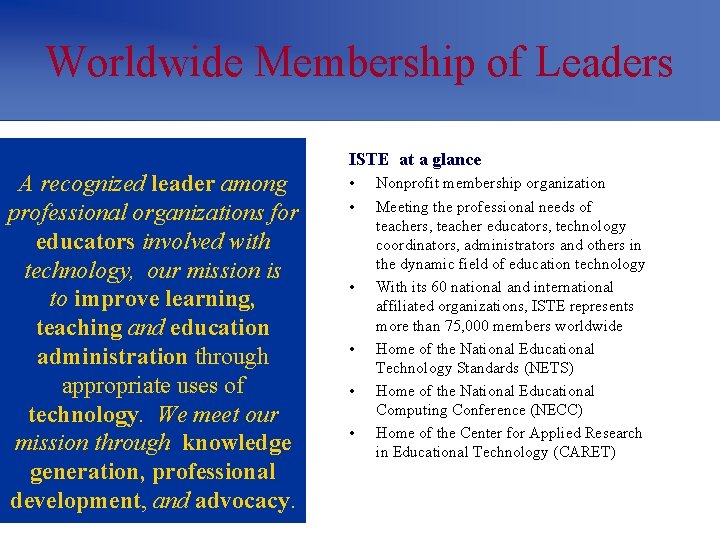
Worldwide Leaders Worldwide Membership of of Leaders ISTE at a glance A recognized leader among professional organizations for educators involved with technology, our mission is to improve learning, teaching and education administration through appropriate uses of technology. We meet our mission through knowledge generation, professional development, and advocacy. • • • Nonprofit membership organization Meeting the professional needs of teachers, teacher educators, technology coordinators, administrators and others in the dynamic field of education technology With its 60 national and international affiliated organizations, ISTE represents more than 75, 000 members worldwide Home of the National Educational Technology Standards (NETS) Home of the National Educational Computing Conference (NECC) Home of the Center for Applied Research in Educational Technology (CARET)
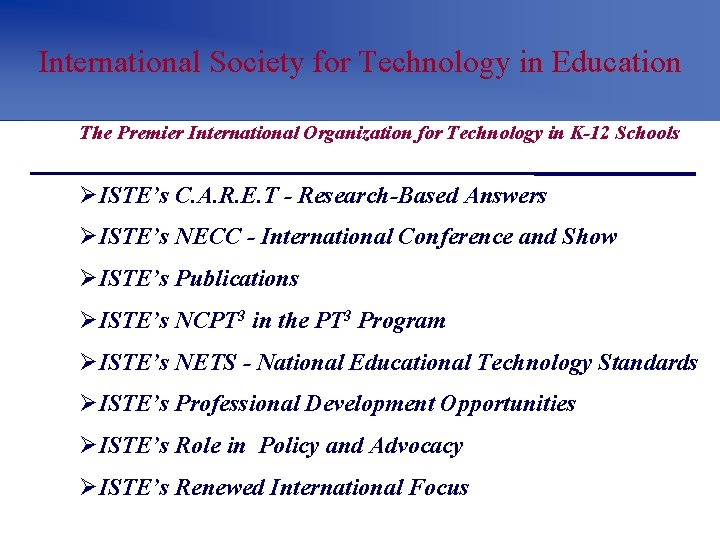
International Society for Technology in Education The Premier International Organization for Technology in K-12 Schools ØISTE’s C. A. R. E. T - Research-Based Answers ØISTE’s NECC - International Conference and Show ØISTE’s Publications ØISTE’s NCPT 3 in the PT 3 Program ØISTE’s NETS - National Educational Technology Standards ØISTE’s Professional Development Opportunities ØISTE’s Role in Policy and Advocacy ØISTE’s Renewed International Focus
C. A. R. E. T. http: //caret. iste. org Don Knezek dknezek@iste. org
§ISTE’s National Educational Technology Standards
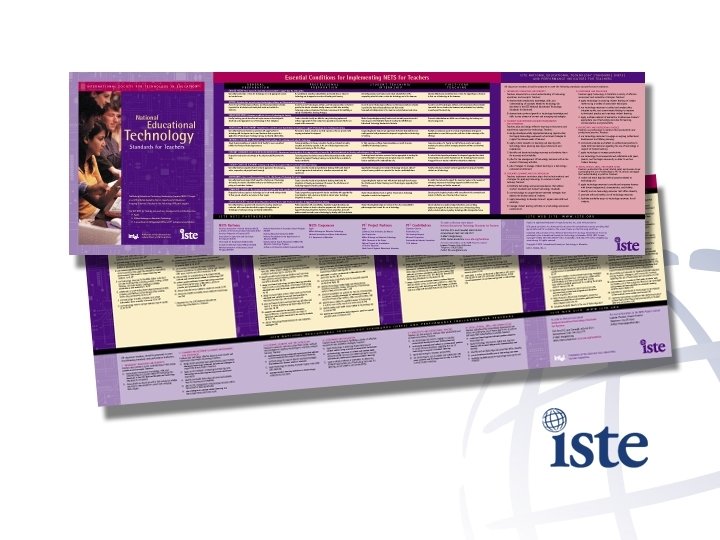
ISTE’s National Educational Technology Standards NETS for Students, Teachers, and Administrators • • Standards Essential Conditions Implementation Resources Support for Assessment
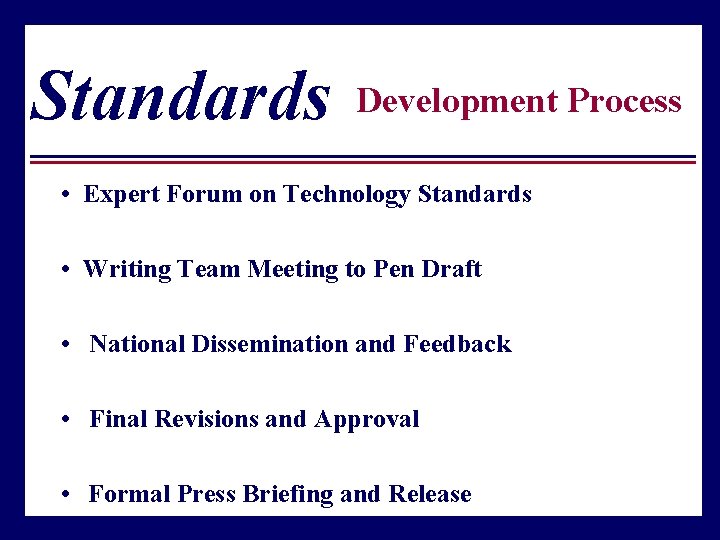
Standards Development Process • Expert Forum on Technology Standards • Writing Team Meeting to Pen Draft • National Dissemination and Feedback • Final Revisions and Approval • Formal Press Briefing and Release
U. S. Department of Education funding initiative ISTE National Educational Technology Standards (NETS) for Teachers Copyright © 2000, ISTE and its licensors. Freely reproducible and modifiable for nonprofit, educational use. E-mail permissions@ iste. org for other uses.
3 PT • • • Grant Partners Apple, Inc. California State University San Marcos Intel Corporation Milken Exchange on Education Technology NASA Classroom of the Future NCATE U. S. Department of Education funded initiative
3 PT • • Contributors Classroom Connect Knowvation The Learning Company Semiconductor Industry Association Microsoft Corporation Public Broadcasting Stations T. H. E. Institute U. S. Department of Education funded initiative
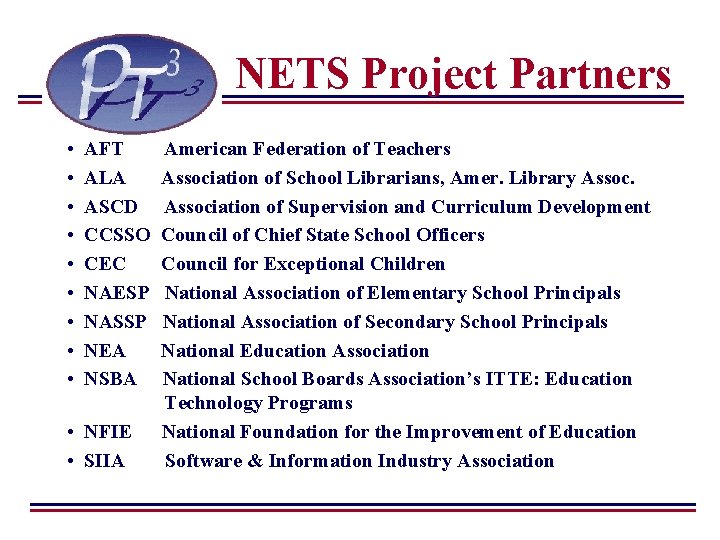
NETS Project Partners • • • AFT ALA ASCD CCSSO CEC NAESP NASSP NEA NSBA • NFIE • SIIA American Federation of Teachers Association of School Librarians, Amer. Library Association of Supervision and Curriculum Development Council of Chief State School Officers Council for Exceptional Children National Association of Elementary School Principals National Association of Secondary School Principals National Education Association National School Boards Association’s ITTE: Education Technology Programs National Foundation for the Improvement of Education Software & Information Industry Association
CURRICULUM ORGANIZATIONS • ACTFL American Council on Teaching of Foreign Languages International Reading Association • IRA • NCSS National Council for the Social Studies • NCTM National Council of Teachers of Mathematics • NCTE National Council for the Teachers of English • NSTA National Science Teachers Association
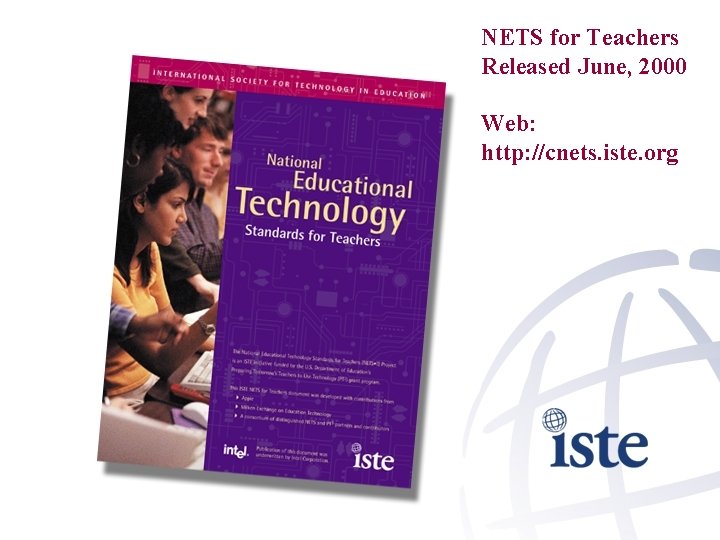
NETS for Teachers Released June, 2000 Web: http: //cnets. iste. org
§A little about No Child Left Behind. . .
No Child Left Behind • Alignment with Standards • Adequate Yearly Progress • Scientifically-Based Research
No Child Left Behind • Literate Students • Competent Teachers • Integration Across the Curriculum
OPPORTUNITIES v ISTE Membership and SIG v Partnership for 21 st Century Skills v Defining ICT or ICLT Literacy v National Ed Tech Plan
§A little about technology integration. . .
§It’s all about leadership. . .
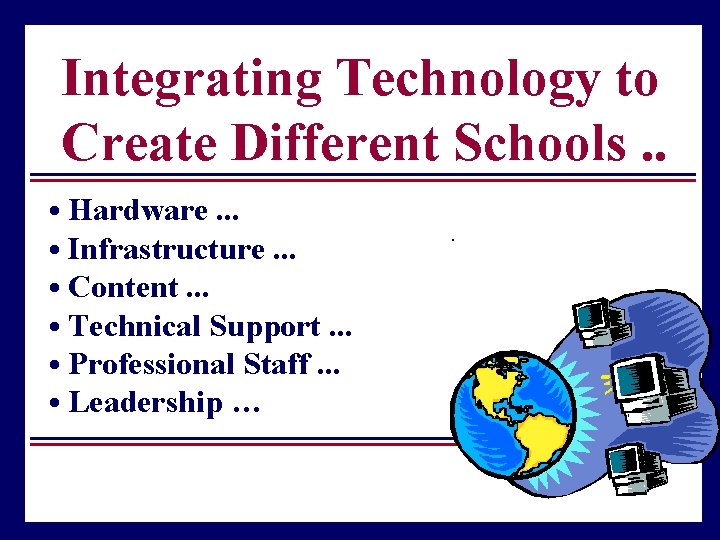
Integrating Technology to Create Different Schools. . • Hardware. . . • Infrastructure. . . • Content. . . • Technical Support. . . • Professional Staff. . . • Leadership …
TSSA An Initiative of the TSSA Collaborative Technology Standards for School Administrators September 2002 http: //www. iste. org … with funding from the PT 3 Program of the US Dept of ED
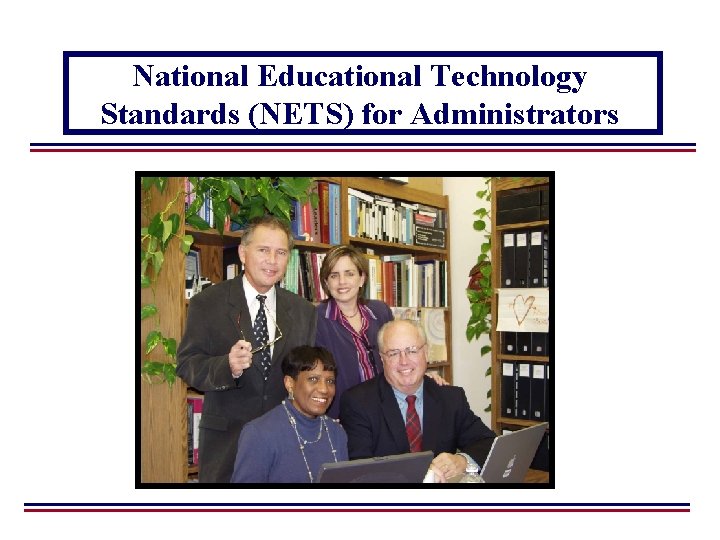
National Educational Technology Standards (NETS) for Administrators
TSSA The TSSA Collaborative AASA • NAESP • NASSP • NSBA • AESA ISTE • Co. SN NCRTEC/NCREL • SREB KY State Dept of Ed • MS State Dept of Ed Principals’ Executive Program - UNC College of Education - Western Michigan An initiative of the TSSA Collaborative managed by ISTE.
Implementing Technology in Schools is, in Itself, Systemic School Reform Effective leadership is the single most important factor: … a national consensus on what school administrators should know about and be able to do to ensure optimal technology integration across all facets of schooling
TSSA The TSSA Target Product • Technology Foundation Standards for All P -12 Administrators • Standards for Superintendents and Superintendent Cabinet Members • Standards for Principals and Assistant Principals • Standards for District-Level Leaders of Academic and Special Programs
TSSA Major Project Events • Expert Forums on Technology Standards for School Administrators - Oct-Dec’ 00 • TSSA Writing Team Meetings to Pen & Refine TSSA - Feb’ 01 & Jun’ 01 & Sep’ 01 • National Dissemination and Feedback on Draft TSSA - Apr’ 01 through Sept’ 01 • Final Revisions and Approval; Formal Press Briefing and Release - Nov’ 01
TSSA • • • Writing Team Experience 160 yrs as superintendent or supt cabinet 90 yrs as other district-wide program leader 150 yrs as principal or assistant principal 145 yrs in higher education 90 yrs in regional labs or service agencies, or state departments of education • 450 yrs in classroom teaching, counseling, librarian, etc.
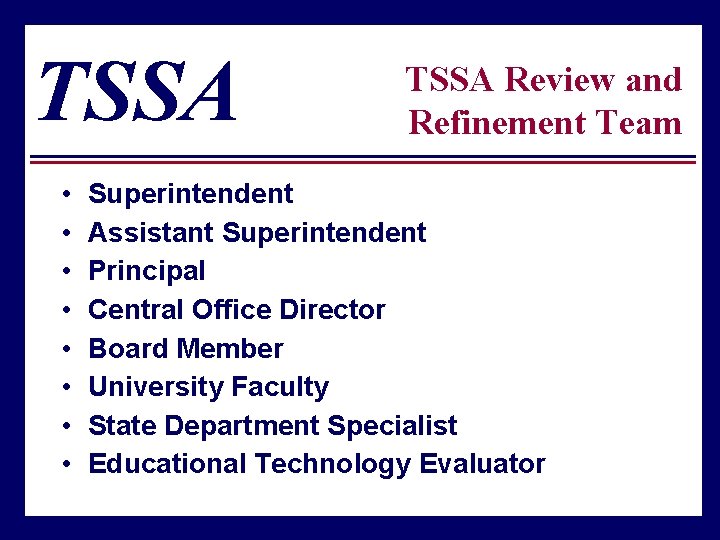
TSSA • • TSSA Review and Refinement Team Superintendent Assistant Superintendent Principal Central Office Director Board Member University Faculty State Department Specialist Educational Technology Evaluator
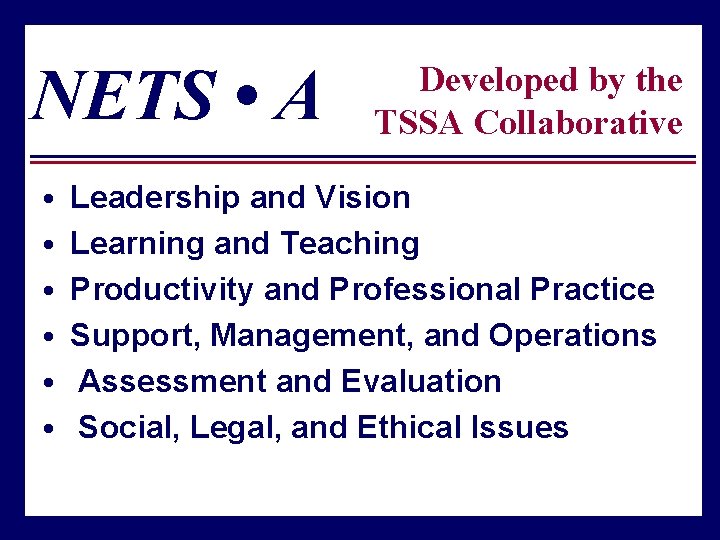
NETS • A • • • Developed by the TSSA Collaborative Leadership and Vision Learning and Teaching Productivity and Professional Practice Support, Management, and Operations Assessment and Evaluation Social, Legal, and Ethical Issues
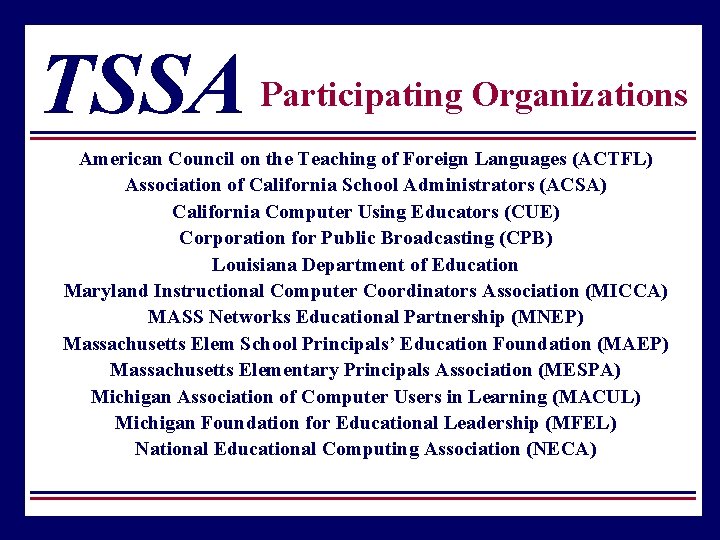
TSSA Participating Organizations American Council on the Teaching of Foreign Languages (ACTFL) Association of California School Administrators (ACSA) California Computer Using Educators (CUE) Corporation for Public Broadcasting (CPB) Louisiana Department of Education Maryland Instructional Computer Coordinators Association (MICCA) MASS Networks Educational Partnership (MNEP) Massachusetts Elem School Principals’ Education Foundation (MAEP) Massachusetts Elementary Principals Association (MESPA) Michigan Association of Computer Users in Learning (MACUL) Michigan Foundation for Educational Leadership (MFEL) National Educational Computing Association (NECA)
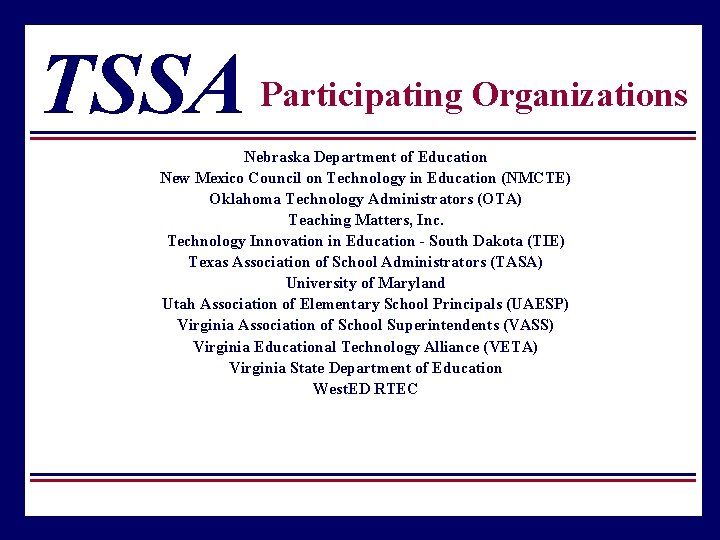
TSSA Participating Organizations Nebraska Department of Education New Mexico Council on Technology in Education (NMCTE) Oklahoma Technology Administrators (OTA) Teaching Matters, Inc. Technology Innovation in Education - South Dakota (TIE) Texas Association of School Administrators (TASA) University of Maryland Utah Association of Elementary School Principals (UAESP) Virginia Association of School Superintendents (VASS) Virginia Educational Technology Alliance (VETA) Virginia State Department of Education West. ED RTEC
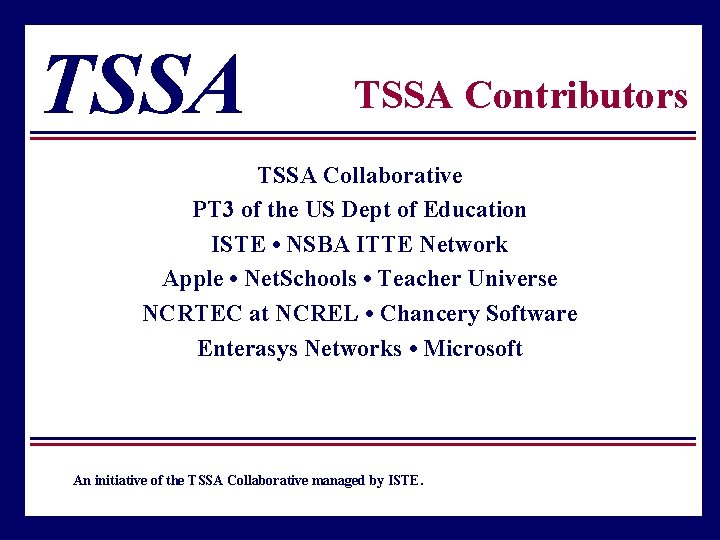
TSSA Contributors TSSA Collaborative PT 3 of the US Dept of Education ISTE • NSBA ITTE Network Apple • Net. Schools • Teacher Universe NCRTEC at NCREL • Chancery Software Enterasys Networks • Microsoft An initiative of the TSSA Collaborative managed by ISTE.
§A little more about You. . .
NHSTE • Issues, Questions, Suggestions and Observations
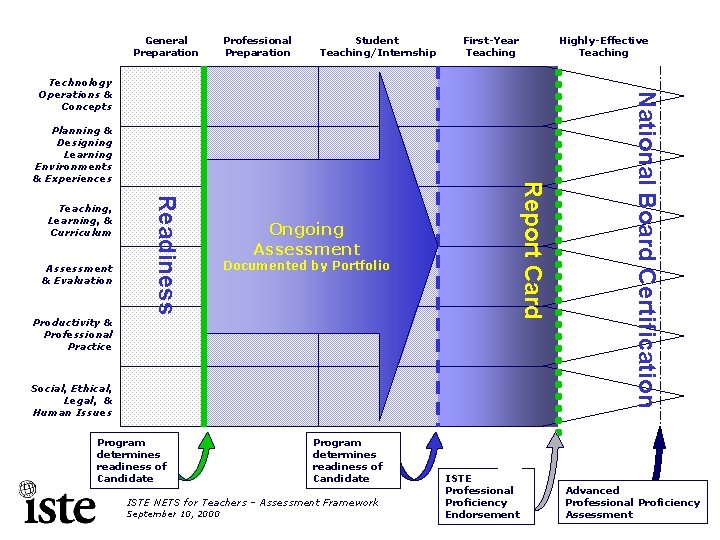
General Preparation Professional Preparation Student Teaching/Internship First-Year Teaching Highly-Effective Teaching Assessment & Evaluation Readiness Teaching, Learning, & Curriculum Report Card Planning & Designing Learning Environments & Experiences Ongoing Assessment Documented by Portfolio Productivity & Professional Practice Social, Ethical, Legal, & Human Issues Program determines readiness of Candidate ISTE NETS for Teachers – Assessment Framework September 10, 2000 ISTE Professional Proficiency Endorsement National Board Certification Technology Operations & Concepts Advanced Professional Proficiency Assessment
What’s better?
Contact Information Don Knezek, ISTE CEO Em. dknezek@iste. org Ph. 202. 841. 2785 www. iste. org www. pt 3. org http: //caret. iste. org