
Competencybased Clinical Supervision A Transtheoretical or Metatheoretical Approach
Competency-based Clinical Supervision: A Transtheoretical (or Metatheoretical) Approach Carol Falender, Ph. D. Edward P. Shafranske, Ph. D. , ABPP
American Psychological Association Task Force on Supervision Definition Competency-based supervision is a metatheoretical approach that explicitly identifies the knowledge, skills and attitudes that comprise clinical competencies, informs learning strategies and evaluation procedures, and meets criterion-referenced competence standards consistent with evidence-based practices (regulations), and the local/cultural clinical setting (adapted from Falender & Shafranske, 2007). Competency-based supervision is one approach to supervision; it is metatheoretical and does not preclude other
Transtheoretical or Metatheoretical • Our use of transtheoretical differs significantly from Prochaska and Norcross (2007), and refers to its application as a framework for any other model of clinical supervision as well as on its own (Falender & Shafranske, in press). As such it offers a metatheoretical approach across different models of supervision. • Gonsalvez & Calvert (2014) described competency-based models as transtheoretical as they can be integrated with other models (psychotherapeutic and developmental) and provide a molecular model, “starting with the end in mind” (p. 202)
Competency-based Clinical Supervision • Competency-based clinical supervision entails an intentional, systematic approach to the multiple competencies— knowledge, skills, and attitudes • It includes observation, collaborative selfassessment and feedback on the assessment; experiential learning and skill development, instruction, modeling, and mutual problem solving; ongoing assessment, feedback and evaluation, role modeling
Competency-based Clinical Supervision • Competency-based supervision’s intentional, systematic approach is in contrast to psychotherapy-driven or other supervision approaches are not comprehensive in all the components essential to clinical supervision • Essential is the interplay of self-assessment, supervisor collaborative assessment and feedback with the collaborative development of a training contract articulating discrete competencies to be attained and means to achieve those.
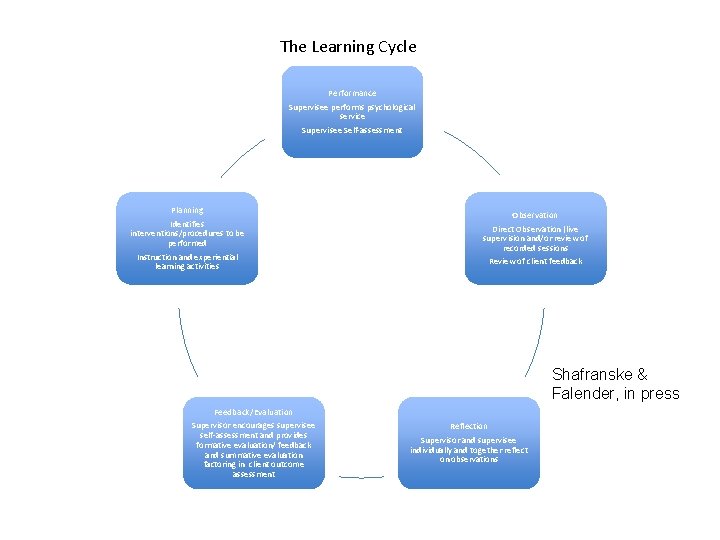
The Learning Cycle (Falender & Shafranske, 2016) The Learning Cycle Performance Supervisee performs psychological service Supervisee Self-assessment Planning Identifies interventions/procedures to be performed Instruction and experiential learning activities Observation Direct Observation (live supervision and/or review of recorded sessions Review of client feedback Shafranske & Falender, in press Feedback/Evaluation Supervisor encourages supervisee self-assessment and provides formative evaluation/ feedback and summative evaluation factoring in client outcome assessment Reflection Supervisor and supervisee individually and together reflect on observations
Complexity of Supervision • Supervisor competence—to make valid entrustment decisions about supervisee – Competence clinical practice under supervision • (e. g. , populations, theories, assessment, interventions, models, multiculturalism, context, research, evidence-base) – Competence in clinical supervision • (e. g. , competencies outlined in APA Supervision Guidelines)
Clinical Supervision, Training, and Professional Development Research Center, at Pepperdine University • Three Studies on Counterproductive Supervision that frame essential need for change in clinical supervision – i. Q-sort by current graduate students – ii. Q-sort by experts in clinical supervision – Iii. Q-sort by practicing supervisors • Study (Wall, 2009) found high frequency of non-adherence to ethical practices affected alliance • Four studies on impact of supervisory alliance on supervisee disclosure
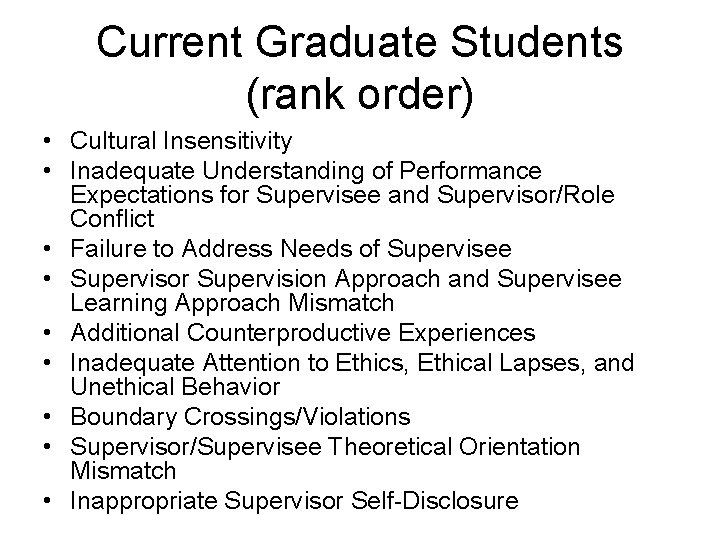
Current Graduate Students (rank order) • Cultural Insensitivity • Inadequate Understanding of Performance Expectations for Supervisee and Supervisor/Role Conflict • Failure to Address Needs of Supervisee • Supervisor Supervision Approach and Supervisee Learning Approach Mismatch • Additional Counterproductive Experiences • Inadequate Attention to Ethics, Ethical Lapses, and Unethical Behavior • Boundary Crossings/Violations • Supervisor/Supervisee Theoretical Orientation Mismatch • Inappropriate Supervisor Self-Disclosure
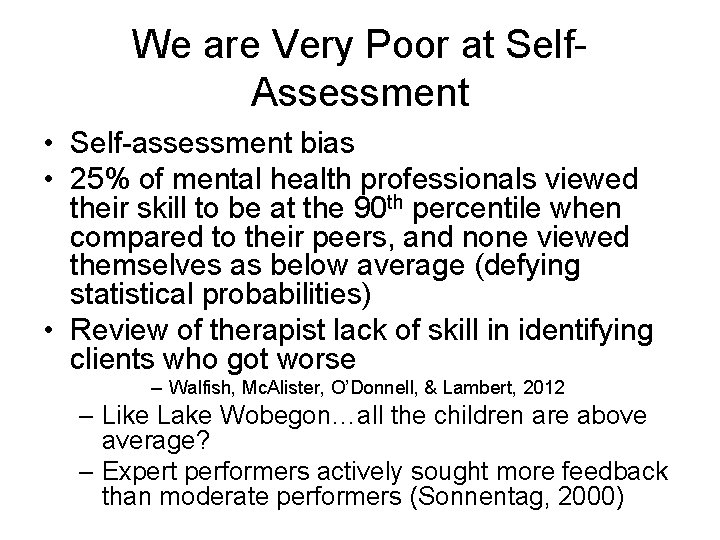
We are Very Poor at Self. Assessment • Self-assessment bias • 25% of mental health professionals viewed their skill to be at the 90 th percentile when compared to their peers, and none viewed themselves as below average (defying statistical probabilities) • Review of therapist lack of skill in identifying clients who got worse – Walfish, Mc. Alister, O’Donnell, & Lambert, 2012 – Like Lake Wobegon…all the children are above average? – Expert performers actively sought more feedback than moderate performers (Sonnentag, 2000)
• We do not systematically teach supervisees self-assessment or provide feedback to increase accuracy • We believe a core component of competency-based supervision is competence of the supervisor to assess supervisee “entrustability” and to systematically address the multiple aspects of clinical supervision as they relate to clinical practice
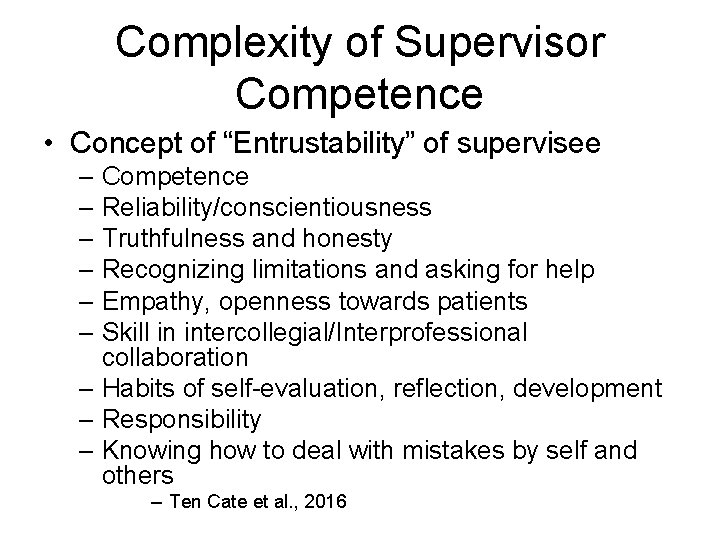
Complexity of Supervisor Competence • Concept of “Entrustability” of supervisee – Competence – Reliability/conscientiousness – Truthfulness and honesty – Recognizing limitations and asking for help – Empathy, openness towards patients – Skill in intercollegial/Interprofessional collaboration – Habits of self-evaluation, reflection, development – Responsibility – Knowing how to deal with mistakes by self and others – Ten Cate et al. , 2016

Vignette • Dr. Hass, a 57 year old Caucasian male, prefaced supervision that has been supervising for over 20 years, and launched right in with Alberta, a 27 year old self described “African-American digital native. ” In response to Alberta’s persistent efforts to structure supervision, Dr. Hass told her he simply works from theory and all else falls into place. He finds goals cumbersome, and urged her simply to begin discussing her client cases. Quickly he began reflecting about several aspects of client dynamics and they have only covered the one case in the first three weeks, her efforts notwithstanding.
Strengths and What is Missing?
Conundrum • Essentially, study of clinical supervision is compromised without consensus on its definition, lack of formal training—and highly variable training if any—and debate whether supervision is a distinct professional practice • Movement towards agreement on definition?
First Step: Components • Self-assessment and collaborative assessment of supervisee competence and ongoing feedback • Supervisory relationship • Addressing strains and ruptures to relationship • Diversity and multiculturalism • Reactivity or countertransference, selfcare • Legal and ethical standards/aspects
Support? Evidence? • Adoption of Competency-based Supervision model by multiple countries including Australia and New Zealand • Intersection of competency-based and psychotherapy model for Motivational Interviewing • Stein, Clair, Soenksen-Bassett, Martin, & Clarke, 2015 • Skill sets associated with client outcomes • Bearman et al. , 2015 • Use of symptom checklists, therapeutic alliance associated with enhanced client
• Do supervisors matter? – Rousmaniere, Swift, Babins-Wagner, Whipple, & Berzins, 2016 • Are we throwing away the baby with the proverbial bath water focusing so intensively on client outcomes and failing to attend to therapist’s contributions? – Miller, Hubble, Chow, & Seidel, 2015 • Or the supervisory contributions? (F & S) • Need to consider therapist’s contribution —supervisee, supervisor AND systematic, intentional process
Future Directions • Train supervisees in role invocation—to be successful supervisees as an entrée into the supervision process (Vespia et al. , Falender & Shafranske, 2012) • Train supervisors, use of supervisor competence assessment to ensure intentional, ethical supervision practice • Assess supervisor competence and develop a protocol for supervisors to self-assess and model development of their own goals for the training sequence
(2) • Track supervisee supervision outcomes and client outcomes as a matter of course —and use these as feedback to inform supervision/treatment • Through practice and guidelines adoption, increase value attached to clinical supervision in our profession, settings, and more generally

References • American Psychological Association. Board of Educational Affairs. (2014) Guidelines for clinical supervision for health service psychologists. Retrieved from: http: //www. apa. org/about/policy/guidelinessupervision. pdf • Bearman, S. K. , Weisz, J. R. , Chorpita, B. F. , Hoagwood, K. , Ward, A. , Ugeuto, A. M. , & Bernstein, A. (2013). More practice, less preach? The role of supervision practices and therapist characteristics in EBP implementation. Administrative Policy in Mental Health, doi: 10. 1007/s 10488 -013 -0485 -5 • Falender, C. A. , & Shafranske, E. P. (2007). Competence in competency-based supervision practice: Construct and application. Professional Psychology: Research and Practice, 38(3), 232 -240.
• Falender, C. A. & Shafranske, E. P. (in press). Supervision essentials for the practice of competency-based supervision. American Psychological Association. • Gonsalvez, C. J. , & Calvert, F. L. (2014). Competency-based models of supervision: Principles and applications, promises and challenges. Australian Psychologist, 49, 200208. doi: 10. 1111/ap. 12055 • Prochaska, J. O. , & Norcross, J. C (2009). Systems of psychotherapy: A transtheoretical analysis (7 th ed. ). Belmont, Ca. : Brooks Cole.
• Shafranske, E. P. , & Falender, C. A. , (in press). Clinical Supervision. In J. C. Norcross, G. R. , Vanden. Bos & D. K. Freedheim (Eds. ), APA Handbook of Clinical Psychology Volume V: Education and Profession. Washington, DC: American Psychological Association. • Stein, L. A. R. , Clair, M. , Soenksen-Bassett, S. , Martin, R. A. , & Clarke, J. G. (2015). Studying process and proximal outcomes of supervision for motivational interviewing. Training and Education in Professional Psychology, 9(2), 175 -182. doi: http: //dx. doi. org/10. 1037/tep 0000073
• Ten Cate, O. , Hart, D. , Ankel, F. , Busari, J. , Englander, R. , Glasgow, N, …. Wycliffe-Jones, K. (2016). Entrustment decision making in clinical training. Academic Medicine, 91, 191198. doi: 10. 1097/ACM. 0000001044 • Walfish, S. , Mc. Alister, B. , O’Donnell, P. , & Lambert, M. J. (2012). An investigation of self-assessment bias in mental health providers. Psychological Reports, 110, 639644. doi: 10. 2466/02. 07. 17. PR 0. 110. 2. 639644
- Slides: 25