
Competency to Stand Trial Phase I Staff Productivity

- Slides: 21
Competency to Stand Trial, Phase I: Staff Productivity Standards, Data Reliability, and Other Parties’ Actions May Impact DSHS’s Ability to Meet Timelines Briefing Report Elisabeth Donner, Zane Potter, Eric Thomas JLARC Staff December 5, 2012
2012 Legislation (SSB 6492) Provided Guidance to DSHS and JLARC Increase in referrals raised concerns about amount of time defendants wait for evaluation DSHS § Legislation established performance targets for DSHS. Targets established how long it has to complete competency evaluations. JLARC § Directed JLARC to complete two performance assessments of the agency’s approach and success in meeting targets. s Second study will be completed December 2013. Competency to Stand Trial Audit 1 of 2 Report Page No. 1, 9 December 5, 2012 2
Presentation Overview Background § What is a competency evaluation? § What do we know about referrals for competency evaluations? New requirements for completing evaluations and DSHS’s plan to address them. Three issues of concern in early implementation. § Assumed staffing and productivity standards not likely met. § Data reliability issues. § Evaluations involve more parties than just state hospitals. Competency to Stand Trial Audit 1 of 2 December 5, 2012 3
Background: What Is a Competency Evaluation?
Evaluations Intended to Prevent Prosecution of Mentally Incompetent Defendants § Criminal defendant is not competent to stand trial if: s Lack capacity to understand the proceedings against them; or s Cannot assist in their defense. § State statute requires that “no incompetent person shall be tried, convicted, or sentenced for the commission of an offense so long as such incapacity continues. ” Competency to Stand Trial Audit 1 of 2 Report Page No. 1, 3 December 5, 2012 5
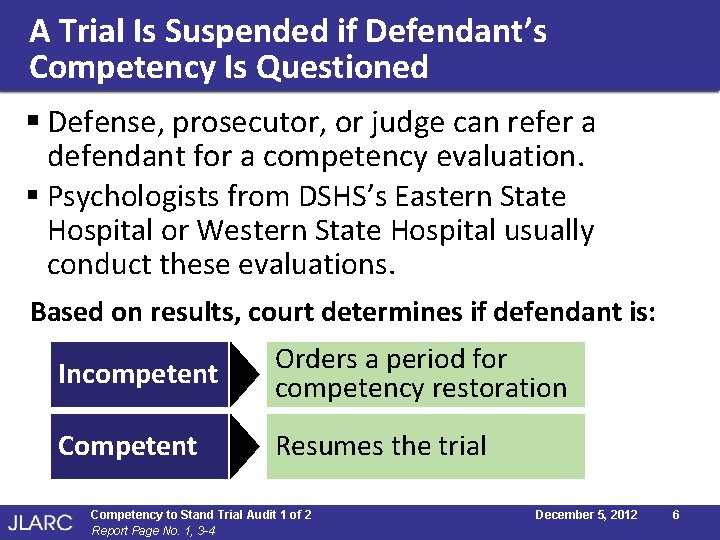
A Trial Is Suspended if Defendant’s Competency Is Questioned § Defense, prosecutor, or judge can refer a defendant for a competency evaluation. § Psychologists from DSHS’s Eastern State Hospital or Western State Hospital usually conduct these evaluations. Based on results, court determines if defendant is: Incompetent Orders a period for competency restoration Competent Resumes the trial Competency to Stand Trial Audit 1 of 2 Report Page No. 1, 3 -4 December 5, 2012 6
Background: What Do We Know About Referrals?
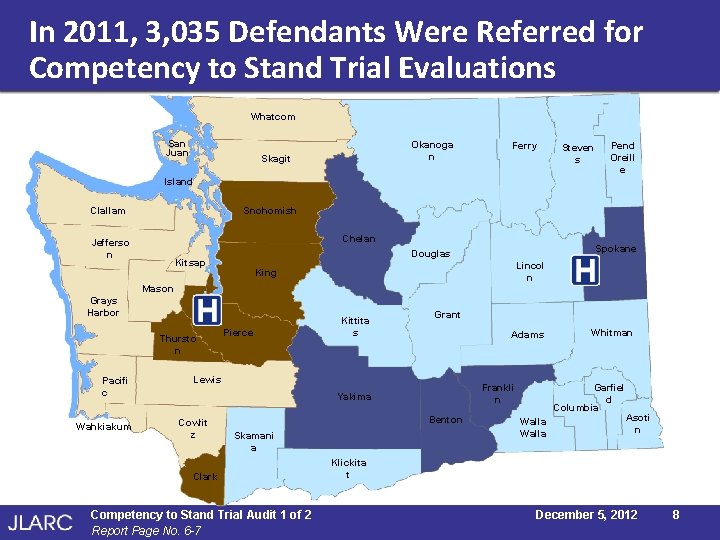
In 2011, 3, 035 Defendants Were Referred for Competency to Stand Trial Evaluations Whatcom San Juan Okanoga n Skagit Ferry Steven s Pend Oreill e Island Clallam Snohomish Chelan Jefferso n Spokane Douglas Kitsap Lincol n King Mason Grays Harbor Thursto n Pacifi c Wahkiakum Pierce Kittita s Grant Adams Lewis Frankli n Yakima Cowlit z Benton Skamani a Clark Competency to Stand Trial Audit 1 of 2 Report Page No. 6 -7 Whitman Garfiel d Columbia Walla Asoti n Klickita t December 5, 2012 8
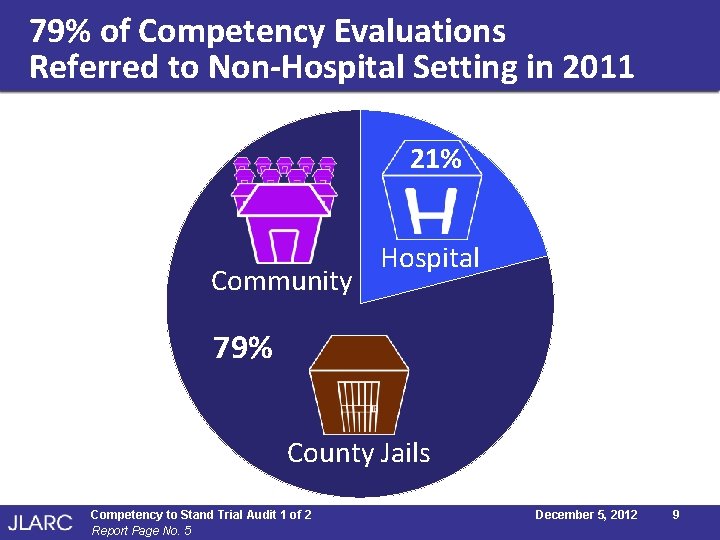
79% of Competency Evaluations Referred to Non-Hospital Setting in 2011 21% 25% Community 79% Hospital 54% County Jails Competency to Stand Trial Audit 1 of 2 Report Page No. 5 December 5, 2012 9
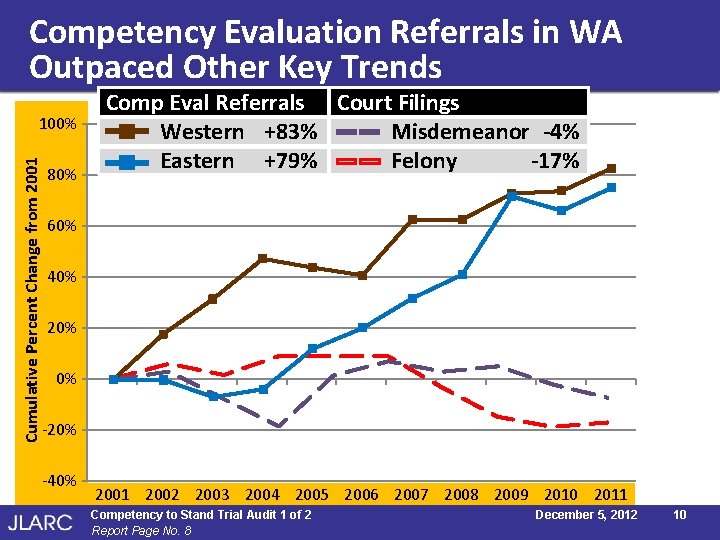
Competency Evaluation Referrals in WA Outpaced Other Key Trends Cumulative Percent Change from 2001 100% 80% Comp Eval Referrals Court Filings Western +83% Misdemeanor -4% Eastern +79% Felony -17% 60% 40% 20% 0% -20% -40% 2001 2002 2003 2004 2005 2006 2007 2008 2009 2010 2011 Competency to Stand Trial Audit 1 of 2 Report Page No. 8 December 5, 2012 10
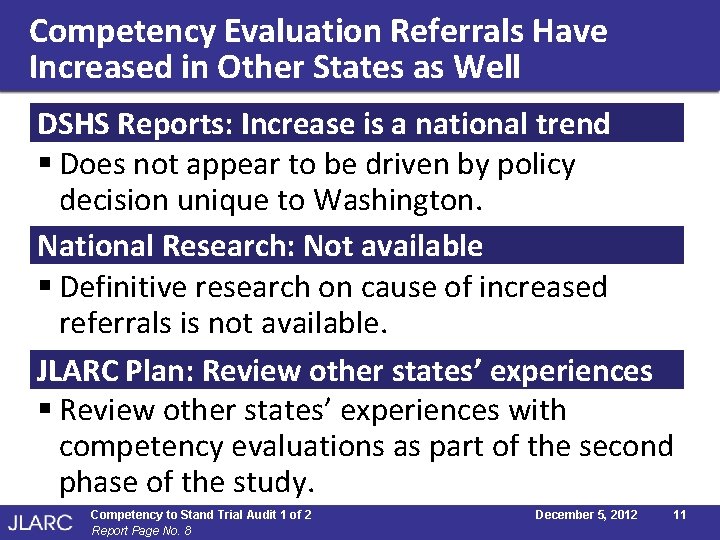
Competency Evaluation Referrals Have Increased in Other States as Well DSHS Reports: Increase is a national trend § Does not appear to be driven by policy decision unique to Washington. National Research: Not available § Definitive research on cause of increased referrals is not available. JLARC Plan: Review other states’ experiences § Review other states’ experiences with competency evaluations as part of the second phase of the study. Competency to Stand Trial Audit 1 of 2 Report Page No. 8 December 5, 2012 11
New Requirements for Completing Evaluations and DSHS’s Plans to Address Them
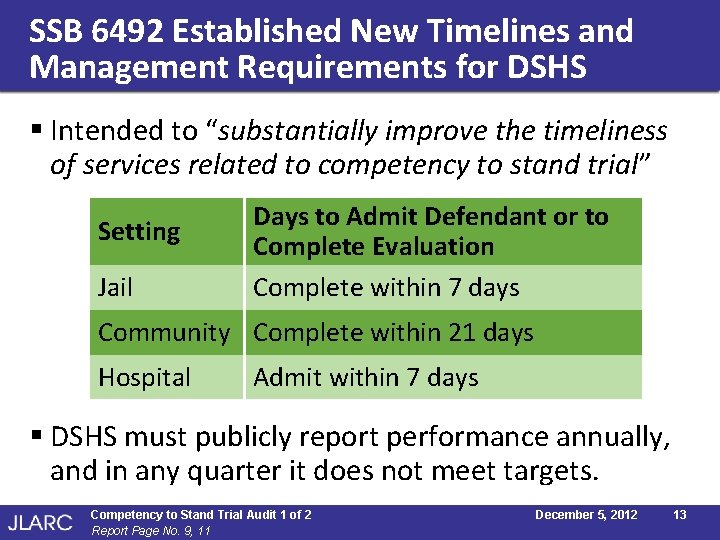
SSB 6492 Established New Timelines and Management Requirements for DSHS § Intended to “substantially improve the timeliness of services related to competency to stand trial” Setting Jail Days to Admit Defendant or to Complete Evaluation Complete within 7 days Community Complete within 21 days Hospital Admit within 7 days § DSHS must publicly report performance annually, and in any quarter it does not meet targets. Competency to Stand Trial Audit 1 of 2 Report Page No. 9, 11 December 5, 2012 13
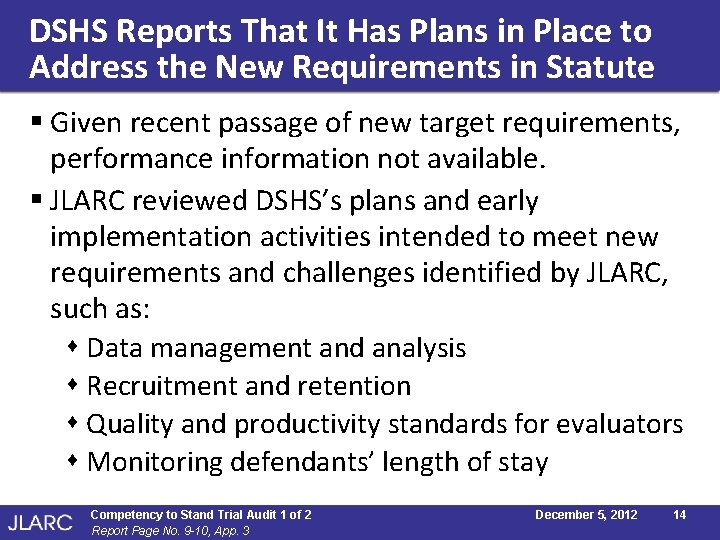
DSHS Reports That It Has Plans in Place to Address the New Requirements in Statute § Given recent passage of new target requirements, performance information not available. § JLARC reviewed DSHS’s plans and early implementation activities intended to meet new requirements and challenges identified by JLARC, such as: s Data management and analysis s Recruitment and retention s Quality and productivity standards for evaluators s Monitoring defendants’ length of stay Competency to Stand Trial Audit 1 of 2 Report Page No. 9 -10, App. 3 December 5, 2012 14
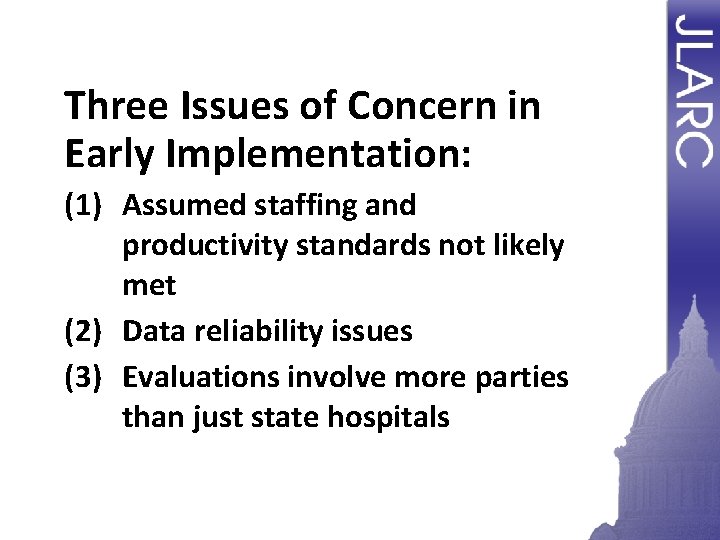
Three Issues of Concern in Early Implementation: (1) Assumed staffing and productivity standards not likely met (2) Data reliability issues (3) Evaluations involve more parties than just state hospitals
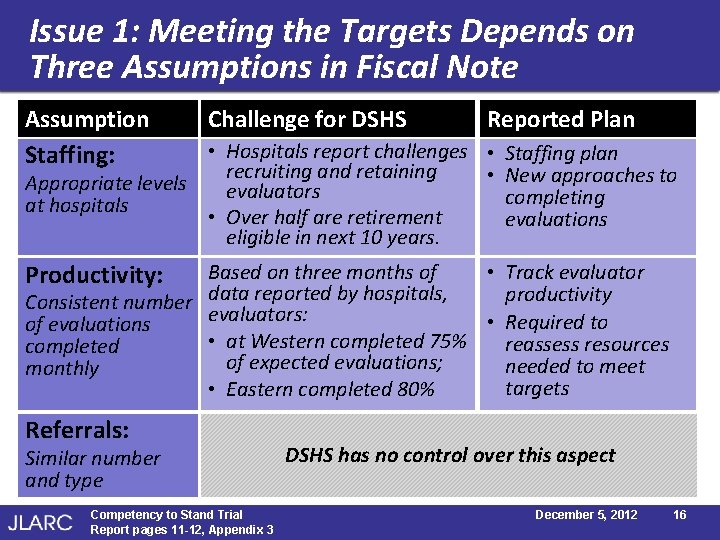
Issue 1: Meeting the Targets Depends on Three Assumptions in Fiscal Note Assumption Staffing: Challenge for DSHS Reported Plan • Hospitals report challenges • Staffing plan recruiting and retaining • New approaches to Appropriate levels evaluators completing at hospitals • Over half are retirement evaluations eligible in next 10 years. Based on three months of • Track evaluator productivity Consistent number data reported by hospitals, evaluators: • Required to of evaluations • at Western completed 75% reassess resources completed of expected evaluations; needed to meet monthly targets • Eastern completed 80% Productivity: Referrals: Similar number and type Competency to Stand Trial Report pages 11 -12, Appendix 3 DSHS has no control over this aspect December 5, 2012 16
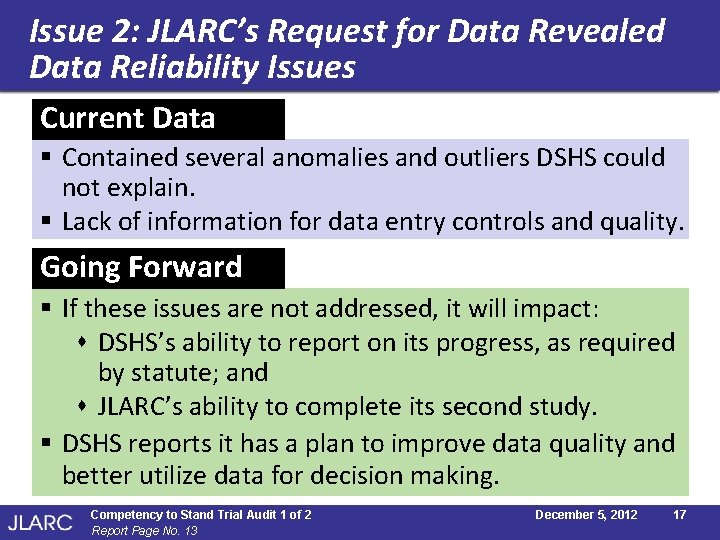
Issue 2: JLARC’s Request for Data Revealed Data Reliability Issues Current Data § Contained several anomalies and outliers DSHS could not explain. § Lack of information for data entry controls and quality. Going Forward § If these issues are not addressed, it will impact: s DSHS’s ability to report on its progress, as required by statute; and s JLARC’s ability to complete its second study. § DSHS reports it has a plan to improve data quality and better utilize data for decision making. Competency to Stand Trial Audit 1 of 2 Report Page No. 13 December 5, 2012 17
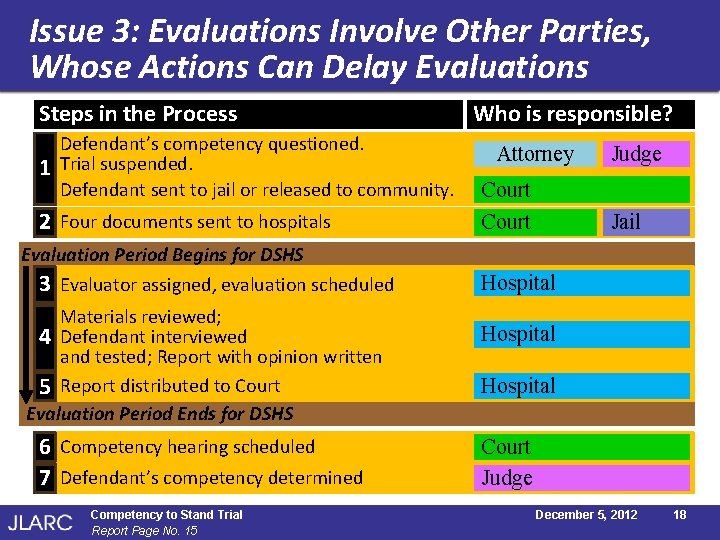
Issue 3: Evaluations Involve Other Parties, Whose Actions Can Delay Evaluations Steps in the Process 1 Defendant’s competency questioned. Trial suspended. Defendant sent to jail or released to community. 2 Four documents sent to hospitals Evaluation Period Begins for DSHS 3 Evaluator assigned, evaluation scheduled Materials reviewed; 4 Defendant interviewed and tested; Report with opinion written 5 Report distributed to Court Evaluation Period Ends for DSHS 6 Competency hearing scheduled 7 Defendant’s competency determined Competency to Stand Trial Report Page No. 15 Who is responsible? Attorney Court Judge Jail Hospital Court Judge December 5, 2012 18
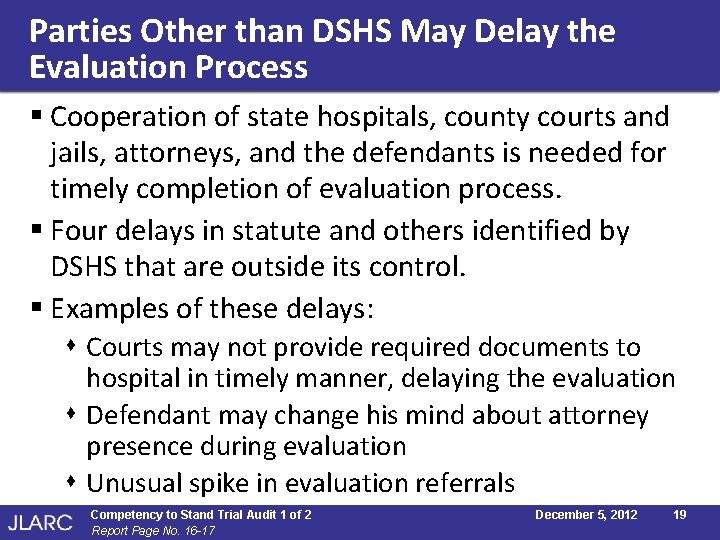
Parties Other than DSHS May Delay the Evaluation Process § Cooperation of state hospitals, county courts and jails, attorneys, and the defendants is needed for timely completion of evaluation process. § Four delays in statute and others identified by DSHS that are outside its control. § Examples of these delays: s Courts may not provide required documents to hospital in timely manner, delaying the evaluation s Defendant may change his mind about attorney presence during evaluation s Unusual spike in evaluation referrals Competency to Stand Trial Audit 1 of 2 Report Page No. 16 -17 December 5, 2012 19
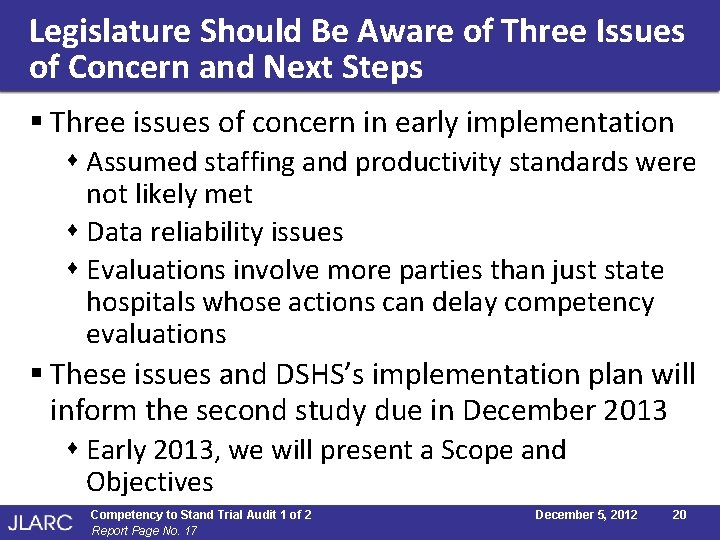
Legislature Should Be Aware of Three Issues of Concern and Next Steps § Three issues of concern in early implementation s Assumed staffing and productivity standards were not likely met s Data reliability issues s Evaluations involve more parties than just state hospitals whose actions can delay competency evaluations § These issues and DSHS’s implementation plan will inform the second study due in December 2013 s Early 2013, we will present a Scope and Objectives Competency to Stand Trial Audit 1 of 2 Report Page No. 17 December 5, 2012 20
Contact Information Eric Thomas, Project Lead 360 -786 -5182 eric. thomas@leg. wa. gov Elisabeth Donner, Research Analyst 360 -786 -5190 elisabeth. donner@leg. wa. gov Zane Potter, Research Analyst 360 -786 -5194 zane. potter@leg. wa. gov Valerie Whitener, Project Supervisor 360 -786 -5191 valerie. whitener@leg. wa. gov www. jlarc. leg. wa. gov