
Competency Based Learning The Paradigm Shift Youhansen Y
Competency Based Learning: The Paradigm Shift Youhansen Y. Eid President NAQAAE president_naqaae@naqaae. eg
Presentation Outline • • www. naqaae. eg Introduction Challenging the teacher-centered paradigm The Paradigm Shift What is Competency Based Learning (CBL) Teaching Learning and Assessment Role of NAQAAE in promoting CBL Conclusion Prof. Youhansen Y. Eid NAQAAE – OCT. 2019
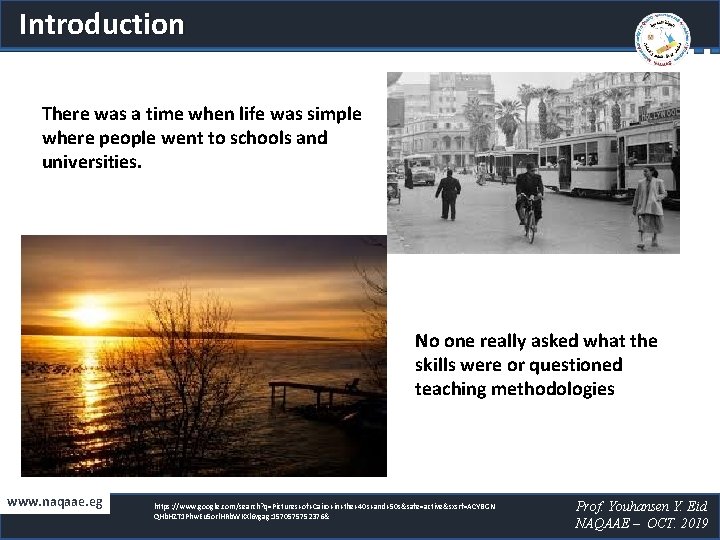
Introduction There was a time when life was simple where people went to schools and universities. No one really asked what the skills were or questioned teaching methodologies www. naqaae. eg https: //www. google. com/search? q=Pictures+of+Cairo+in+the+40 s+and+50 s&safe=active&sxsrf=ACYBGN QHb. HZT 1 Phw. Eu 5 orl. HRb. WKXl 6 vgag: 1570575752376& Prof. Youhansen Y. Eid NAQAAE – OCT. 2019
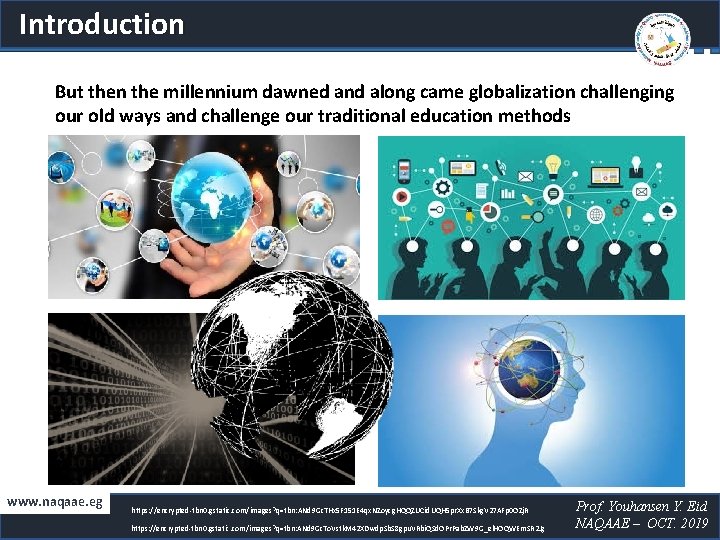
Introduction But then the millennium dawned and along came globalization challenging our old ways and challenge our traditional education methods www. naqaae. eg https: //encrypted-tbn 0. gstatic. com/images? q=tbn: ANd 9 Gc. THx 5 F 151 E 4 qx. NZoycg. HQQZUCid. UQH 5 pr. Xx. B 7 Skg. V 27 AFp 0 OZj. R https: //encrypted-tbn 0. gstatic. com/images? q=tbn: ANd 9 Gc. To. Vstk. M 42 XDwdp. Sb. S 8 gpu. VRbi. QSd. OPr. Pab. ZW 9 G_el. HOQWEm. SR 2 Jg Prof. Youhansen Y. Eid NAQAAE – OCT. 2019
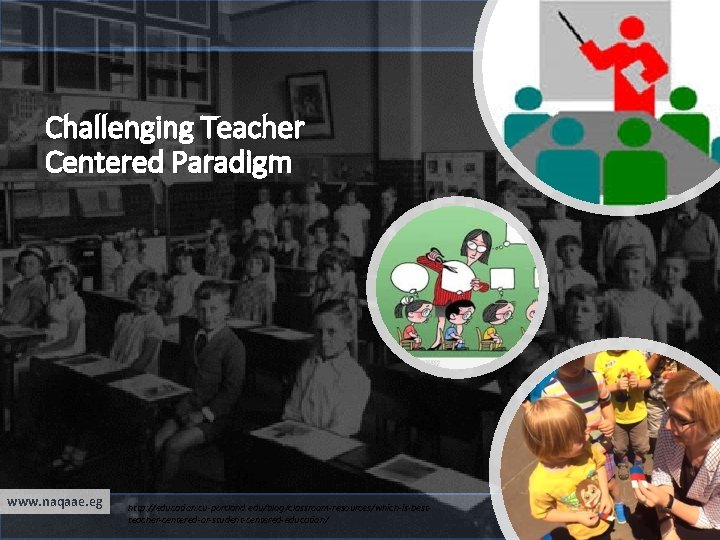
Challenging Teacher Centered Paradigm www. naqaae. eg http: //education. cu-portland. edu/blog/classroom-resources/which-is-bestteacher-centered-or-student-centered-education/ Prof. Youhansen Y. Eid NAQAAE – OCT. 2019
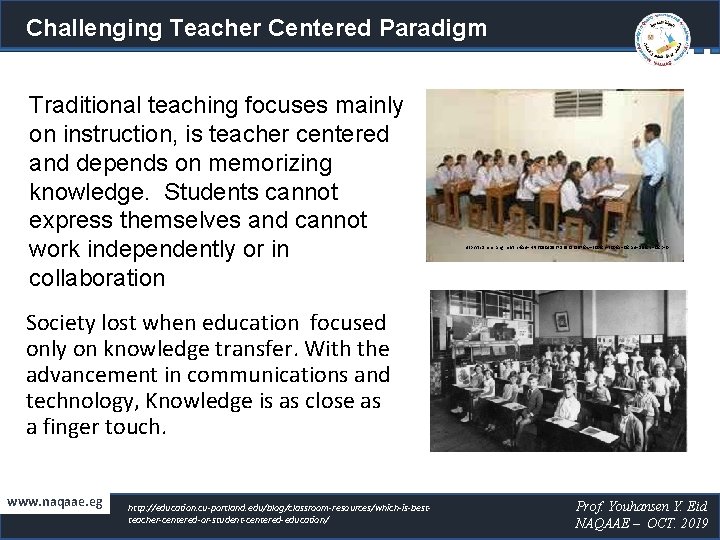
Challenging Teacher Centered Paradigm Traditional teaching focuses mainly on instruction, is teacher centered and depends on memorizing knowledge. Students cannot express themselves and cannot work independently or in collaboration http: //ts 1. mm. bing. net/th? &id=HN. 608048927169383897&w=300&h=300&c=0&pid=1. 9&rs=0&p=0 Society lost when education focused only on knowledge transfer. With the advancement in communications and technology, Knowledge is as close as a finger touch. www. naqaae. eg http: //education. cu-portland. edu/blog/classroom-resources/which-is-bestteacher-centered-or-student-centered-education/ Prof. Youhansen Y. Eid NAQAAE – OCT. 2019
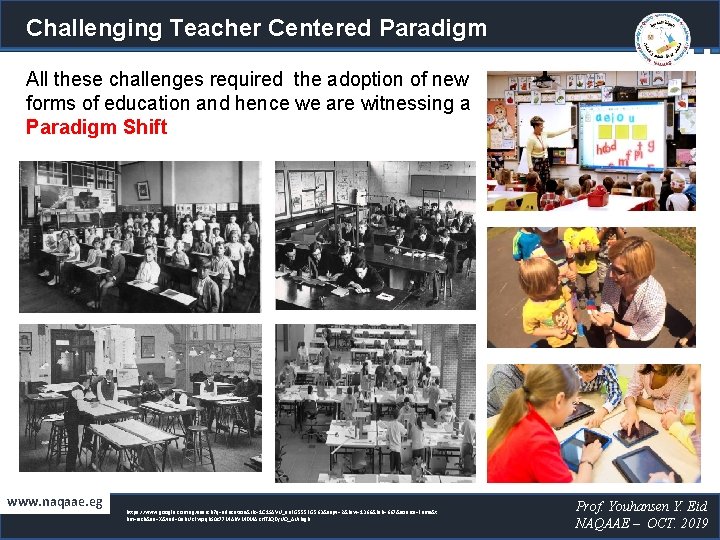
Challenging Teacher Centered Paradigm All these challenges required the adoption of new forms of education and hence we are witnessing a Paradigm Shift www. naqaae. eg https: //www. google. com. eg/search? q=education&rlz=1 C 1 SAVU_en. EG 555 EG 563&espv=2&biw=1366&bih=667&source=lnms&t bm=isch&sa=X&ved=0 ah. UKEwjxqb. S 0 z 77 MAh. VMDMAKHTJQDy. UQ_AUIBig. B Prof. Youhansen Y. Eid NAQAAE – OCT. 2019
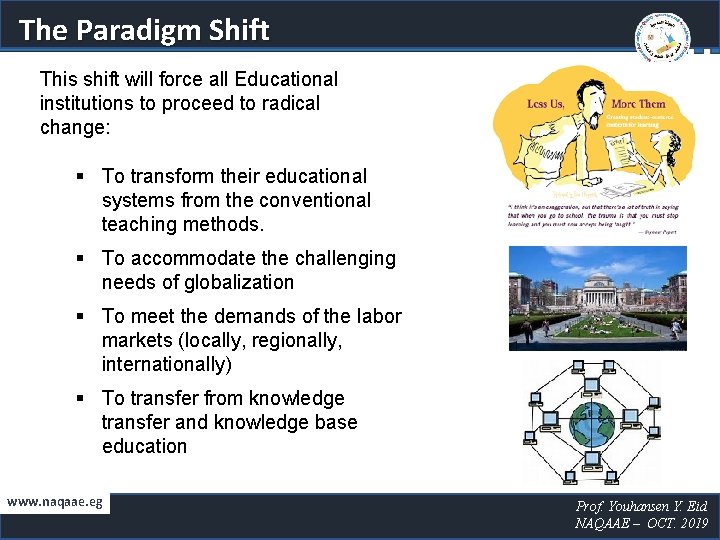
The Paradigm Shift This shift will force all Educational institutions to proceed to radical change: § To transform their educational systems from the conventional teaching methods. § To accommodate the challenging needs of globalization § To meet the demands of the labor markets (locally, regionally, internationally) § To transfer from knowledge transfer and knowledge base education www. naqaae. eg Prof. Youhansen Y. Eid NAQAAE – OCT. 2019
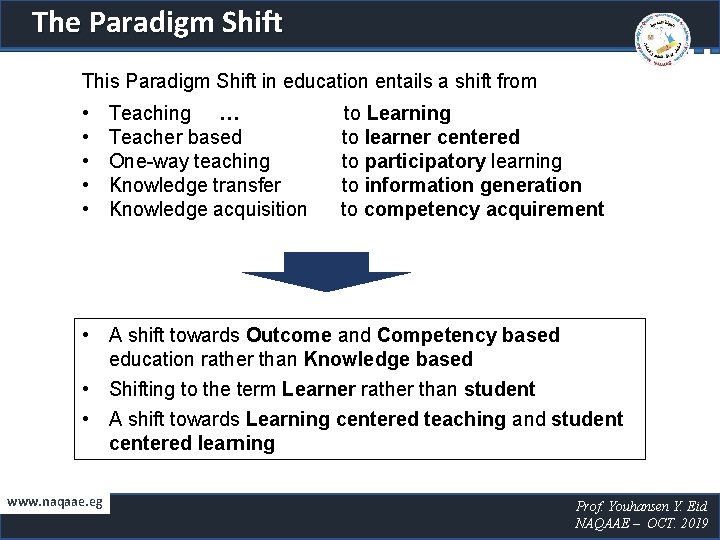
The Paradigm Shift This Paradigm Shift in education entails a shift from • • • Teaching … Teacher based One-way teaching Knowledge transfer Knowledge acquisition to Learning to learner centered to participatory learning to information generation to competency acquirement • A shift towards Outcome and Competency based education rather than Knowledge based • Shifting to the term Learner rather than student • A shift towards Learning centered teaching and student centered learning www. naqaae. eg Prof. Youhansen Y. Eid NAQAAE – OCT. 2019
What is CBL www. naqaae. eg Prof. Youhansen Y. Eid NAQAAE – OCT. 2019

What is Competency Based Learning What is a Competency q The ability to do something successfully or efficiently q The combination of observable and measurable knowledge, skills, abilities and personal attributes that contribute to enhanced performance and ultimately result in success. www. naqaae. eg https: //hr. unl. edu/compensation/nuvalues/corecompetencies. shtml/ Prof. Youhansen Y. Eid NAQAAE – OCT. 2019

What is Competency Based Learning Attributes of Competencies • Competencies do not establish baseline performance levels; rather they are used to raise the bar on performance. They provide road maps to incrementally increase capabilities. • Competencies focus on culture and values. • Competencies are aligned to short- and long-term missions and goals and reflect objectives of any agency. • Competencies focus on how results are achieved rather than merely the end result. • In this manner they bridge the gap between performance management and employee development and are an integral component of personal development plans. • Competencies close skill gaps www. naqaae. eg Prof. Youhansen Y. Eid NAQAAE – OCT. 2019
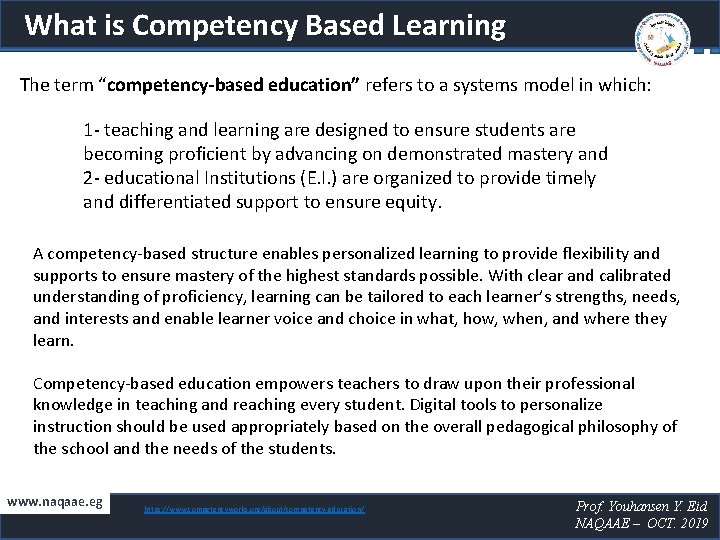
What is Competency Based Learning The term “competency-based education” refers to a systems model in which: 1 - teaching and learning are designed to ensure students are becoming proficient by advancing on demonstrated mastery and 2 - educational Institutions (E. I. ) are organized to provide timely and differentiated support to ensure equity. A competency-based structure enables personalized learning to provide flexibility and supports to ensure mastery of the highest standards possible. With clear and calibrated understanding of proficiency, learning can be tailored to each learner’s strengths, needs, and interests and enable learner voice and choice in what, how, when, and where they learn. Competency-based education empowers teachers to draw upon their professional knowledge in teaching and reaching every student. Digital tools to personalize instruction should be used appropriately based on the overall pedagogical philosophy of the school and the needs of the students. www. naqaae. eg https: //www. competencyworks. org/about/competency-education/ Prof. Youhansen Y. Eid NAQAAE – OCT. 2019
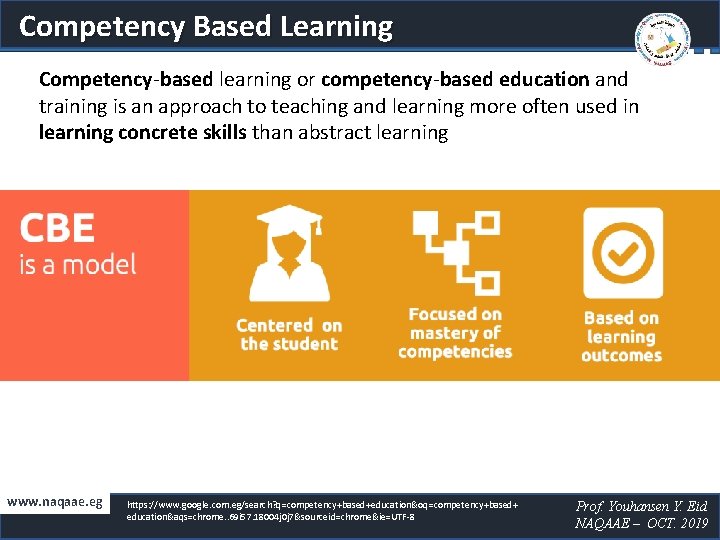
Competency Based Learning Competency-based learning or competency-based education and training is an approach to teaching and learning more often used in learning concrete skills than abstract learning www. naqaae. eg https: //www. google. com. eg/search? q=competency+based+education&oq=competency+based+ education&aqs=chrome. . 69 i 57. 18004 j 0 j 7&sourceid=chrome&ie=UTF-8 Prof. Youhansen Y. Eid NAQAAE – OCT. 2019
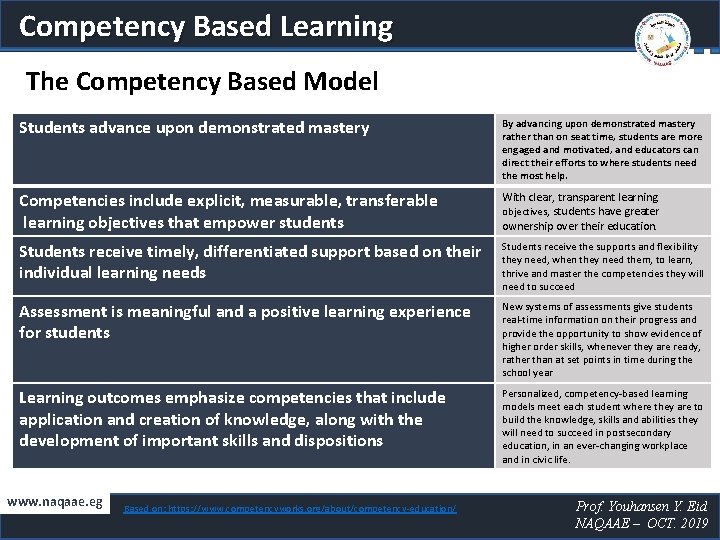
Competency Based Learning The Competency Based Model Students advance upon demonstrated mastery By advancing upon demonstrated mastery rather than on seat time, students are more engaged and motivated, and educators can direct their efforts to where students need the most help. Competencies include explicit, measurable, transferable learning objectives that empower students With clear, transparent learning objectives, students have greater ownership over their education. Students receive timely, differentiated support based on their individual learning needs Students receive the supports and flexibility they need, when they need them, to learn, thrive and master the competencies they will need to succeed Assessment is meaningful and a positive learning experience for students New systems of assessments give students real-time information on their progress and provide the opportunity to show evidence of higher order skills, whenever they are ready, rather than at set points in time during the school year Learning outcomes emphasize competencies that include application and creation of knowledge, along with the development of important skills and dispositions Personalized, competency-based learning models meet each student where they are to build the knowledge, skills and abilities they will need to succeed in postsecondary education, in an ever-changing workplace and in civic life. www. naqaae. eg Based on: https: //www. competencyworks. org/about/competency-education/ Prof. Youhansen Y. Eid NAQAAE – OCT. 2019
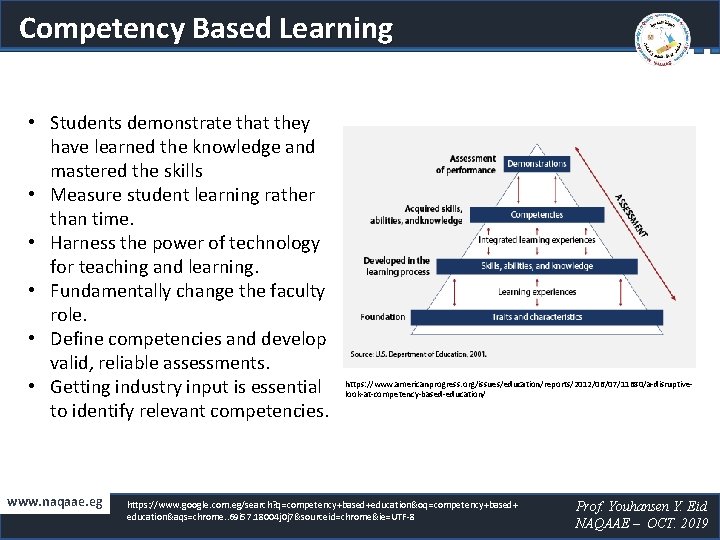
Competency Based Learning • Students demonstrate that they have learned the knowledge and mastered the skills • Measure student learning rather than time. • Harness the power of technology for teaching and learning. • Fundamentally change the faculty role. • Define competencies and develop valid, reliable assessments. • Getting industry input is essential to identify relevant competencies. www. naqaae. eg https: //www. americanprogress. org/issues/education/reports/2012/06/07/11680/a-disruptivelook-at-competency-based-education/ https: //www. google. com. eg/search? q=competency+based+education&oq=competency+based+ education&aqs=chrome. . 69 i 57. 18004 j 0 j 7&sourceid=chrome&ie=UTF-8 Prof. Youhansen Y. Eid NAQAAE – OCT. 2019
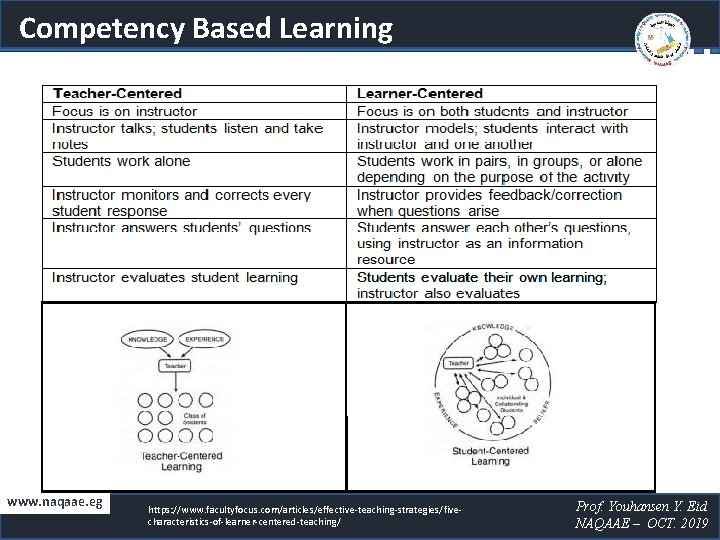
Competency Based Learning www. naqaae. eg https: //www. facultyfocus. com/articles/effective-teaching-strategies/fivecharacteristics-of-learner-centered-teaching/ Prof. Youhansen Y. Eid NAQAAE – OCT. 2019

Learning Centered Teaching Structured/Traditional Teaching Vs Active Learning Structure Control Activity/ Interaction Direct Instruction/ Classic Lecture High Teacher Low Active Models Workout methods Medium Teacher and Student Medium Explorative Methods Low Student High www. naqaae. eg Prof. Youhansen Y. Eid NAQAAE – OCT. 2019
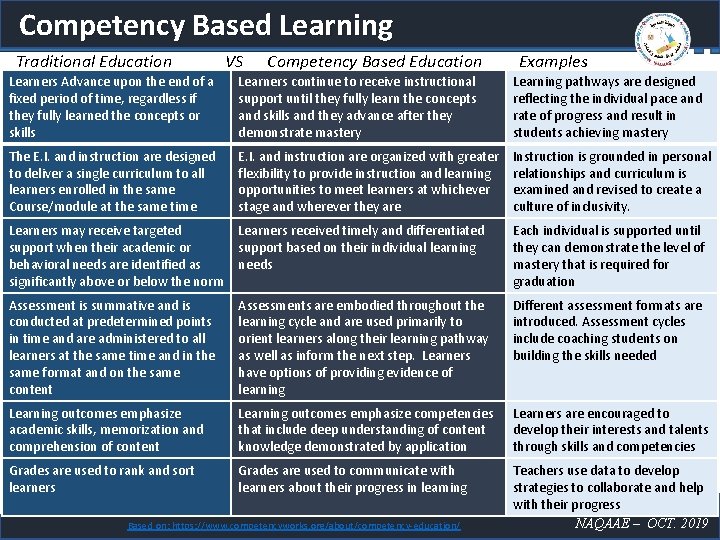
Competency Based Learning Traditional Education VS Competency Based Education Examples Learners Advance upon the end of a fixed period of time, regardless if they fully learned the concepts or skills Learners continue to receive instructional support until they fully learn the concepts and skills and they advance after they demonstrate mastery Learning pathways are designed reflecting the individual pace and rate of progress and result in students achieving mastery The E. I. and instruction are designed to deliver a single curriculum to all learners enrolled in the same Course/module at the same time E. I. and instruction are organized with greater flexibility to provide instruction and learning opportunities to meet learners at whichever stage and wherever they are Instruction is grounded in personal relationships and curriculum is examined and revised to create a culture of inclusivity. Learners may receive targeted support when their academic or behavioral needs are identified as significantly above or below the norm Learners received timely and differentiated support based on their individual learning needs Each individual is supported until they can demonstrate the level of mastery that is required for graduation Assessment is summative and is conducted at predetermined points in time and are administered to all learners at the same time and in the same format and on the same content Assessments are embodied throughout the learning cycle and are used primarily to orient learners along their learning pathway as well as inform the next step. Learners have options of providing evidence of learning Different assessment formats are introduced. Assessment cycles include coaching students on building the skills needed Learning outcomes emphasize academic skills, memorization and comprehension of content Learning outcomes emphasize competencies that include deep understanding of content knowledge demonstrated by application Learners are encouraged to develop their interests and talents through skills and competencies Grades are used to rank and sort learners www. naqaae. eg Grades are used to communicate with learners about their progress in learning Teachers use data to develop strategies to collaborate and help with their progress Prof. Youhansen Y. Eid NAQAAE – OCT. 2019 Based on: https: //www. competencyworks. org/about/competency-education/
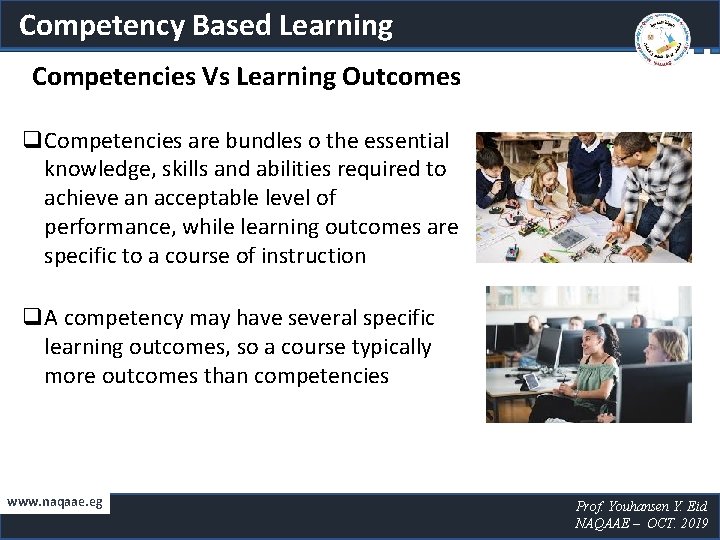
Competency Based Learning Competencies Vs Learning Outcomes q. Competencies are bundles o the essential knowledge, skills and abilities required to achieve an acceptable level of performance, while learning outcomes are specific to a course of instruction q. A competency may have several specific learning outcomes, so a course typically more outcomes than competencies www. naqaae. eg Prof. Youhansen Y. Eid NAQAAE – OCT. 2019
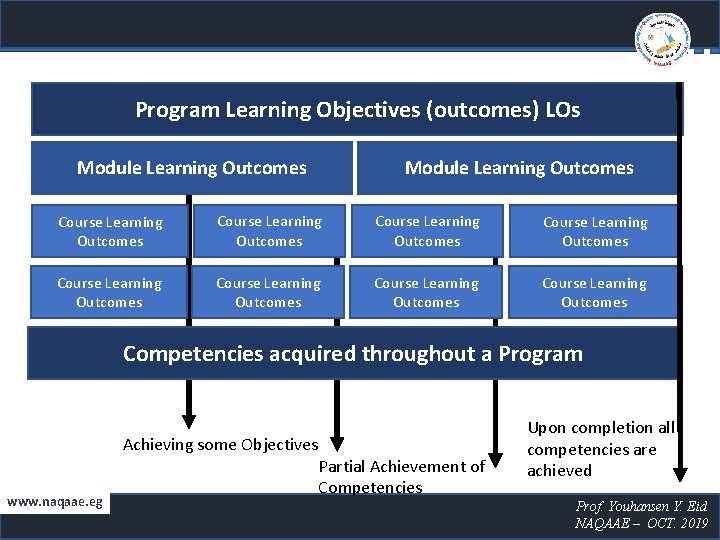
Program Learning Objectives (outcomes) LOs Module Learning Outcomes Course Learning Outcomes Course Learning Outcomes Competencies acquired throughout a Program Achieving some Objectives www. naqaae. eg Partial Achievement of Competencies Upon completion all competencies are achieved Prof. Youhansen Y. Eid NAQAAE – OCT. 2019
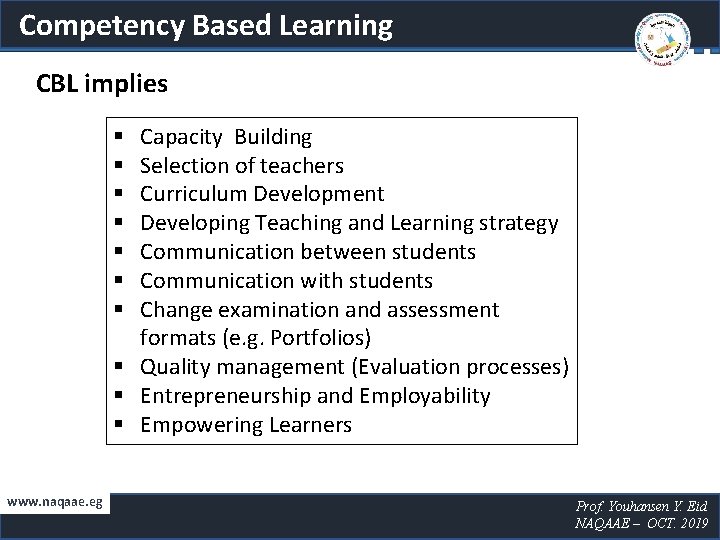
Competency Based Learning CBL implies Capacity Building Selection of teachers Curriculum Development Developing Teaching and Learning strategy Communication between students Communication with students Change examination and assessment formats (e. g. Portfolios) § Quality management (Evaluation processes) § Entrepreneurship and Employability § Empowering Learners § § § § www. naqaae. eg Prof. Youhansen Y. Eid NAQAAE – OCT. 2019
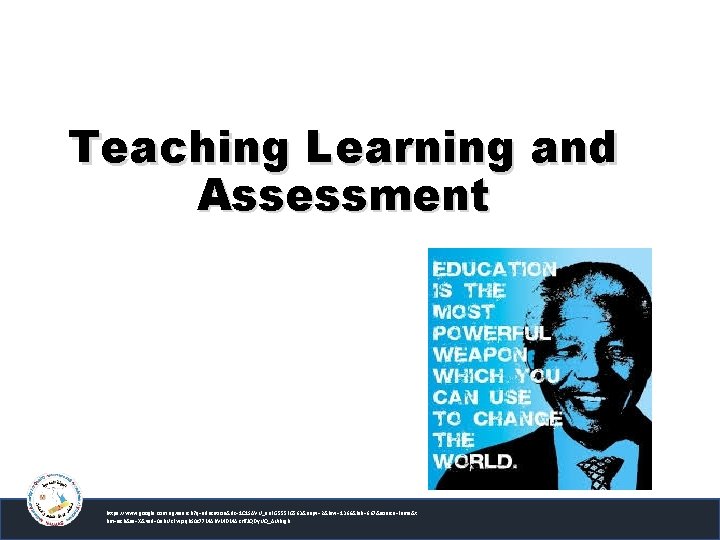
Teaching Learning and Assessment https: //www. google. com. eg/search? q=education&rlz=1 C 1 SAVU_en. EG 555 EG 563&espv=2&biw=1366&bih=667&source=lnms&t bm=isch&sa=X&ved=0 ah. UKEwjxqb. S 0 z 77 MAh. VMDMAKHTJQDy. UQ_AUIBig. B
Teaching … Learning … Assessment Programs are Teaching is www. naqaae. eg § Professional oriented rather than discipline oriented § Demand driven competitive, strongly quality assured § Multidimensional and transdisciplinary § § Student centered Learning outcome oriented Innovative as possible Guided by an institutional teaching philosophy Prof. Youhansen Y. Eid NAQAAE – OCT. 2019
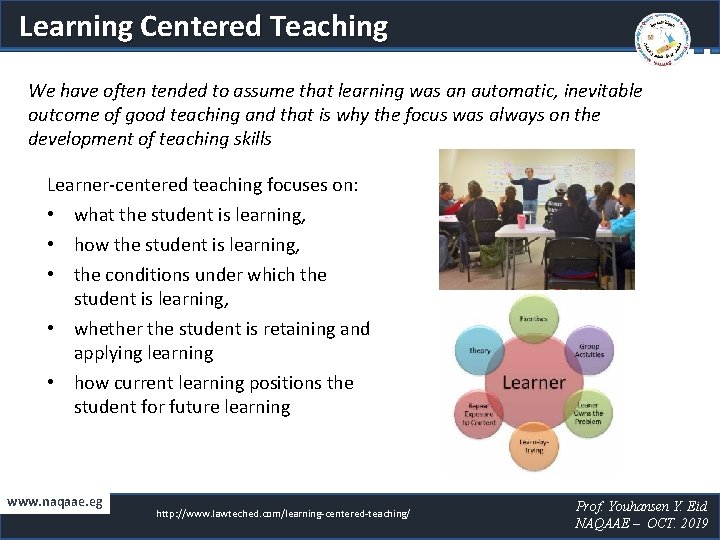
Learning Centered Teaching We have often tended to assume that learning was an automatic, inevitable outcome of good teaching and that is why the focus was always on the development of teaching skills Learner-centered teaching focuses on: • what the student is learning, • how the student is learning, • the conditions under which the student is learning, • whether the student is retaining and applying learning • how current learning positions the student for future learning www. naqaae. eg http: //www. lawteched. com/learning-centered-teaching/ Prof. Youhansen Y. Eid NAQAAE – OCT. 2019
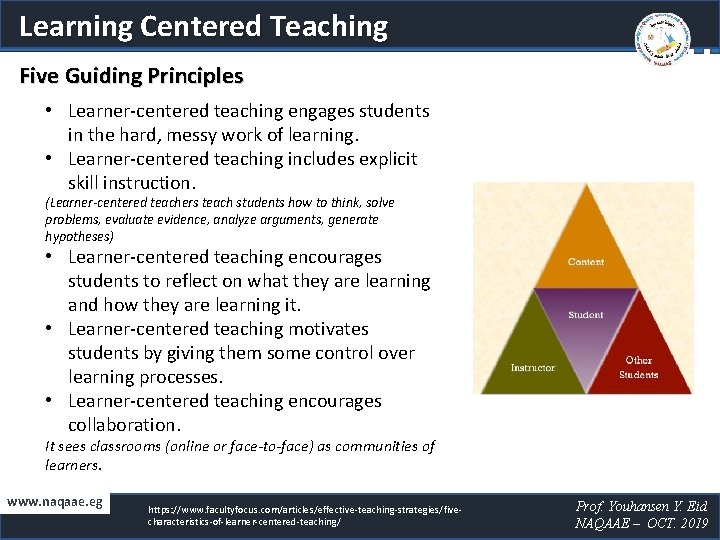
Learning Centered Teaching Five Guiding Principles • Learner-centered teaching engages students in the hard, messy work of learning. • Learner-centered teaching includes explicit skill instruction. (Learner-centered teachers teach students how to think, solve problems, evaluate evidence, analyze arguments, generate hypotheses) • Learner-centered teaching encourages students to reflect on what they are learning and how they are learning it. • Learner-centered teaching motivates students by giving them some control over learning processes. • Learner-centered teaching encourages collaboration. It sees classrooms (online or face-to-face) as communities of learners. www. naqaae. eg https: //www. facultyfocus. com/articles/effective-teaching-strategies/fivecharacteristics-of-learner-centered-teaching/ Prof. Youhansen Y. Eid NAQAAE – OCT. 2019
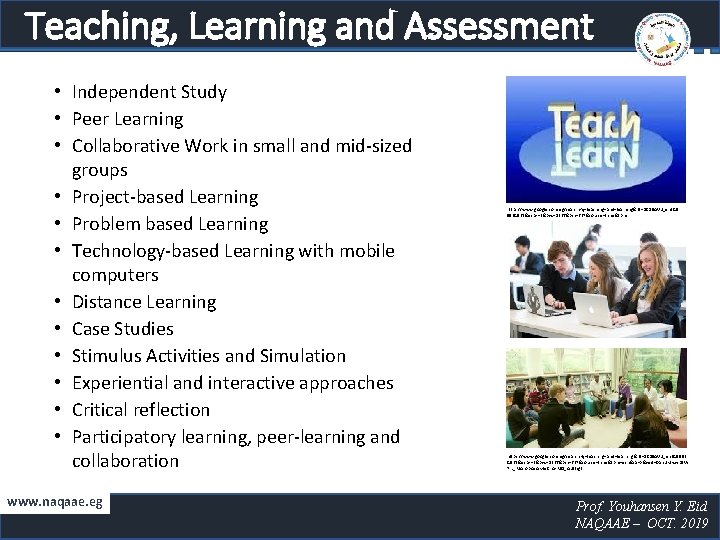
Teaching, Learning and Assessment • Independent Study • Peer Learning • Collaborative Work in small and mid-sized groups • Project-based Learning • Problem based Learning • Technology-based Learning with mobile computers • Distance Learning • Case Studies • Stimulus Activities and Simulation • Experiential and interactive approaches • Critical reflection • Participatory learning, peer-learning and collaboration www. naqaae. eg https: //www. google. com. eg/search? q=teaching+and+learning&rlz=1 C 1 SAVU_en. EG 5 55 EG 563&espv=2&biw=1366&bih=667&source=lnms&tbm https: //www. google. com. eg/search? q=teaching+and+learning&rlz=1 C 1 SAVU_en. EG 555 E G 563&espv=2&biw=1366&bih=667&source=lnms&tbm=isch&sa=X&ved=0 ah. UKEwiyp. ZW 7 r. L_MAh. Xp. As. AKHe. Cn. A-MQ_AUIBig. B Prof. Youhansen Y. Eid NAQAAE – OCT. 2019
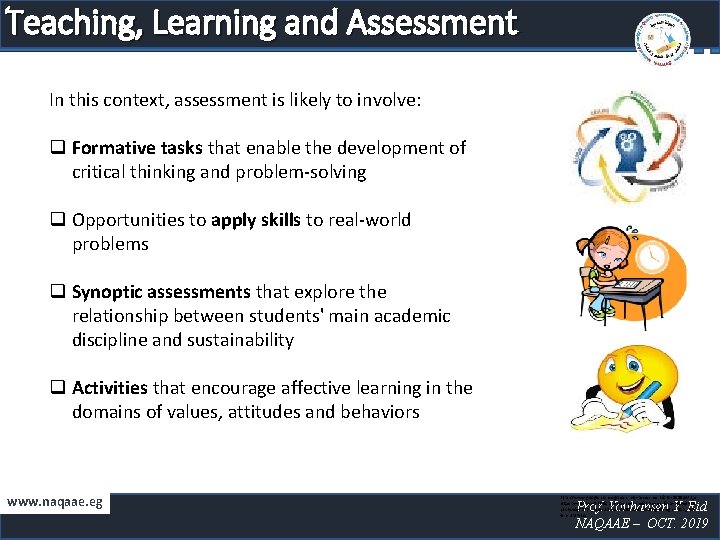
Teaching, Learning and Assessment In this context, assessment is likely to involve: q Formative tasks that enable the development of critical thinking and problem-solving q Opportunities to apply skills to real-world problems q Synoptic assessments that explore the relationship between students' main academic discipline and sustainability q Activities that encourage affective learning in the domains of values, attitudes and behaviors www. naqaae. eg https: //www. google. com. eg/search? q=assessment&rlz=1 C 1 SAVU_e n. EGespv=2&biw=1366&bih=source=lnms&tbm=isch&sa=X&ved=0 a h. UKEwi. Aj 6 DFp. L_MAh. UDLs. AKHR 8 QDx. YQ_AUIBig. B#imgrc=p. Gp_No. Y Hsnvu. IM%3 A Prof. Youhansen Y. Eid NAQAAE – OCT. 2019
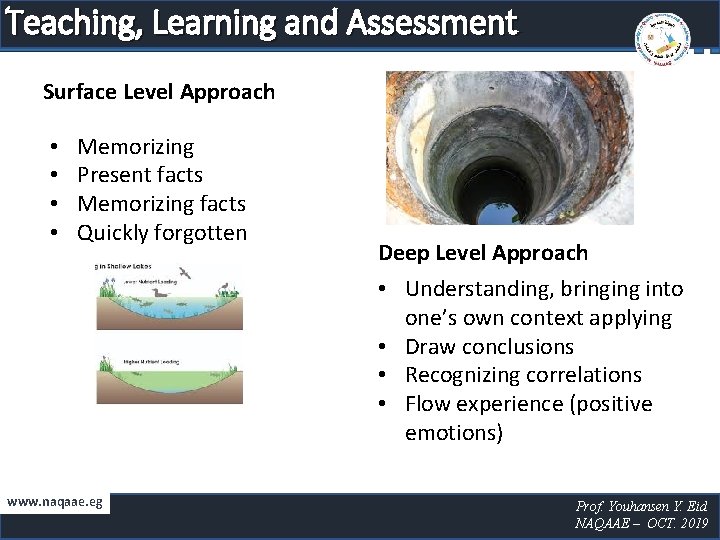
Teaching, Learning and Assessment Surface Level Approach • • Memorizing Present facts Memorizing facts Quickly forgotten Deep Level Approach • Understanding, bringing into one’s own context applying • Draw conclusions • Recognizing correlations • Flow experience (positive emotions) www. naqaae. eg Prof. Youhansen Y. Eid NAQAAE – OCT. 2019
Role of NAQAAE in Promoting CBL
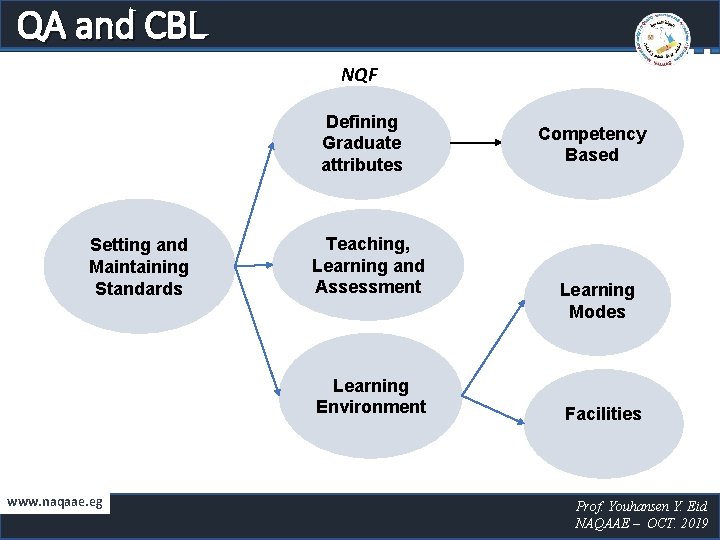
QA and CBL NQF Defining Graduate attributes Setting and Maintaining Standards Teaching, Learning and Assessment Learning Environment www. naqaae. eg Competency Based Learning Modes Facilities Prof. Youhansen Y. Eid NAQAAE – OCT. 2019
QA and CBL Revision and Development of Standards www. naqaae. eg • To comply with the Level descriptors of the NQF • Developed with the collaboration and participation of relevant stakeholders • Subjected to wide stakeholder consultation and Feedback • Encompass standards that reflect and achieve the UNESCO SDG 4 • Developed Competency Based Standards for several Sectors (Medicine- Pharamacy- Nursing – Engineering) • Employability and entrepreneurship are key elements in these standards • Learners are trained to become Lifelong learners Prof. Youhansen Y. Eid NAQAAE – OCT. 2019
QA and CBL Program Design www. naqaae. eg • • • Diverse Programs that are fit for purpose Market Surveys - Needs Future oriented Define graduate attributes Employability Skills Entrepreneurship Define the outcomes Promote life-long learning Based on learners acquiring competencies Training and internships Stakeholder involvement Prof. Youhansen Y. Eid NAQAAE – OCT. 2019
Finally
§ Adopting the CBL approach to programs is becoming crucial to all disciplines § It requires a deep understanding and a flexible approach § It requires changing perspective from unstructured to comprehensive strategy § A strategy for teaching, learning and research § It requires changing assessment strategies § Empowering learners § Commitment of all is a crucial point to the success of implementation True it is a long process … Yet the Journey is the Destination www. naqaae. eg Prof. Youhansen Y. Eid NAQAAE – OCT. 2019
www. naqaae. eg Prof. Youhansen Y. Eid NAQAAE – OCT. 2019
- Slides: 36