
Competency Based Education Followup and Facilitated Dialogue Recap
Competency Based Education: Follow-up and Facilitated Dialogue
Recap • • • CBE Definition Differences between CBE programs and other programs Student Experience Equity Imperative 5 C Efforts to date 2
In this session. . . • • • Guiding principles and regulations framework Equity imperative and assessment Key decisions outlined in draft regulations • Program Design and Approval • Faculty Roles • Grading and Academic Calendar • CBE Collaborative and Discussion 3
5 C Guiding Principles 1. 2. 3. 4. 5. 6. 7. Maintain equity as a central goal and driver for change Support college access, persistence, and completion Prepare students for college, career, and lifelong learning Intentional, transparent, and meaningful competencies Design with the student in mind – anytime, anywhere learning Provide students with timely and accessible support Empower students to be active learners and faculty to engage in continual and collaborative inquiry processes 8. Cultural validation (culturally responsive pedagogy) in program design to support diverse learners 9. Serve populations being left behind with an emphasis on historically underserved students 10. Equity minded data collection and evaluation 4
5 C Regulatory Workgroup Purpose • The workgroup was responsible for the review and drafting of regulatory language for statewide implementation of direct assessment competency based education. Process • The workgroup met concurrently to regularly scheduled 5 C meetings. In preparation for each CBE meeting, the workgroup provided a set of regulatory changes for the 5 C committee to review and discuss. 5 5
Regulations Framework • Regulations are needed to enable colleges to maximize state and federal funding support for CBE programs. • The regulations will reside under the Alternative Instructional Methodologies in Subchapter 3 of Title 5 Division 6 Chapter 6. • The student learning journey, with emphasis on equity, is the focus of the design and elements of the program. • Focus on direct assessment competency based education as a starting point. • Program and module quality standards align with those of degree programs and degree applicable credit courses. • The implementation of a CBE program will include related professional development. • Chancellor’s Office approval will be required before a college can offer a CBE program for apportionment purposes. • CBE programs will have a separate program approval process, modules are to be adopted as part of a program. • In providing students with the flexibility to learn at their own pace, grading and transcripts systems will align with a national model. • Regulations will allow for greater flexibility and will clearly differentiate between direct assessment CBE and other programs. 6
Ensuring an Equity minded Approach Each section of the proposed Title 5 regulations was reviewed using CUE’s policy review framework which includes 6 indicators and related questions to evaluate whether language is maintaining an equity minded approach. https: //cue. usc. edu/files/2017/02/CUE Protocol 1. Equity mindedness as the guiding paradigm for policy 2. Equity in language 3. Data collection and reporting Strategy 4. Disproportionate Impact 5. Policy Consistency and Ubiquity 6. Equity framing Workbook Final_Web. pdf 7
The Equity Imperative How? Adopt Culturally Responsive Practices • Utilize culturally responsive learning activities, curricula, and instruction • Support faculty in developing culturally responsive teaching practices • Maintain high academic standards Utilize Data • What's measured gets noticed • Meet students where they are and continuously support them Recognize the Importance of Collectivism • The feeling of belonging supports student success • Create learning environments that support peer to peer learning 8
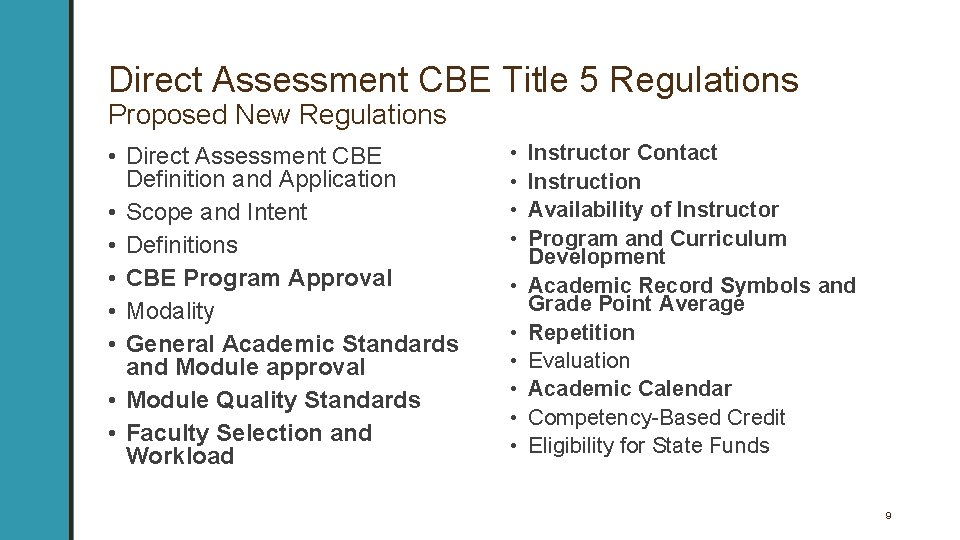
Direct Assessment CBE Title 5 Regulations Proposed New Regulations • Direct Assessment CBE Definition and Application • Scope and Intent • Definitions • CBE Program Approval • Modality • General Academic Standards and Module approval • Module Quality Standards • Faculty Selection and Workload • • • Instructor Contact Instruction Availability of Instructor Program and Curriculum Development Academic Record Symbols and Grade Point Average Repetition Evaluation Academic Calendar Competency Based Credit Eligibility for State Funds 9
Program Approval & Standards
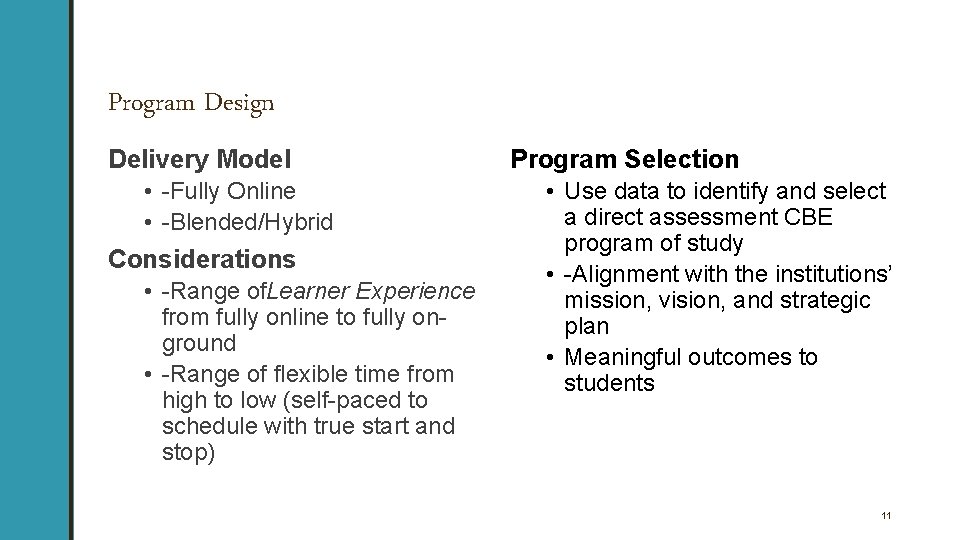
Program Design Delivery Model • Fully Online • Blended/Hybrid Considerations • Range of Learner Experience from fully online to fully on ground • Range of flexible time from high to low (self paced to schedule with true start and stop) Program Selection • Use data to identify and select a direct assessment CBE program of study • Alignment with the institutions’ mission, vision, and strategic plan • Meaningful outcomes to students 11
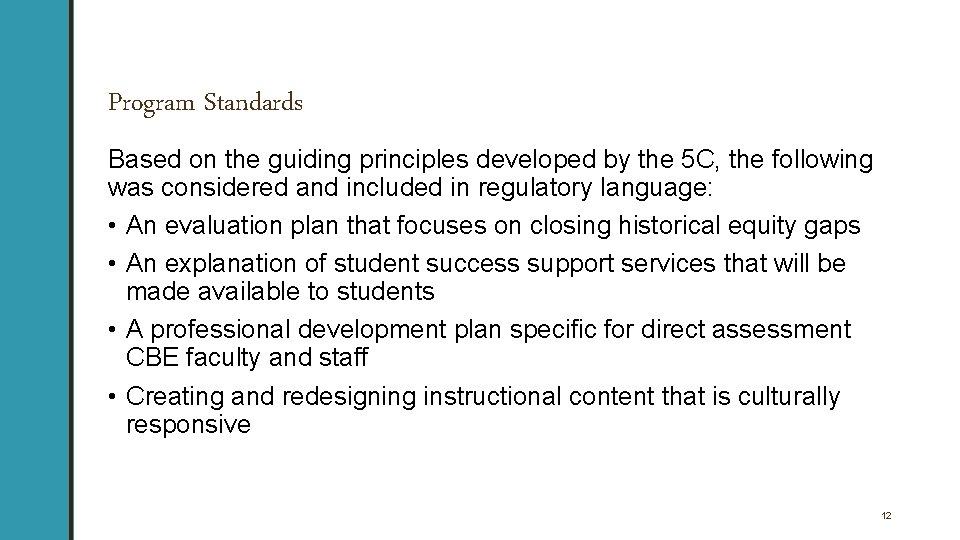
Program Standards Based on the guiding principles developed by the 5 C, the following was considered and included in regulatory language: • An evaluation plan that focuses on closing historical equity gaps • An explanation of student success support services that will be made available to students • A professional development plan specific for direct assessment CBE faculty and staff • Creating and redesigning instructional content that is culturally responsive 12
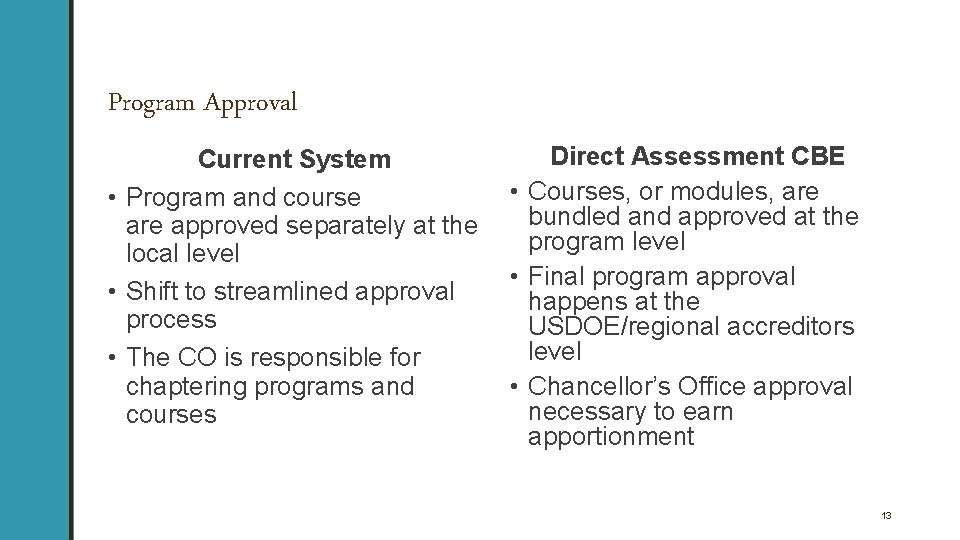
Program Approval Direct Assessment CBE Current System • Courses, or modules, are • Program and course bundled and approved at the are approved separately at the program level local level • Final program approval • Shift to streamlined approval happens at the process USDOE/regional accreditors level • The CO is responsible for chaptering programs and • Chancellor’s Office approval necessary to earn courses apportionment 13
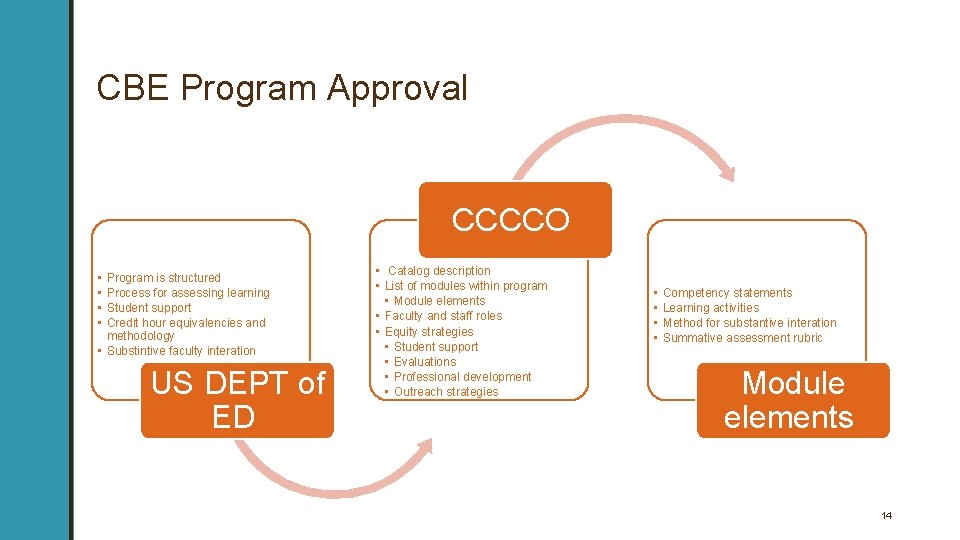
CBE Program Approval CCCCO • • Program is structured Process for assessing learning Student support Credit hour equivalencies and methodology • Substintive faculty interation US DEPT of ED • Catalog description • List of modules within program • Module elements • Faculty and staff roles • Equity strategies • Student support • Evaluations • Professional development • Outreach strategies • • Competency statements Learning activities Method for substantive interation Summative assessment rubric Module elements 14
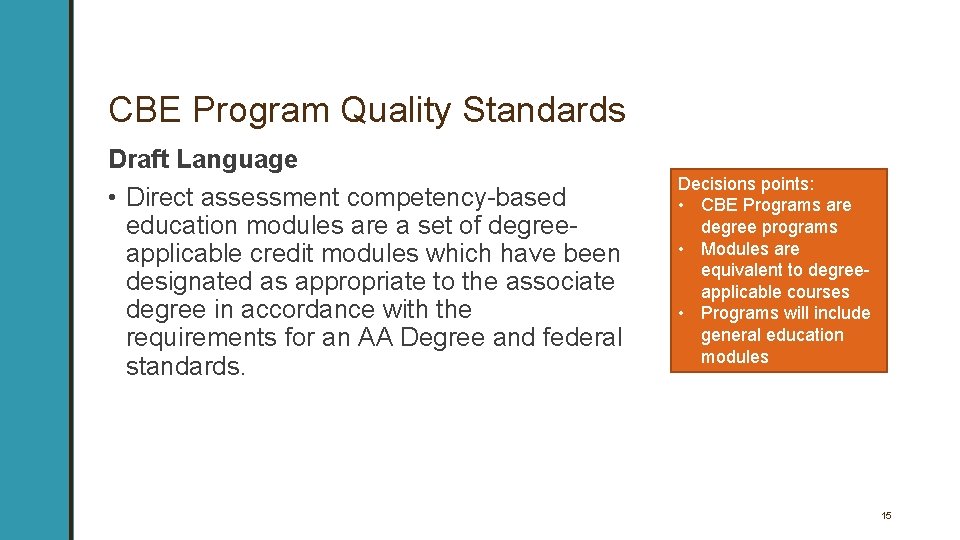
CBE Program Quality Standards Draft Language • Direct assessment competency based education modules are a set of degree applicable credit modules which have been designated as appropriate to the associate degree in accordance with the requirements for an AA Degree and federal standards. Decisions points: • CBE Programs are degree programs • Modules are equivalent to degree applicable courses • Programs will include general education modules 15

Faculty Roles
Faculty Selection and Workload Faculty is inseparable from design and implementation of direct assessment CBE programs. However, CBE faculty roles typically differ from traditional roles in order to meet the unique components of the CBE approach and USDOE requirements on faculty learner interaction. 17
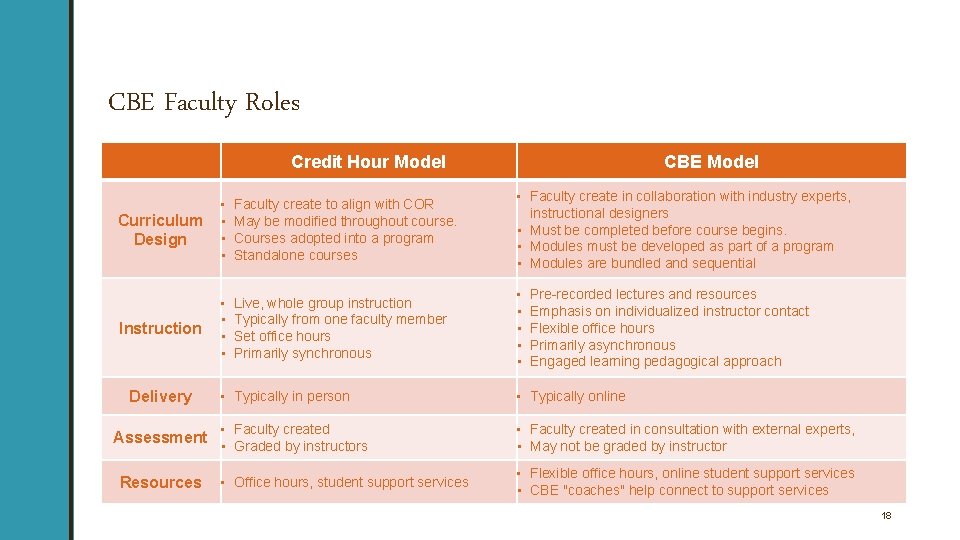
CBE Faculty Roles Credit Hour Model • Faculty create to align with COR Curriculum • May be modified throughout course. • Courses adopted into a program Design • Standalone courses • Live, whole group instruction Instruction Delivery • Faculty create in collaboration with industry experts, instructional designers • Must be completed before course begins. • Modules must be developed as part of a program • Modules are bundled and sequential • Pre recorded lectures and resources • Typically from one faculty member • Set office hours • Primarily synchronous • • • Typically in person • Typically online • Faculty created in consultation with external experts, Assessment • Graded by instructors Resources CBE Model • Office hours, student support services Emphasis on individualized instructor contact Flexible office hours Primarily asynchronous Engaged learning pedagogical approach • May not be graded by instructor • Flexible office hours, online student support services • CBE "coaches" help connect to support services 18
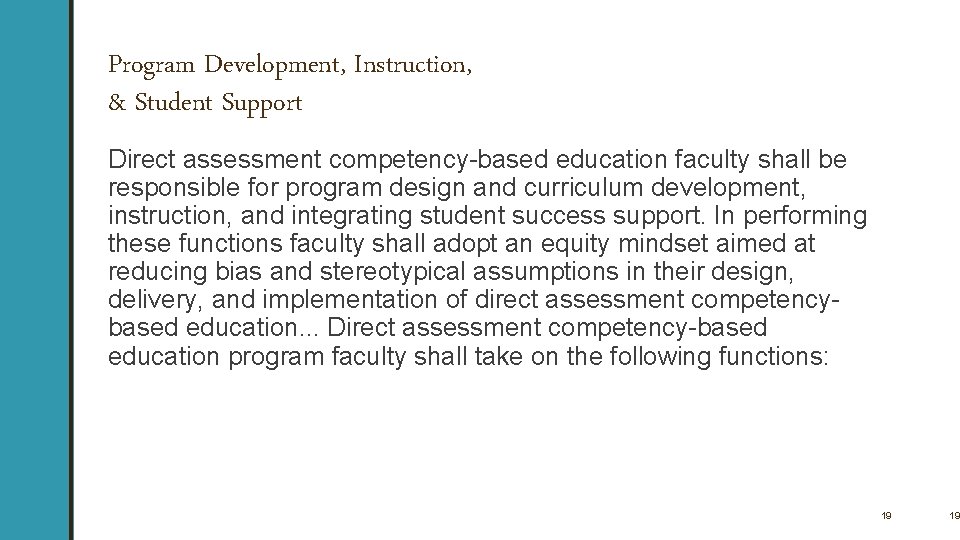
Program Development, Instruction, & Student Support Direct assessment competency based education faculty shall be responsible for program design and curriculum development, instruction, and integrating student success support. In performing these functions faculty shall adopt an equity mindset aimed at reducing bias and stereotypical assumptions in their design, delivery, and implementation of direct assessment competency based education. . . Direct assessment competency based education program faculty shall take on the following functions: 19 19
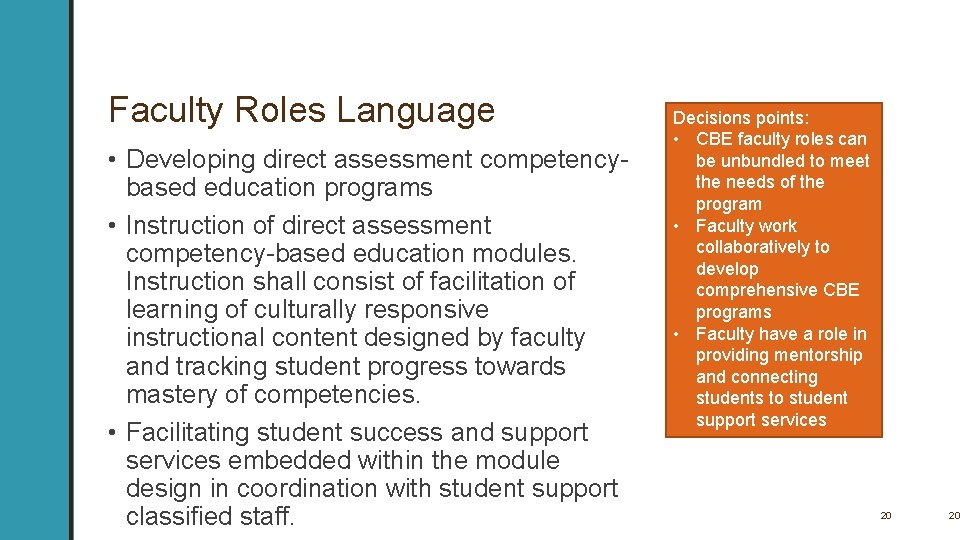
Faculty Roles Language • Developing direct assessment competency based education programs • Instruction of direct assessment competency based education modules. Instruction shall consist of facilitation of learning of culturally responsive instructional content designed by faculty and tracking student progress towards mastery of competencies. • Facilitating student success and support services embedded within the module design in coordination with student support classified staff. Decisions points: • CBE faculty roles can be unbundled to meet the needs of the program • Faculty work collaboratively to develop comprehensive CBE programs • Faculty have a role in providing mentorship and connecting students to student support services 20 20
Faculty Roles – Discussion How does competency based education (CBE) align with current pedagogical approaches to teaching and learning at the California Community Colleges? How might it differ? 21

Academic Symbols & Grading
Grading in CBE • Under direct assessment CBE programs, mastery or achievement of competencies is not tied to a traditional grading system and a GPA is not automatically calculated. • Students must demonstrate discrete competencies to receive graded marks. 23
Defining Mastery “Mastery” means a student has mastered the competency by meeting or exceeding the minimum requirement of 80% or higher on the summative assessment. 24
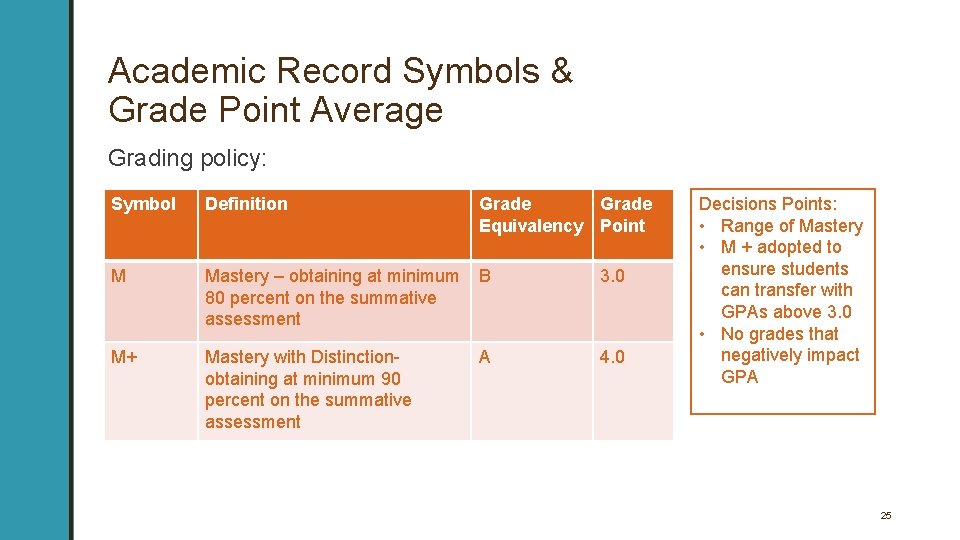
Academic Record Symbols & Grade Point Average Grading policy: Symbol Definition Grade Equivalency Point M Mastery – obtaining at minimum B 80 percent on the summative assessment 3. 0 M+ Mastery with Distinction obtaining at minimum 90 percent on the summative assessment 4. 0 A Decisions Points: • Range of Mastery • M + adopted to ensure students can transfer with GPAs above 3. 0 • No grades that negatively impact GPA 25

Academic Calendar & Enrollment Guidelines
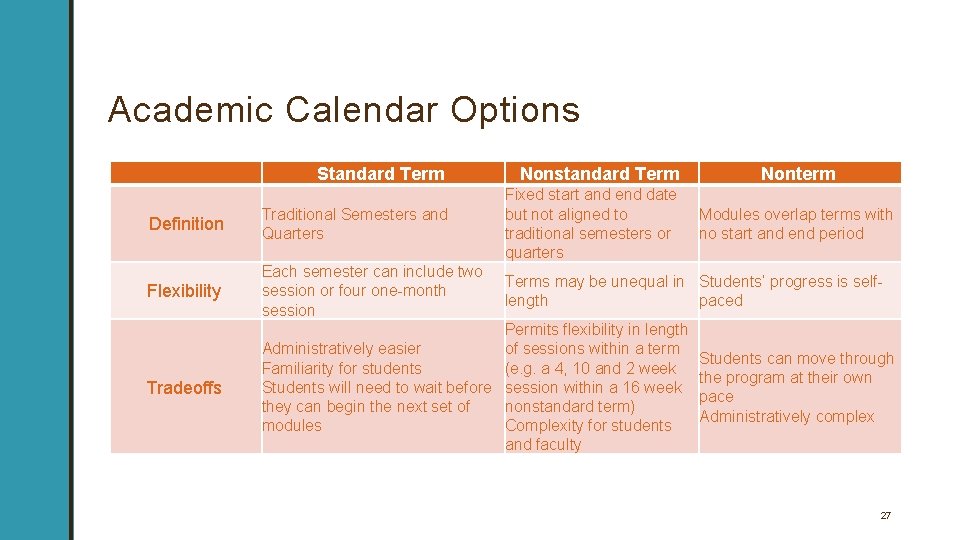
Academic Calendar Options Standard Term Nonstandard Term Nonterm Definition Traditional Semesters and Quarters Fixed start and end date but not aligned to traditional semesters or quarters Flexibility Each semester can include two session or four one month session Terms may be unequal in Students’ progress is self length paced Tradeoffs Permits flexibility in length Administratively easier of sessions within a term Familiarity for students (e. g. a 4, 10 and 2 week Students will need to wait before session within a 16 week they can begin the next set of nonstandard term) modules Complexity for students and faculty Modules overlap terms with no start and end period Students can move through the program at their own pace Administratively complex 27
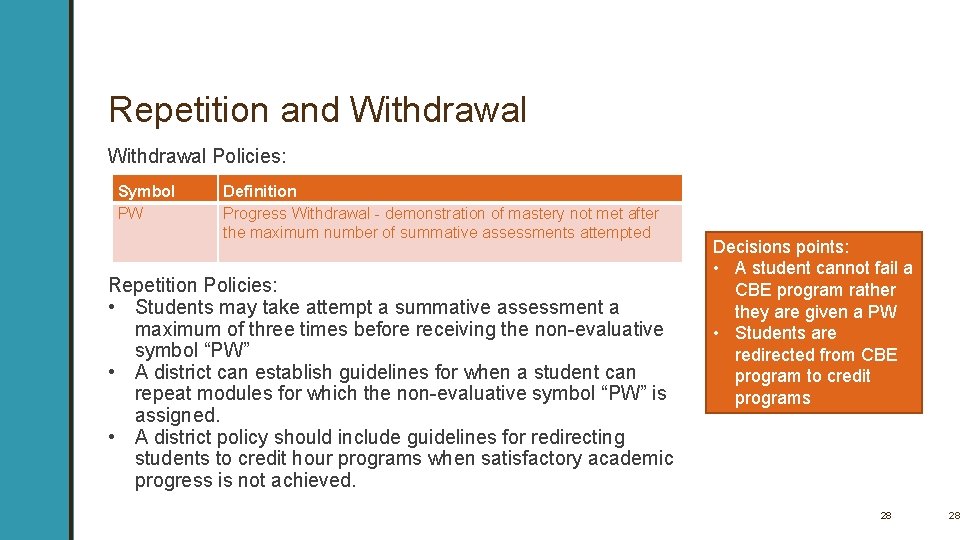
Repetition and Withdrawal Policies: Symbol PW Definition Progress Withdrawal demonstration of mastery not met after the maximum number of summative assessments attempted Repetition Policies: • Students may take attempt a summative assessment a maximum of three times before receiving the non evaluative symbol “PW” • A district can establish guidelines for when a student can repeat modules for which the non evaluative symbol “PW” is assigned. • A district policy should include guidelines for redirecting students to credit hour programs when satisfactory academic progress is not achieved. Decisions points: • A student cannot fail a CBE program rather they are given a PW • Students are redirected from CBE program to credit programs 28 28
Discussion The committee wrestled with the elements introduced in this sections (and others not covered here), what comes to mind as we discussed these components of direct assessment CBE? 29
Direct Assessment CBE Collaborative
CBE Collaborative • • Goals Objectives Criteria/Structure Timeline 31
Goals for the Collaborative • Adoption and application of direct assessment CBE Title 5 regulations. • The development of best practices and procedures for direct assessment CBE and curriculum design. • The development of an equity minded direct assessment CBE program framework that will help inform a systemwide toolkit for implementation. • The identification of resources needed inclusive of costs, personnel, professional development, and technology needs. • Information sharing to inform Chancellor’s Office planning and state level infrastructure to support local implementation of direct assessment CBE programs. • The cultivation of CBE leaders within the system to provide training and technical support to other colleges. 32 32
Direct Assessment CBE Collaborative Objectives 1. Establish a local structure to support the development and implementation of a direct assessment CBE program 2. Support the development of a direct assessment CBE program framework 3. To assist with the development and dissemination of direct assessment CBE program framework for system level implementation 33 33
Collaborative Criteria Colleges will be selected based on their ability to demonstrate the following: • A historical commitment to serving adult learners and students from minoritized communities through innovative practices and a proven dedication to eliminating opportunity gaps in their service area. • College wide and district level commitment to the implementation of direct assessment CBE that includes a willingness to make financial investments and build capacity for innovation and implementation inclusive of working with college leaders to ensure long term sustainability of reforms. • A proven ability to bring together cross departmental teams of faculty, staff, and administrators with shared enthusiasm for change and innovation. This should include a history of working closely with the local Academic Senate and local bargaining units to adopt innovative teaching and learning strategies. • A history of collaborating with external partners and four year institutions to implement intersegmental efforts with a particular focus on equity. Colleges should also demonstrate a willingness and commitment from four year partners to implement direct assessment CBE. • Ability to integrate data informed decisions in the selection of programs by conducting labor market analysis to determine which degrees are in demand offer the greatest opportunities for students. 34 34
Collaborative Structure • The Chancellor's Office is providing seed money to support the implementation of direct assessment CBE among a collaborative of X colleges. • The CBE collaborative will establish a direct assessment CBE learning community with the goal of informing key aspects for systemwide implementation of direct assessment CBE. • Interested districts and/or colleges will apply for funds through an application process established by the Chancellor’s Office. • The collaborative is expected to commence Spring 2021 and end in Fall 2023. 35 35
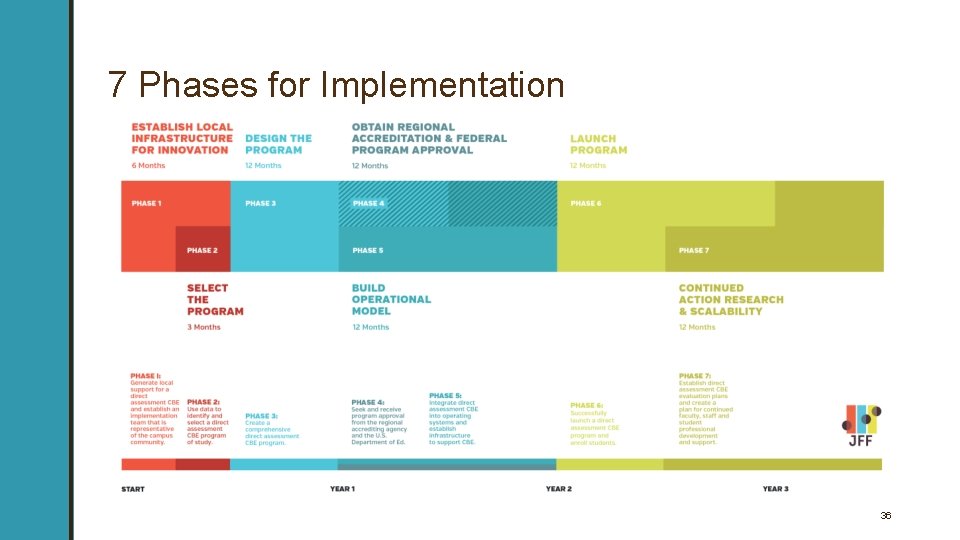
7 Phases for Implementation 36
CBE Collaborative Discussion • • • Timeline College Selection Criteria Program Selection Criteria

Q & A
- Slides: 38