
Competency Based Education and Training CBET An Overview
Competency Based Education and Training (CBET) An Overview Marcia Rowe Amonde (Ph. D) HEART Trust NTA August 7, 2020
Technical Vocational Education and Training (TVET) Important to achieving the Economic Development Goals Marcia Rowe Amonde (Ph. D) | August 7, 2020
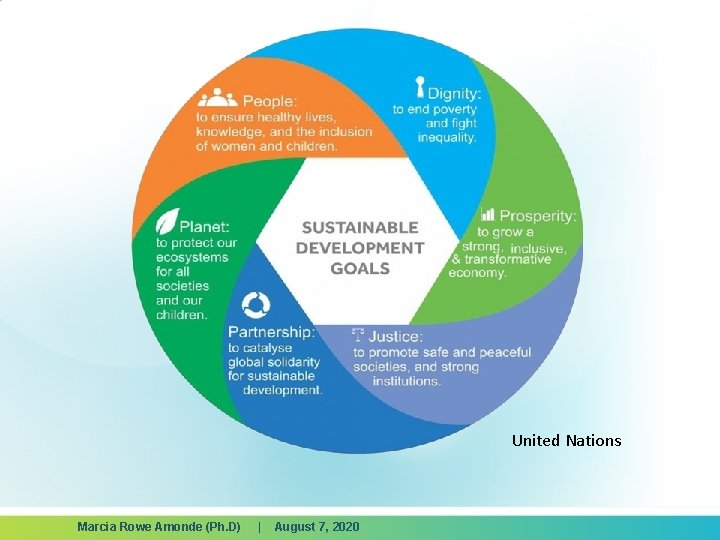
United Nations Marcia Rowe Amonde (Ph. D) | August 7, 2020
• Relevant • Responsive • Add Value
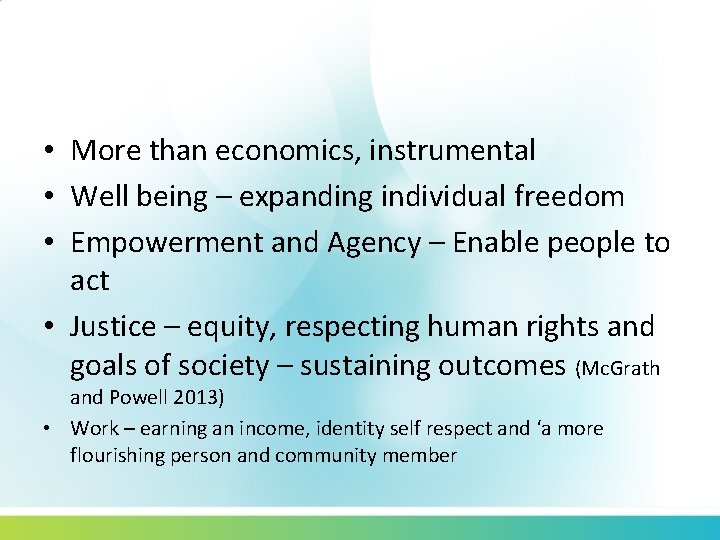
• More than economics, instrumental • Well being – expanding individual freedom • Empowerment and Agency – Enable people to act • Justice – equity, respecting human rights and goals of society – sustaining outcomes (Mc. Grath and Powell 2013) • Work – earning an income, identity self respect and ‘a more flourishing person and community member
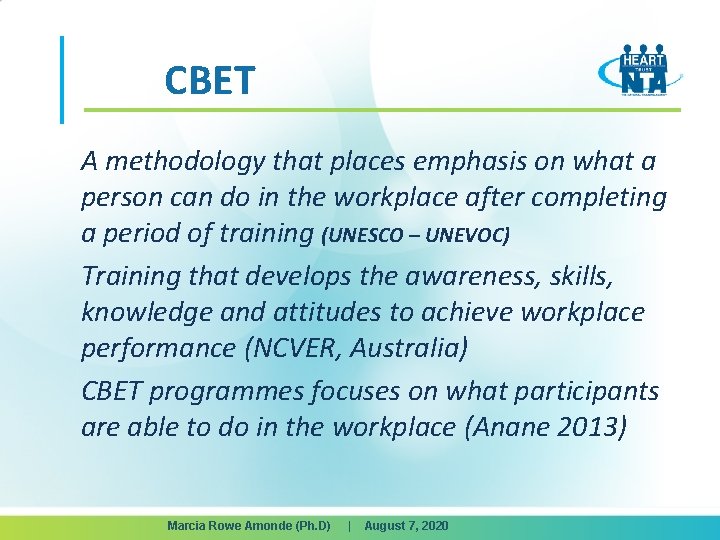
CBET A methodology that places emphasis on what a person can do in the workplace after completing a period of training (UNESCO – UNEVOC) Training that develops the awareness, skills, knowledge and attitudes to achieve workplace performance (NCVER, Australia) CBET programmes focuses on what participants are able to do in the workplace (Anane 2013) Marcia Rowe Amonde (Ph. D) | August 7, 2020
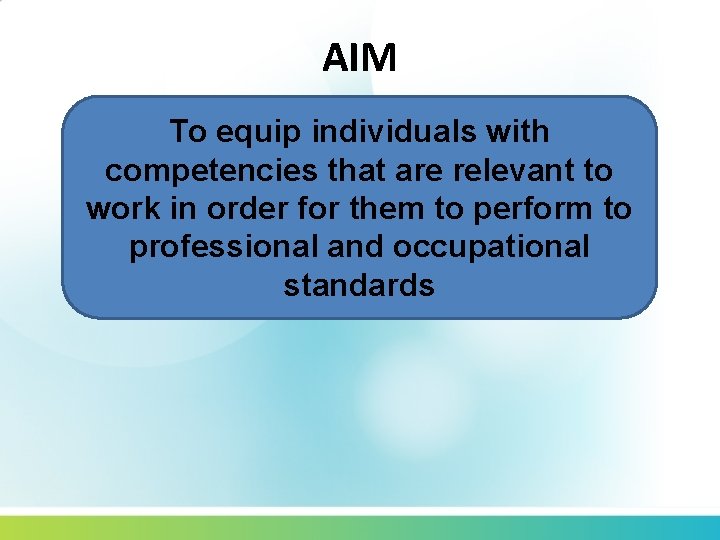
AIM To equip individuals with competencies that are relevant to work in order for them to perform to professional and occupational standards
UNESCO – Learning Outcomes • Learning to do • Learning to be Capability Approach
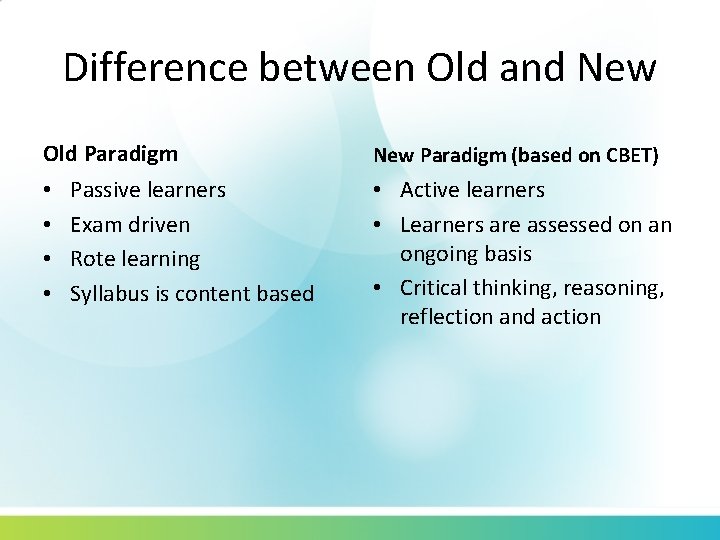
Difference between Old and New Old Paradigm • • Passive learners Exam driven Rote learning Syllabus is content based New Paradigm (based on CBET) • Active learners • Learners are assessed on an ongoing basis • Critical thinking, reasoning, reflection and action
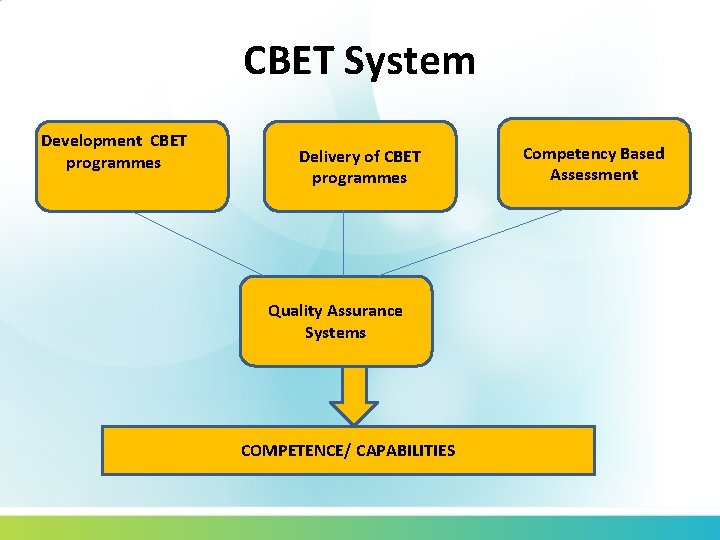
CBET System Development CBET programmes Delivery of CBET programmes Quality Assurance Systems COMPETENCE/ CAPABILITIES Competency Based Assessment
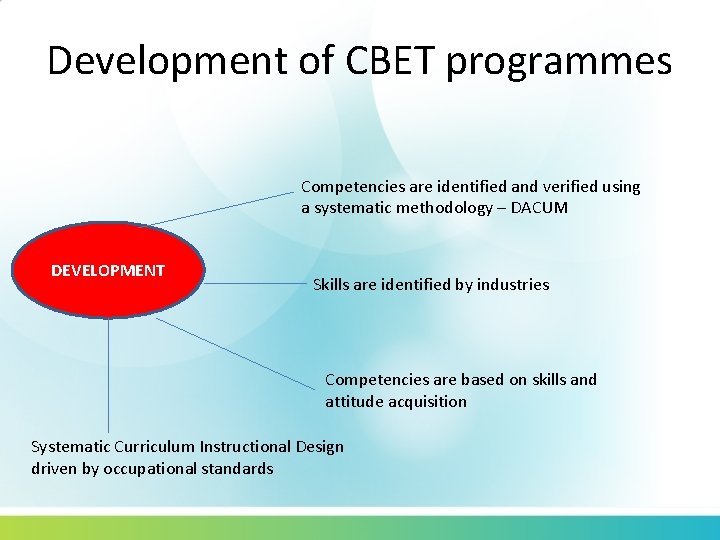
Development of CBET programmes Competencies are identified and verified using a systematic methodology – DACUM DEVELOPMENT Skills are identified by industries Competencies are based on skills and attitude acquisition Systematic Curriculum Instructional Design driven by occupational standards
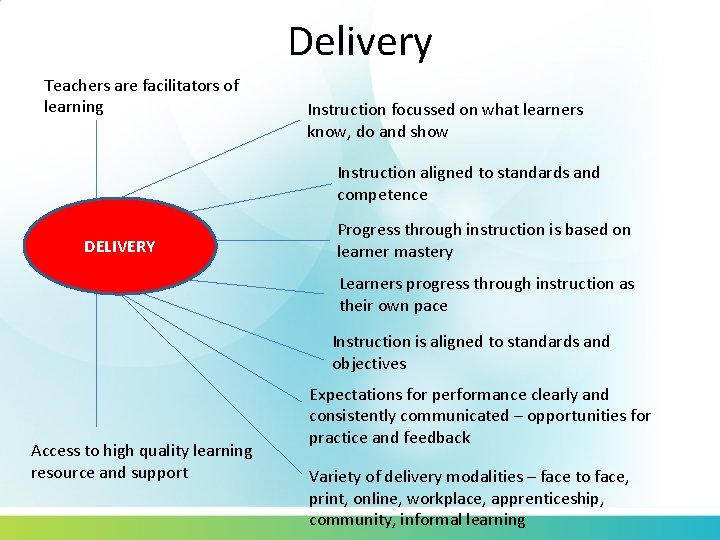
Delivery Teachers are facilitators of learning Instruction focussed on what learners know, do and show Instruction aligned to standards and competence DELIVERY Progress through instruction is based on learner mastery Learners progress through instruction as their own pace Instruction is aligned to standards and objectives Access to high quality learning resource and support Expectations for performance clearly and consistently communicated – opportunities for practice and feedback Variety of delivery modalities – face to face, print, online, workplace, apprenticeship, community, informal learning
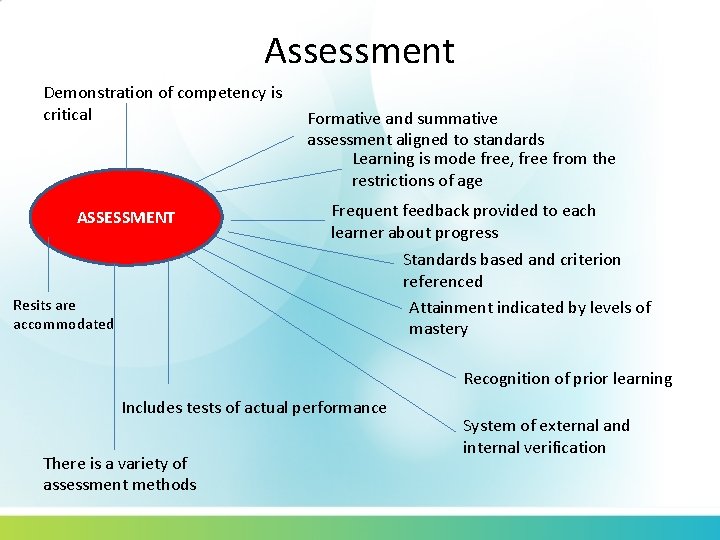
Assessment Demonstration of competency is critical ASSESSMENT Formative and summative assessment aligned to standards Learning is mode free, free from the restrictions of age Frequent feedback provided to each learner about progress Standards based and criterion referenced Attainment indicated by levels of mastery Resits are accommodated Recognition of prior learning Includes tests of actual performance There is a variety of assessment methods System of external and internal verification
Performance Criteria • Standards against which performance is judged
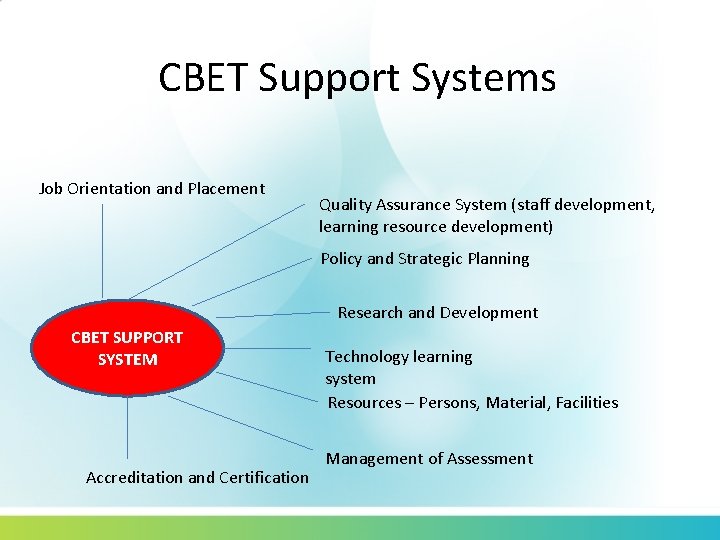
CBET Support Systems Job Orientation and Placement Quality Assurance System (staff development, learning resource development) Policy and Strategic Planning Research and Development CBET SUPPORT SYSTEM Accreditation and Certification Technology learning system Resources – Persons, Material, Facilities Management of Assessment
Structure of CBET Training • Competencies to be achieved are carefully identified, verified and made public in advance • Criteria for achievement are explicitly stated and made public • Instructional programme provides for individual development and evaluation of specified competencies • Assessment of the competency requires actual performance • Participants progress at their own pace
Facilitation Methods for CBET • • Practical Tasks Project Based Learning Direct Instruction Method Discussion Method Small Group Method Individual study Problem Solving Method Research Method

“ It is important to have persons who can think, lead and act from a global perspective and who must possess a global mind as well as global skills ” (Kim P. S. 1999) Marcia Rowe Amonde (Ph. D) | August 7, 2020
Benefits of CBET • Learners achieve competencies required to perform jobs • Learners build confidence as they succeed in mastering competencies • Training time is used more efficiently and effectively as the trainer is a facilitator of learning as opposed to provider of information • More training time is devoted to evaluating each learner’s ability to perform essential job skills
HEART’S CBET SYSTEM AT A GLANCE • • • Development of occupational standards Industry Partnership/ Linkages Practical hands on training Career Guidance Pathways to access learning Systematic Curriculum and Instructional Design – Driven by Standards Various modes of delivery – online, print, face to face, ICT Integration, Workplace, Apprenticeship, Community Training Continuous Assessment Learner readiness for assessment Management Advisory Committees Prior Learning Assessment
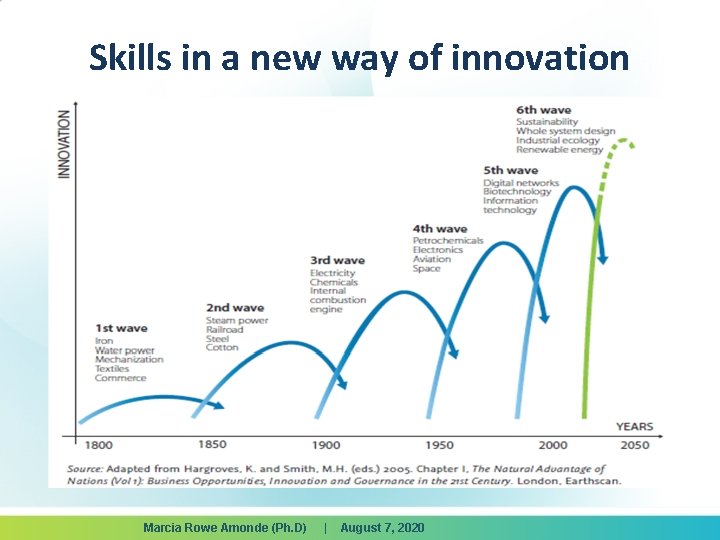
Skills in a new way of innovation Marcia Rowe Amonde (Ph. D) | August 7, 2020
- Slides: 21