
Competencies Why the need for CDS Competency Standards
- Slides: 18
Competencies & Why the need for CDS Competency Standards? Nina Lean Member: HIMAA CDS Competencies Working Party
HIMAAs Role: HIMAA “Promotes & supports HIM professionals as the universally recognised specialists in information management, at all levels of the healthcare system”
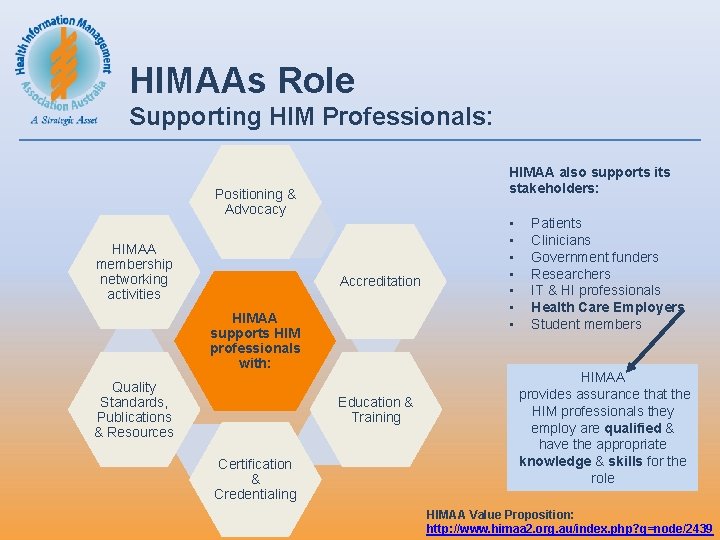
HIMAAs Role Supporting HIM Professionals: HIMAA also supports its stakeholders: Positioning & Advocacy HIMAA membership networking activities Accreditation HIMAA supports HIM professionals with: Quality Standards, Publications & Resources Education & Training Certification & Credentialing • • Patients Clinicians Government funders Researchers IT & HI professionals Health Care Employers Student members HIMAA provides assurance that the HIM professionals they employ are qualified & have the appropriate knowledge & skills for the role HIMAA Value Proposition: http: //www. himaa 2. org. au/index. php? q=node/2439
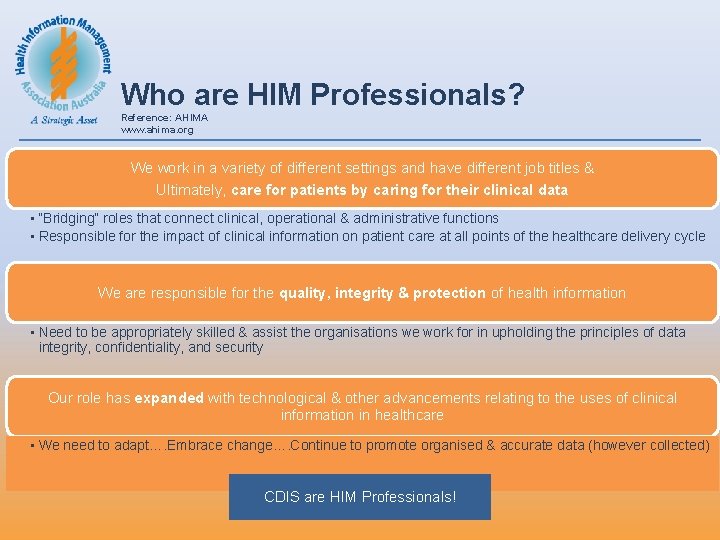
Who are HIM Professionals? Reference: AHIMA www. ahima. org We work in a variety of different settings and have different job titles & Ultimately, care for patients by caring for their clinical data • “Bridging” roles that connect clinical, operational & administrative functions • Responsible for the impact of clinical information on patient care at all points of the healthcare delivery cycle We are responsible for the quality, integrity & protection of health information • Need to be appropriately skilled & assist the organisations we work for in upholding the principles of data integrity, confidentiality, and security Our role has expanded with technological & other advancements relating to the uses of clinical information in healthcare • We need to adapt…. Embrace change…. Continue to promote organised & accurate data (however collected) CDIS are HIM Professionals!
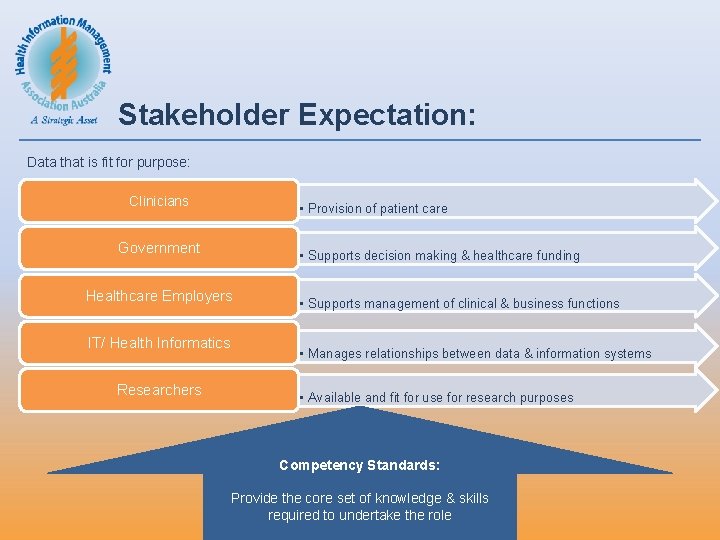
Stakeholder Expectation: Data that is fit for purpose: Clinicians • Provision of patient care Government • Supports decision making & healthcare funding Healthcare Employers IT/ Health Informatics Researchers • Supports management of clinical & business functions • Manages relationships between data & information systems • Available and fit for use for research purposes Competency Standards: Provide the core set of knowledge & skills required to undertake the role
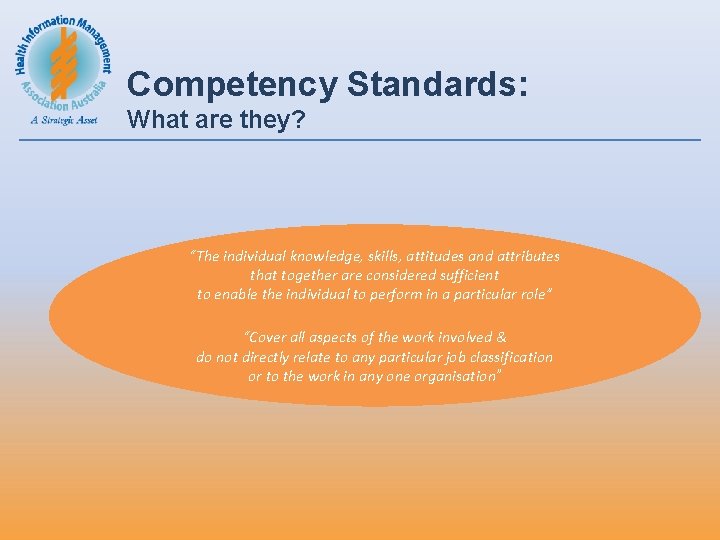
Competency Standards: What are they? “The individual knowledge, skills, attitudes and attributes that together are considered sufficient to enable the individual to perform in a particular role” “Cover all aspects of the work involved & do not directly relate to any particular job classification or to the work in any one organisation”
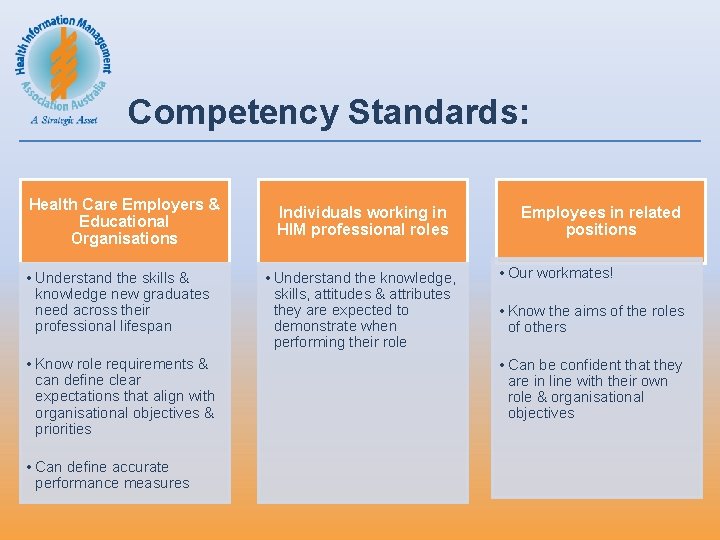
Competency Standards: Health Care Employers & Educational Organisations • Understand the skills & knowledge new graduates need across their professional lifespan • Know role requirements & can define clear expectations that align with organisational objectives & priorities • Can define accurate performance measures Individuals working in HIM professional roles • Understand the knowledge, skills, attitudes & attributes they are expected to demonstrate when performing their role Employees in related positions • Our workmates! • Know the aims of the roles of others • Can be confident that they are in line with their own role & organisational objectives
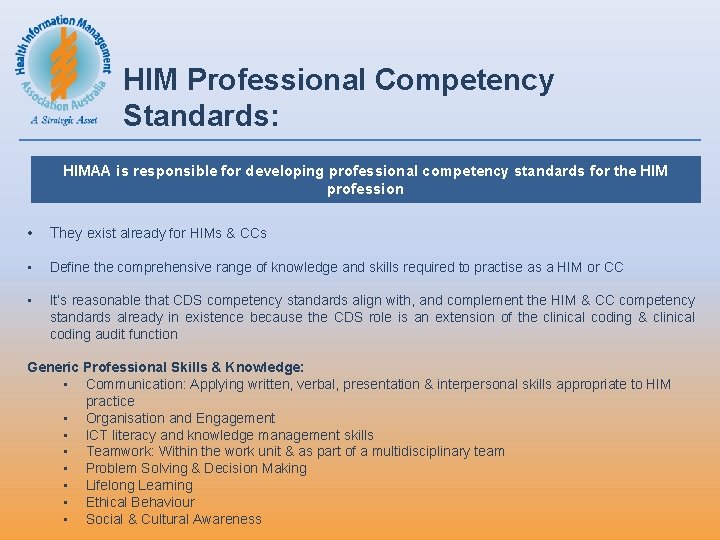
HIM Professional Competency Standards: HIMAA is responsible for developing professional competency standards for the HIM profession • They exist already for HIMs & CCs • Define the comprehensive range of knowledge and skills required to practise as a HIM or CC • It’s reasonable that CDS competency standards align with, and complement the HIM & CC competency standards already in existence because the CDS role is an extension of the clinical coding & clinical coding audit function Generic Professional Skills & Knowledge: • Communication: Applying written, verbal, presentation & interpersonal skills appropriate to HIM practice • Organisation and Engagement • ICT literacy and knowledge management skills • Teamwork: Within the work unit & as part of a multidisciplinary team • Problem Solving & Decision Making • Lifelong Learning • Ethical Behaviour • Social & Cultural Awareness
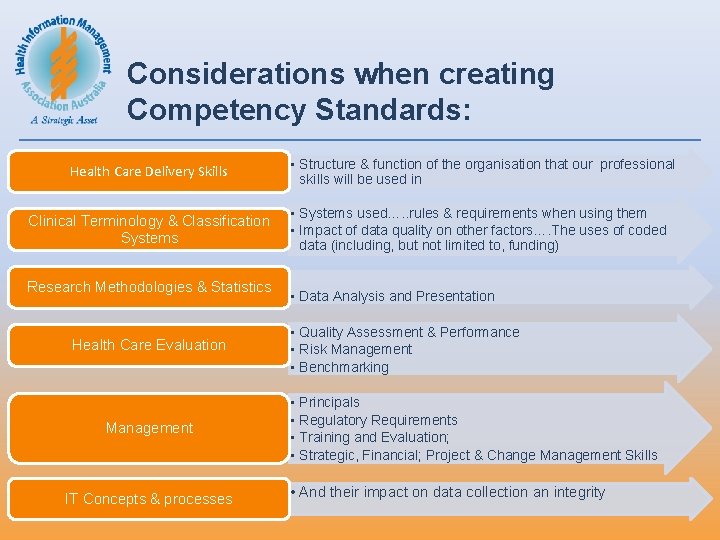
Considerations when creating Competency Standards: Health Care Delivery Skills Clinical Terminology & Classification Systems Research Methodologies & Statistics Health Care Evaluation Management IT Concepts & processes • Structure & function of the organisation that our professional skills will be used in • Systems used…. . rules & requirements when using them • Impact of data quality on other factors…. The uses of coded data (including, but not limited to, funding) • Data Analysis and Presentation • Quality Assessment & Performance • Risk Management • Benchmarking • Principals • Regulatory Requirements • Training and Evaluation; • Strategic, Financial; Project & Change Management Skills • And their impact on data collection an integrity
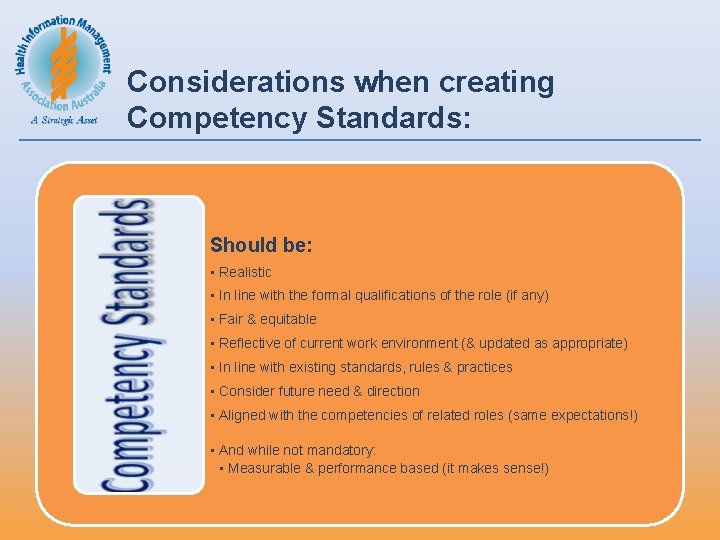
Considerations when creating Competency Standards: Should be: • Realistic • In line with the formal qualifications of the role (if any) • Fair & equitable • Reflective of current work environment (& updated as appropriate) • In line with existing standards, rules & practices • Consider future need & direction • Aligned with the competencies of related roles (same expectations!) • And while not mandatory: • Measurable & performance based (it makes sense!)
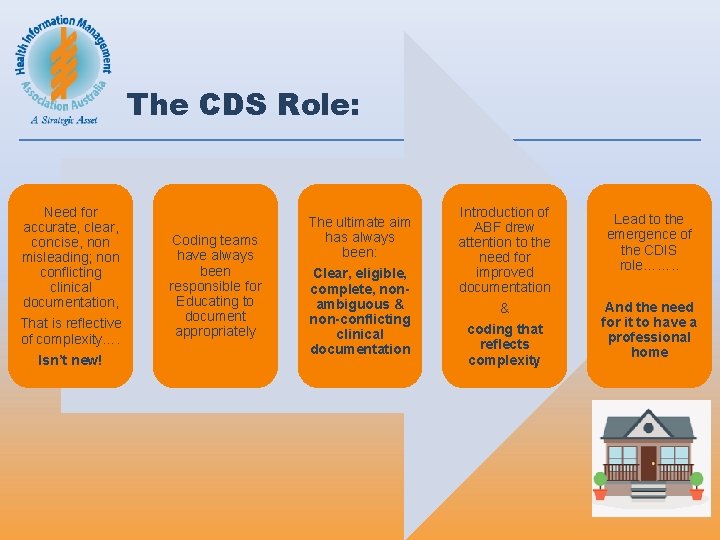
The CDS Role: Need for accurate, clear, concise, non misleading; non conflicting clinical documentation, That is reflective of complexity…. Isn’t new! Coding teams have always been responsible for Educating to document appropriately The ultimate aim has always been: Clear, eligible, complete, nonambiguous & non-conflicting clinical documentation Introduction of ABF drew attention to the need for improved documentation & coding that reflects complexity Lead to the emergence of the CDIS role……. . And the need for it to have a professional home
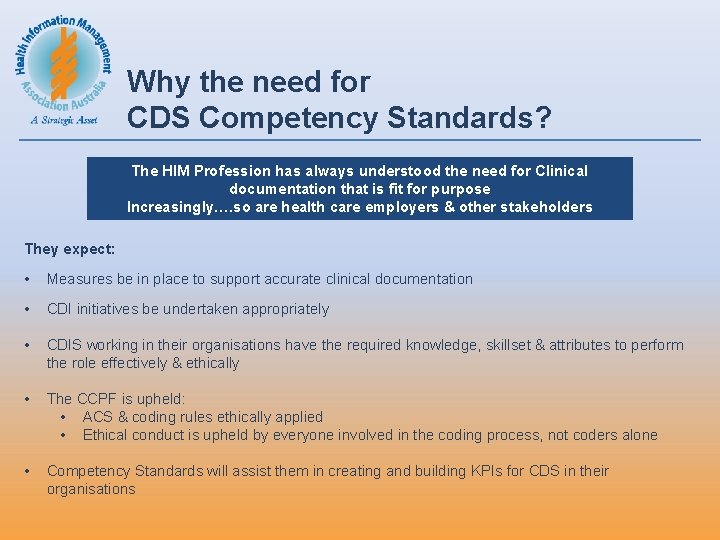
Why the need for CDS Competency Standards? The HIM Profession has always understood the need for Clinical documentation that is fit for purpose Increasingly…. so are health care employers & other stakeholders They expect: • Measures be in place to support accurate clinical documentation • CDI initiatives be undertaken appropriately • CDIS working in their organisations have the required knowledge, skillset & attributes to perform the role effectively & ethically • The CCPF is upheld: • ACS & coding rules ethically applied • Ethical conduct is upheld by everyone involved in the coding process, not coders alone • Competency Standards will assist them in creating and building KPIs for CDS in their organisations
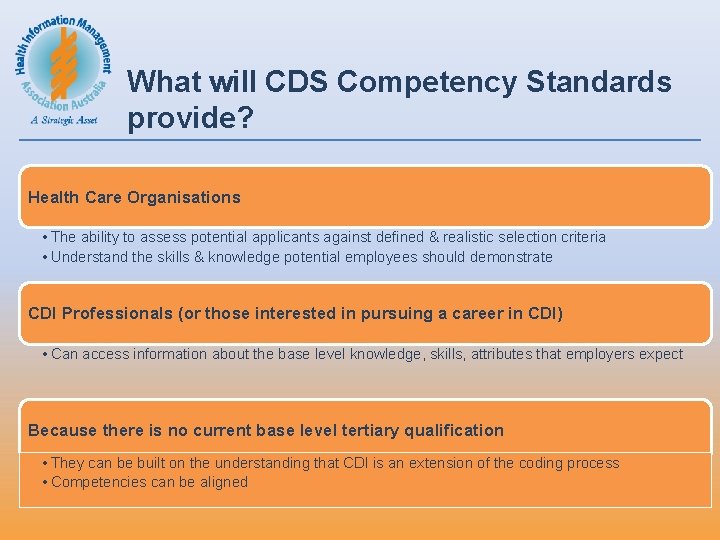
What will CDS Competency Standards provide? Health Care Organisations • The ability to assess potential applicants against defined & realistic selection criteria • Understand the skills & knowledge potential employees should demonstrate CDI Professionals (or those interested in pursuing a career in CDI) • Can access information about the base level knowledge, skills, attributes that employers expect Because there is no current base level tertiary qualification • They can be built on the understanding that CDI is an extension of the coding process • Competencies can be aligned
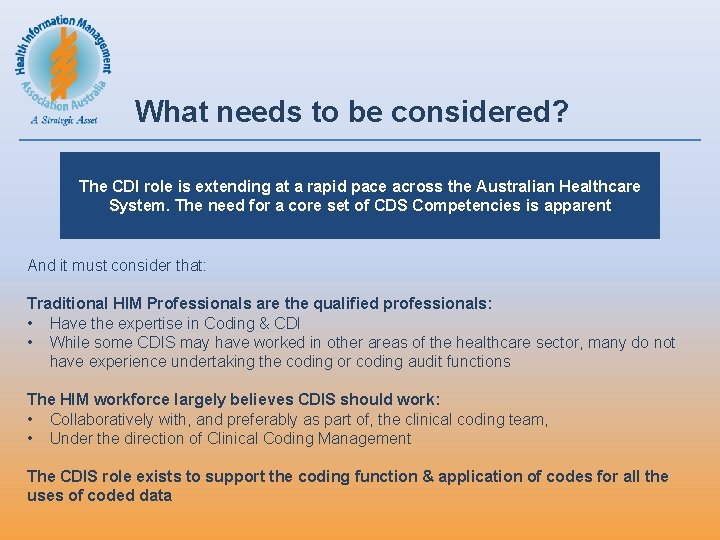
What needs to be considered? The CDI role is extending at a rapid pace across the Australian Healthcare System. The need for a core set of CDS Competencies is apparent And it must consider that: Traditional HIM Professionals are the qualified professionals: • Have the expertise in Coding & CDI • While some CDIS may have worked in other areas of the healthcare sector, many do not have experience undertaking the coding or coding audit functions The HIM workforce largely believes CDIS should work: • Collaboratively with, and preferably as part of, the clinical coding team, • Under the direction of Clinical Coding Management The CDIS role exists to support the coding function & application of codes for all the uses of coded data
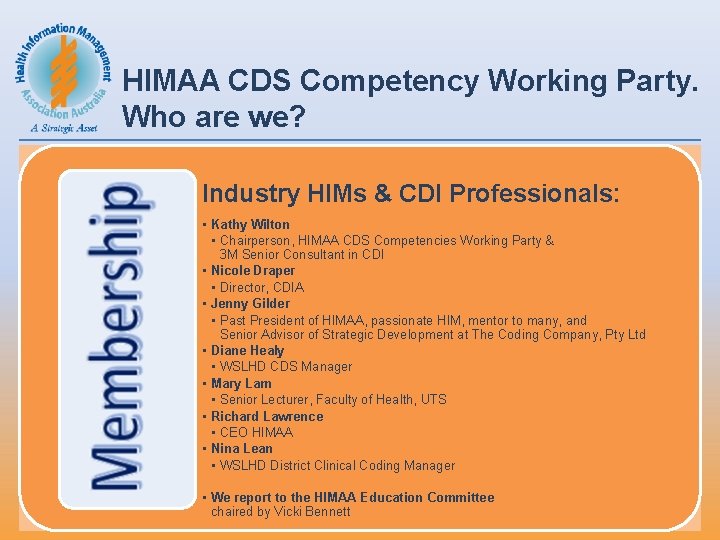
HIMAA CDS Competency Working Party. Who are we? Industry HIMs & CDI Professionals: • Kathy Wilton • Chairperson, HIMAA CDS Competencies Working Party & 3 M Senior Consultant in CDI • Nicole Draper • Director, CDIA • Jenny Gilder • Past President of HIMAA, passionate HIM, mentor to many, and Senior Advisor of Strategic Development at The Coding Company, Pty Ltd • Diane Healy • WSLHD CDS Manager • Mary Lam • Senior Lecturer, Faculty of Health, UTS • Richard Lawrence • CEO HIMAA • Nina Lean • WSLHD District Clinical Coding Manager • We report to the HIMAA Education Committee chaired by Vicki Bennett
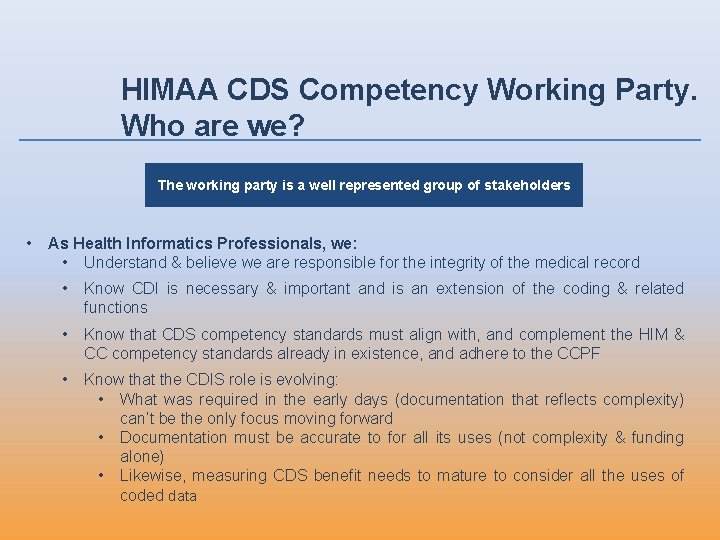
HIMAA CDS Competency Working Party. Who are we? The working party is a well represented group of stakeholders • As Health Informatics Professionals, we: • Understand & believe we are responsible for the integrity of the medical record • Know CDI is necessary & important and is an extension of the coding & related functions • Know that CDS competency standards must align with, and complement the HIM & CC competency standards already in existence, and adhere to the CCPF • Know that the CDIS role is evolving: • What was required in the early days (documentation that reflects complexity) can’t be the only focus moving forward • Documentation must be accurate to for all its uses (not complexity & funding alone) • Likewise, measuring CDS benefit needs to mature to consider all the uses of coded data
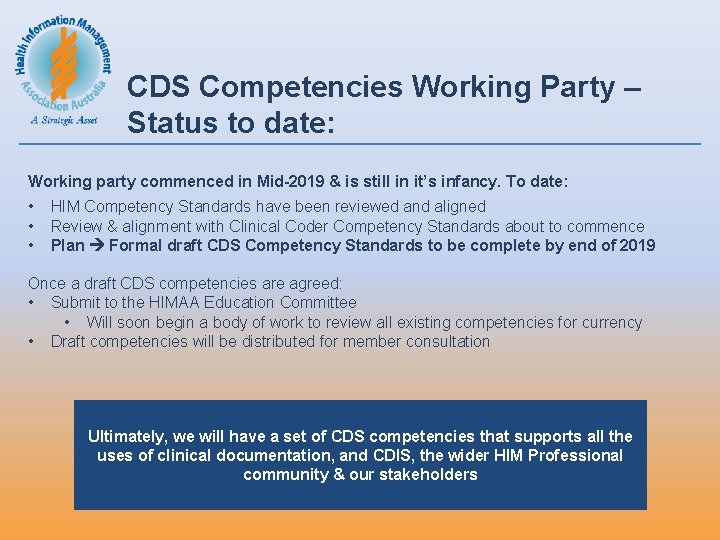
CDS Competencies Working Party – Status to date: Working party commenced in Mid-2019 & is still in it’s infancy. To date: • • • HIM Competency Standards have been reviewed and aligned Review & alignment with Clinical Coder Competency Standards about to commence Plan Formal draft CDS Competency Standards to be complete by end of 2019 Once a draft CDS competencies are agreed: • Submit to the HIMAA Education Committee • Will soon begin a body of work to review all existing competencies for currency • Draft competencies will be distributed for member consultation Ultimately, we will have a set of CDS competencies that supports all the uses of clinical documentation, and CDIS, the wider HIM Professional community & our stakeholders
Thank you Nina Lean On behalf of the HIMAA CDS Competencies Working Party