
Competencies and Rubrics What are they Good For
Competencies and Rubrics, What are they Good For? ! Law, Social Work and Psychology Standards in an Interprofessional Context Virgil Wiebe, Patricia Stankovitch & George Baboila University of St. Thomas Interprofessional Center

Rubrics! Huh! Yeah! What are they good for? ! Absolutely nothing?
“Rubrics, I despise, because they mean destruction to innocent lives. Rubrics leave tears in thousands of teacher’s eyes when their students go to practice and loose their minds. . . ” paraphrasing the Temptations and the late Edwin Starr and the PERSONAL KNOCK ON RUBRICS: Time consuming Reductionist Bulky Time consuming
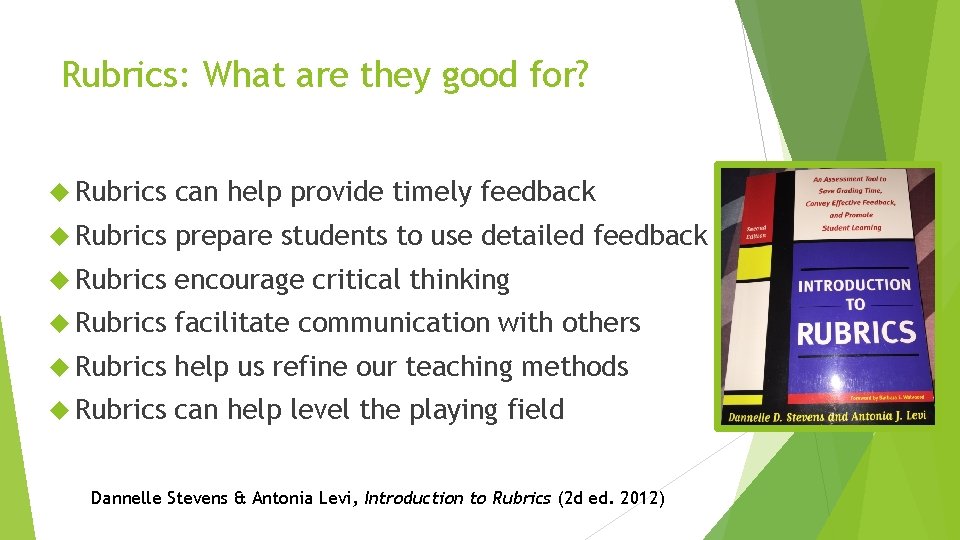
Rubrics: What are they good for? Rubrics can help provide timely feedback Rubrics prepare students to use detailed feedback Rubrics encourage critical thinking Rubrics facilitate communication with others Rubrics help us refine our teaching methods Rubrics can help level the playing field Dannelle Stevens & Antonia Levi, Introduction to Rubrics (2 d ed. 2012)
Outline ABA Standards – Learning Outcomes & Assessment Competency Based Education in Social Work & Psych Interprofessional Collaboration Competencies Training Implementation in practice – recent cases Evaluation of Interprofessional collaboration Interactive Other exercise - [hidden curriculum] methods of Interprofessional Collaboration Evaluation

The New ABA Standards – Learning Outcomes and Competencies
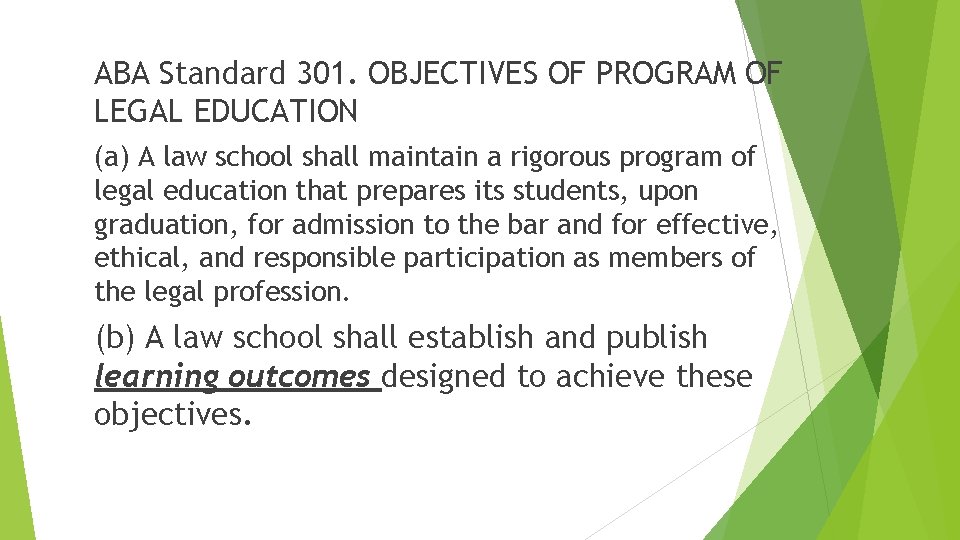
ABA Standard 301. OBJECTIVES OF PROGRAM OF LEGAL EDUCATION (a) A law school shall maintain a rigorous program of legal education that prepares its students, upon graduation, for admission to the bar and for effective, ethical, and responsible participation as members of the legal profession. (b) A law school shall establish and publish learning outcomes designed to achieve these objectives.
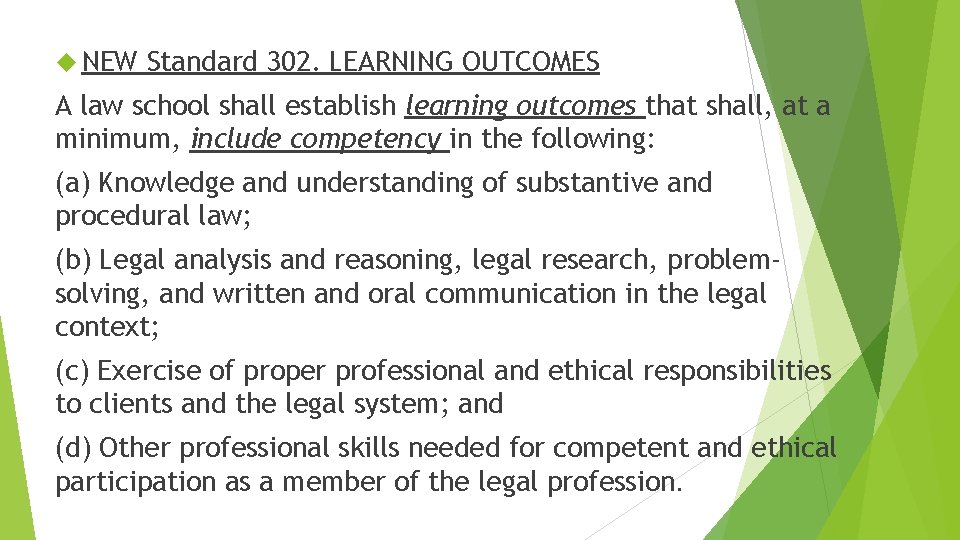
NEW Standard 302. LEARNING OUTCOMES A law school shall establish learning outcomes that shall, at a minimum, include competency in the following: (a) Knowledge and understanding of substantive and procedural law; (b) Legal analysis and reasoning, legal research, problemsolving, and written and oral communication in the legal context; (c) Exercise of proper professional and ethical responsibilities to clients and the legal system; and (d) Other professional skills needed for competent and ethical participation as a member of the legal profession.
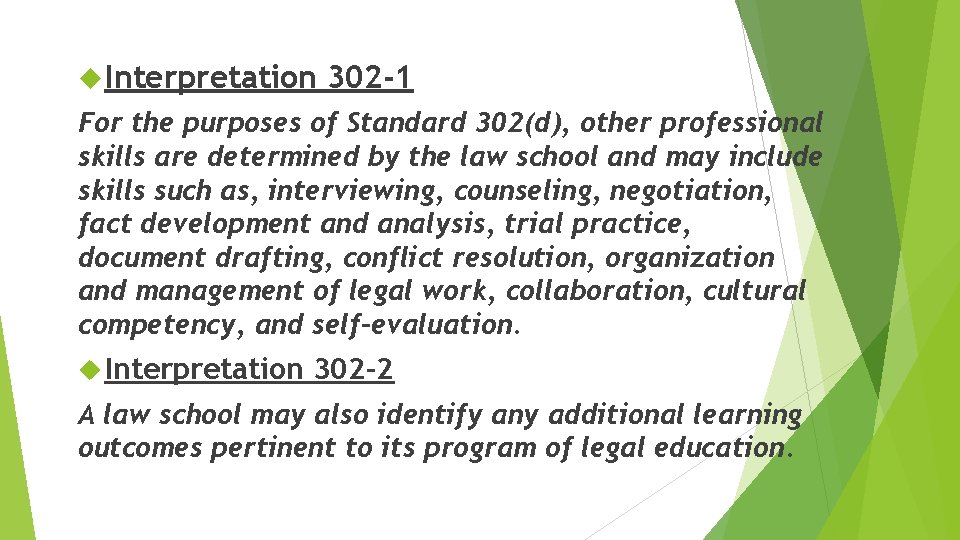
Interpretation 302 -1 For the purposes of Standard 302(d), other professional skills are determined by the law school and may include skills such as, interviewing, counseling, negotiation, fact development and analysis, trial practice, document drafting, conflict resolution, organization and management of legal work, collaboration, cultural competency, and self-evaluation. Interpretation 302 -2 A law school may also identify any additional learning outcomes pertinent to its program of legal education.
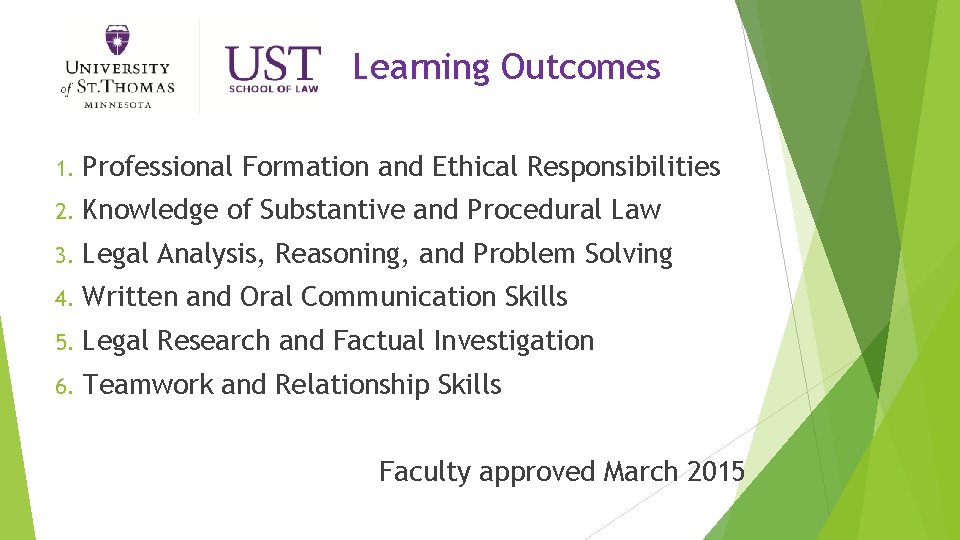
Learning Outcomes 1. Professional 2. Knowledge 3. Legal of Substantive and Procedural Law Analysis, Reasoning, and Problem Solving 4. Written 5. Legal Formation and Ethical Responsibilities and Oral Communication Skills Research and Factual Investigation 6. Teamwork and Relationship Skills Faculty approved March 2015

The New ABA Standards – Assessment Methods
Standard 314. ASSESSMENT OF STUDENT LEARNING A law school shall utilize both formative and summative assessment methods in its curriculum to measure and improve student learning and provide meaningful feedback to students.
Standard 315. LEARNING OUTCOMES, AND ASSESSMENT METHODS The dean and the faculty of a law school shall conduct ongoing evaluation of the law school’s program of legal education, learning outcomes, and assessment methods; and shall use the results of this evaluation to determine the degree of student attainment of competency in the learning outcomes and to make appropriate changes to improve the curriculum. Interp. 315 -2 “The methods used to measure the degree of student achievement of learning outcomes are likely to differ from school to school and law schools are not required by this standard to use any particular methods. ”
Professional Competencies and Evaluative Tools Social Work

Educational Policy and Accreditation Standards (EPAS) 2008 The Council on Social Work Education (CSWE) uses the Educational Policy and Accreditation Standards (EPAS) to accredit social work programs. Competency-based education is an outcome performance approach to curriculum design. Competencies are measurable practice behaviors that are comprised of knowledge, values, and skills. The goal of the outcome approach is to demonstrate the integration and application of the competencies in practice with individuals, families, groups, organizations, and communities.

assess, A 2. 1. 10 (a)-(d) – Engage, intervene, and evaluate with individuals, families, groups, organizations, and communities. A 2. 1. 10 (b)—Assessment. Advanced practitioners in clinical social work 1. use multidimensional bio-psycho-social-spiritual assessment tools; 2. assess clients’ readiness for change; 3. assess client coping strategies to reinforce and improve adaptation to life situations, circumstances, and events; 4. select and modify appropriate intervention strategies based on continuous clinical assessment; and 5. use differential and multiaxial diagnoses.
In the Field Setting (Internship) IV. CLINICAL PRACTICE METHODS Objectives: To apply the knowledge and skills of the clinical social work perspective to practice with individuals, families and groups. To differentially apply clinical knowledge, analytic, and practice skills that are sensitive to client systems that differ in social, cultural, racial, religious, spiritual and class backgrounds, gender, sexual orientation, ability, and age.
Rubric for evaluating Clinical Assessment competency
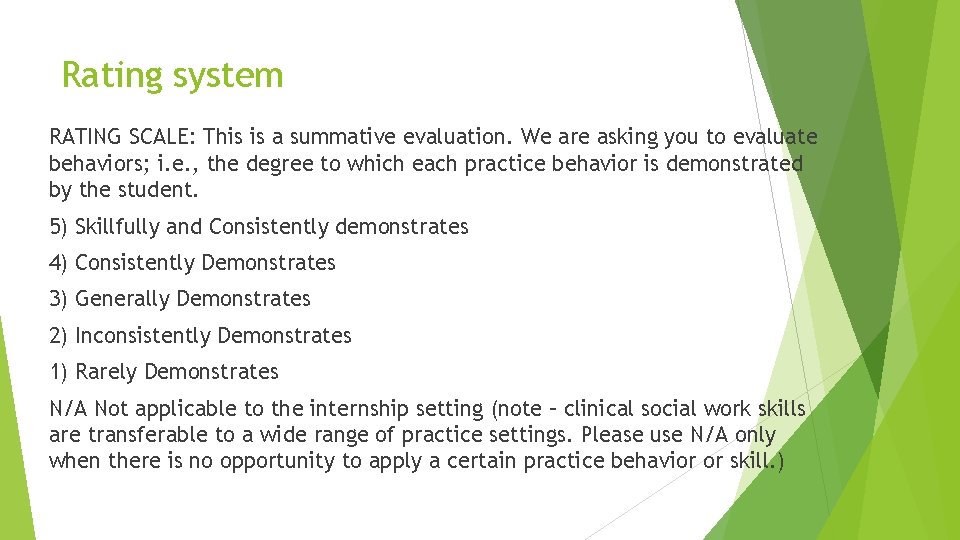
Rating system RATING SCALE: This is a summative evaluation. We are asking you to evaluate behaviors; i. e. , the degree to which each practice behavior is demonstrated by the student. 5) Skillfully and Consistently demonstrates 4) Consistently Demonstrates 3) Generally Demonstrates 2) Inconsistently Demonstrates 1) Rarely Demonstrates N/A Not applicable to the internship setting (note – clinical social work skills are transferable to a wide range of practice settings. Please use N/A only when there is no opportunity to apply a certain practice behavior or skill. )
Social Work & Interprofessional Assessment
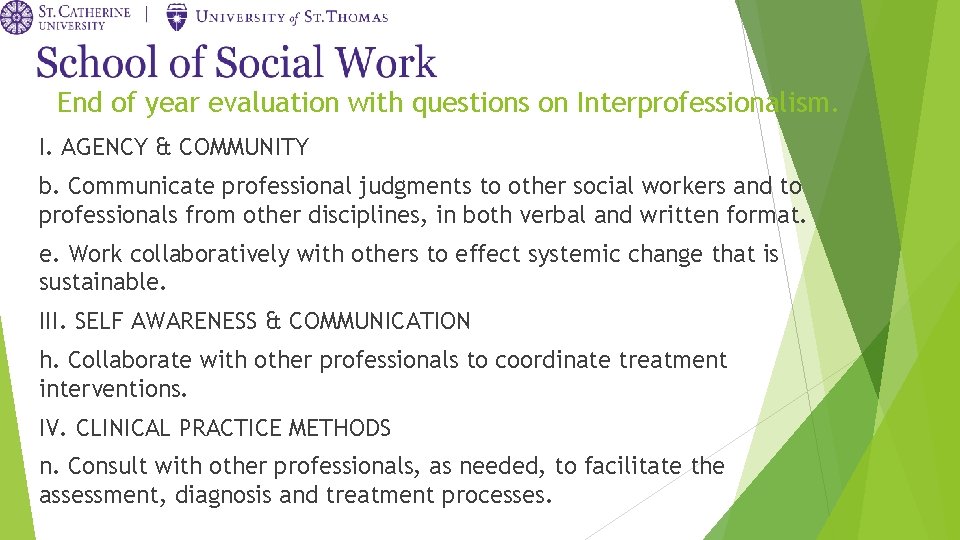
End of year evaluation with questions on Interprofessionalism. I. AGENCY & COMMUNITY b. Communicate professional judgments to other social workers and to professionals from other disciplines, in both verbal and written format. e. Work collaboratively with others to effect systemic change that is sustainable. III. SELF AWARENESS & COMMUNICATION h. Collaborate with other professionals to coordinate treatment interventions. IV. CLINICAL PRACTICE METHODS n. Consult with other professionals, as needed, to facilitate the assessment, diagnosis and treatment processes.
Professional Competencies and Evaluative Tools Psychology
Practitioner-Scholar Training Model; APA Accredited Prepares students for practice in professional psychology & to base practice on science National Council of Schools and Programs of Professional Psychology (NCSPP) Model of Training: good fit for our teaching & evaluation of students

NCSPP Model of Training Core Competency Areas Relationship Intervention Diversity Research & Evaluation Management & Supervision Assessment Consultation & Education

Intervention Competency = Activities that promote, restore, sustain, &/or enhance positive client functioning Ability to collaborate with clients on treatment plans, orient clients to treatment process & plan as necessary. Ability to clearly articulate & consistently follow through with theory and its connection to the case Ability to manage sessions, facilitate interventions & follow through on recommendations/previous sessions Ability to be reflective & mindful of one’s abilities and limits & how they affect interventions & outcomes Ability to terminate appropriately, with sensitivity to the issues at hand. Appreciation of client strengths, resiliency and effectiveness

Rating Scales Below Minimum Competence Needs considerable improvement; remediation Novice EXPECTED here at beginning Practicum I Intermediate Novice less prominent; generalizability of skills to new clients/situations somewhat limited; support still needed to guide performance Advanced EXPECTED @ end Practicum II; Internship ready
Pros & Cons of Competency-Based Education Cons Difficult to define uniform standards & expectations The profession is more than simply a set of skills Some knowledge/skills/ attitudes hard to measure; so evaluations may focus too much on those that are easily measured Significant time & possibly financial cost
Pros & Cons of Competency-Based Education Pros Clearly communicates expectations for learning Foundation Assists for evaluating students’ progress in determining curriculum & course development Provides way to view students’ growth over time
UST Interprofessional Collaboration Competencies
Interprofessional Competencies – drawn from health professions Domain I. Values and Ethics: Work with individuals of other professions to maintain a climate of mutual respect and shared values. Domain II. Roles and Responsibilities - Use the knowledge of one’s own role and those of other professions to appropriately assess and address the service needs of the clients and populations served. Domain III. Interprofessional Communication - Communicate with clients, families, communities, and other professionals in a responsive and responsible manner that supports a team approach to the provision of services. Domain IV. Collaboration and Teamwork - Build teams and relationships based on appropriate roles in order to plan and deliver services. Domain V. Conflict Management: Build an environment of trust in which disagreements and conflict can be addressed directly and productively.
Implementation of the Interprofessional Competencies Orientation exercise (see handout) Interprofessional Simulation Ethics class and readings – expert and lay professional witness class Therapeutic Jurisprudence
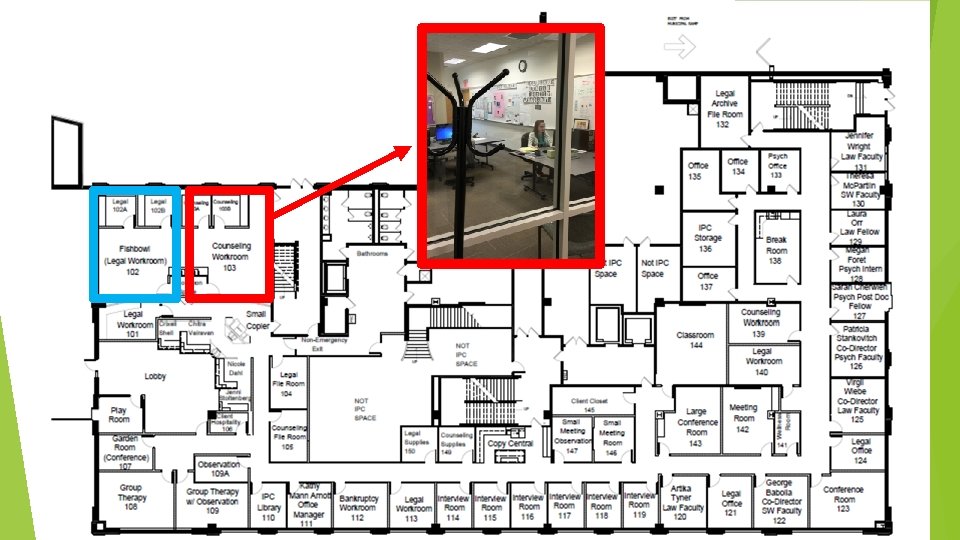
Interprofessionalism in practice Physical Setting Recent cases
Evaluation - UST Law Clinic Skill Area Assessment Modeled on Georgetown Center for Applied Legal Studies Goal Identification by students of practice skill areas plus other goals Ongoing informal formative assessments Formal summative Midterm Evaluation - self-evaluation plus individual meeting with supervisor(s) Formal summative Final Evaluation – self-evaluation plus individual meeting with supervisor(s)
Evaluation of Interprofessional Competencies Case Team Meetings Rubrics Breakout session Rounds Client Satisfaction Surveys
Small group instructions After presentation of the case, each group will evaluate the performance on this case of Virgil (and his students) or Pat (and her student) or George (and his students) by using the IPC rubric created for our law students Pick two or three of the domains to discuss with the presenters. One person from the group will report back.
Swing Out Sister – Breakout! When https: //www. youtube. com/watch? v=-P 67 b 07 z 7 Qw explanations make no sense When every answer's wrong You're fighting with lost confidence All expectations come The time has come to make or break Move on don't hesitate Breakout
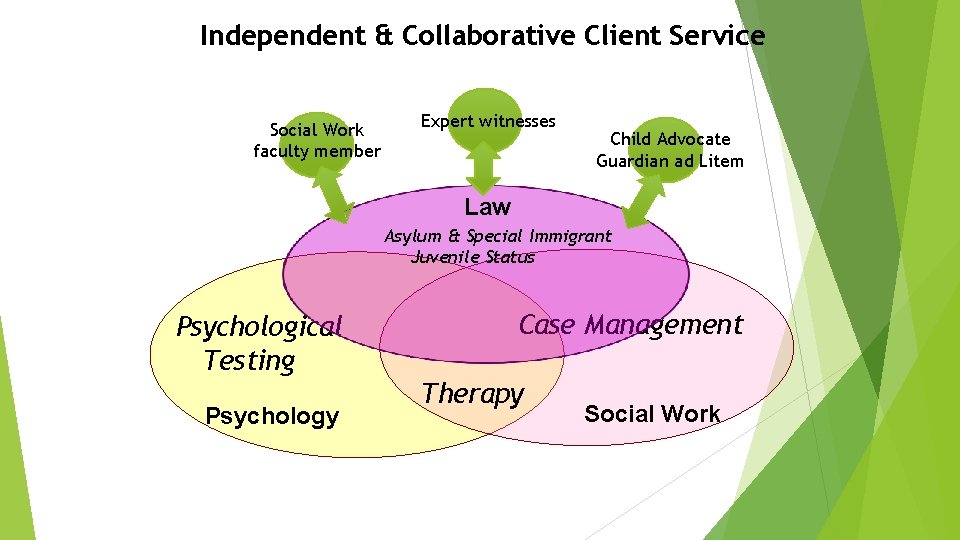
Independent & Collaborative Client Service Social Work faculty member Expert witnesses Child Advocate Guardian ad Litem Law Asylum & Special Immigrant Juvenile Status Psychological Testing Psychology Case Management Therapy Social Work
Other Methods of Interprofessional Collaboration Assessment https: //nexusipe. org/measurement-instruments Examples from the health professions: Videotaped Objective structured clinical examinations Knowledge Implicit simulations tests association tests
Questions? www. stthomas. edu/ipc George Baboila GVBABOILA@stthomas. edu Pat Stankovitch PASTANKOVITC@stthomas. edu Virgil Wiebe vowiebe@stthomas. edu
- Slides: 41