
Competences and key objectives 1 The student builds
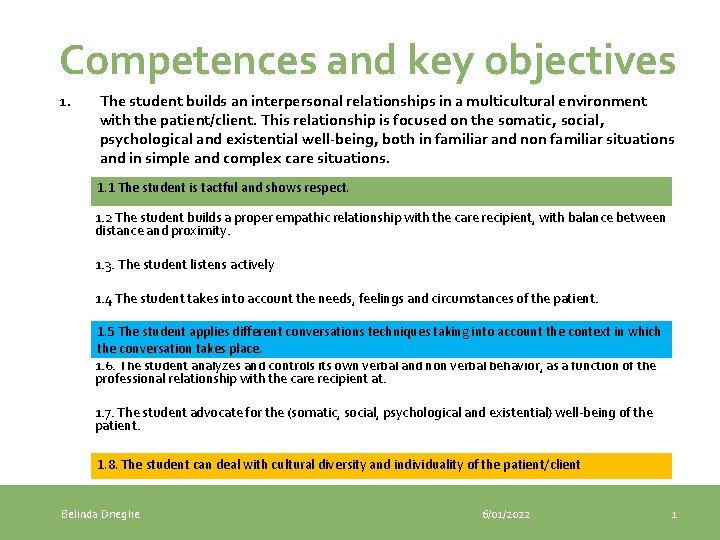
Competences and key objectives 1. The student builds an interpersonal relationships in a multicultural environment with the patient/client. This relationship is focused on the somatic, social, psychological and existential well-being, both in familiar and non familiar situations and in simple and complex care situations. 1. 1 The student is tactful and shows respect. 1. 2 The student builds a proper empathic relationship with the care recipient, with balance between distance and proximity. 1. 3. The student listens actively 1. 4 The student takes into account the needs, feelings and circumstances of the patient. 1. 5 The student applies different conversations techniques taking into account the context in which the conversation takes place. 1. 6. The student analyzes and controls its own verbal and non verbal behavior, as a function of the professional relationship with the care recipient at. 1. 7. The student advocate for the (somatic, social, psychological and existential) well‐being of the patient. 1. 8. The student can deal with cultural diversity and individuality of the patient/client Belinda Drieghe 6/01/2022 1
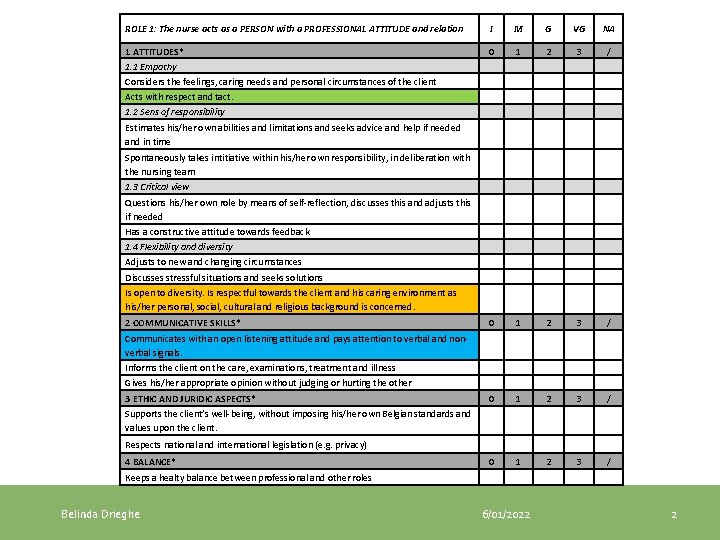
ROLE 1: The nurse acts as a PERSON with a PROFESSIONAL ATTITUDE and relation I M G VG NA 1 ATTITUDES* 0 1 2 3 / 1. 1 Empathy Considers the feelings, caring needs and personal circumstances of the client Acts with respect and tact. 1. 2 Sens of responsibility Estimates his/her own abilities and limitations and seeks advice and help if needed and in time Spontaneously takes intitiative within his/her own responsibility, in deliberation with the nursing team 1. 3 Critical view Questions his/her own role by means of self-reflection, discusses this and adjusts this if needed Has a constructive attitude towards feedback 1. 4 Flexibility and diversity Adjusts to new and changing circumstances Discusses stressful situations and seeks solutions Is open to diversity. Is respectful towards the client and his caring environment as his/her personal, social, cultural and religious background is concerned. 2 COMMUNICATIVE SKILLS* Communicates with an open listening attitude and pays attention to verbal and nonverbal signals. Informs the client on the care, examinations, treatment and illness Gives his/her appropriate opinion without judging or hurting the other 3 ETHIC AND JURIDIC ASPECTS* Supports the client’s well-being, without imposing his/her own Belgian standards and values upon the client. Respects national and international legislation (e. g. privacy) 4 BALANCE* Keeps a healty balance between professional and other roles Belinda Drieghe 6/01/2022 2
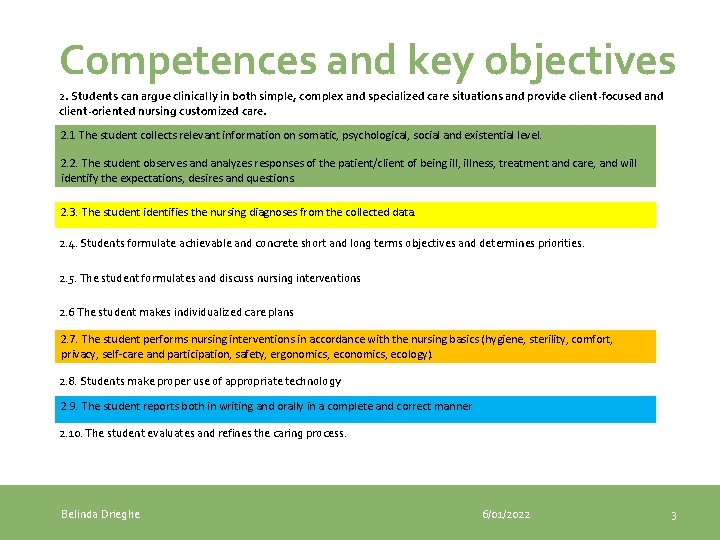
Competences and key objectives 2. Students can argue clinically in both simple, complex and specialized care situations and provide client-focused and client-oriented nursing customized care. 2. 1 The student collects relevant information on somatic, psychological, social and existential level. 2. 2. The student observes and analyzes responses of the patient/client of being ill, illness, treatment and care, and will identify the expectations, desires and questions. 2. 3. The student identifies the nursing diagnoses from the collected data. 2. 4. Students formulate achievable and concrete short and long terms objectives and determines priorities. 2. 5. The student formulates and discuss nursing interventions 2. 6 The student makes individualized care plans 2. 7. The student performs nursing interventions in accordance with the nursing basics (hygiene, sterility, comfort, privacy, self-care and participation, safety, ergonomics, ecology). 2. 8. Students make proper use of appropriate technology 2. 9. The student reports both in writing and orally in a complete and correct manner 2. 10. The student evaluates and refines the caring process. Belinda Drieghe 6/01/2022 3
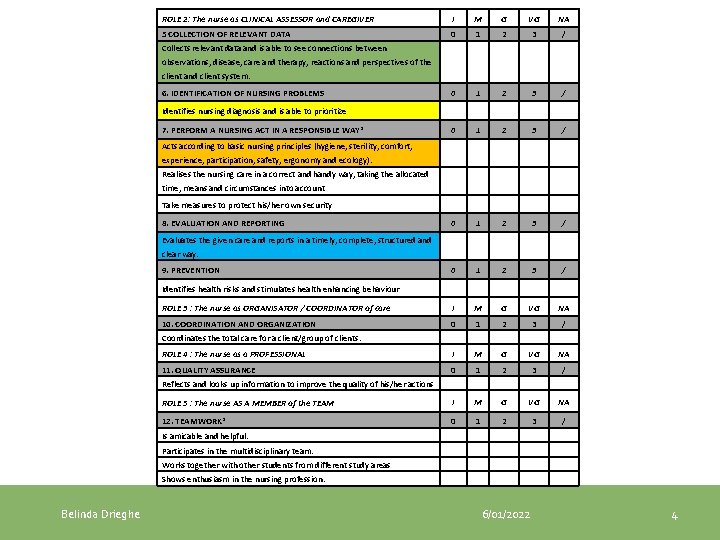
ROLE 2: The nurse as CLINICAL ASSESSOR and CAREGIVER I M G VG NA 5 COLLECTION OF RELEVANT DATA 0 1 2 3 / 0 1 2 3 / ROLE 3 : The nurse as ORGANISATOR / COORDINATOR of care I M G VG NA 10. COORDINATION AND ORGANIZATION 0 1 2 3 / ROLE 4 : The nurse as a PROFESSIONAL I M G VG NA 11. QUALITY ASSURANCE 0 1 2 3 / ROLE 5 : The nurse AS A MEMBER of the TEAM I M G VG NA 12. TEAMWORK* 0 1 2 3 / Collects relevant data and is able to see connections between observations, disease, care and therapy, reactions and perspectives of the client and client system. 6. IDENTIFICATION OF NURSING PROBLEMS Identifies nursing diagnosis and is able to prioritize 7. PERFORM A NURSING ACT IN A RESPONSIBLE WAY* Acts according to basic nursing principles (hygiene, sterility, comfort, experience, participation, safety, ergonomy and ecology). Realises the nursing care in a correct and handy way, taking the allocated time, means and circumstances into account Take measures to protect his/her own security 8. EVALUATION AND REPORTING Evaluates the given care and reports in a timely, complete, structured and clear way. 9. PREVENTION Identifies health risks and stimulates health enhancing behaviour Coordinates the total care for a client/group of clients. Reflects and looks up information to improve the quality of his/her actions Is amicable and helpful. Participates in the multidisciplinary team. Works together with other students from different study areas Shows enthusiasm in the nursing profession. Belinda Drieghe 6/01/2022 4
Competences and key objectives 3. The student shall deliver, on a methodical evidence-based way, nursing care in accordance with the general and occupational legislation and shows an attitude of responsibility and proactivity. Belinda Drieghe 6/01/2022 5

Competences and key objectives 4. The student looks in a focused and methodical way for scientific literature and evaluates them on relevance and usefulness. The student integrates new insights into professional development and participates in practice-oriented research. Belinda Drieghe 6/01/2022 6
Competences and key objectives 5. The student is aware of the values and standards of the care recipient and themselves as a person and as a caregiver. The student act ethically and sets an example for others. Belinda Drieghe 6/01/2022 7
Competences and key objectives 6. The student develops a personal vision on Nursing, based on theoretical frameworks, international credentials and own experience. He also develops a constructively critical attitude towards both his view of nursing as from those of the organization. Belinda Drieghe 6/01/2022 8
Competences and key objectives 7. The student takes autonomous initiatives on prevention and applies them adequately at all levels. He organizes methodical health promotion and patient education to individuals and groups. He encourages health-promoting behaviors in the care recipient(s). Belinda Drieghe 6/01/2022 9
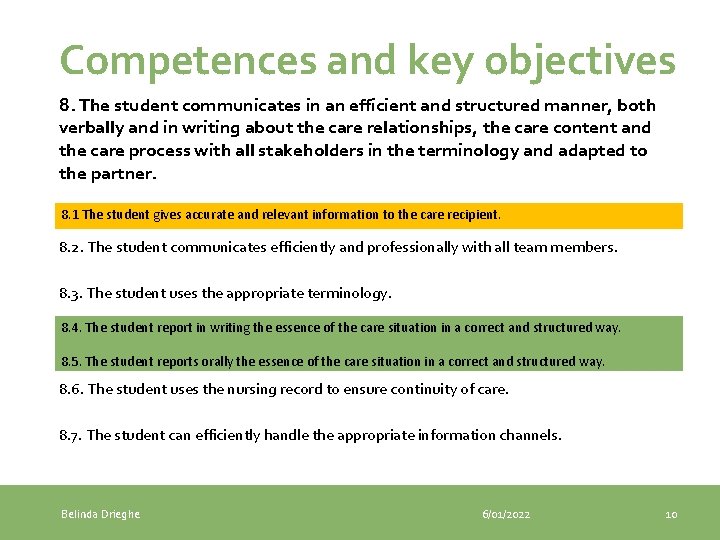
Competences and key objectives 8. The student communicates in an efficient and structured manner, both verbally and in writing about the care relationships, the care content and the care process with all stakeholders in the terminology and adapted to the partner. 8. 1 The student gives accurate and relevant information to the care recipient. 8. 2. The student communicates efficiently and professionally with all team members. 8. 3. The student uses the appropriate terminology. 8. 4. The student report in writing the essence of the care situation in a correct and structured way. 8. 5. The student reports orally the essence of the care situation in a correct and structured way. 8. 6. The student uses the nursing record to ensure continuity of care. 8. 7. The student can efficiently handle the appropriate information channels. Belinda Drieghe 6/01/2022 10
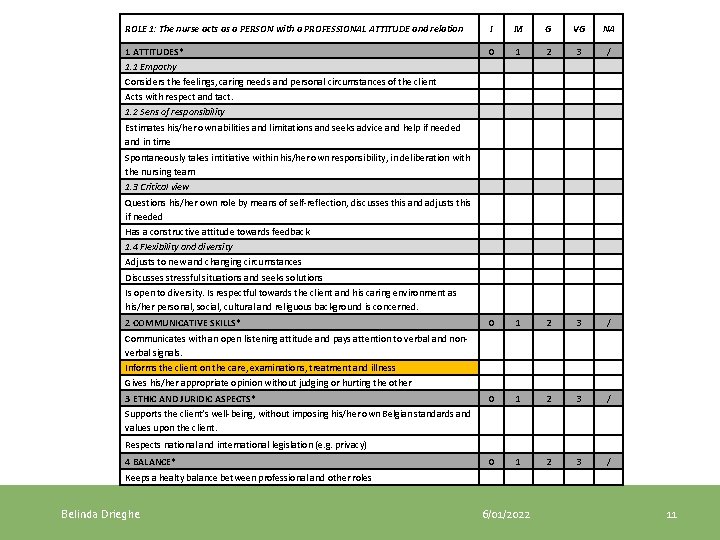
ROLE 1: The nurse acts as a PERSON with a PROFESSIONAL ATTITUDE and relation I M G VG NA 1 ATTITUDES* 0 1 2 3 / 1. 1 Empathy Considers the feelings, caring needs and personal circumstances of the client Acts with respect and tact. 1. 2 Sens of responsibility Estimates his/her own abilities and limitations and seeks advice and help if needed and in time Spontaneously takes intitiative within his/her own responsibility, in deliberation with the nursing team 1. 3 Critical view Questions his/her own role by means of self-reflection, discusses this and adjusts this if needed Has a constructive attitude towards feedback 1. 4 Flexibility and diversity Adjusts to new and changing circumstances Discusses stressful situations and seeks solutions Is open to diversity. Is respectful towards the client and his caring environment as his/her personal, social, cultural and religuous background is concerned. 2 COMMUNICATIVE SKILLS* Communicates with an open listening attitude and pays attention to verbal and nonverbal signals. Informs the client on the care, examinations, treatment and illness Gives his/her appropriate opinion without judging or hurting the other 3 ETHIC AND JURIDIC ASPECTS* Supports the client’s well-being, without imposing his/her own Belgian standards and values upon the client. Respects national and international legislation (e. g. privacy) 4 BALANCE* Keeps a healty balance between professional and other roles Belinda Drieghe 6/01/2022 11
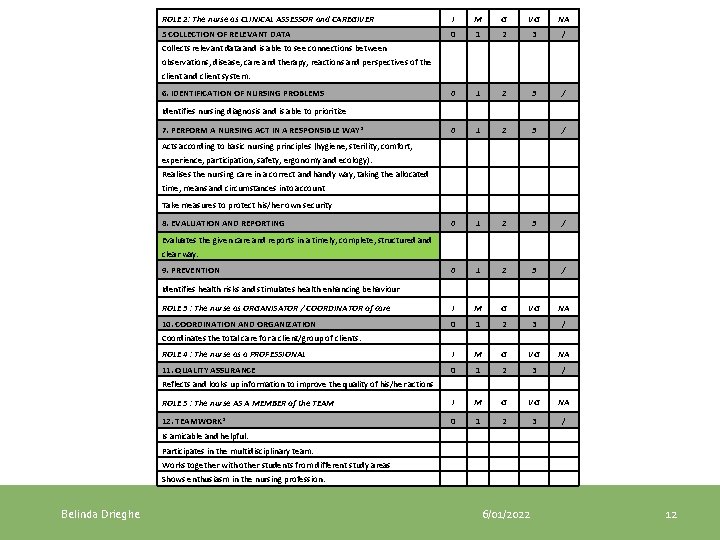
ROLE 2: The nurse as CLINICAL ASSESSOR and CAREGIVER I M G VG NA 5 COLLECTION OF RELEVANT DATA 0 1 2 3 / 0 1 2 3 / ROLE 3 : The nurse as ORGANISATOR / COORDINATOR of care I M G VG NA 10. COORDINATION AND ORGANIZATION 0 1 2 3 / ROLE 4 : The nurse as a PROFESSIONAL I M G VG NA 11. QUALITY ASSURANCE 0 1 2 3 / ROLE 5 : The nurse AS A MEMBER of the TEAM I M G VG NA 12. TEAMWORK* 0 1 2 3 / Collects relevant data and is able to see connections between observations, disease, care and therapy, reactions and perspectives of the client and client system. 6. IDENTIFICATION OF NURSING PROBLEMS Identifies nursing diagnosis and is able to prioritize 7. PERFORM A NURSING ACT IN A RESPONSIBLE WAY* Acts according to basic nursing principles (hygiene, sterility, comfort, experience, participation, safety, ergonomy and ecology). Realises the nursing care in a correct and handy way, taking the allocated time, means and circumstances into account Take measures to protect his/her own security 8. EVALUATION AND REPORTING Evaluates the given care and reports in a timely, complete, structured and clear way. 9. PREVENTION Identifies health risks and stimulates health enhancing behaviour Coordinates the total care for a client/group of clients. Reflects and looks up information to improve the quality of his/her actions Is amicable and helpful. Participates in the multidisciplinary team. Works together with other students from different study areas Shows enthusiasm in the nursing profession. Belinda Drieghe 6/01/2022 12
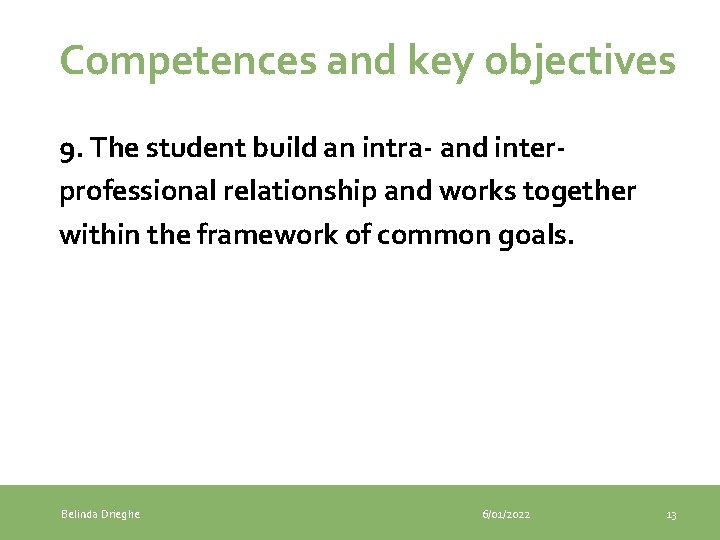
Competences and key objectives 9. The student build an intra- and interprofessional relationship and works together within the framework of common goals. Belinda Drieghe 6/01/2022 13
Competences and key objectives 10. The student organizes and coordinates, autonomously and in consultation with other health care providers, intra-, trans- and extramural care. Belinda Drieghe 6/01/2022 14
Competences and key objectives 11. The student instructs, coaches and leads members of an intra-disciplinary team. Belinda Drieghe 6/01/2022 15
Competences and key objectives 12. The student monitors and promotes the quality of the individual and overall care within its own organization. Belinda Drieghe 6/01/2022 16
Competences and key objectives 13. The student reflect continually on his own nursing actions, analyzes his learning needs and desires and translate these initiative in life long. Belinda Drieghe 6/01/2022 17
Competences and key objectives 14. The student contribute to the image of the profession, he has a broad view on social events and developments and is critical on an economic, social and ethical policy. Belinda Drieghe 6/01/2022 18
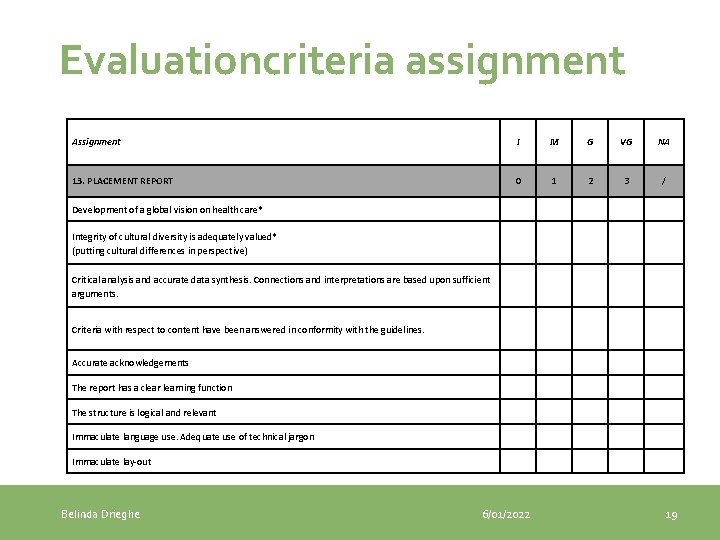
Evaluationcriteria assignment Assignment I M G VG NA 13. PLACEMENT REPORT 0 1 2 3 / Development of a global vision on health care* Integrity of cultural diversity is adequately valued* (putting cultural differences in perspective) Critical analysis and accurate data synthesis. Connections and interpretations are based upon sufficient arguments. Criteria with respect to content have been answered in conformity with the guidelines. Accurate acknowledgements The report has a clearning function The structure is logical and relevant Immaculate language use. Adequate use of technical jargon Immaculate lay-out Belinda Drieghe 6/01/2022 19
But what if things does’nt go as you wish… IV. Failing a nurse student Belinda Drieghe 6/01/2022 20
IV. Failing a student • The Process of managing a failed clinical assessment • • Identifying the weak student Develloping a plan of action The decision to fail After the deed is done Belinda Drieghe 6/01/2022 21
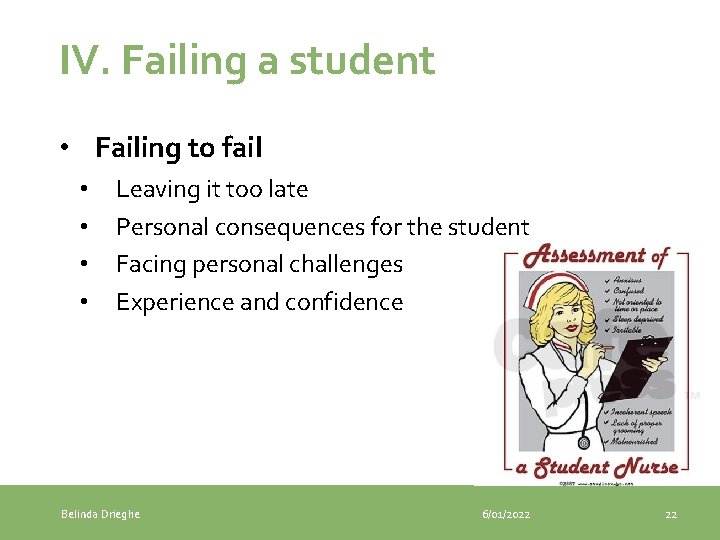
IV. Failing a student • Failing to fail • • Leaving it too late Personal consequences for the student Facing personal challenges Experience and confidence Belinda Drieghe 6/01/2022 22
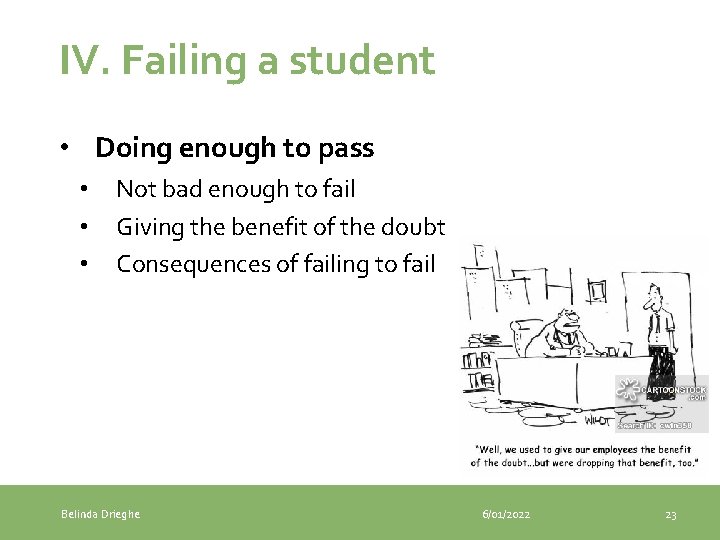
IV. Failing a student • Doing enough to pass • • • Not bad enough to fail Giving the benefit of the doubt Consequences of failing to fail Belinda Drieghe 6/01/2022 23
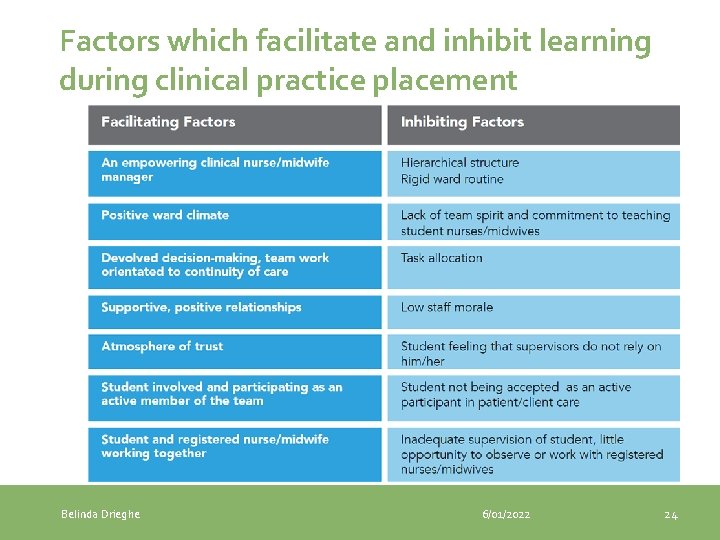
Factors which facilitate and inhibit learning during clinical practice placement Belinda Drieghe 6/01/2022 24
Belinda Drieghe 6/01/2022 25
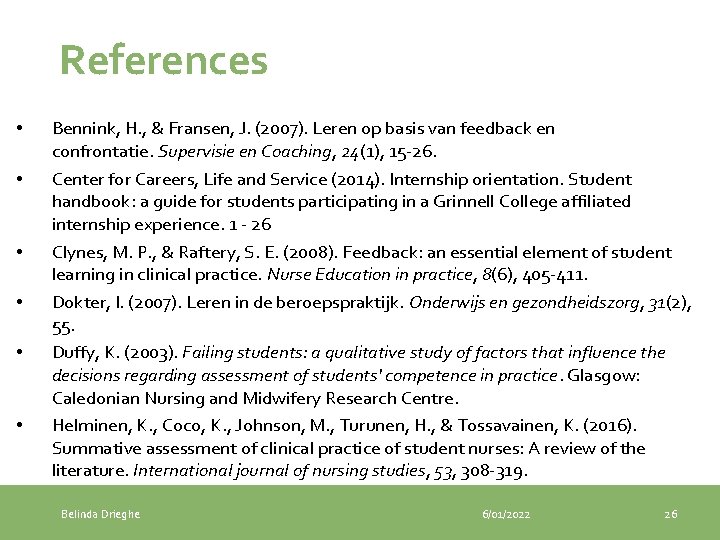
References • • • Bennink, H. , & Fransen, J. (2007). Leren op basis van feedback en confrontatie. Supervisie en Coaching, 24(1), 15‐ 26. Center for Careers, Life and Service (2014). Internship orientation. Student handbook: a guide for students participating in a Grinnell College affiliated internship experience. 1 ‐ 26 Clynes, M. P. , & Raftery, S. E. (2008). Feedback: an essential element of student learning in clinical practice. Nurse Education in practice, 8(6), 405‐ 411. Dokter, I. (2007). Leren in de beroepspraktijk. Onderwijs en gezondheidszorg, 31(2), 55. Duffy, K. (2003). Failing students: a qualitative study of factors that influence the decisions regarding assessment of students' competence in practice. Glasgow: Caledonian Nursing and Midwifery Research Centre. Helminen, K. , Coco, K. , Johnson, M. , Turunen, H. , & Tossavainen, K. (2016). Summative assessment of clinical practice of student nurses: A review of the literature. International journal of nursing studies, 53, 308‐ 319. Belinda Drieghe 6/01/2022 26
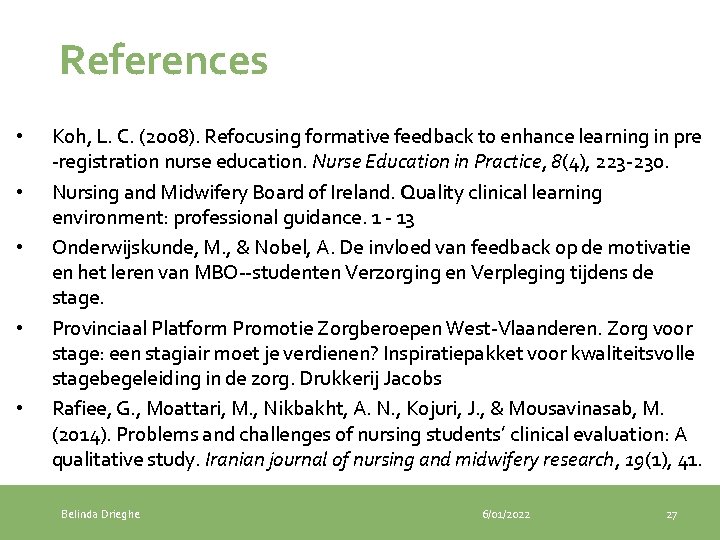
References • • • Koh, L. C. (2008). Refocusing formative feedback to enhance learning in pre ‐registration nurse education. Nurse Education in Practice, 8(4), 223‐ 230. Nursing and Midwifery Board of Ireland. Quality clinical learning environment: professional guidance. 1 ‐ 13 Onderwijskunde, M. , & Nobel, A. De invloed van feedback op de motivatie en het leren van MBO‐‐studenten Verzorging en Verpleging tijdens de stage. Provinciaal Platform Promotie Zorgberoepen West‐Vlaanderen. Zorg voor stage: een stagiair moet je verdienen? Inspiratiepakket voor kwaliteitsvolle stagebegeleiding in de zorg. Drukkerij Jacobs Rafiee, G. , Moattari, M. , Nikbakht, A. N. , Kojuri, J. , & Mousavinasab, M. (2014). Problems and challenges of nursing students’ clinical evaluation: A qualitative study. Iranian journal of nursing and midwifery research, 19(1), 41. Belinda Drieghe 6/01/2022 27
- Slides: 27